The first issues of Jeff Lemire's series are traded on two distinct markets that should never be confused: raw and graded. Statement of August 28, 2026 on current announcements in the American market: a Sweet Tooth #1 gross asks around $25 in median, the same number ranked around $105. The gap is not a comfort bonus: it's another product.
Two markets, not one. This is the only thing to understand before looking for a price for a first issue of Lemire.
The figures below are prix demandés, noted on August 28, 2026 on current announcements on the American market, isolated copies only: lots, reissues and collections excluded. These are not realized sales prices, and this distinction is developed below because it changes the use that can be made of them.
The statement, series by series
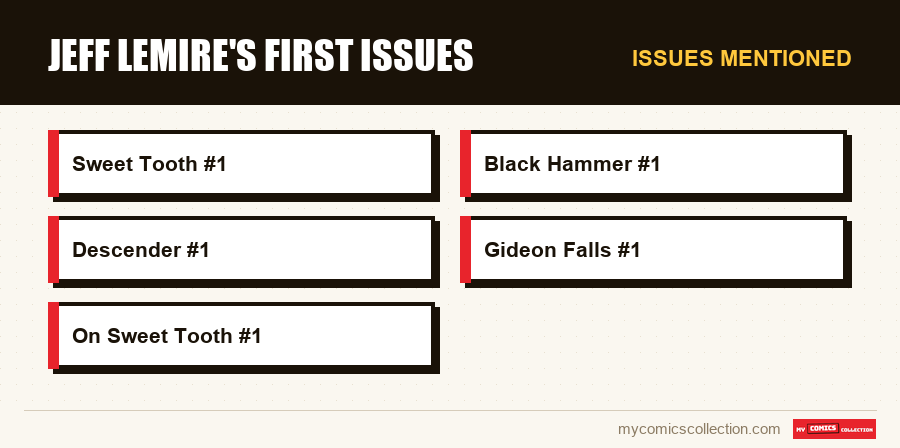
Sweet Tooth #1: Vertigo, 2009
Raw : median $24.86 across 47 listings, from $1.92 to $299.99.
Gradé : median $105 across 28 listings, from $69.99 to $299.
This is the title where the graded market is the most developed: 28 advertisements, or more than a third of the offer. The TV series created a demand that didn't exist before.
Black Hammer #1: Dark Horse, 2016
Raw : median $15.99 across 72 listings, from $3.60 to $399.99.
Grade : median $105 across 17 listings, from $39.99 to $150.
Same graded median as Sweet Tooth for a title seven years more recent: a sign of demand supported by the extended universe rather than an adaptation.
Descender #1: Image, 2015
Brut : median $10 across 66 listings, from $1.25 to $1,600.
Grade : median $69.90 across 16 listings, from $20 to $179.99.
The largest raw extent of the survey. The $1,600 maximum says nothing about the market: it designates a rare variant, not the current number.
Gideon Falls #1: Image, 2018
Raw : median $9.99 across 65 listings, from $2.29 to $109.78.
Grade : median $49.99 across 10 listings, from $31.76 to $174.99.
The newest and least expensive of the four, with the narrowest graded market: just ten listings.
Why the raw/graded gap is not a premium
On Sweet Tooth #1, the graded median is more than four times the raw median. It would be tempting to see this as the price of the certificate. This is a false reading, for three reasons.
They are not the same copies
We only certify what is worth the cost of the operation. The graded examples are therefore, by selection, the best preserved in the deposit: the comparison pits the top of the basket against the general average.
The note changes everything
A graded median aggregates very different scores. Between a 9.8 and an 8.0, the price gap often exceeds that which separates rough from grade. A single number hides this dispersion.
The crude is unverifiable
"Near Mint" in a listing is a seller's opinion. Certification replaces this opinion with a contestable but enforceable rating. This is what the buyer pays, as much as the state itself.
Certification has a cost
Shipping, costs, return, deadline. On a book whose gross costs $10, the operation makes no economic sense: which explains the narrow graded market of Gideon Falls.
What these numbers allow, and what they don't allow
You have to be precise about the nature of the data, because most articles that display odds do not.
These are asking prices. eBay's public interface shows current listings, not the history of completed sales. A seller may ask $300 for a Sweet Tooth #1 gross: This is on the statement, and it absolutely does not prove that a buyer paid it.
The median is therefore a floor of intention, not a value. It indicates what the market hopes to achieve. The price actually realized is structurally lower, because the most expensive ads are also those that stay online the longest, and mechanically inflate the sample.
The honest use of these figures is comparative. Ils disent que Sweet Tooth #1 is an order of magnitude higher than Gideon Falls #1, and that the raw/graded gap is more marked on old titles. It's useful. They don't say what the copy sitting on your shelf is worth.
How to check a price for good. To find out a realized and unasked price, you must consult the history of sales concluded: accessible from eBay's search filters once connected, or via the specialized services which compile this data.
The reflex that avoids costly errors: always compare with equal scores and equal numbers. A first printing and a fifth have the same number on the cover, and have nothing to do with it on the market.
Variants, or why the maximum means nothing
L'étendue de Descender #1 ranges from $1.25 to $1,600 in the same statement. This difference of 1,280 times does not reflect an irrational market: it reflects the fact that “Descender #1” refers to several different objects.
Independent publishers commonly publish a single issue under multiple covers: main cover, artist variants, boutique exclusives, limited editions. Some exist in a few hundred copies, while the main cover has a circulation of several tens of thousands.
Practical consequence: the maximum of a range almost always designates a rare variant, and the minimum a damaged copy or a poorly labeled reissue. Only the median describes the current number, and again, provided that the lots have been excluded: which is what the statement above does.
Collecting this series?
Track what you own, what you are missing and what your collection is worth. 7 day trial.
Start my trial →Reading a fork: four-step method
When faced with an ad, the question is never “what is the market price” but “where is this specific copy located”. Here is the approach that avoids the two symmetrical errors: overpaying for a reissue, or selling off a variant.
1. Identify the draw. This is indicated in the legal notices on the inside page, never on the cover. A “second printing” is sometimes indicated by a different logo color, often by nothing at all. If in doubt about an ad, ask for a photo of this page.
2. Identify the variant. On independent publishers, the same issue appears under several covers. Compare the artwork to the reference ad: an artist variation does not compare to the main cover.
3. Spread the top and bottom of the fork. The maximum almost always designates a rare variant or a certified high grade example; the minimum, a damaged or poorly described copy. The useful segment is the middle one.
4. Compare on an equal footing. If the specimen is certified, only compare it to specimens of the same grade. A difference of half a point on the certification scale often weighs more than the difference between two titles.
This method does not give a price: it gives a defensible interval. This is all that can honestly be obtained from a market where each copy is unique in its condition.
What this means for your catalog
Three pieces of information determine the value of a copy, and none appear on the cover: the edition, the condition or grade, and the variant.
A catalog which records “Sweet Tooth #1” does not allow any estimation. The same catalog recording “Sweet Tooth #1, first printing, main cover, graded 9.4” places the copy in a specific segment of the market, and allows it to be compared to equivalent ads rather than a meaningless average.
It's the difference between knowing what you have and knowing what it's worth. The first question is resolved with a shelf; the second requires having noted, at the time of purchase, what can no longer be reconstructed later.
The number of ads says as much as the price
One piece of information in the statement goes unnoticed and is worth reading: the number of ads available for each title.
Black Hammer #1 has 72 gross ads, Sweet Tooth #1 only 47. This difference in volume tells something that price alone doesn't: availability. An abundantly available security is easily found, negotiated, and never requires rushing. A rare title requires you to take what comes.
The contrast is even clearer on the grade side: 28 examples certified for Sweet Tooth, against 10 for Gideon Falls. In a market as narrow as the second, a single atypical announcement moves the median by several dozen dollars. In other words, the smaller the sample, the less reliable the figure: and it is precisely on rare titles that we would like a solid estimate.
The reflex to remember: always look at how many ads make up a range before giving it credit. Ten ads don't make a deal.
The profile of these series on the market
A general observation emerges from the survey, and it is valid beyond Lemire.
Creator-owned series from recognized authors follow a different trajectory from runs from major publishers. A Animal Man from the same period remains very accessible because it benefited from a massive circulation linked to an editorial relaunch. A Sweet Tooth #1, published by a label with a modest circulation by a then unknown author, exists in significantly fewer copies.
This explains why an independent title from 2009 costs more than a major publisher title from 2011: the initial print run, not the quality or the current notoriety of the author.
Frequently asked questions
No, these are prices requested on announcements in progress as of August 28, 2026, and the distinction is crucial. An advert that is too expensive does not find a buyer, remains online for months, and weighs even more heavily in the statistics the longer it stays there. The price actually obtained is therefore structurally lower than the median of requests. To find out the actual price, you must consult the history of sales concluded, accessible from the search filters once connected. The distinction is important: an expensive ad that does not find a buyer remains visible for a long time and weighs on the statistics. The price actually obtained is structurally lower than the median of requests.
Because they are two markets with different buyers. Certified copies are by selection the best preserved, and the buyer pays as much for the opposability of the note as for the condition. Mixing the two produces a median that describes no real exemplar.
Almost always a rare variant, not the common issue. The same first issue often exists under several covers with very uneven print runs. The maximum of a range designates the rare item; only the median describes what most collectors own.
It depends entirely on the title and condition. On a copy whose gross price is around $10, the cost of the operation exceeds the expected gain: this is exactly what the very narrow graded market shows. Gideon Falls. On an old copy in very good condition, the calculation changes.
The edition, the variant cover and the condition or grade. None of the three are on the cover, and none are reconstituted two years later. Without them, a catalog says what you own but does not allow any serious estimation.
Note the edition, variant and condition
These are the only three pieces of information that allow us to value a copy, and the three that we can no longer find after the fact.