Around the story which closes the destiny of Jean Gray in X-Men #137 is a publication from 1984, Phoenix: The Untold Story, which allows us to read an end envisaged then discarded before publication. On the statement dated August 30, 2026 (ads in progress on a general American auction site, amounts claimed by sellers and no sales concluded), this item is asking for between $6.00 and $9.99, when the central value of verified copies of the original booklet is at $125.00. However, the market places it in the same place, under the same name, without indicating it as an additional document. A collection which does not reserve its own category therefore counts numbers which it does not possess.
There exists, around the most commented stories, a layer of objects which does not belong to either of the two usual families. These are not reissues: they do not reproduce the published content. They are not sequels: they do not extend anything. These are documentary publications (unretained versions, preparatory plates, archive files, reproduced editorial exchanges) which tell how the story was made, and sometimes how it could have ended differently. They are often released years after the episode they illuminate, with a cover which includes the same characters, a title which contains the same keywords, and a place in the sales lists strictly identical to that of the original.
The survey carried out on August 30, 2026 on the query “Jean Gray X-Men 137 1980” gives this family a measurable outline. There are one hundred and eighteen unverified listings, from a minimum of $2.49 to a maximum of $649.82, with a central value of $50.00. Copies passed by a verification body are counted separately: thirty advertisements, from $75.00 to $1,099.98, central value $125.00. These amounts are those that sellers display on a single date; none of them attests that a transaction took place at this level, and a reading taken at a single moment cannot describe any movement, neither rise nor fall. What he describes, however, is the composition of the list, and this composition is instructive.
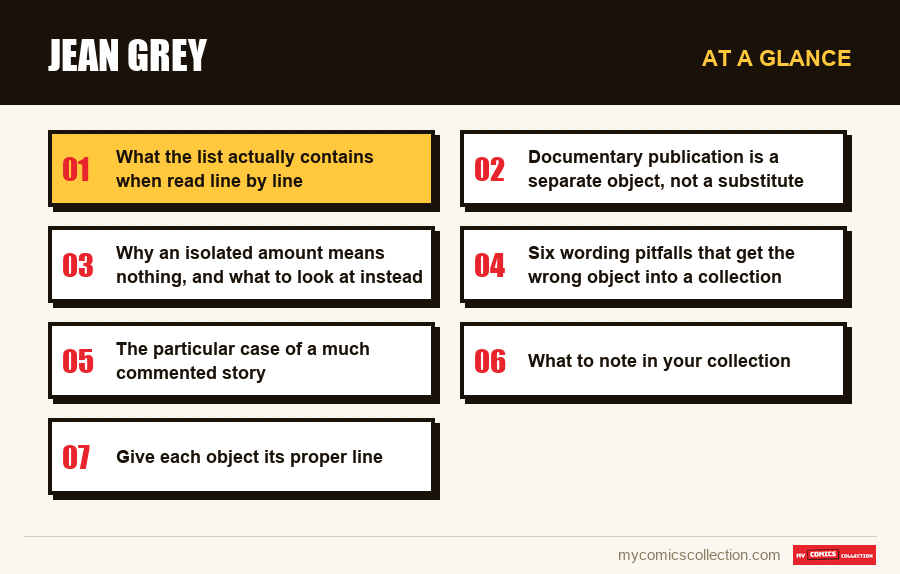
What the list actually contains when read line by line
The five cheapest listings in the survey form a sample that needs to be looked at closely, because none of them offer what the query asked for. The first, at $2.49, is an issue of a summary title that goes back to previous stories; it has no direct relationship with the booklet in question. The second, at $2.50, bears a two-word label, a publisher's name and a series name, and nothing else: no number, no year, no indication of condition. The third and fourth, at $6.00 and $9.99, are two copies of the same 1984 publication, one that has a different original ending than the one that was printed. The fifth, at $9.99, is an issue of yet another title, whose internal storage code of the seller coincidentally contains the number sought.
In other words, of the five lines that pull the lower bound down, two are off-topic, one is unreadable, and two are the additional subject. None are the original booklets. The displayed minimum of $2.49 therefore provides no information on what the episode itself costs: it provides information on the porosity of the request. This is a point of method which is valid well beyond this specific case, and which we return to in detail in our comparison between reading the story and owning the object.
The central value of the one hundred and eighteen unverified listings, $50.00, inherits this mix. It combines copies of the original booklet, documentary publications, numbers of other series and empty labels. It does not measure a price: it measures the median of a heterogeneous basket. The central value of the verified copies, $125.00, is based on a more homogeneous set, verification requires at least that the object has been identified, but it concerns thirty advertisements, a number sufficient to give an order of magnitude and insufficient to resolve a question of exact level.
Documentary publication is a separate object, not a substitute
It does not replace the original
A publication that documents a story does not contain that story as it appeared. It shows a previous state, an abandoned intention, working material. Owning one never means owning the other, and a list that confuses them produces a false count.
It brings what the original doesn't have
The published booklet gives the version retained. The 1984 publication gives the rejected version. This is content that the original episode does not contain and never will contain: the only way to read it is to obtain the ancillary object.
It is classified in the same place
The search engines of sales sites index words. “X-Men 137” appears in the title of the side announcement as in that of the original. Nothing in the automatic classification indicates that one is a document over the other.
It claims to be an order of magnitude cheaper
Between $6.00 and $9.99 on this statement, compared to $125.00 central value for verified copies of the original booklet. The difference is not a good deal: it is the price of two different objects.
This last line is worth paying attention to, because it is the exact place where purchasing misunderstandings occur. A buyer who searches for the episode and sees a $6.00 ad with the right words in the title may conclude that they have found a rare opportunity. He didn't find anything rare: he found another object, correctly listed for sale at his price, which happened to share a vocabulary with the one he was looking for. The seller, in the two cases noted here, had also written what was necessary: the mention of the original ending appears in black and white in the wording. It is the partial reading of the title, not the announcement, which creates the error.
Two sellers out of five, in the low sample of this survey, describe their subject in a usable way: they give the full title, the year and the nature of the publication. The other three offer a truncated wording, an internal storage code, or two words without number or state.
The practical consequence is simple: in this type of list, the burden of identification rests on the buyer. Reading the entire title, down to the last word, is not a comfort precaution: it is the only filter available.
Why an isolated amount means nothing, and what to look at instead
The unverified statement maximum, $649.82, and the verified listing maximum, $1,099.98, belong to a category of data that must be handled with care. A maximum is the price that a single seller has decided to display. It expresses a hope, not an observation. There is nothing in the statement to indicate that anyone has paid this amount, or that they are close to doing so. A figure of this kind has a descriptive utility, it limits the extent of the list, and no decision-making utility.
The lower terminal suffers from the symmetrical defect, as we have seen: it is held by objects which are not the one we are looking for. Between the two, the central value remains the least distorted statistic, provided you know which set it relates to. Separating the verified examples from the others is not a refinement: it is the only way to obtain two populations about which we can say something. A copy passed by a verification body has been identified, described and sealed; an unverified copy only offers the seller's word, which, in three out of five listings here, says almost nothing.
It is necessary to add a limit that the statement imposes itself. All these measures were taken on August 30, 2026, in one go. They don't compare to anything. No trend, no rise, no decline can be deduced from it, and any sentence which claims the opposite would add information absent from the data. A single statement is a photograph; it would take a series of photographs taken under the same conditions to speak of movement.
Finally, the thirty verified advertisements constitute a modest number. It is enough to say that the object is circulating and to give an order of magnitude, it is not enough to arbitrate between two close levels nor to qualify a particular state. Where the number drops below ten, which happens quickly as soon as we filter by state or by variant, the only tenable position is to give up on concluding. This reflex, applied systematically, avoids most estimation errors. It also applies to entire series, as shown in our overview of the editorial history of the X-Men.
Collecting this series?
Track what you own, what you are missing and what your collection is worth. 7 day trial.
Start my trial →Six wording pitfalls that get the wrong object into a collection
The title that contains the right words
An ad that displays the name of the character, that of the series and the number sought is not necessarily the desired object. The 1984 publication noted here ticks all three, and remains a distinct publication. The determining word is often the last in the wording.
The year that doesn't stick
The original booklet is dated 1980, the documentary publication is dated 1984. A difference in years in a wording which otherwise appears to describe the same object is the most reliable and quickest signal to verify. It should trigger a full playback of the title.
The two word wording
The $2.50 statement ad is reduced to a publisher name and a series name. No number, no state, no year. A line like this does not allow any purchasing decision, and yet it occupies second place in the ranking by price and draws the lower limit.
The summary title
The cheapest ad, at $2.49, belongs to a series that goes back to previous stories. It appears in the results because it shares words with the query, not because it suggests the episode. This type of publication forms a family in its own right.
The seller's storage code
An announcement of the survey carries an internal reference where the number sought appears, without this number designating anything in the publication. A number stuck to other characters in a label is almost always a stock reference, not a number.
The confusion between neighboring series
Two announcements in the survey come from titles different from the one targeted, one of which shares the universe and characters. Checking the exact name of the series, not just the presence of the character, rules out this category of error in a second.
The particular case of a much commented story
Stories that have had a lasting impact on their readership produce more ancillary objects than others, and for a mechanical reason: editorial interest in behind the scenes is proportional to the attention paid to the result. When an outcome has been discussed for years, the version that had been considered before it in turn becomes a document. Its publication, in 1984, four years after the episode, is part of this logic: it responds to a curiosity that the published story had created.
The fate reserved for the character in this episode is a serious event in the story, and there is no need to detail its staging here. What matters for a collection is a simple, verifiable editorial fact: a different conclusion had been prepared, it was not accepted, and it was later made public in a separate publication. This fact alone explains why two distinct objects are circulating today under similar labels.
It also explains why the price gap between them is not abnormal. The companion publication was printed in a different context, at a different market era, and it does not occupy the same place in readers' memories. Asking why it is “worth so little” is like comparing two things that cannot be compared. The useful question is the opposite: what do we gain from having it? Answer: access to content that the original does not provide, for a claimed amount that, on this statement, fits into a ten dollar coin.
This is why these objects deserve to be known to collectors who are gradually building their collection. They are an inexpensive entry into a story whose original copy is an order of magnitude higher, and they provide real reading material, not a mere decorative duplicate. The logic is the same as that described in our guide on ways to approach the X-Men without a high budget, except that here the accessible object is not a degraded version of the good object: it is another, complementary object.
What to note in your collection
Create a “document” category separate from the booklet and the reissue. A publication that reproduces a discarded ending is neither the episode nor its reprint. As long as it remains placed in one of these two boxes, it distorts everything that results from it: the count of numbers owned, the list of shortages, and the idea you have of the progress of the series. Three boxes are better than two here, and the third is just for that.
Record the year of publication next to the issue, not just the issue. In this specific case, 1980 and 1984 are the two pieces of information that instantly separate the two objects, while the number cited in the labels is the same. A form which only bears the number loses the only discriminating data available at the time of entry.
Copy the full wording of the ad, including its ending. The two announcements correctly described in the statement are so thanks to their last words, those which specify the nature of the publication. A wording that is truncated upon entry loses exactly the information that will allow you, in two years, to know which of the two items you purchased.
Note whether the exemplar is verified, and consider the two populations separately. The statement counts them separately because they do not describe the same thing: thirty verified advertisements on one side, one hundred and eighteen unverified advertisements on the other, with central values which do not have the same meaning. Reporting this distinction in your files allows you to never compare a sealed copy to a line whose condition has never been described.
Date every amount you record, and never treat it as a given. The figures cited here are those that sellers requested on August 30, 2026; none correspond to a closed sale. An undated value becomes, after a few months, a belief from which we no longer know where it comes from. A dated value remains an observation, with its visible limits.
No, under no circumstances. It gives access to a state of the story which was not selected for publication, therefore to content which the published episode does not contain. It is complementary, never substitutable. In a collection list, it should occupy its own line and never check the original number box.
By the year, then by the end of the wording. The original fascicle is dated 1980, the documentary publication 1984. The correct wording of the statement explicitly mentions that it is an ending of different origin; You still have to read the title until the end, because this precision always comes after the keywords which brought up the ad.
No. This announcement concerns a summary title not directly related to the episode in question. The five cheapest ads in the survey are all something other than the original issue: two documentary publications, two issues of other series and an unusable two-word label. The lower bound measures the porosity of the request, not a price level.
It indicates how far the list goes, and nothing more. A maximum amount is displayed by a single seller and reflects their expectation; the statement does not contain any information on a transaction that would have been concluded at this level. To get an idea, the central value of the thirty verified ads, $125.00, is much more informative: while remaining based on a modest number.
No, and the statement doesn't even allow us to ask the question. All measurements were taken on the same day, August 30, 2026, and there are no previous points of comparison taken under the same conditions. A single observation describes a state, never an evolution. It would take several spaced surveys, constructed identically, to speak of a trajectory.
Give each object its proper line
Distinguishing between an original booklet, a reissue and a documentary publication is not easy when everything arrives in the same list of results, under the same keywords. My Comics Collection lets you record the exact nature of each copy, its year, its condition, and the amount you paid for it, on the date you paid for it, so your issue count matches what you really own.