
A 1976 booklet changes the name, nature and appearance of a character that already existed. In principle, this type of operation does not create any desired object: no one is introduced, we simply repaint a known figure. The statement of August 29, 2026 says the opposite. On 93 ads without verification, the amounts claimed range from $2.50 to $950.00 for a median of $12.00; out of 42 announcements of copies passed through verification, the spread goes from $42.00 to $12,995.00 for a median of $772.50. The ratio of sixty-four between the two medians is not a clean measurement, the unverified segment is a catch-all, but the gap remains too wide to be attributed to noise alone. The reason lies in one specific point: this number does not rename, it transforms.
The distinction seems academic until we put it to the test of the market. A renaming is a change of label: the character keeps his abilities, his place in the group, his dramatic function, and only exchanges one word for another on the cover. A transformation is a change in nature: after the number, the character can do things that he could not do before, and the rest of the story must deal with this new situation. The two gestures look similar on the title page. They have nothing in common in what they engage in.
The market makes the difference without ever stating it. He does not pay for names. Dozens of characters have changed names over the decades without the issue in question ever leaving the dollar bin. What the market pays for are the issues after which something has become impossible to undo. This is exactly what the statement of August 29, 2026 shows in this 1976 issue, and this is what this article aims to dismantle: what criteria separate a transformation from a renaming, why publishers produce a lot of the former and very few of the latter, and how to recognize a real transformation before the market has delivered its verdict.
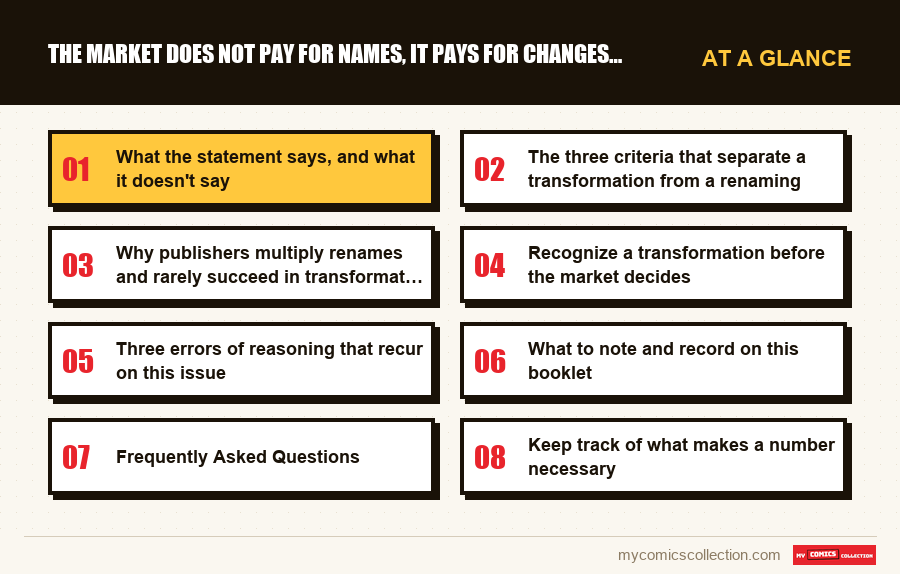
What the statement says, and what it doesn't say
Let's start by framing the numbers, because any reasoning built on them is worth as much as reading them is worth. The amounts cited are sums requested by sellers on August 29, 2026, not completed transactions. A displayed price is an assumption; a sale is a fact. There is nothing in this statement to suggest that anyone paid $12,995.00, or even $772.50. What we observe is where sellers place their cursor, which remains useful information, the cursor rarely moves at random, but which is not confused with a market price.
Second precaution, even more important: this reading was taken on a single date. A photograph shows no movement. There is therefore, in these 135 announcements, absolutely no information on an increase, a decrease or stability. Anyone who writes that this booklet “rises” would be projecting onto static data a dynamic that it does not contain. To speak of evolution, we would need at least two comparable surveys spaced over time, constructed using the same method.
Third precaution, decisive for the gap itself: the two segments do not describe the same population. The 42 verified advertisements concern copies whose identity and condition have been checked by a third party; we know what we're looking at. The 93 unverified advertisements form a heterogeneous whole. There we find reissues, neighboring issues of the same series, lots, copies whose description remains ambiguous. This heterogeneity mechanically pulls the median downward: it does not measure the price of the booklet, it measures the price of what appears when we search for this booklet. The ratio of sixty-four between $12.00 and $772.50 should therefore be read as a rough order of magnitude, never as a verification coefficient.
That said, precaution does not dissolve observation. Even assuming that a good half of the unverified segment was off-topic, the gap would still be wide. And above all, the low end of the verified segment: $42.00: is already above the high end of the ordinary basket of the other segment. In other words, as soon as a copy is identified with certainty, it leaves the twelve dollar zone. It is this threshold which deserves attention, much more than the isolated maximum of $12,995.00, which expresses the hope of a single seller and in no way constitutes an observed level.
The three criteria that separate a transformation from a renaming
To sort, you need criteria that you can apply to a booklet you hold in your hand, without waiting for the market to speak. Three are enough. They are cumulative: two out of three, we are dealing with a cosmetic overhaul; the three together, we have a transformation.
The character acquires abilities that he did not have
First criterion, the most tangible. After the number, the character does things that the internal logic of the story previously prohibited him from doing. It is not a gradual rise in power, the characters progress all the time, but a change of order of magnitude or register. A rename leaves the catalog of abilities intact: same actions, same limits, different name. The transformation rewrites it. The practical test consists of rereading the following episodes while looking for an impossible scene before: if none is found, there has been no transformation.
His relationship with others is redefined
Second criterion, often neglected. A character does not exist alone: he occupies a position in a system, protected or protective, subordinate or pivotal. A transformation moves this position. Those around him must revise their attitude, and this revision can be read in the dialogues of the following issues. A simple renaming does nothing of the sort: the others continue to address the character exactly as before, with a different word. Relational displacement is the most difficult signal for an editor to simulate, because it requires rewriting everyone, not just one file.
The subsequent story becomes impossible without this change
Third criterion, the most severe and the most reliable. We take the arcs published afterwards, and we try to tell them by removing the issue in question. If the plot holds up, the change was decorative. If it collapses-if entire issues lose their purpose, if conflicts no longer have a cause-then the number is structurally necessary. It is this necessity that the market ends up paying for, without ever calling it that. A booklet that we can do without to understand the rest is only a step; a booklet whose absence makes the rest incomprehensible is a point of support.
The 1976 case brings together all three
Applied to the 1976 issue, all three criteria are satisfied simultaneously. The character changes its name, but also its nature and appearance: three layers modified at once, while a renaming only affects one. What follows in the series is conditioned by this shift: the scale of the issues, the character's place in the group and the resulting conflicts all presuppose the event of this issue. It is this convergence, and not the change of name, which explains that the verified examples are located in an entirely different zone from the rest.
It is important to note the limitation of this tool: these three criteria are verified by reading, not on a technical sheet. No database indicates “the further story becomes impossible without this number”. It is a reader's judgment, and that is precisely why it offers an advantage: it is not accessible to those who simply consult lists of numbers deemed important.
A common objection deserves to be posed frankly: we often hear that a renaming introduces no one, therefore creates nothing. The formula is correct in its letter and misleading in its use. It is fair because no new character appears. It is misleading because it assimilates narrative value to the mere arrival of a new figure, which is only one of the possible mechanisms.
What this 1976 case shows is that a character already present for years can become, in one issue, something that the story will have to treat differently afterwards. The novelty is not in the casting, it is in the rules. And a booklet that changes the rules weighs more than a booklet that adds a name to the list.
Why publishers multiply renames and rarely succeed in transformations
If transformation is so superior to renaming in terms of value, why aren't publishers continually producing it? The answer is economic, in the sense of the economics of producing a monthly soap opera.
A rename costs nothing. It is decided in a meeting, executed in a cover and a logo, and imposes no constraints on the authors who will take over. The character remains usable exactly as before. If the operation disappoints, we go back after a few months without anyone having to repair anything. It is a reversible gesture, therefore low risk, therefore frequent.
A transformation involves everything that follows. Once a character can do more, each subsequent plot must explain why he does not solve the problem on his own. As soon as his position in the group changes, the following writers inherit a balance that they did not choose. A successful transformation is a narrative debt that the series incurs and will have to repay issue after issue. Many publishers shy away from this debt, and those who accept it do not always manage to keep it.
It should be added that the transformation is difficult to undo. The renaming is undone by another renaming; transformation, no, or then at the cost of a visible maneuver that readers register as a denial. This relative irreversibility is what makes it valuable and what explains its rarity. Irreversible actions are the only ones that we can say, decades later, that they really took place.
A practical consequence arises from this for those who collect: the volume of renamings being much greater than the volume of transformations, the probability that a booklet announcing “a new identity” is a simple change of label is high. Doubt should be the default position, and the burden of proof is on the booklet, not the reader.
Collecting this series?
Track what you own, what you are missing and what your collection is worth. 7 day trial.
Start my trial →Recognize a transformation before the market decides
The market takes years to decide, and when it does, it is too late to benefit. The advantage of the method is to rule sooner. Here are the checks that are carried out without price data.
Read the next six issues
The transformation is not proven in the booklet itself, where the editor always asserts that something considerable has just happened. It is proven in what follows. Six issues are generally enough: if the character acts as before, the announcement was hollow.
Locate the event in the trajectory
The same gesture does not have the same impact depending on when it occurs. On a character who has been installed for years, a transformation affects an already established reading capital. On a figure introduced a few months earlier, it looks more like a design tweak.
Distinguer l'annonce du contenu
The covers constantly announce definitive upheavals. Promotional vocabulary is not a source. You have to open the booklet and check that the event actually takes place there, rather than being promised for later or told after the fact.
Separate the original from the covers
The same content then circulates in other forms: reissues, collections, subsequent versions. These objects are searched with the same words and are found in the same results. A notable portion of the 93 unverified listings are due to this confusion, which explains a median of $12.00.
Verify identity before state
The question of state only arises after that of identity. A superb copy of a booklet that is not what you think it is is not worth what you think it is. The difference between the two segments of the survey firstly reflects a difference in certainty, before translating a difference in conservation.
Test deletion
The most discriminating test is done cold: recount the posterior arches by removing this number. If the story holds, the change was on the surface. If it falls apart, we have a structural point of support, and it is this type of booklet that the verified copies promote.
Three errors of reasoning that recur on this issue
The first is to treat the sixty-four ratio as a measure of the effect of the audit. He is not. It compares a specific population to a composite population. Verification explains part of the discrepancy; the heterogeneity of the second group explains another part, impossible to isolate with the data available. Presenting this figure as a coefficient would be a methodological error.
The second is to rely on the extremes. The maximum of $12,995.00 appears in the statement, but an isolated maximum says nothing about the level at which copies change hands: it says what a seller decided to list. The verified segment's low of $42.00 is actually more informative, because a floor expresses consensus while a ceiling expresses an individual hypothesis.
The third consists of generalizing from the 42 advertisements verified as if it were a large sample. Forty-two is not nothing, the number well exceeds the threshold below which any conclusion would be imprudent, but it remains a narrow market where a few atypical announcements significantly move the median. The correct wording is prudent: on this statement, the verified examples are located in a significantly higher zone. No more.
These three errors have one thing in common: they substitute a figure for reasoning. However, the reasoning here is based on the initial thesis and is verified apart from the prices: this booklet changes what the character can do, therefore it weighs. The figures come later, as partial and dated confirmation.
What to note and record on this booklet
Note the nature of the change, not just the name. In your sheet, write in one line what the character can do after this number and what he could not do before. This line is better than a label: it will allow you, in two years, to instantly find out why you had classified this issue separately, without depending on an external list.
Save the verification status as its own field. The two segments of the August 29, 2026 reading are not directly comparable. If your listing doesn't distinguish a verified item from one described by its seller, you will later mix up items that are not from the same market: exactly the error that crushes the median of 93 unverified listings.
Record the date of each price statement next to the amount. An amount without a date is unusable: it cannot be compared to anything and suggests an evolution that has not been measured. Write down "August 29, 2026", note that this is an asking price, and you can later build a real series by adding a second point.
Specify whether this is the original issue or a later reprint. This is the most costly confusion on this title, since it occurs during the search: reissues and neighboring issues come up with the same keywords. An explicit mention in your file saves you from having to recount, each time, what you actually hold.
Connect this number to the arcs that depend on it. Since the value is due to structural necessity, an isolated plug loses the essential. Note the two or three later arcs which would be incomprehensible without it: you thus document the reason for its status, and you will know which other fascicles usefully complete the whole.
Frequently Asked Questions
The questions that come up most often relate less to the fascicle itself than to how to read the difference between the two segments of the statement. Here are the most direct answers possible.
No, and it should not be presented that way. The 93 unverified announcements form a heterogeneous set which includes reissues and neighboring issues; their median of $12.00 describes this mix, not the booklet. Verification explains part of the difference with the $772.50 in the second segment, heterogeneity explains another, and these data do not allow us to separate the two effects.
Almost never. A renaming leaves intact the character's abilities, his place in the group and the logic of the following episodes: nothing has become impossible to undo. What the market ends up valuing are the numbers after which the story can no longer function as before. The name is only a sometimes present symptom, never a cause.
That this is an isolated request, made by a seller on August 29, 2026, and not an observed price. No sale is established by this statement. A maximum describes an individual expectation; To locate a level, the median of the 42 verified ads and especially their floor of $42.00 are much more informative.
They don't show anything like that. All announcements were observed on the same day. A single measurement is a photograph: it has no before or after, so it cannot establish any trend. To speak of progression or decline, there would need to be at least a second survey constructed using the same method, on another date.
By applying three reading tests. Does the character perform actions after this number that were inaccessible to him before? Do the other characters change their attitude towards him? And above all: can we tell the following arcs by deleting this booklet? If the answer to this last question is no, you are in for a transformation, regardless of the price listed today.
Keep track of what makes a number necessary
A booklet that changes the nature of a character is not recognized by its price but by what it subsequently makes impossible. Record this reason, the verification status of your copy and the date of each amount recorded: this is what transforms a stack of issues into a documented collection.