On a current listing report dated August 30, 2026, the query "Jean Gray Phoenix X-Men 101" returns 95 unverified offers, between $2.50 and $950.00, with a central value of $12.00; copies passed by a verification agency are counted separately, 36 offers, from $42.00 to $12,040.00, central value $700.00. These amounts are those claimed by sellers on this date, not completed transactions. The lower limit is not the historical issue: it is a reissue published by the publisher itself, which announces in black and white the issues it includes. In other words, the story can be bought for the price of a coffee, the original object can be bought in a completely different order of magnitude, and confusing the two in a collection distorts the estimate by a considerable factor.
There is a moment in a reader's life when the desire to read a story and the desire to own the booklet that carried it cease to be the same desire. As long as we have not made this division, we move forward in a comfortable ambiguity: we say “I collect Jean Grey” and we let the word cover two projects which have neither the same budget, nor the same timetable, nor the same definition of success. The August 30, 2026 statement makes this split visible at a glance, because it places side by side, in the same results list, an offer at $2.50 and an offer at $12,040.00 for what looks, from a distance, like the same subject.
What I want to show here is not that the market would be absurd. He is not. It is perfectly readable as soon as you agree to read the titles of the advertisements instead of only looking at the amounts. The two ends of the reading do not describe the same object, and the gap between them does not measure anything at all until sorted. Once the sorting is done, good news appears: access to the story has never been so cheap, and it is the publisher himself who organizes it.
What exactly the August 30, 2026 statement says
The figures first, with their instructions for use. On a general auction site, American market, the query "Jean Gray Phoenix Counted separately, 36 verified examples range from $42.00 to $12,040.00, with a central value of $700.00. All of these numbers are prices posted by sellers hoping to get them. None certifies that a buyer has agreed to pay them.
This clarification is not a stylistic clause. A claimed amount is a unilateral proposal; a concluded amount is an agreement between two parties. The first can remain online for months without finding a buyer, the second constitutes market information. Confusing the two is like taking the wish list for a balance sheet. The $950.00 high in the unverified segment is a perfect illustration of this: it expresses a seller's optimism, it does not prove that an unverified copy has ever traded at that level.
Second clarification, just as important: this reading was taken only once, on a single date. A single photograph shows no movement. So I can't say anything about a rise or a fall, or a trend, or a cycle. I only have a snapshot, and a snapshot doesn't drift. Any sentence that asserts “it’s rising” or “it’s settling” based on these data alone would be a pure and simple invention. I will stick to describing what was posted that day.
Third clarification, and this is where the subject becomes interesting: 36 verified advertisements, that's a modest number. A central value calculated on thirty-six offers remains fragile; it only takes a handful of sellers to revise their claims for that $700.00 to move significantly. I give it because that's what the statement contains, but I qualify it with this reservation rather than presenting it as a stable reference.
The lower terminal is not the booklet you are looking for
$2.50: an assured reissue
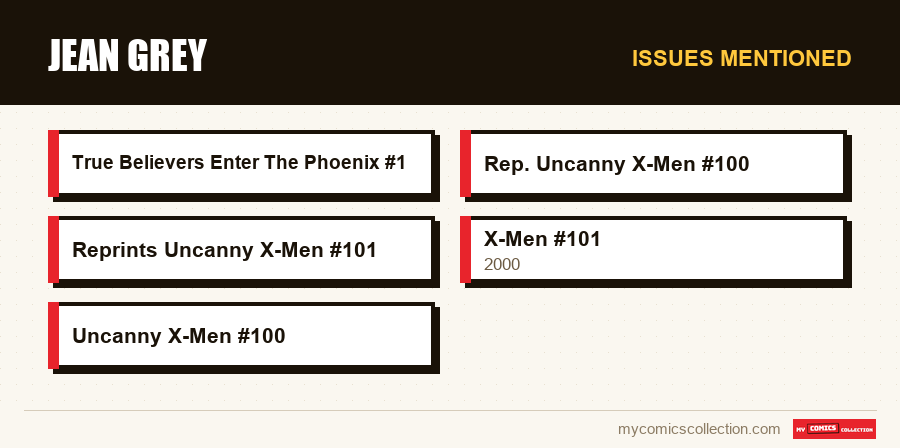
The cheapest ad is called « True Believers Enter The Phoenix #1 Rep. Uncanny X-Men #100-101 ». The title bears the abbreviation « reprints » and lists the numbers included. This is a reissue of a cheap line published by the publisher, not a first issue issue. She doesn't hide anything.
$7.00: a booklet dated 2000
The second lowest bid is marked « X-Men 101 […] 2000 ». The number is the same, the year of publication is not. A hasty reader only sees « X-Men 101 »; the full title nevertheless specifies the year and removes the ambiguity.
$8.95: a blank alternative cover
“X-MEN Uncanny 101 Virgin Variant-B […] Excl. » designates an alternative cover without covering, offered exclusively. Legitimate object, market in its own right, but object distinct from the historical booklet: it does not replace it and does not compare with it.
$8.99 and $9.50: the same categories, elsewhere
“True Believers Enter The Phoenix #1 Comic 2017 Reprints Uncanny X-Men #101” from another seller, then “X-Men #101 (Marvel Comics, 2000) High Grade”. The five cheapest offers in the survey are therefore reissues and issues from 2000. None are the original objects.
That's why the unverified segment's central value of $12.00 doesn't describe what most people think they're looking for when they type this query. This segment is populated by clearly labeled reissues and booklets published in 2000. The statistic is correct; its legend is false if we attribute it to the historical booklet. Saying it frankly costs the comfort of a reassuring figure, and I prefer to pay that price rather than let someone build a budget on an average that relates to something else.
An estimation engine that swallows these 95 ads without reading the titles will produce a value of a dozen dollars and apply it to the first issue issue. The error does not come from the calculation: it comes from the fact that the query mixed different objects in the same bag.
The remedy is not to look for a better algorithm, but to sort before counting. A reissue, an alternate cover, and an original booklet share only three words in their title, and those three words are enough to bring them together in the same hit list.
A reissue is not a trap, it's an offer
It would be tempting to treat these reissues as market pollution. This would be a parsing error and a reader error. The $2.50 ad does not disguise itself: it names its editorial line, it displays the words “reprints”, it lists the issues reprinted. A seller who wanted to deceive would not write this title. What we have here is a decision by the publisher: to make a sought-after episode available for almost nothing, in complete transparency.
For anyone who wants to read, this is the best possible news. Access to the story is paid for the price of a coffee, without negotiation, without waiting, without compromising on the condition of an ancient object. We open, we read, we close, and we risk nothing. The reader curious to know what these episodes contain before committing further now has a gateway that costs virtually nothing.
The difficulty begins elsewhere, and it is purely statistical. These reissues occupy the lower limit of the survey and weigh on any automatic aggregation. They do not fool any human who reads the entire title; they systematically mislead any processing that only looks at the number after the dollar symbol. This is a property of the calculation, not a fault of the seller.
The same reasoning applies to the 2000 issues and to the blank alternative cover. Each is a real object, with its buyers and its own logic. None are illegitimate. Simply, none is interchangeable with the first publication issue, and adding them amounts to taking the average of things that do not have the same unit. To deepen the narrative context of these episodes, it is useful to read the arcs that structure the character before deciding which one deserves to exist as a duplicate in a library.
Collecting this series?
Track what you own, what you are missing and what your collection is worth. 7 day trial.
Start my trial →Two projects, two budgets, two schedules
Read the full title
The difference between $2.50 and a three-digit sum is in the words following the number. “Reprints”, a year in parentheses, “Variant”: each of these markers changes the nature of the proposed object.
Find the year displayed
Two sections of the report explicitly bear the year 2000 in their title. The number alone is never enough to identify a booklet; you need the year, and failing that, you have to give up on concluding.
Separate verified and unverified
The survey counts the two populations separately, and this is the only honest way to do it. Mixing 95 unverified offers and 36 verified offers would produce a value that describes neither.
Treat extremes as noise
$950.00 in the unverified segment and $12,040.00 in the verified ones are isolated claims. They limit the display, they do not provide information on the level at which copies change hands.
Count ads before believing the median
Thirty-six verified offers are not many. The central value of $700.00 is stated with this reservation attached, never on its own as if it had the solidity of a large sample.
Decide which project to pursue
Accessing the story and holding the historical object are two commitments without a proportional relationship. The first is completed in one order, the second requires preparation, a budget and patience.
This sharing has a very concrete practical consequence. If the goal is to read, the availability of clearly marked reissues is completely liberating: one no longer needs to wait for the perfect opportunity or forgo an episode because the original issue is out of budget. If the objective is to hold the historic object, on the other hand, the lower limit of the survey does not concern this project and has no reason to serve as a benchmark. To make a mistake is to set yourself up for disappointment which will only happen at the time of resale.
This clarification also applies well beyond a single character. Any old series of which an episode has left its mark ends up generating its reissues, its alternative covers and its late revivals, and any query relating to this episode ends up putting them together. It is a general mechanism, of which the character's pivotal episode is only a particularly clear particular case here.
What to note in a collection
List the reissue, but in a separate category. A reissue fully deserves its place in an inventory: it has been purchased, it is owned, it gives access to the story. What it should never do is occupy the line of the original booklet. Confused with it, it inflates the estimate by a considerable factor, and no one notices it until the day of resale: that is to say at the worst possible moment.
Report the mention “reprints” and the numbers reproduced. The $2.50 ad specifies that it reprises Uncanny X-Men #100-101. This information is the identity sheet of the object: it says what we read and what we do not have. Noted in the description field, it survives oblivion; left aside, it disappears in a few months and the line becomes ambiguous forever.
Record the year of publication, not just the number. Two offerings in the statement advertise “X-Men 101” with the year 2000 in the title. Without this field, two issues with the same number become indistinguishable in an inventory, and one of them silently inherits the value of the other. Year is the least expensive field to enter and the most profitable in the long run.
Mark alternative covers separately. The $8.95 offer describes an exclusive alternative blank cover. It is an autonomous category, with its own buyers and its own logic of scarcity. To classify it with the standard coverage is to assume an equivalence that nothing in the statement supports.
Record the date and nature of any amounts carried forward. If you enter $12.00 or $700.00 in a form, also indicate that it is an asking price on August 30, 2026 and not a concluded sale, and for the second, that it is based on thirty-six offers only. A figure without its date and without its nature becomes, six months later, a false certainty that no one knows how to question.
This is precisely what it announces: its title bears the words “reprints” and names the issues reprinted, Uncanny X-Men #100-101. It therefore provides access to the content. What it does not give is the object of first publication, with its paper, its date and its material history. Both projects are legitimate; they are just not the same.
Not just because of the audit. The difference is primarily due to the composition of the unverified segment: it is dominated by reissues and by issues from 2000, not by the original issue. We are therefore not comparing two states of the same object, but two populations of different objects. Add that the verified value is based on thirty-six offers, a number that must be taken into account before relying on it.
No. This is the amount a seller is asking for on August 30, 2026, not an amount a buyer has paid. An isolated ceiling describes an individual hope. It limits the display of the statement, it provides no information on the level at which copies actually change hands.
He can't show anything like that. A measurement taken on a single date does not contain any movement information: at least two comparable readings would be required to sketch a direction. All these numbers describe is the status of requests posted that day.
By giving it its own category upon entry, with the year and the mention of what it covers. The work takes a few seconds at the time of addition and avoids a deviation of a considerable factor in the total. The opposite error is only discovered upon resale, when it is too late to correct it.
Separate the story from the item in your inventory
Reissues, alternative covers, late covers: a collection that distinguishes these categories from the moment of entry maintains a credible estimate years later. Record each copy with its year, nature and date of the amount recorded, and your total ceases to be a guess.