The 1992 Infinity War comic reading order is simple: Infinity War is a six-issue limited series published from June to November 1992, written by Jim Starlin, penciled by Ron Lim and inked by Al Milgrom. Read The Infinity Gauntlet first, then the opening issues of Warlock and the Infinity Watch, then The Infinity War #1 to 6, slotting in Warlock and the Infinity Watch #7 to 10. The other crossover titles are optional extras.
This is not the 2018 movie: The Infinity War is a 1992 comic book story, the direct sequel to The Infinity Gauntlet, featuring the Magus and an army of evil doppelgangers of Earth's heroes. There is no full recap here, only an issue-by-issue path through the story, plus the list of what can stay in the longbox.
As always on this guide, only verified facts (creators, issue numbers, dates) are stated as fact; the analysis is our own, with no reproduction of protected art or dialogue.
What to read before
Infinity War makes little sense without its direct predecessor, also written by Jim Starlin. Here are the reads that set the stage, from the most essential to the most useful.
- The Infinity Gauntlet (six issues, 1991). Written by Jim Starlin, it is drawn by George Pérez on issues 1 to 3 and part of issue 4, then by Ron Lim for the rest. It is the event that Infinity War directly follows: without it, the presence of the Soul Gem, the Gauntlet and Warlock means nothing. Our key issues guide breaks down that series, and the one on its first issue is for those who want the opening single issue.
- Silver Surfer vol. 3, issues 34 to 50. Starlin's run, which began with issue 34 (cover dated February 1990), reintroduced Thanos and leads up to the event. It is not required to follow Infinity War, but it explains where the relationships between the Surfer, Thanos and Warlock come from.
- The Thanos Quest (two issues, 1990). Written by Starlin and drawn by Ron Lim, this miniseries is a direct extension of the Silver Surfer run and follows Thanos as he gathers the gems.
- The first issues of Warlock and the Infinity Watch. Jim Starlin writes it, Angel Medina draws it, and its first issue dates from 1992, just as Warlock has taken the Gauntlet from Thanos and split up the gems. Issues 1 to 6 come before issues 7 to 10, which tie into the event: they set up the group of guardians and their daily life.
If your time is short, the rule is simple: The Infinity Gauntlet is essential, Warlock and the Infinity Watch #1 to 6 is highly recommended, and the rest is a bonus. Our overview of Adam Warlock's history puts the pieces in order for anyone new to the character.
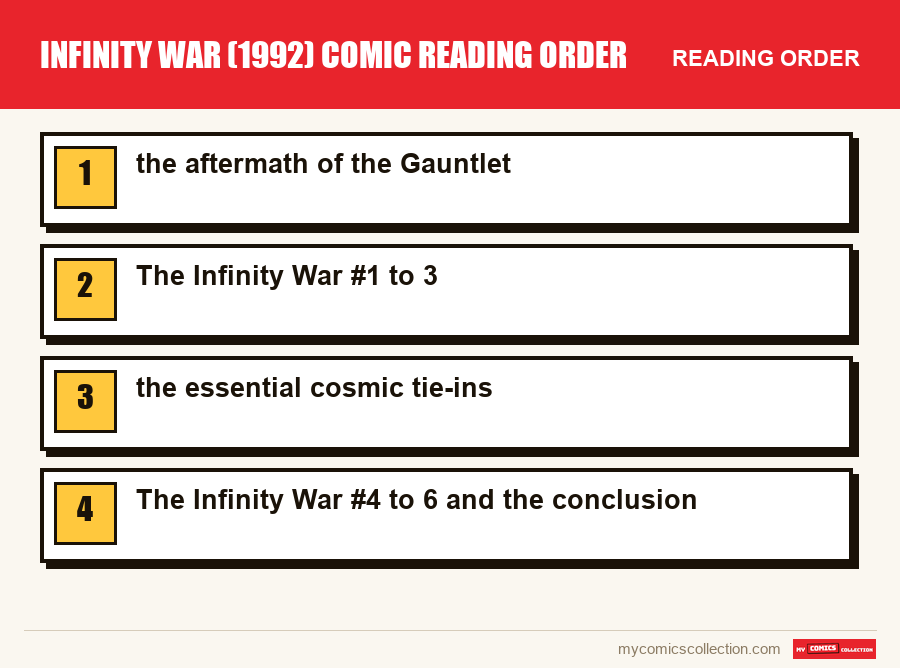
Phase 1: the aftermath of the Gauntlet
Before opening the first issue of the main series, set the scene. The Gauntlet has been used, the Soul Gem has returned to Adam Warlock, and Earth lives in the shadow of a narrowly avoided catastrophe. That is the ground covered by Warlock and the Infinity Watch: the series is born right after Warlock takes the Gauntlet from Thanos and splits up the gems, and its team forms around that situation.
In practice, read the first issues before opening The Infinity War #1, then keep going with the series up to issue 6 before tackling issues 7 to 10, which tie into the event. That way you will have in mind the group that the Magus is about to target.
As for dates, issue 2 of the series is dated March 1992, which places its first issues before the limited series opens in June.
Phase 2: The Infinity War #1 to 3
The main series runs six issues, published from June to November 1992. Jim Starlin writes it, Ron Lim handles the pencils and Al Milgrom the inks; the colors are by Ian Laughlin and Christie Scheele, the lettering by Jack Morelli.
The first three issues set the stakes. Light spoiler warning: the event rests on the return of the Magus, whom the evil side of Adam Warlock recreates after Warlock takes the Gauntlet. The Magus gathers five cosmic containment units, neutralizes Eternity and builds himself an interdimensional realm. At the same time, an army of evil doppelgangers of Earth's heroes is unleashed on the planet to keep their defenders busy.
This is where the crossover becomes a collective affair: the event spills over into many monthly series, from Fantastic Four to Daredevil or Spider-Man, which explains the length of the tie-in list. Read The Infinity War #1, dated June, then slot the cosmic tie-ins from the next phase in between issues 2 and 6 according to their cover month, since they run from July to November 1992: the attack on Earth and the Magus's plan then advance in step.
Phase 3: the essential cosmic tie-ins
The series tied to the event ran from July to November 1992, in parallel with the six main issues. Of all the titles affected, only those that extend the cosmic thread are listed here.
- Warlock and the Infinity Watch #7 to 10. This is the natural tie-in: same writer as the main series, same characters, same story arc. It follows directly from the first six issues mentioned above.
- Silver Surfer vol. 3 #67 to 69. The Silver Surfer was a pillar of Marvel's cosmic line at the time; these three issues connect the event to his own storyline.
- Guardians of the Galaxy vol. 1 #27 to 29. A cosmic team book; a useful extra if you follow this group.
- Quasar #38 to 40. Another cosmic title of the period, which fits into the same publication window.
- Marvel Comics Presents #108 to 111. An anthology series that contributed to the crossover through its successive chapters.
For the order, the most reliable method is to sort the single issues by cover date: each block of tie-ins is read between the main issue that precedes it and the one that follows it. That is enough to rebuild the chronology without relying on an internal numbering that the series do not always carry.
To place this reading within the whole Thanos saga, our reading guide to the character and our page on his crossovers offer a wider view, from his debut to the modern era.
Phase 4: The Infinity War #4 to 6 and the conclusion
The last three issues tighten the plot around the Magus and Warlock. Spoiler warning: after the confrontation, the Soul Gem absorbs the Magus and Warlock falls into a coma; Thanos explains that the Magus never reached omnipotence, because the Reality Gem he depended on was a fake. In the final issue, the containment units are stolen by Warlock's "good" facet, the Goddess, and Eternity declares that the gems can never again be used as a whole.
That last decision closes the door on any new unified use of the gems. The next event, The Infinity Crusade, arrives in 1993.
A reading tip: after issue 6, reopen the final issues of The Infinity Gauntlet. The contrast between the two endings, the first centered on Thanos and the second on Warlock and the Magus, then reads all at once.
Do you collect this series?
Track what you own, what you are missing and what your collection is worth. 7-day trial.
Start my trial →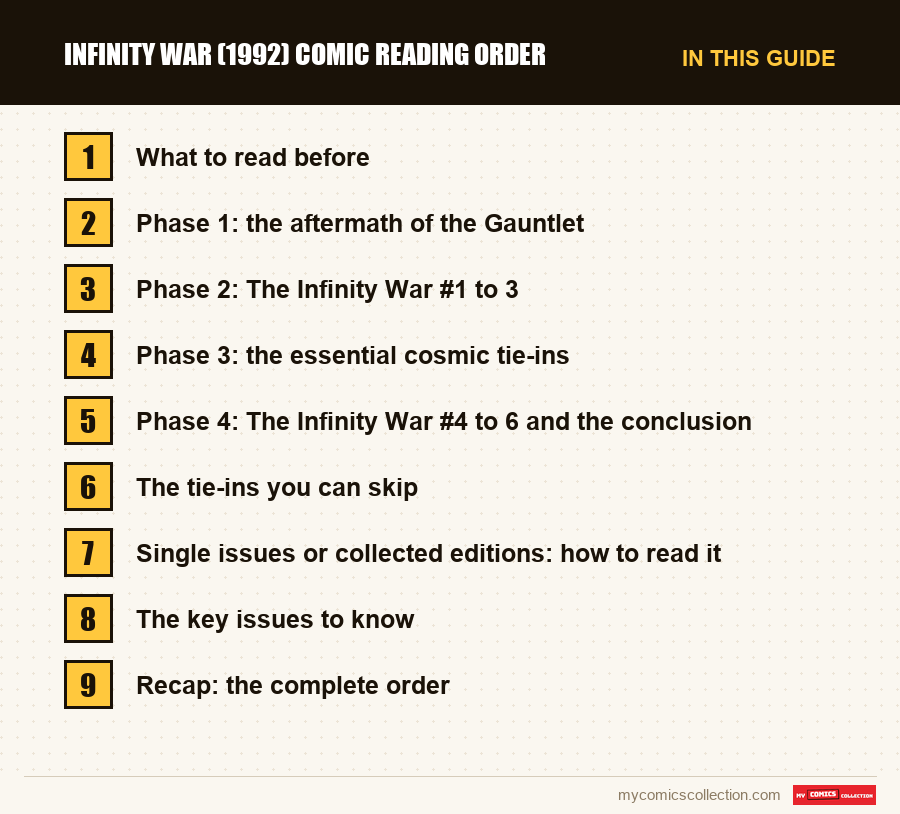
The tie-ins you can skip
The full list of series touched by the crossover is long: Alpha Flight #110 to 112, Captain America #408, Daredevil #310, Deathlok #16, Doctor Strange, Sorcerer Supreme #42 to 47, Fantastic Four #366 to 370, Marc Spector: Moon Knight #41 to 44, The New Warriors #27, Nomad vol. 2 #7, Silver Sable and the Wild Pack #4 and 5, Sleepwalker #18, Spider-Man #24 and Wonder Man #13 and 14, among others.
They are optional for a simple reason: these series are stories in their own right, with their own characters and their own creative teams. In their case, the event serves as a backdrop to a local story centered on the series' hero. The main plot is self-contained and does not need these issues to be understood.
They remain valuable, though, if you follow one of these series or collect the heroes involved. Fantastic Four #366 to 370 and Doctor Strange, Sorcerer Supreme #42 to 47, for example, form blocks of several issues that can be bought or read as short sagas. Read them for the pleasure of seeing the crossover from another corner of Earth, not out of necessity.
Our page on Thanos crossovers places this event among the other great convergences in which the character appears.
Single issues or collected editions: how to read it
The question plays out differently depending on your goal. If you want to read the story, a collected edition that gathers the main series and the cosmic tie-ins is the most comfortable: you no longer have to interleave the issues yourself. If you collect single issues, count the pieces you need to track down: six issues for the main series, plus the blocks you have chosen to add.
A simple method for deciding: list the series you already follow. Every tie-in belonging to one of them deserves a period single issue, because it completes your run. For the rest, a collected reprint is enough. Before buying a collected edition, check the table of contents to see which issues it contains: compilations bundle different tie-ins, and some volumes leave out issues that others include.
On the single-issue side, make sure no issue is missing from a block of three or four tie-ins before shelving it: a gap at #68 of Silver Surfer spoils the whole block. Our Infinity Gauntlet guide describes the checkpoints that also apply to its sequel.
The key issues to know
As always, the value of an event single issue depends on its place in the story and on the interest readers show in it. Here is how to approach the question, without dollar figures, with methodological benchmarks.
- The Infinity War #1. The opening issue of the limited series, dated June 1992: it is the single issue that marks the start of the event and the one you gather first in a themed collection.
- The Infinity War #6. The last issue, which closes the event; the closing issue always carries completion interest.
- Warlock and the Infinity Watch #7 to 10. The four single issues of the Starlin and Medina series that fit into the event: they are of interest if you follow the series.
- Variants and reprints. Check the printing number, the barcode and the year printed in the indicia before buying. A copy whose indicia states a reprint does not carry the value of a period first printing.
Before setting a price for your The Infinity War #3 or #4, compare it with sold listings of that issue, grade against grade. Our page on the first issue of Infinity Gauntlet shows the approach on a neighboring case, and you can use the same reasoning here.
Recap: the complete order
- The Infinity Gauntlet #1 to 6 (1991), Starlin, Pérez and Lim.
- Silver Surfer vol. 3 #34 to 50 and The Thanos Quest #1 to 2, for context (optional).
- Warlock and the Infinity Watch #1 to 6 (1992), the first issues before the opening, the rest in parallel.
- The Infinity War #1 (June 1992).
- The Infinity War #2 to 6 (July to November 1992), slotting in the following blocks by cover month.
- Warlock and the Infinity Watch #7 to 10.
- Silver Surfer vol. 3 #67 to 69, Guardians of the Galaxy #27 to 29 and Quasar #38 to 40 (cosmic tie-ins).
- Optional tie-ins depending on your series: Fantastic Four #366 to 370, Doctor Strange, Sorcerer Supreme #42 to 47, Marvel Comics Presents #108 to 111 and the rest.
- Sequel: The Infinity Crusade (1993).
Frequently asked questions
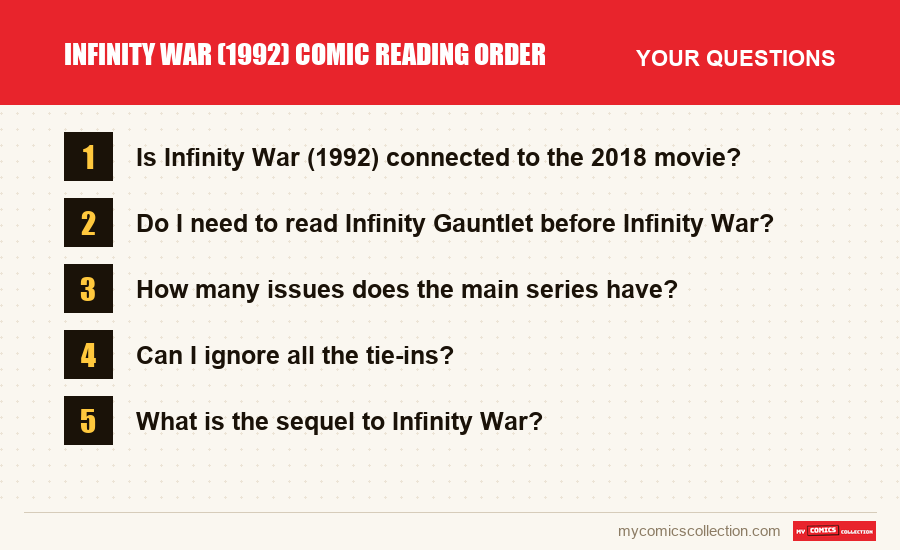
No. The 2018 film Avengers: Infinity War borrows its title and some elements of the universe, but the 1992 comic book story is a six-issue series featuring the Magus and evil doppelgangers. Our page on the movie compared with the comics details the differences.
Yes, it is the most useful read. Infinity War is the direct sequel to The Infinity Gauntlet, written by the same writer, Jim Starlin. Without it, the presence of Warlock, the gems and the containment units lacks context and the plot loses much of its force.
Six issues, published from June to November 1992, written by Jim Starlin, penciled by Ron Lim and inked by Al Milgrom. If you add the cosmic tie-ins recommended in this guide, count seventeen extra single issues, depending on which series you choose to follow.
Yes, the main series stands on its own. The tie-ins mostly show how the evil doppelgangers affect each hero's series. If you want an extra, keep Warlock and the Infinity Watch #7 to 10, which shares the writer and the characters of the main series.
The sequel is The Infinity Crusade, published in 1993. It comes after Eternity's decision about the gems. If you want to read the recent events around the gems, our guide to the 2013 Infinity event covers a different story.
Did you find a period copy of The Infinity War or its cosmic tie-ins? Estimate its value in a few minutes.
Estimate my comic