The Infinity Crusade reading order is simple: the six-issue series ran from June to November 1993, written by Jim Starlin, penciled by Ron Lim and inked by Al Milgrom. It closes the Infinity trilogy after The Infinity Gauntlet and The Infinity War. Read the main series alternating with Warlock Chronicles #1 to 5 and Warlock and the Infinity Watch #18 to 22; the tie-ins from other series are optional.
The Goddess, one facet of Adam Warlock, wants to impose a happiness with no pain and no choice, and Earth's heroes are drafted into her cause. The last chapter of Jim Starlin's early-1990s cosmic saga reads best when you know which issues belong to the core and which sit on the edges. That is the point of this guide: it gives you the path issue by issue and does not retell the plot.
As always in this guide, only verified information (creators, issue numbers, dates) is stated as fact; the analysis is our own, with no reproduction of protected pages or dialogue.
What to read before
The Infinity Crusade is the third and final step of a run by the same creative team. Its story rests on what Warlock did with the Gauntlet: without that foundation, the splitting of the character into a benevolent facet and a malevolent one makes no sense. Here are the useful reads, from the most necessary to the most optional.
- The Infinity Gauntlet (six issues, 1991). Jim Starlin writes it, and the art passes from George Pérez to Ron Lim along the way. This is the starting point: Thanos, the gems and the Gauntlet all come from here. Our key issues guide for the series helps you choose single issues, and the one on issue #1 is for anyone chasing the first issue.
- The Infinity War (six issues, 1992). Jim Starlin writes it, Ron Lim draws it and Al Milgrom inks it. This is the middle chapter: it sets up the separation of Adam Warlock's aspects, which The Infinity Crusade picks up. Our Infinity War reading order covers this step in detail.
- Operation: Galactic Storm (1992). This Avengers-line crossover came out in 1992, the same year as The Infinity War. It is peripheral to our topic: you can skip it without losing the thread.
- Warlock and the Infinity Watch #1 to 17. The series, created by Jim Starlin and Angel Medina, launches in 1992. Issues #18 to 22 tie into the 1993 event; the ones before them set up the gem keepers and their routine.
If you have to choose, The Infinity Gauntlet and The Infinity War form the foundation; Warlock and the Infinity Watch before issue #18 is a nice extra. To place these reads in Thanos's life, our history of the character puts the dates back in order.
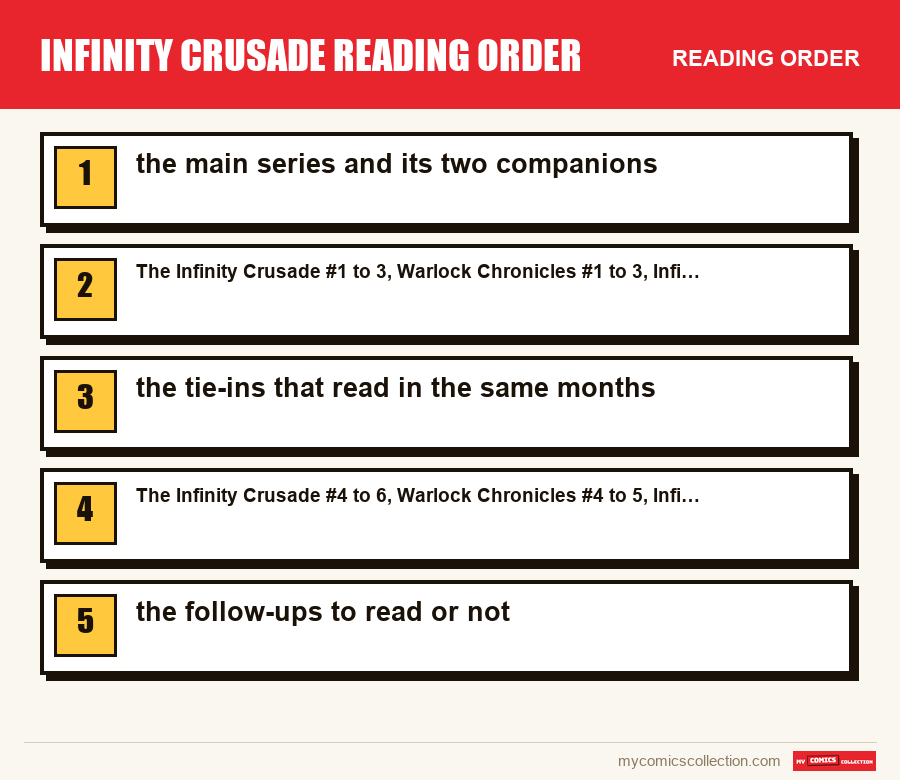
Phase 1: the main series and its two companions
The event has one particularity: it is told across three series that move forward together. First the six issues of The Infinity Crusade, then Warlock Chronicles in five issues, and finally issues #18 to 22 of Warlock and the Infinity Watch. This is not a tie-in in the usual sense: these three titles form the core, and the story passes from one to the next.
On the creators' side, Jim Starlin writes the main series, Ron Lim draws the pages and Al Milgrom inks them; Ian Laughlin handles the colors. Ron Lim also did the cover of issue #1.
The simplest method is to follow the split of the two collected editions published in 2008 and 2009, which reproduce this order: you read a block of three issues of the main series, the first three issues of Warlock Chronicles and issues #18 and 19 of Warlock and the Infinity Watch, then move on to the next block.
Phase 2: The Infinity Crusade #1 to 3, Warlock Chronicles #1 to 3, Infinity Watch #18 to 19
This first block sets up the situation. Mild spoiler: Adam Warlock takes back the Gauntlet and expels his good and evil aspects; the evil one becomes the Magus, the good one becomes the Goddess. She gathers thirty Cosmic Cubes, fuses them into a Cosmic Egg able to grant her wishes, then creates a refuge called Paradise Omega and recruits heroes under Moondragon's influence.
Read issue #1 of the main series, then the first chapters of the two companions in whatever order you like: the three series do not wait for one another, but each brings a different angle. Reading each block in full before moving to the next is enough to keep the story's chronology.
One landmark to spot: Warlock Chronicles #2 is the issue that marks Thanos joining the Infinity Watch, with an August 1993 cover date. For the rest, the order is a matter of taste, as long as you do not skip a block of three issues.
Phase 3: the tie-ins that read in the same months
The series attached to the event came out alongside the six main issues. About a dozen series are involved; here we keep the ones that are most useful if you follow a particular hero.
- Silver Surfer vol. 3 #83 to 85. The Silver Surfer's series is a natural thread for anyone who has followed Starlin's cosmic saga from the start. Our Silver Surfer reading guide places these issues in his path.
- Thor #463 to 467. Five consecutive issues, the longest stretch of tie-ins on the list. Read them if you follow the thunder god's monthly series; otherwise they are skippable. Our Thor reading guide places this period.
- Doctor Strange, Sorcerer Supreme #54 to 56. The Sorcerer Supreme's series ties into the event over three issues. To place the character, see our Doctor Strange reading guide.
To slot these issues in, use the cover date. Slide each block of tie-ins in after the main issue whose cover date is closest: Thor, Silver Surfer and Doctor Strange share no numbering with Starlin's series, only the calendar links them.
Phase 4: The Infinity Crusade #4 to 6, Warlock Chronicles #4 to 5, Infinity Watch #20 to 22
The second block leads to the showdown. Spoilers ahead: Thanos is the Goddess's first target, but Warlock saves him; Mephisto trades information about her for a Cosmic Cube; Thanos, Warlock and Professor Xavier, who falls into a coma after attempting telepathic contact with Moondragon, attack the Goddess on the spiritual plane, and she is absorbed by the Soul Gem. Thanos then destroys Paradise Omega.
The Cube handed to Mephisto turns out, after the fact, to be useless. This is an ending where each series contributes its piece: reading the three in the same order as in the previous phase keeps the feeling of a story with several voices, rather than a main series flanked by supplements.
The last issue of the main series works as a stopping point if you want to limit your reading: everything that follows is aftermath and no longer affects your understanding of the event.
Do you collect this series?
Track what you own, what you are missing and what your collection is worth. 7-day trial.
Start my trial →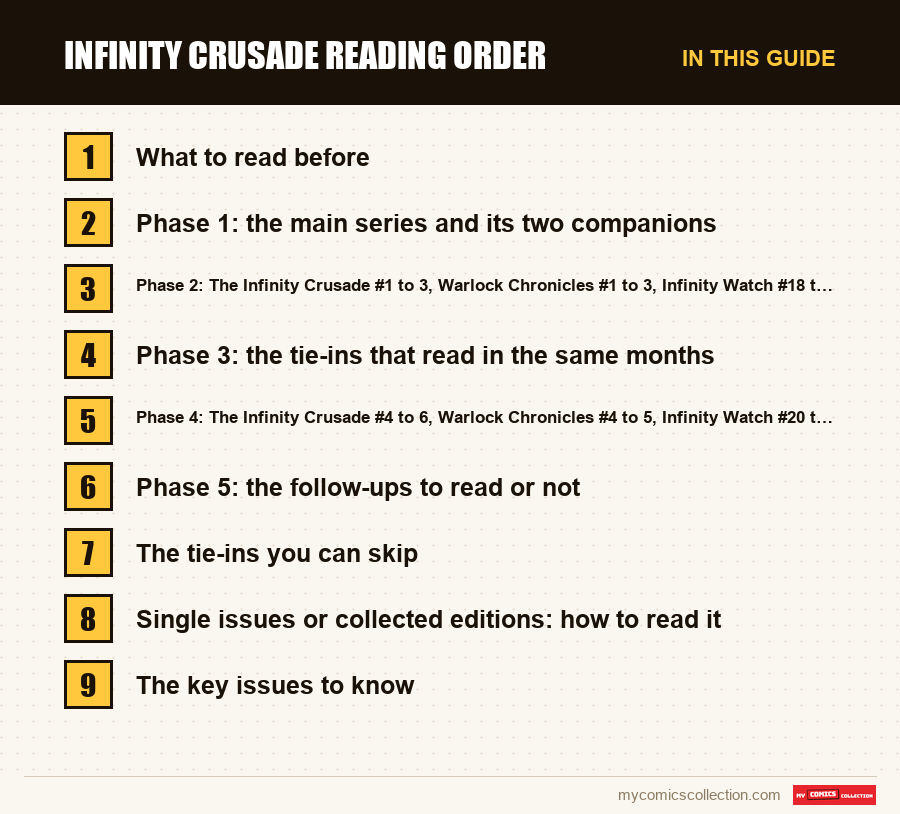
Phase 5: the follow-ups to read or not
Warlock Chronicles has an issue #6 that falls outside the event: it appears in the second volume of the Infinity Watch collections, along with Warlock and the Infinity Watch #26 to 42. That series, launched by Jim Starlin and Angel Medina, runs through issue #42.
If you want to extend the adventure, the most logical move is therefore to go back to Warlock and the Infinity Watch after issue #22 rather than looking for another event. For an overview of Thanos's saga beyond the trilogy, our Thanos collecting guide and our page on his crossovers offer other entry points.
The tie-ins you can skip
The other series touched by the event are single issues of their own monthly: their regular readers find their hero in action there, but the main story stands on its own with its two companions. Here is what you can leave aside without losing the thread.
- Alpha Flight #122 to 124.
- Avengers West Coast #96 and 97.
- Cage #17.
- Darkhawk #30 and 31.
- Deathlok vol. 2 #28 and 29.
- Iron Man #295.
- Marc Spector: Moon Knight #57.
- Silver Sable and the Wild Pack #16 and 17.
- Web of Spider-Man #104 to 106.
This is not a judgment on their quality: these issues mostly matter to followers of the series, and someone collecting, say, Moon Knight will find real interest in issue #57 of that run. The question to ask yourself: do you want to understand the event or complete a run?
Single issues or collected editions: how to read it
It all depends on your hunting budget and your shelf space. In single issues, alternating reading comes naturally: six issues, five issues and five issues of the companion series add up to sixteen single issues, not counting tie-ins. The order we give below is built on the split of the two collected editions.
In collected form, two volumes exist, published in December 2008 and February 2009. The first gathers The Infinity Crusade #1 to 3, Warlock Chronicles #1 to 3 and Warlock and the Infinity Watch #18 and 19; the second collects The Infinity Crusade #4 to 6, Warlock Chronicles #4 and 5 and Warlock and the Infinity Watch #20 to 22. The tie-ins are not in these volumes.
Another collection, from 2016, covers Warlock and the Infinity Watch #1 to 22 in its first volume and the continuation, #26 to 42 with Warlock Chronicles #6, in the second. Choose the 2008 and 2009 trade paperbacks for the event alone, the 2016 edition to read the whole companion series.
The key issues to know
No dollar figures here: a single issue's value moves with its condition and with the season. The landmarks that matter for this event are the following.
- The Infinity Crusade #1. The opening of the series, with a Ron Lim cover: it is the first issue of the limited series.
- Warlock Chronicles #2. The issue of Thanos joining the Infinity Watch, dated August 1993.
- The Infinity Crusade #6. The last issue of the main series, the one that closes the trilogy.
- Silver Surfer vol. 3 #83 and Thor #463. The entry points of the two monthly series into the event, useful for anyone completing those runs.
For variants or alternate covers, look at each issue's catalog page: you can compare covers and printings there. To set a buy or sell price, compare closed sales of copies in the same condition as yours. Our Infinity Gauntlet guide offers a method that applies to the whole trilogy.
Recap: the complete order
- The Infinity Gauntlet #1 to 6 (1991).
- The 1992 middle chapter: the six-issue The Infinity War series.
- Warlock and the Infinity Watch #1 to 17, for the keepers and their daily life.
- The Infinity Crusade #1 to 3, Warlock Chronicles #1 to 3, Warlock and the Infinity Watch #18 and 19.
- Selected tie-ins, by cover date: Silver Surfer vol. 3 #83 to 85, Thor #463 to 467, Doctor Strange, Sorcerer Supreme #54 to 56.
- The Infinity Crusade #4 to 6, Warlock Chronicles #4 and 5, Warlock and the Infinity Watch #20 to 22.
- Continuation: Warlock and the Infinity Watch #26 to 42 and Warlock Chronicles #6.
Frequently asked questions
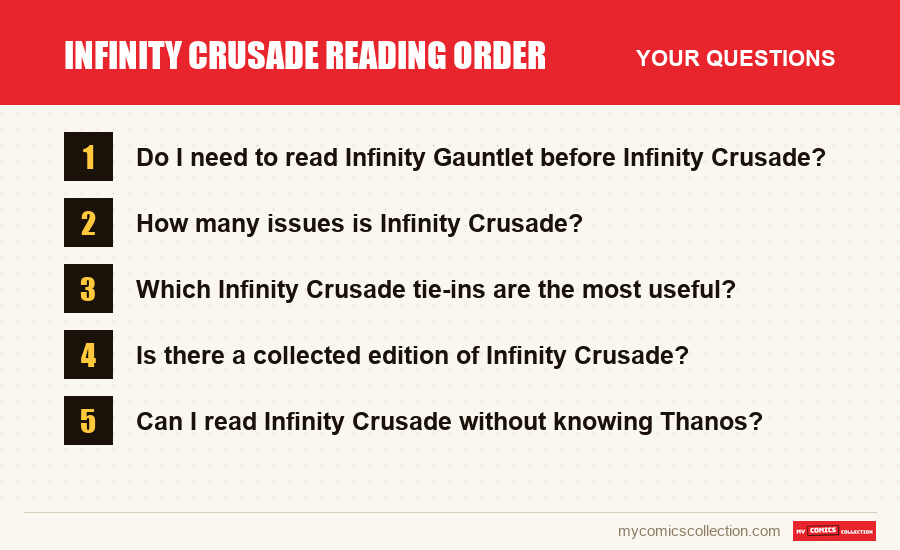
Ideally, yes. The Infinity Crusade is the third chapter of a trilogy, after The Infinity Gauntlet from 1991 and The Infinity War from 1992, all by Jim Starlin. Without those two steps, the Goddess's origin and Thanos's role are hard to grasp. If you only read one, pick The Infinity War.
Six issues for the main series, running from June to November 1993. The story is completed by five issues of Warlock Chronicles and five of Warlock and the Infinity Watch, from issue #18 to issue #22. Together they form the core of the event, before the tie-ins from the period's other monthly series.
It depends on what you collect. Silver Surfer vol. 3 #83 to 85, Thor #463 to 467 and Doctor Strange, Sorcerer Supreme #54 to 56 are among the longest stretches on the list. The other tie-ins, from Alpha Flight to Web of Spider-Man, mostly speak to followers of their own series.
Yes. Two volumes, published in December 2008 and February 2009, gather the main series, Warlock Chronicles and issues #18 to 22 of Warlock and the Infinity Watch in the recommended reading order. The tie-ins from the other series are not included: you have to hunt for them as single issues.
Yes, if you accept discovering the character along the way: the series recaps what you need. Thanos is the Goddess's first target there, but his role is easier to grasp with The Infinity Gauntlet in mind. Our Thanos reading guide offers a broader path.
Did you find an issue from the Infinity trilogy in your boxes? Appraise it before deciding whether it joins the collection or goes up for sale.
Appraise my comic