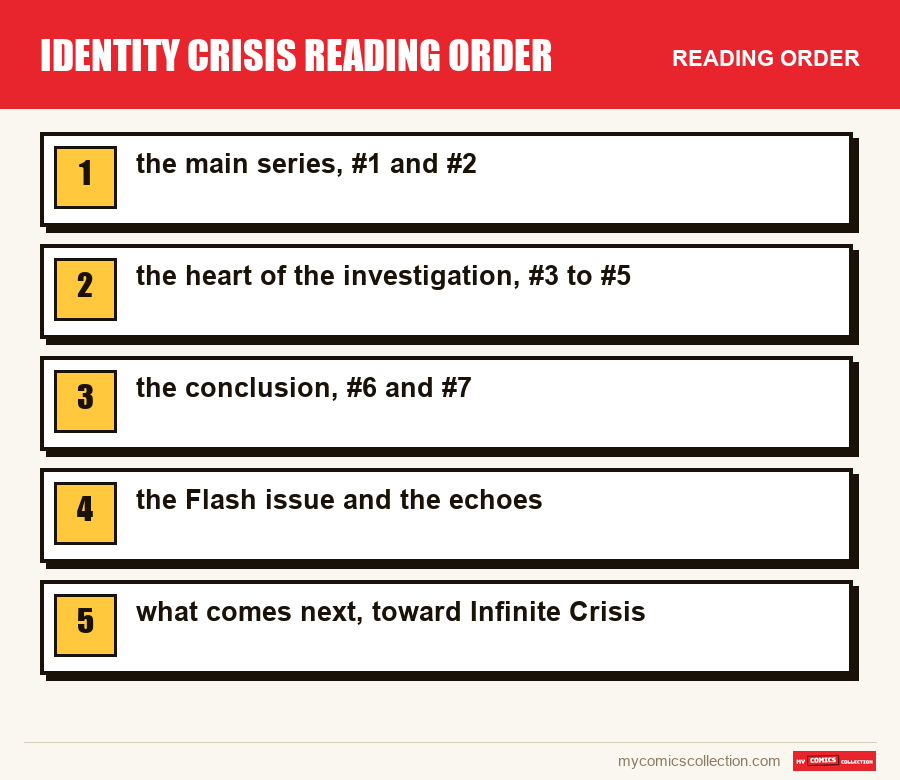
To follow the Identity Crisis reading order, start with the 2004 seven-issue miniseries Identity Crisis, written by Brad Meltzer and drawn by Rags Morales, and read #1 through #7 straight through. No prelude is required: a few Justice League landmarks are enough. Then read Countdown to Infinite Crisis and Infinite Crisis, which pick up its fallout, and save the issue of The Flash where the Rogues regroup in the event's wake for last.
Among the miniseries DC published in the 2000s, Identity Crisis is the one whose reading order raises the fewest practical problems and the most fundamental questions: it fits in seven single issues, yet it changes the way you read everything that comes after it. This guide tells you where to place it, what to read around it, and how to buy it without picking the wrong format.
As always in this guide, we only state verified facts (creators, issue numbers, dates); the analysis is our own, with no reproduction of protected pages or dialogue.
What to read before
Good news if you are new to the event: there is no prelude you have to force yourself through. Brad Meltzer designed Identity Crisis as a miniseries that stands on its own, and you can jump in at #1 without having opened a single other issue. That said, the story plays on a shared past among the heroes of the Justice League, and that past reads better with a few landmarks.
The first landmark is the character Elongated Man. Ralph Dibny, the stretching hero, debuts in The Flash #112 (1960). His career is covered in our Elongated Man selection: reading it before the miniseries gives weight to what Meltzer does with him. You can also just start with #1, which gives you what you need to know.
The second landmark is the history of the League itself. Two reads shed light on this context: Crisis on Infinite Earths (1985), which redrew the universe the team lives in, and the Justice League of America #166 to #168 arc (1979), from which Meltzer borrows an old League episode. For further reading, the Justice League reading path follows the team, and the page on Crisis on Infinite Earths key issues covers the first of those two reads in detail.
The third landmark is subtler: tone. DC in the 2000s is not DC in the 1960s. The miniseries is a crime story that barges into the homes of heroes you knew from their exploits. If you have just read lighter League adventures, expect a change of register from the very first pages.
Phase 1: the main series, #1 and #2
Identity Crisis runs seven issues. The credits are stable throughout: script by Brad Meltzer, art by Rags Morales, inks by Michael Bair, colors by Alex Sinclair, lettering by Ken Lopez, covers by Michael Turner, edited by Mike Carlin. From the day it came out, #1 ranked among DC's best sellers, and it is still in demand.
Issue #1 sets up the investigation. The register is that of a crime thriller: a brutal event strikes a circle of heroes, and the rest of the miniseries is about understanding who acted and why. It would be a shame to say more here, because this article is meant to guide your reading, not retell the story. Just remember that it reads in one sitting with #2, which develops the immediate consequences and sets up the leads the rest will follow.
One practical tip: do not read the covers as a summary. Michael Turner's covers are polished, but they serve the sale of the single issue more than the narrative. If you are a collector, the gap between the cover image and the content is a good reason to read first and admire afterward.
Phase 2: the heart of the investigation, #3 to #5
Issues #3 to #5 form the middle of the miniseries. This is where Meltzer and Rags Morales linger on the heroes' shared past: flashback scenes alternate with the present-day investigation. Michael Bair inks these pages with a consistency that avoids the jarring break between past and present, the usual weak point of this kind of structure.
Our advice is to read these three issues back to back rather than at the original monthly pace. The series was designed to be followed over several months, but its effectiveness comes from the accumulation of clues: three single issues in a row make the progression easier to follow than a spaced-out read.
A word of caution on spoilers: the question of who acted dominates these three issues, and plenty of fan pages answer it right away. This guide does not mention it. If you want to preserve the reading experience, avoid recaps and discussion threads about the miniseries until you have finished #7.
Phase 3: the conclusion, #6 and #7
The last two issues close the investigation and open the way to what follows. Again, nothing more here about the content. Without giving anything away, know that #7 leaves behind decisions whose effects reach beyond the miniseries, which is why it serves as the bridge to Infinite Crisis.
Remember to reread #1 after you finish #7. A miniseries built around a mystery reads differently once you know the answer, and the opening pages take on a meaning the first read does not deliver. It is a good time to compare the attention Rags Morales pays to faces with the restraint of the page layouts.
Phase 4: the Flash issue and the echoes
The clearest tie-in is an issue of The Flash that brings together the Rogues, the hero's gallery of adversaries, in the wake of the miniseries. Be careful, it reveals part of the outcome: read it after #7, not during. It shows how the Flash corner of the universe absorbs the shock. To place this role, our Flash reading guide gives the character's general path.
We stick to this tie-in for the immediate reading phase. To go further, start from the JLA series: issues #115 to #119, the Crisis of Conscience arc (2005), pick up the tensions born from the miniseries within the League.
Phase 5: what comes next, toward Infinite Crisis
After #7, the natural follow-up is Countdown to Infinite Crisis (2005), a single issue that works as a launch ramp, then Infinite Crisis (2005-2006), written by Geoff Johns. Identity Crisis is not the first piece of that puzzle by itself, but it is what sets it in motion: trust between the heroes is chipped away here, and the next event exploits that crack.
Our page on DC Comics crossovers places these three blocks in the publisher's broader event timeline. And to understand what Infinite Crisis borrows from Crisis on Infinite Earths, go back to the key issues page mentioned above.
Do you collect this series?
Track what you own, what you are missing and what your collection is worth. 7-day trial.
Start my trial →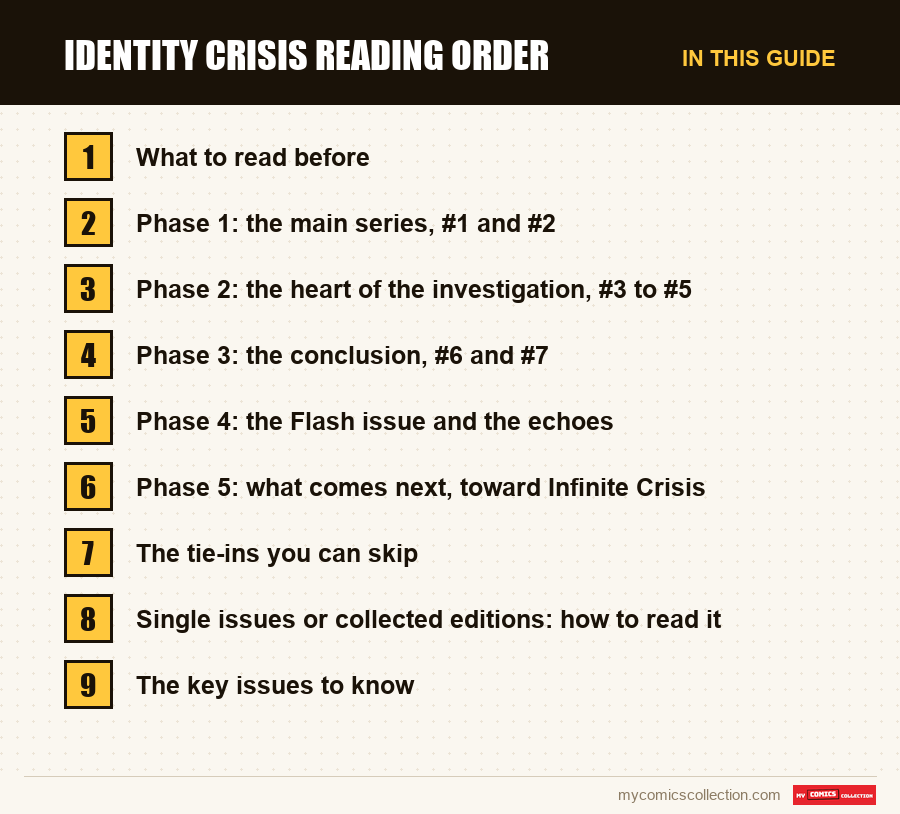
The tie-ins you can skip
The list is short, and that is deliberate. The miniseries has many echoes in other series, but they are more a matter of mood than narrative necessity. A reader who goes from Identity Crisis to Infinite Crisis loses nothing essential by leaving out the peripheral issues.
The The Flash issue is not essential either: it is a supplement, not a step. It is mainly worth it for readers who already follow the Flash series, or who collect by character. Rogues fans will find some insight into those characters there, but understanding the event does not depend on it.
The same goes for JLA #115 to #119: the event reads very well without them. They will interest those who want to follow the League over the years rather than read a standalone event.
Single issues or collected editions: how to read it
With only seven issues, Identity Crisis is one of the easiest events to pick up in a collected edition. There is a hardcover published in September 2005, a softcover published in 2006 and an Absolute Edition published in 2011. The choice has less to do with the story than with how you use it: the softcover for reading, the oversized format for admiring Rags Morales's art and Alex Sinclair's colors.
Single issues keep a real appeal for two kinds of buyers: the collector who wants Michael Turner's covers as originally published, and the reader who likes the original monthly rhythm. For a first read, a collected edition saves you from chasing seven issues. To dig deeper, our page on collected edition formats explains the differences between trade paperback, hardcover and omnibus.
If you buy single issues, check that the run is complete before you pay: an incomplete seven-issue set is unreadable, and a single missing issue spoils the progression of the investigation. Compare the photos, the printing notice and the condition of the spines rather than trusting a listing title.
The key issues to know
The key issue here is #1: the opening of the miniseries, its early printings and the Michael Turner cover. It is the single issue around which the event's secondary market is organized, and the one readers look for first. Our usual method applies: look at condition before scarcity, because a beaten-up copy quickly loses the edge of a sought-after printing.
Issue #7 is the second landmark: it concludes the investigation, and it is the one you want in the same condition as #1 so the run looks uniform on the shelf. In between, issues #2 to #6 are worth more or less the same; they complement rather than stand out from one another.
For the first appearance of Elongated Man, it is The Flash #112 (1960), a landmark that Silver Age collectors know well. It predates the miniseries by more than forty years, and its collecting interest stands on its own. To go further on this character, see our dedicated page.
As for variants, the method is to check the credits page and the cover of the copy rather than the listing title, for each of the seven issues.
Recap: the complete order
- Identity Crisis #1 and #2 (2004): the investigation opens.
- Identity Crisis #3 to #5: the heroes' shared past, to be read back to back.
- Identity Crisis #6 and #7: the conclusion.
- Reread #1 if you want to catch the clues planted from the opening.
- The issue of The Flash that brings the Rogues together after the event (optional).
- JLA #115 to #119, Crisis of Conscience (2005, optional).
- Countdown to Infinite Crisis (2005).
- Infinite Crisis (2005-2006), by Geoff Johns.
Why this order works
The miniseries stands on its own; what matters is what it leaves behind. Reading seven issues in order, without getting sidetracked, gives the effect Brad Meltzer intended. Scattering the read across other titles breaks the rhythm of the investigation, which is its main strength.
Those who come back to Identity Crisis after reading Infinite Crisis often reverse the order and end up disoriented. The sense of broken trust that runs through what follows is built here. Respecting the publication chronology, 2004 then 2005, is the safest advice.
Frequently asked questions
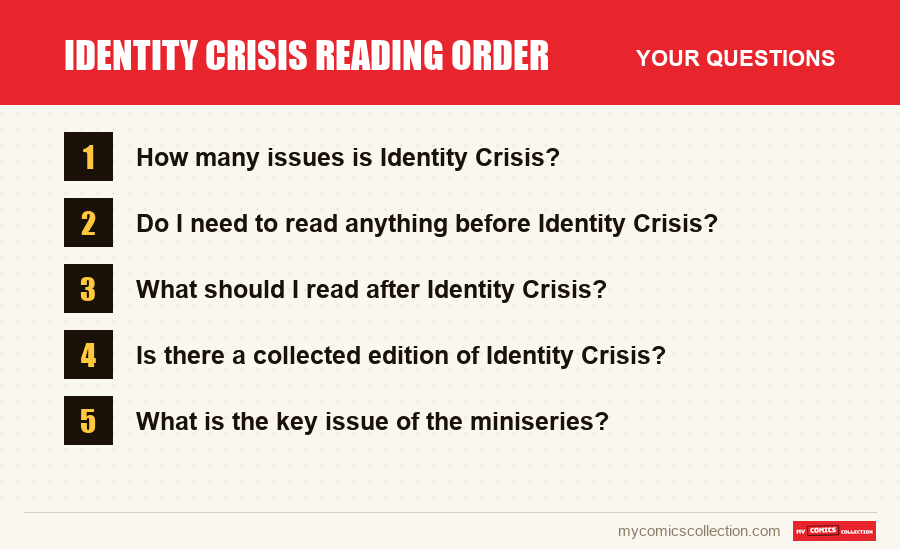
The miniseries runs seven issues, published monthly in 2004. It is written by Brad Meltzer and drawn by Rags Morales, with Michael Bair on inks and Alex Sinclair on colors. It reads as a single block, from #1 to #7, with no other title to slot in.
No, the miniseries stands on its own. A few landmarks help: Elongated Man, who debuts in The Flash #112 in 1960, and the history of the Justice League, illuminated by Crisis on Infinite Earths and by Justice League of America #166 to #168 (1979). No specific issue is required to follow the investigation.
Move on to Countdown to Infinite Crisis, published in 2005, then Infinite Crisis, written by Geoff Johns and published in 2005-2006. JLA issues #115 to #119, titled Crisis of Conscience, are tied to the miniseries and make a good companion read if you follow the League.
Yes. A hardcover came out in September 2005, a softcover in 2006 and an Absolute Edition in 2011. The softcover suits a simple read, the Absolute suits the oversized format. For a first purchase, a collected edition saves you from chasing seven single issues.
Issue #1, with the Michael Turner cover, is the single issue collectors look for first, preferably in a first printing. Judge condition first, then the printing notice. Issue #7 comes next, so the run stays uniform on the shelf.
Do you own all seven issues of Identity Crisis or a collected edition? Get your copy appraised.
Estimate my comic