In short
Iceman, the ice-powered teenager Bobby Drake, joins Professor Xavier's first class of five in the pages of X-Men #1 (September 1963), a Stan Lee and Jack Kirby book. He spent the 1970s and 1980s in the Champions, the Defenders and X-Factor, then became a headline character in 2015, when All-New X-Men #40 by Brian Michael Bendis revealed that the teenage Bobby is gay. Sina Grace's Iceman (2017) and the Krakoa-era The Astonishing Iceman carried that story into solo books.
Bobby Drake is the X-Man who spent the longest time being treated as a background player and then became one of the most discussed. He was a founding student in 1963, a presence at the margins of the team for decades, a member of three other superhero groups, and, from 2015 onward, the lead of his own ongoing series. The shape of his bibliography explains why a plain run of X-Men issues gives a thin picture of him.
Credits, issue numbers and cover years for the 1963 debut, the Champions, the Defenders, X-Factor, the 2003 mutation, the 2015 revelation and the solo series were checked against published references. Where a Krakoa-era credit could not be confirmed it is not given. The reasons we offer for why each turn matters are opinion, and this page lists no prices.
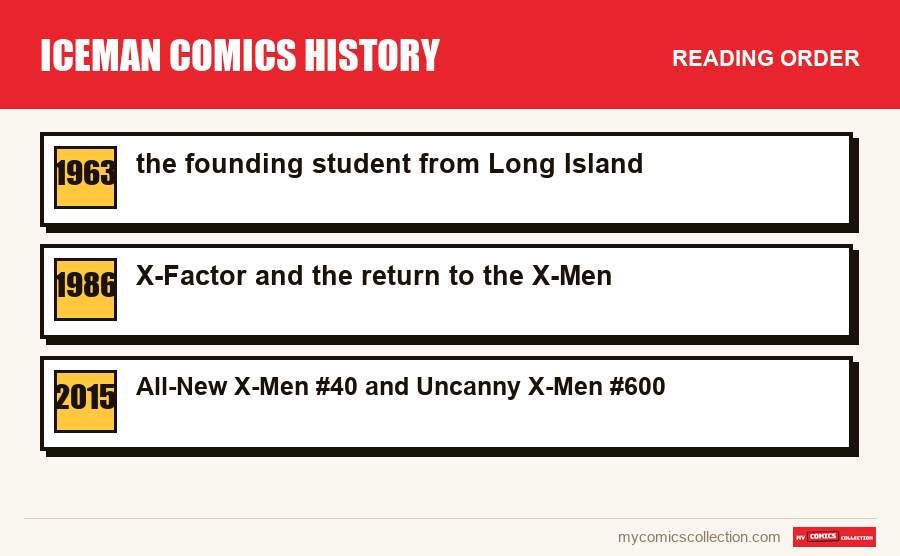
1963: the founding student from Long Island
Bobby is on the roster from the very start: Stan Lee scripts X-Men #1 (September 1963), and Jack Kirby draws it and co-plots. In the early story he is a teenager from Floral Park on Long Island whose powers first show when he freezes a local bully on a date. Scott Summers comes to take him to Xavier, Bobby refuses, the two fight briefly, and Professor Xavier steps between them. Lee later described Iceman as a copy of the Human Torch in an opposite way, a character built around cold rather than fire.
The earliest issues use him as a member of the team that battles the Brotherhood of Mutants in X-Men #4. In X-Men #8, cover-dated November 1964, he takes on an ice-covered form, a design choice that anticipates the version most readers know. For collectors, those early appearances matter less for Bobby than for the founding of the series, so a copy of #1 is usually shelved by its team debut and not as an Iceman issue.
1970 to 1975: reprints, guest spots and a departure
The original X-Men run covers issues #1 to #66, and the story ends with the battle against the Hulk in #66 (March 1970). Old stories fill issues #67 (December 1970) to #93 (April 1975), so for five years the title that introduced Bobby prints no new adventures of him at all.
Relaunch comes in May 1975 through Giant-Size X-Men #1, where Wein and Cockrum build a roster of mutants from several countries around Cyclops. Uncanny X-Men #94 (August 1975) is Chris Claremont's first issue as writer, and all the original X-Men except Cyclops leave the team. Bobby's own exit follows the capture of the original team by the living island Krakoa. The departure matters because it removes him from the series that would become Marvel's flagship for years.
1975 to 1978: the Champions
Tony Isabella writes and Don Heck pencils The Champions #1, which carries an October 1975 date. Its founding members are Angel, Iceman, Black Widow, Hercules and Ghost Rider, a team based in Los Angeles whose series runs for 17 issues, from October 1975 to January 1978. In Los Angeles Bobby studies at UCLA and fronts a group whose premise has little to do with a school for mutants. The team disbands in Peter Parker, the Spectacular Spider-Man #17 and #18 (1978).
For a collector the series is a side road. It is not a place to begin reading about Iceman, and its pacing is of its time, yet it takes Bobby out of Xavier's school and places him in a group of his own. It also gives him a life outside the X-Men: a college graduate who goes on to earn an accounting degree, which the finance-teaching story of the recent years echoes.
1980s: the Defenders and a first miniseries
After brief X-Men guest roles, including the rescue of Miss Locke from Arcade's henchman in Uncanny X-Men #145 and #146, Bobby returns to team life with the Defenders. He joins the team alongside Beast and Angel in The Defenders #122, #123 and #125, and he is then a member of The New Defenders, which runs from 1983 to 1986. The Defenders are an unusual fit for him, since the group was built around loners, and his role there shows a different Bobby, less of a student and more of an equal.
In 1984 and 1985 he receives a self-titled limited series, written by J. M. DeMatteis, who later called it a mistake. It is a short spotlight, and it begins a pattern of occasional solo attention without a permanent title that lasts for decades. Collectors who find this miniseries in a bin should treat it as a character piece rather than as a key issue.
1986: X-Factor and the return to the X-Men
Bobby is one of the five at the heart of X-Factor #1 (February 1986), together with Beast, Cyclops, Jean Grey and Angel. Bob Layton and Jackson Guice created this version of the group. Publicly, the five sell their services to clients as non-powered mutant hunters headquartered in TriBeCa, in downtown New York; in private, every mutant they locate is a recruit. In issue #6 Louise Simonson introduces Apocalypse, and Iceman meets him there for the first time.
The book gives Bobby more than the older team titles. A story involving Loki boosting his powers, with Thor rescuing him, runs through Thor #377 and #378. He wears a power-dampening belt until he gains control, and he dates Opal Tanaka in X-Factor #63 and #64. After the "Muir Island Saga," the original five rejoin the X-Men, and Bobby rejoins the main team in Uncanny X-Men #281 and in the new X-Men #1 (1991). This is the point where the four-way split of his career comes back together.
2000s: a second mutation and a second miniseries
Early in the 2000s, Andy Lanning and Dan Abnett write a second Iceman limited series, drawn by Karl Kerschl, whose four issues were collected as X-Men Icons: Iceman in 2001. A larger change comes in Uncanny X-Men #429 (August 2003), where an encounter with Azazel leaves Bobby's body shattered from the neck down. The Decimation event leads him to believe he has lost his powers, although he had suppressed them.
The decade includes several relationship stories, among them a relationship with Mystique that ends when she is revealed as a Marauder spy in X-Men #200 to #203, and a fight against the Children of the Vault in X-Men #188 (July 2006). Wolverine and the X-Men #2 returns to his off-and-on romance with Kitty Pryde. These issues add depth but do not change what Bobby is.
Do you collect this series?
Track what you own, what you are missing and what your collection is worth. 7-day trial.
Start my trial →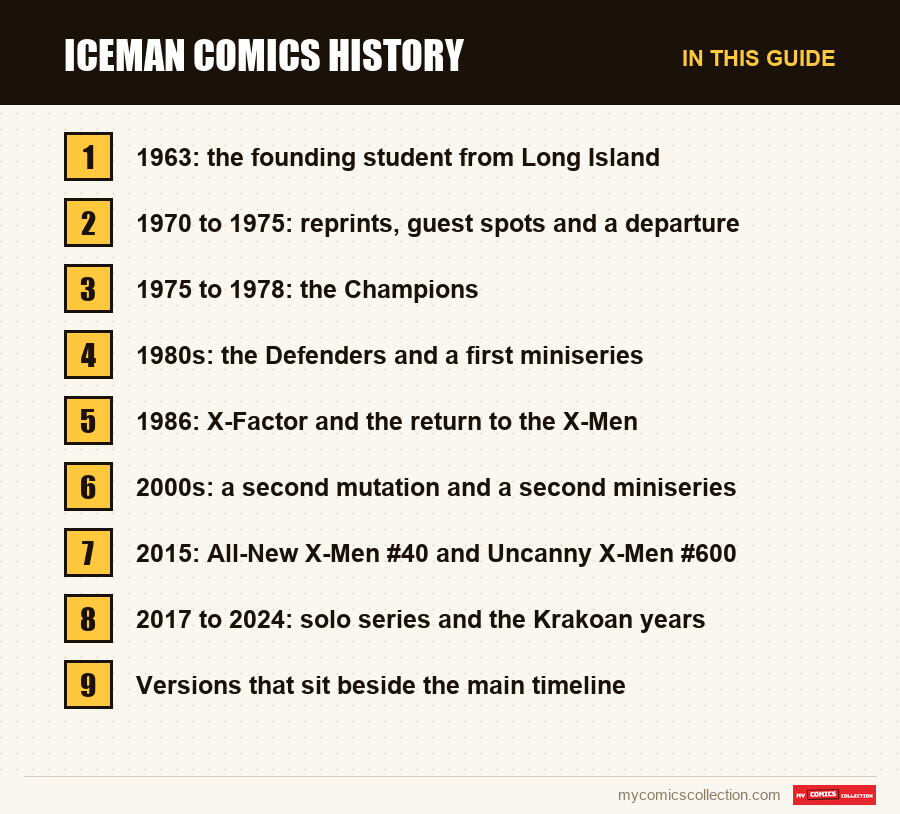
2015: All-New X-Men #40 and Uncanny X-Men #600
The turn that redefines him comes in All-New X-Men, where Brian Michael Bendis, with Stuart Immonen, has the five teenage originals pulled into the present. In All-New X-Men #40, cover-dated April 2015, Jean Grey reveals that the teenage Bobby is gay; Mahmud Asrar is credited as artist. A mind lock from Jean later returns the young Bobby to the closet, while the present-day Bobby retains both sets of memories and remains out.
That second step follows in Uncanny X-Men #600, published in November 2015, where the young Iceman confronts his older self, who admits that he is gay and that he had repressed it. The two-part sequence is what makes the character a lead: the younger and older versions mirror one another, and the story reads as a delayed answer to fifty years of a background teammate. Bobby later comes out to Anole in Extraordinary X-Men #6, which carries the thread into another team book.
2017 to 2024: solo series and the Krakoan years
Iceman volume 3 #1 (2017), written by Sina Grace with pencils by Alessandro Vitti, gives the character an ongoing solo series. The early issues deal with his father's heart attack (#1), a family dinner attacked by Purifiers (#2 and #3), his coming out to his parents (#4 and #5), a relationship with Judah (#6 to #8) and an attack by Daken that ends it (#10). Marvel cancelled the series, with the last issue in early 2018, then reversed the decision, and Grace wrote a new book in 2019 under the Fresh Start initiative. Iceman Vol. 1: Thawing Out collects #1 to #5.
In the Krakoan era, Bobby joins the island after Age of X-Man and the Marauders, has a casual relationship with Christian Frost, reconnects with Romeo, and is killed by Nimrod at the third Hellfire Gala; Romeo's powers restore him, and The Astonishing Iceman #1 covers that death and revival. Issues #1 to #5 are collected as Astonishing Iceman: Out Cold. After Krakoa leaves for the White Hot Room, Bobby stays on Earth and teaches finance at Avengers Academy as a guest instructor.
Versions that sit beside the main timeline
The time-displaced Iceman from All-New X-Men is the version that matters most, because the revelation depends on him. He later appears in X-Men Blue. Outside the mainline, the Age of Apocalypse Bobby is trained by Magneto and joins Archangel in Uncanny X-Force's "The Dark Angel Saga," where Nightcrawler kills him. In Ultimate Marvel's Ultimate X-Men, he runs away from his family during Sentinel attacks and becomes the youngest founding X-Man, dating Rogue and then Shadowcat.
Because each version sits in a different continuity, a cover that says "Iceman" is not enough to place an issue. Note the series and the line when you log a copy, so that a time-displaced or Ultimate appearance is not shelved among the mainline Bobby Drake issues.
The key issues across his history
- X-Men #1 (1963): the debut of Bobby Drake among the five founders, by Stan Lee and Jack Kirby.
- X-Men #8 (1964): he takes on the ice-covered form.
- The Champions #1 (1975): Tony Isabella and Don Heck launch the team with Iceman and Angel.
- The Defenders #125 (1983): Iceman is on the roster, alongside Beast and Angel.
- X-Factor #1 (1986): the original five X-Men reunite, with Bob Layton and Jackson Guice.
- Uncanny X-Men #429 (2003): after an encounter with Azazel, his body is shattered from the neck down.
- All-New X-Men #40 (2015): the teenage Bobby is revealed to be gay, by Brian Michael Bendis.
- Iceman #1 (2017): Sina Grace and Alessandro Vitti launch his ongoing series.
Following Iceman through a collection
Begin with All-New X-Men volume 1 (41 issues) and Grace's Iceman series, then go back to X-Factor for the team years. The Champions and Defenders runs are collector projects rather than entry points. Numbering is the trap: X-Men #67 through #93 are reprints, Iceman exists as two limited series and later ongoing volumes with different numbering, and The New Defenders follows The Defenders.
A workable method is to keep a shelf for the 1963 founding issues, one for the team books where he is a member, and one for the solo and Krakoa material. The Iceman reading guide and the X-Men history guide give the wider context for the groups around him.
Frequently asked questions
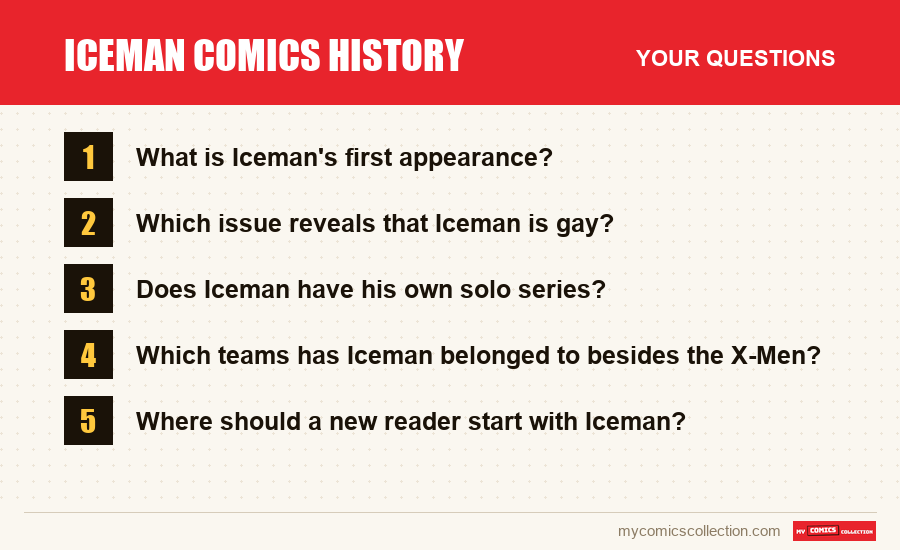
Go to the founding issue of the team's title, credited to Stan Lee and Jack Kirby. Bobby is one of five founding students at Professor Xavier's school, alongside Cyclops, Beast, Angel and Marvel Girl.
Brian Michael Bendis writes All-New X-Men #40 for April 2015, with Mahmud Asrar as artist, and that issue is the one for the time-displaced teenager. The adult Bobby follows in Uncanny X-Men #600 (November 2015), where he admits that he is gay and that he had repressed it.
Yes. Iceman volume 3 #1 (2017), written by Sina Grace with pencils by Alessandro Vitti, launched his ongoing series, preceded by limited series in 1984 to 1985 and in the early 2000s. In the Krakoan era he has The Astonishing Iceman, collected as Astonishing Iceman: Out Cold.
He was a founding member of the Champions of Los Angeles, whose series ran from 1975 to 1978, and a member of the Defenders and The New Defenders in the 1980s. He was also part of X-Factor's original lineup alongside Cyclops, Beast, Jean Grey and Angel from 1986, and he has a brief former membership in the Fantastic Four.
Start with All-New X-Men #40 and Sina Grace's Iceman, because they put Bobby at the center, and then read X-Factor #1 for the team years. The Champions and Defenders runs are collector reads, and the 1963 issues are founding-team comics more than Iceman stories.
Holding an early X-Men issue or a Champions #1? Get an estimate before you decide where it belongs on the shelf.
Estimate my comic