
When a character enters a group, the market treats that issue as a standalone event, separate from the first appearance. The current listing report for August 30, 2026, on a general auction site in the American market, shows that the sellers of Avengers #221 write the event in the very title of their ad: “She-Hulk Joins Avengers”, “She Hulk & Hawkeye Join the Team”, and yet charge between $3.59 and $4.99. These amounts are requested, not collected: these are announcements in progress, never concluded transactions. The motif is therefore recognized by the market vocabulary without being paid, which makes it the best identified and cheapest entry point for starting a collection around a character.
There is an implicit hierarchy of events in a booklet, and the beginning collector almost never discovers it in a guide: he discovers it in the wording of the announcements. The first appearance occupies the top, everyone knows that. Beneath that, there's a series of secondary events that the market has learned to name because they sell: the first cover, the first time a character puts on their final costume, death, return, and joining a team. This last motif is particular because it does not only concern the character: it also concerns the group, so it interests two audiences instead of one. This is probably why sellers write it so willingly.
The case noted here is that of Avengers #221, published by Marvel Comics in 1982, where She-Hulk joins the team. On August 30, 2026, I looked at what this number was displayed in the current advertisements of a general auction site oriented to the American market. The following figures therefore describe prices claimed on this date by sellers, at the time of the reading: not sales, not a time series, not a value. A single measurement, taken on a single day, cannot by construction show any movement: it photographs an intention to sell and nothing else. I specify this from the outset because the rest of the article is entirely based on this limit.
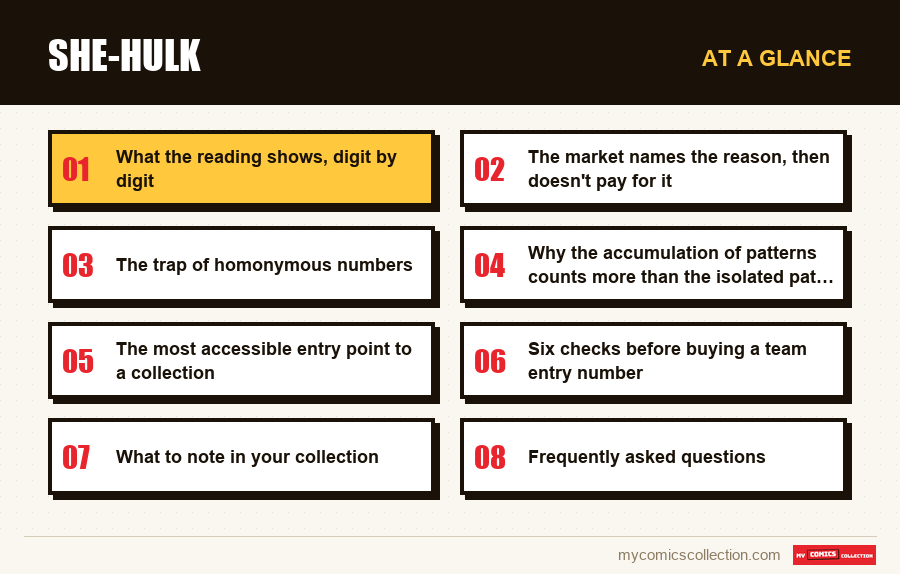
What the reading shows, digit by digit
The query “She-Hulk Avengers 221” returns 91 unverified advertisements, that is to say copies described by their seller without passing through a verification body. Of these 91 listings, the minimum claimed is $2.75, the median is $15.00, the maximum is $2,500.00. Besides, counted separately because they do not describe the same object, the verified copies represent only 6 advertisements: minimum $39.99, central value $205.00, maximum $524.99.
Six announcements is too little to say anything about a price level. A median calculated on six points changes entirely if two sellers modify their display during the day. I will therefore not draw any conclusions from the verified block beyond an observation of rarity: at that date, very few people offered this number in a verified form. This is information about supply, not value.
The gap between the median of unverified listings, $15.00, and their maximum, $2,500.00, deserves the same treatment. A ratio of more than one hundred and fifty between the center and the high end does not describe a range: it describes a heterogeneous whole in which an isolated announcement no longer has anything to do with the others. This maximum reflects what a seller hopes to get, one day, from someone. It says nothing about what the booklet costs for, and it should never be used as a reference for a buyer.
The market names the reason, then doesn't pay for it
The event is written in the title
The three cheapest ads that are actually for the correct booklet all mention joining the team: « Avengers #221 She-Hulk Joins Avengers [...] Newsstand 1982 » at $3.59, « Avengers #221 She Hulk & Hawkeye Join the Team [...] Newsstand VG/FN » at $4.49, « Avengers #221 (Marvel Comics 1982) She-Hulk Joins, Fine » at $4.99. Three independent sellers, three different formulations, the same idea put forward.
The price does not follow the promotion
These three listings range between $3.59 and $4.99, well below the $15.00 median from the same statement. A seller can therefore consider the event sufficiently selling to give it the main place in his title, and ask for less than five dollars. Naming and valuing are two distinct actions.
Two entries in the same issue
One of the three announcements indicates that two characters are joining the team in this issue, She-Hulk and Hawkeye. The seller who writes it is selling two designs for the price of one, and it's probably the best-written ad of the three: without it translating into a noticeable price difference with the others.
The distribution channel is indicated
Two out of three advertisements specify a particular distribution channel, the kiosk circuit. It is an attribute that the market has also learned to name, and which is superimposed here on the reason for joining the team without it being possible to disentangle, from these amounts, what each person brings.
You have to measure what that means for someone just starting out. A pattern that the market names is a pattern that can be searched for: all you have to do is type the words that the sellers use to find the item. A motive that the market does not pay for is an accessible motive. The combination of the two, identifiable and inexpensive, is exactly what you want as an entry point into a collection, and it's rare. Most identifiable benchmarks are expensive precisely because they are identifiable.
Be careful not to reverse the reasoning. The fact that three ads advertise the event between $3.59 and $4.99 does not prove that the booklet is “worth” four dollars. These are requests, on a date, on a single site, in states declared by the sellers themselves. A request with no takers can remain posted for months.
What the statement firmly establishes, on the other hand, is the vocabulary: the market has a stable formula to designate this event, and uses it spontaneously. It is this regularity of language, not the amounts, that makes the pattern usable for searching.
The trap of homonymous numbers
The two cheapest ads in the survey, at $2.75 and $3.14, do not relate to the booklet you are looking for at all. They concern an issue #221 of an entirely different title, "Spectacular Spider-Man #221 (1995)". The two advertisements also have identical wording, which suggests the same seller or the same source of copied description. They ended up in the query because a general search engine matches words, not identities.
The consequence is direct and applies well beyond this case: the lower limit of a survey rarely describes the object we are looking for. When we read “from $2.75”, the correct reflex is not to rejoice but to go and check what this ad contains. Here, two of the five cheapest ads, or forty percent of the top of the list, are talking about something else. A buyer in a hurry who would have clicked on the first would have received a booklet of another title, from another year, without any connection with the desired motif.
This collision is structural. Issue numbers are assigned series by series: the same number exists in hundreds of titles, and nothing in the number itself says which series it belongs to. Searching for “221” without naming the series is like searching for a page without naming the book. This is why any serious research must combine three elements: the exact title of the series, the number, and the year of publication. All three correct listings in the statement do this: two of them explicitly say 1982.
Why the accumulation of patterns counts more than the isolated pattern
The most useful observation from the survey isn't the price, it's the overlap. On the same booklet, three distinct attributes meet here: the entry of a character into a team, the entry of a second character into the same team, and a particular distribution channel reported by two out of three sellers. Each one taken alone claims a few dollars. It is their accumulation which gradually builds a sought-after booklet, never one of them in isolation.
This mechanism explains something that many beginners find illogical: two issues which apparently carry the same event can claim very different amounts. It's not the pattern that differs, it's the number of patterns stacked on the same object. A number which combines an entry into a team, a particular draw and a notable cover is not three times more expensive than a number which only has the entry: it changes category.
For a collector, this dictates an inventory method. It is not a question of noting “important number” but of noting quels attributes are present, one by one, on the copy you own. Two copies of the same issue can have different attributes: the distribution channel is the clearest example, since it concerns the physical circulation and not the content. An inventory that does not go down to the item level loses this information.
This also dictates a method of reading ads. When a seller piles up the mentions in his title, he is not necessarily filling in: he is listing the reasons he has identified. Comparing two ads then amounts to comparing two lists of attributes, which is much more informative than comparing two amounts. On the August 30 statement, the $4.49 ad mentions two team entries and a distribution channel; it is the richest description of the three, for an intermediate amount.
Collecting this series?
Track what you own, what you are missing and what your collection is worth. 7 day trial.
Start my trial →The most accessible entry point to a collection
Someone who wants to start a collection around a character almost always comes up against the same wall: the obvious benchmark, the first appearance, is also the most expensive, often out of reach. He is then advised to “start with what he likes”, which is kind but gives no concrete starting point. Joining a team provides this starting point, for three reasons.
The first is that it is dated and unique. A character joins a group in a specific issue, and this information is not discussed. The second is that it is named by the market, therefore findable: the words to type are those used by sellers. The third is that it costs a few dollars, as shown by the three advertisements noted. A beginner can therefore acquire an identified, documented and relatable benchmark for the price of a coffee: which is exactly what is needed to get started, because the first acquisition is mainly used to get started.
This reasoning extends beyond the present case. A character from a lineage (a derivative, a successor, a member of the same family of titles) inherits several possible groups over the course of its editorial career, therefore several entry numbers. Each is a potential access point. To locate these routes, the Hulk story in comics sheds light on the lineage from which She-Hulk comes, and the history of the Fantastic Four shows how the same character can be successively associated with several formations.
One caveat, though. A cheap entry point is still an entry point: it will not turn into a sought-after piece just because you bought it. The point of this type of acquisition is to build a coherent collection, with benchmarks that can be explained, not to build an investment. The August 30 reading does not allow any projections: a single measurement does not trace a trend, and I will not draw from it.
Six checks before buying a team entry number
The exact title of the series
The statement contains two advertisements with identical wording relating to a number 221 of another title. Read the name of the series before the number, always. A number alone does not identify anything.
L'année de publication
Two of the three good adverts write 1982, the intruder advert writes 1995. The year is the second filter, the one that removes the homonyms that the title was not enough to separate.
The distribution channel
Two out of three advertisements explicitly state this. Check that the mention corresponds to the photographed copy, and not just a phrase added to the title to attract searches.
The condition, seen in the photos
The listed listings display states declared by their sellers. A state abbreviation in a title is an opinion; photographs are the only thing you can examine for yourself before purchasing.
The size of the request
Only six advertisements verified in this statement: on such a workforce, no average means anything. Look at how many ads make up the number before giving it weight.
The actual content of the number
An announcement can state an event without the booklet containing it. The “joins the team” motif is verified in the story itself, and prior reading avoids purchasing a poorly described issue.
What to note in your collection
Write the reason in full, and for whom. Do not write down "key number" but "She-Hulk's entry into the Avengers team" and, on the same line, "Hawkeye's entry into the same team". The same booklet here has two separate entries, for two different characters: if your sheet only mentions one, you will lose the second the day you look for what you have on the other character.
Write down the exact series, not just the number. On this statement, a number 221 of an entirely different title, dated 1995, appears in the same request as the 1982 issue sought. Your card must bear the full title of the series and the year, otherwise your own inventory will become ambiguous as soon as you have two 221 numbers from different series: which happens quickly.
Record the distribution channel for your copy. Two out of three announcements report this, indicating that the market considers the information distinctive. It concerns the physical object you hold, not the story: two copies of the same issue may differ on this point. Note this on your copy instead of copying down what the ad said.
Describe the condition you see yourself. The listed listings carry conditions declared by their sellers, and nothing obliges a buyer to take them back. Once the booklet is in your hands, note what you see: the appearance of the spine, the holding of the staples, the folds of the cover. It is this observation that will serve you in ten years, not the abbreviation of an unknown person.
Record the price paid, including shipping. The statement amounts are claimed, never cashed; the only verified figure you will have is the one you paid for yourself. Add shipping costs, which can exceed the price of the booklet by amounts of three to five dollars, and date the line: this is how the only reliable history of your collection is constructed, copy by copy.
Frequently asked questions
The questions that come up most often relate to the distinction between first appearance and entry into a team, to the reliability of the figures recorded, and to how to search without making the wrong series.
No, these are two separate events that occur in two different issues. The first appearance is when the character first exists; joining a team is the moment when he joins an already formed formation. The market names them separately and does not treat them the same way.
Because they come from current announcements noted on August 30, 2026, that is to say from amounts that sellers were asking at that time. An ad can remain displayed indefinitely without finding a buyer. None of these amounts therefore corresponds to a concluded transaction, and the statement says nothing about what the fascicle actually exchanges for.
Nothing, or almost. Faced with a median of $15.00 on the same set, a maximum of $2,500.00 is an isolated value in a heterogeneous set. It reflects the hope of a seller, not a price level. A buyer using this as a benchmark would be wrong by a considerable factor.
Not to deduce a price level. Six announcements constitute too small a number: removing or adding just one of them shifts the central value significantly. This figure provides information above all on the scarcity of the offer verified on this date, which is information on the market and not on the value.
By requiring three matching pieces of information in the ad: the full title of the series, the number, the year of publication. The statement contains two advertisements with identical wording relating to a number 221 of a different title, dated 1995: only the addition of the title and the year allows them to be separated at a glance.
Keep track of each design, copy by copy
A booklet accumulates attributes: entry into a team, distribution channel, condition noted, price paid. My Comics Collection allows you to record each of them at the copy level, and instantly find what you have on a given character.