Of the thirty-seven advertisements noted on August 30, 2026 for “Miss Hulk Marvel”, only one says what the item sold contains: “album 3 = volumes 6 + 7”. This mention transforms an anonymous carton into an identifiable, countable, verifiable object. The other thirty-six keep the buyer guessing. The amounts cited here: from €3.90 to €39.90, median at €12.00: are sums requested by French sellers in euros that day, not completed transactions, and none of these copies were accompanied by verification by an independent body.
The French market for American comics is based on a practice that the original market ignores: grouping. A French publisher takes several issues published separately across the Atlantic, binds them under a single cover, gives them an album number which has nothing to do with the original numbering, and puts the whole thing on sale. The resulting object is perfectly legitimate, often solid, sometimes more pleasant to read than a pile of fragile booklets. But it suffers from a structural defect: its number says nothing about its content. Album 3 can contain two issues, three, four. It can start at the sixth issue of the series or at the tenth. Nothing on the edge indicates this.
This is what makes the announcement at €5.00 noted on August 30, 2026 remarkable: « MARVEL ARTIMA color, Miss Hulk, album 3 = tomes 6 + 7: état correct ». The seller made the gesture that almost no one does. He opened the object, looked at what was inside, and wrote it down. This gesture costs nothing and it changes everything, because it allows the buyer to know what they are buying and, above all, what they will have to look for next. This article starts from this isolated announcement to show what, in concrete terms, a declared composition is worth, and what we lose when it is missing.
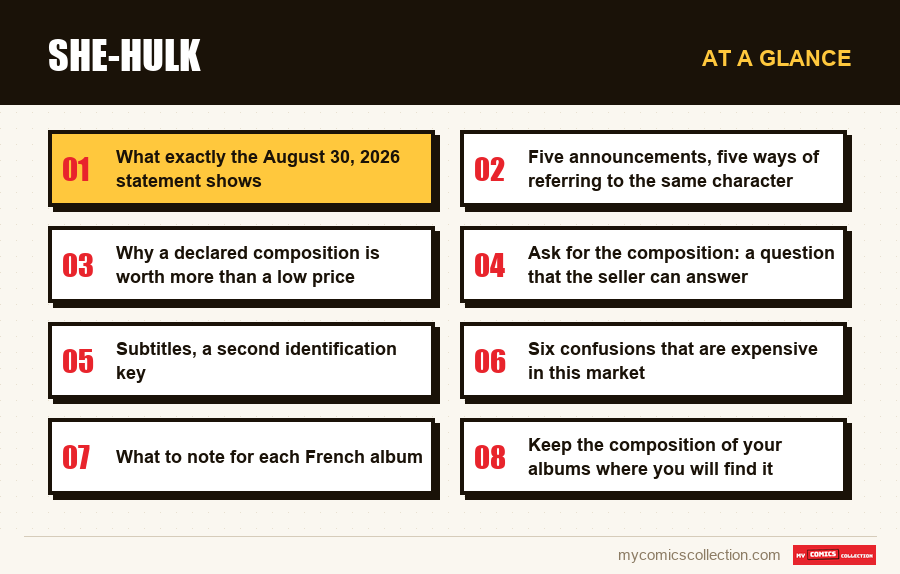
What exactly the August 30, 2026 statement shows
Indispensable methodological precision before any reading of the figures: unlike the statements usually published here, which relate to the American market and are expressed in dollars, this one was carried out on the French market and the amounts are in euros. The query "Miss Hulk Marvel" returned thirty-seven active listings on August 30, 2026. The lowest asking price was €3.90, the highest was €39.90, and the midpoint was €12.00. These three values only describe what sellers were hoping to get that day. None correspond to an amount actually paid by a buyer. An ad can stay online for months without finding a buyer, or disappear in an hour after negotiation: the statement says neither. It photographs an intention of sale, nothing more.
Another precaution: a single reading, taken on a single date, cannot by construction show any movement. Comparing €3.90 and €39.90 does not describe an increase or a decrease, only the difference between the cheapest and most expensive ad at the same time. The maximum, in particular, is worth reading for what it is: a single seller's estimate for a single item, for which there is no guarantee that it will find a buyer. The median at €12.00 is the strongest indication of the lot, because it withstands the extremes on both sides, but it remains a median of requests, not sales.
The fact with the greatest consequences, however, is not a price. Of these thirty-seven advertisements, none concerned a copy whose condition had been noted and sealed by an independent verification body. Zero out of thirty-seven. In a market where verification is widespread, the buyer has an external judgment: someone has opened, examined, noted, and committed his signature. There is nothing like that here. All available information comes from the seller himself, in the text of his ad and in the photos he has chosen to publish. The quality of this description is therefore not an approval: it is all of what the buyer can rely on.
Five announcements, five ways of referring to the same character
The five advertisements noted in detail do not describe comparable objects at all, even though they all respond to the same query. Reading them side by side is enough to understand why a search by name, without further discernment, leads nowhere.
The album which declares its composition: €5.00
“MARVEL ARTIMA color, Miss Hulk, album 3 = volumes 6 + 7: correct condition”. The seller gives the complete equation: this box is numbered 3 but contains issues 6 and 7. The buyer therefore knows exactly what is in his collection and which numbers remain to be found. This is the only announcement of the lot that allows this reasoning.
The magazine which is not a series: €3.90
“Nova Feb 1993 n°181 Marvel Comics Fantastic Miss Hulk Peter Parker”. This number 181 dated February 1993 does not belong to any series of the character: it is a periodical which hosts three different series in the same issue. Number 181 is that of the review, never that of an episode. Confusing it with a serial number distorts all counting.
Booklets with subtitles: €4.00 and €5.00
“MISS HULK No. 2 COUNTERSATTACK COMIC EO ARTIMA Color MARVEL 1981” and “MISS HULK No. 7 - ALONE AGAINST ALL: ARTIMA MARVEL COLOR”. Each one has, in addition to its number, its own title. These subtitles function as episode names and give a second take on the subject, independent of the number.
The general collection volume: €6.90
“MARVEL COMICS THE BEST OF SUPER HEROS: MISS HULK VOLUME NUMBER 51”. The number 51 designates the volume's rank in a collection that covers many characters, not the fifty-first episode devoted to it. Storing this volume under a serial number would produce a false entry in any inventory.
Four numbering regimes therefore coexist in the same list of results: the bound album number, the host journal number, the simple issue number and the rank in a thematic collection. A buyer in a hurry will treat them as equivalents and end up with a collection whose entries mean nothing. The common point of the four regimes is that the figure displayed on the cover is never enough, alone, to identify what it designates. The case of the February 1993 review shows this well: it brings together under the same number stories from distinct editorial groups, and disentangling what it contains requires knowing where these series come from -Hulk editorial history on one side, that of the Fantastic Four on the other.
The character appears in France under a name different from his reference name. All the advertisements noted refer to it by this local name. Searching only for the original name does not bring up these thirty-seven ads: it makes them invisible.
Practical consequence: on this market, the query must be formulated with the publication name used by the sellers, even if it means adding a second search under the reference name. The two sets do not overlap.
Why a declared composition is worth more than a low price
Let's take the €5.00 album and assume that it has no mention of content. The buyer pays a modest sum, receives a box, opens it, discovers two booklets. He has just learned what he has: after payment, after delivery, without having had a choice. If he already had one of the two, he paid a duplicate without knowing it. If he was missing precisely one of the two, he found it by luck. In both cases, the information arrived too late to be of any use.
The mention “album 3 = volumes 6 + 7” moves this information before the purchase. It allows you to answer three questions in order: do I already have this content, does this content fill an identified gap, and what is the unit price per issue for the five euros requested. An album that brings together two issues at €5.00 cannot be compared in the same way to a single issue at €4.00. The declared composition is therefore the factor which makes the prices comparable to each other; without it, comparing one ad to another amounts to comparing objects whose content we do not know.
It has a second virtue, less visible. It makes the object verifiable. A buyer who receives an album advertised as containing issues 6 and 7 can immediately see if the promise is kept. A buyer who receives “album 3” cannot see anything at all: there was no promise to compare. On a market where, as we have seen, not a single copy benefits from an outside opinion, this possibility of control has its own value, independent of the price. The seller who declares the composition runs the risk of being contradicted, and that is exactly what makes his word useful.
Finally, we must remember the proportion: one announcement in five, in the statement, specifies the composition of the album. The other four say nothing about it. Good practice therefore exists, it is simply a minority, which means that it will not be obtained by waiting for it to become generalized but by asking for it, announcement by announcement.
Ask for the composition: a question that the seller can answer
The gesture consists of a sentence sent before purchase: exactly what numbers does this album contain, from the first to the last. This question has a rare property in exchanges between buyer and seller: it requires no skill, no estimate, no judgment. The seller does not have to evaluate a condition, date a print or comment on rarity. All he has to do is open the object he has at hand and copy down what he reads there. A bona fide seller responds within two minutes.
It is also a question whose lack of answer is instructive. A seller who cannot or does not want to say what the album he is offering contains indicates, without meaning to, that he has not opened it or that he is selling without looking. The buyer does not find this proof of dishonesty, many occasional sellers empty an attic without knowing anything about the subject, but he learns that the description is not based on any examination. In a market without external verification, this is useful information in itself.
The answer obtained, however, is only valid if it is kept. A composition communicated in a private message disappears with the message. Recorded in an inventory, it is used indefinitely: it allows us to know, two years later, why a given number appears as possessed when no issue with that number is on the shelf. Copying the equation received when it arrives is the only way to avoid having to ask for it again. This is also what distinguishes a documented collection from a pile of objects.
Collecting this series?
Track what you own, what you are missing and what your collection is worth. 7 day trial.
Start my trial →Subtitles, a second identification key
Two booklets in the survey bear, in addition to their number, a title of their own: “COUNTER-ATTACK” for number 2, “ALONE AGAINST ALL” for number 7. This editorial practice is not anecdotal for those seeking to identify an object. It offers an additional hold, which does not depend on the number.
The utility appears in degraded cases, which are frequent. A worn cover can lose its number without losing its title, printed elsewhere and often in larger print. A seller who knows nothing about the subject will be more likely to copy a legible title than a small number in the corner. A tightly framed photo may cut off the number and leave the title whole. In these situations, the title becomes the only entry point, and a search based on this text brings up ads that a search by number never finds.
The reasoning also turns around: two advertisements which display the same number but different titles do not describe the same object, and one of the two is wrong somewhere. The subtitle then serves as arbiter. It has no value in itself, but it gives a second measurement where the number alone gave only one, and two concordant measurements are much better than just one.
The practical consequence is twofold. On the search side, it is worth trying the headings known as stand-alone queries. In terms of inventory, it is worth noting the title at the same time as the number, precisely because it will sometimes survive the disappearance of the latter. This double key (a number, a title) is the best tool available when faced with an object whose identity no one has certified.
Six confusions that are expensive in this market
Search under wrong name
The character appears in France under a name distinct from its reference name, and this is the one that sellers use. A request formulated with the original name alone does not bring up the thirty-seven advertisements in the statement. We must question both forms.
Take a request for a sale
The amounts recorded on August 30, 2026 are those that sellers displayed, not those that buyers paid. An ad for €39.90 proves that a seller is hoping for this amount, never that someone has paid it.
Believing in a price movement
A reading taken on a single date contains no temporal information. The gap between €3.90 and €39.90 describes the dispersion of demands at a given time, not an progression or a decline.
Buy an album without its composition
Four out of five album announcements do not say which issues they contain. Purchasing under these conditions amounts to discovering your purchase after receipt, with a risk of duplication that no available information could rule out.
Mélanger quatre numérotations
Bound album number, magazine number hosting three series, simple fascicle number, rank in a general collection: four systems which produce figures with identical appearance and incompatible meaning.
Attendre un avis extérieur
None of the thirty-seven advertisements concerned a copy examined by an independent organization. In this segment, the seller's description is not additional information: it is the only information.
What to note for each French album
The composition, number by number. For each bound album, write down the complete equation: what album number, what issues inside, from the first to the last. “Album 3 = volumes 6 + 7” is copied as is. This is the only line that will allow you to know later if you are still missing an issue or if it was already lying dormant in a box, and it is the one that no photo of the spine will replace.
The subtitle of each issue. Note the proper title next to the number each time it exists: “COUNTERATTACK” for number 2, “ALONE AGAINST ALL” for number 7. This second key will allow you to identify a copy whose number is illegible, cut off by framing or simply omitted by a seller who does not know the subject.
The name under which the object appeared in France. Record the correct name on the cover, separate from the international reference name. It is she who will make your future searches productive, she who will help you find your own file in an inventory that has become voluminous, and she who will explain to a potential buyer what it is about.
The publisher and year of publication. Record the French publishing house and the printed year - 1981 for one of the issues noted, February 1993 for the magazine. This couple distinguishes two objects which would bear the same number in two different editions, and they situate the copy in a precise editorial policy rather than in a vague “old”.
The price actually paid, including shipping. Note what the item cost you when it arrived, including shipping, not the price shown in the ad. In a segment where the amounts requested range from €3.90 to €39.90, shipping represents a variable and sometimes decisive part of the total. This is the only price data of which you are certain, since all the others are sellers' expectations.
Because it concerns the French market and not the American market. The bound albums in question here are a French editorial specificity: they do not exist in this form elsewhere, and they are sold in euros between French sellers and buyers. Converting these amounts into dollars would make no sense, since they would not compare to anything.
You do not draw a conclusion about its honesty, but you know that its description is not based on any examination of the object. It's up to you to decide whether the amount requested justifies this risk. On an ad for a few euros, many buyers accept uncertainty; beyond that, the lack of response is sufficient reason to move on to the next announcement.
No. This amount is the sum that a single seller hoped to obtain for a single item on August 30, 2026. Nothing in the statement indicates that a buyer accepted it, or even that the ad found a buyer. An isolated maximum describes an expectation, not a market level.
Never. The reviewed review bears the number 181 and contains three different series in the same issue: this 181 belongs to the periodical, not to one of the stories it hosts. Saving such an object as "number 181" in a series creates an entry that matches nothing and distorts any subsequent counting.
This is first of all a characteristic of the segment: on objects whose asking prices are around twelve euros, having a copy examined by an independent organization would cost more than the object itself. So this is not a negative signal about the merchandise, but it does mean that the ad text and photos are all that the buyer can examine before paying.
Keep the composition of your albums where you will find it
An equation “album 3 = volumes 6 + 7” obtained from a seller is of no use if it remains in an inbox. My Comics Collection allows you to link each issue to the album that contains it, to keep the subtitles and the French publication name next to the number, and to know at a glance what you are really missing before going back to search.