On the statement of August 30, 2026 devoted to Sensational She-Hulk (1989), the cheapest ad of the whole set, posted at $1.00, is precisely the one that highlights a first appearance: “Sensational She-Hulk #4 (1989) 1st Blonde Phantom”. The 152 unverified listings range from $1.00 to $174.99, with a median of $16.97; the 30 verified copy listings, counted separately, range from $35.95 to $199.99 around a central value of $69.95. All of these amounts are prices asked by sellers on a single date, not completed transactions. The lesson is in one sentence: the term “first appearance” describes an accurate editorial fact and promises absolutely no value.
There are few phrases as effective in the collector's vocabulary as “first appearance”. It serves as an argument on the market, as a justification for a high price, as a reason to buy a booklet that you would not have opened otherwise. And yet, when we look at an ad statement without any preconceived idea, this formula appears where we don't expect it: at the very bottom, on the cheapest copy of the lot. The survey carried out on August 30, 2026 on the query “She-Hulk Sensational She-Hulk 1 1989”, on a general auction site on the American market, provides as clear a case as one could hope for.
Of the 152 unverified listings counted that day, the floor is at $1.00. This dollar is not placed on an anonymous number, on a damaged copy that no one wants, or on a mismatched lot: it is placed on a booklet whose title explicitly announces a first appearance. “Sensational She-Hulk #4 (1989) 1st Blonde Phantom.” The seller doesn't cheat, doesn't hide anything, and doesn't get anything either. It is this discrepancy that deserves to be understood, because it determines the way in which we must read a sales catalog and, above all, the way in which we must keep the inventory of our own collection.
What exactly the August 30, 2026 statement shows
Before drawing anything from it, it is necessary to say precisely what these figures are made of. These are announcements in progress at a given time, on a single general auction site, oriented towards the American market. Each amount is what a seller hopes to get. None correspond to an amount actually collected. The difference is not cosmetic: an asking price can remain displayed for months without finding a buyer, while a transaction price binds two parties. What we are measuring here is therefore the condition of a display, not that of a checkout.
Second clarification: the measurement is punctual. A single date, a single passage. No comparison with a previous reading is available, so no conclusions about an increase, a decrease or stability can be made. Writing “this stock is going up” or “this stock is falling” from a snapshot would be like describing a trajectory by having only seen one point. We prohibit this shortcut, and you should prohibit it too when you consult a statement of this type.
Third clarification: copies verified by an external organization are counted separately, and for good reasons. They are not sold under the same conditions, are not aimed at the same buyer, and include in their price the cost of the verification service itself. Mixing them with the raw papers would produce an average that describes nothing real. Here, these verified copies are 30: from $35.95 to $199.99, with $69.95 in the middle. Thirty listings is not an insignificant sample, but it's not a deep market either; we read this range as an indication, not as a reference.
The main block remains: 152 unverified ads, from $1.00 to $174.99, median $16.97. This is where most of what interests us happens, because it is there that we find both the dollar booklet and the most revealing range.
Four lessons that this survey allows us to draw
An exact mention is not a price argument
The $1.00 ad is true: it signals a first appearance, and nothing in its wording is misleading. It simply demonstrates that the accuracy of information and its commercial significance are two independent things. An editorial fact remains an editorial fact even when no one wants it.
A low ceiling is information in itself
The unverified maximum stops at $174.99. In other words, even the most ambitious sellers in the set remain in a narrow zone. When the peak of the hopes displayed remains close to the body of the market, it is a sign of a group without active speculation.
The bottom of the fork is crowded
Below $5 we find several announcements: $1.00, $2.39, $3.00, and two at $4.00. A populated floor, and not an isolated accident, indicates that these numbers are circulating in numbers and that nothing is artificially holding them at the top.
Two publications look similar in the same list
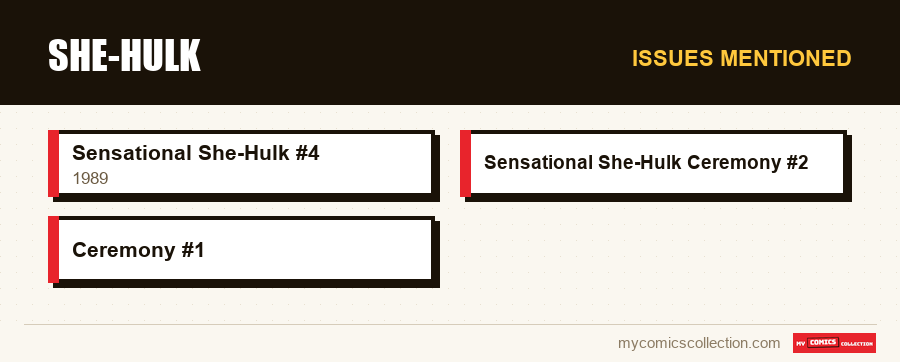
Low profile ads include "Sensational She-Hulk Ceremony #2" and "Sensational She-Hulk in Ceremony #1." They take the name of the main series but bear their own subtitle and their own numbering: they are distinct objects, which a raw survey mixes up without warning.
Taken together, these four observations paint a market that is readable and without mystery. The body of the ads stands around $16.97, the low goes down to the token price, the high stops well short of the levels that trigger the attention of opportunistic buyers. Nothing suggests a supply tension, an announcement effect, or an accumulation movement. This is a set where the difference between two copies of the same issue is largely explained by their condition and by the quality of the presentation of the ad, and not by a race between buyers.
The distinction to remember: “first appearance” is a catalog information, not one market information. The first describes what a fascicle contains; the second describes what buyers are willing to do to obtain it. They can coincide, but nothing obliges them to do so.
What makes a first appearance valuable, when it has one, is not the event itself: it is what the character subsequently became. Without follow-up, without reappearances, without demand built over time, all that remains is an exact line in a database and a one-dollar booklet.
Six reading pitfalls that this survey highlights
Confusing the ad and the sale
The 152 amounts recorded are requests, never collections. Reading a median of $16.97 as “what these issues are worth” is to confuse the label with the receipt. The correct wording is: this is what sellers were asking for that day.
Read a trend in a single point
A statement dated August 30, 2026 says nothing about what it was a month earlier. Without a second measurement point, no direction is observable. Any sentence containing “rising” or “declining” would here be a pure extrapolation.
Take as much as possible for a reference
The high $174.99 of the unverified range describes a seller's hope, not a level reached. An isolated maximum reads like a display terminal. It becomes interesting above all because of what it reveals here: its modesty.
Mix Verified and Unverified
The 30 verified copy listings, from $35.95 to $199.99, form a subset of their own. Merging them into the other 152 would create a hybrid range that would not correspond to any real purchasing situation.
Believing that a number 1 is unique
The statement contains two numbers 1 and two numbers 2, because a publication with its own subtitle coexists with the main series under a similar name. Looking for “#1” without further qualification amounts to designating two objects at once.
Treat “1st” as a label of value
The $1.00 booklet is marked and remains on the floor. The mention identifies content; it does not certify scarcity, demand, or liquidity. It deserves to be recorded as descriptive data, never as an estimate.
Why two publications with similar names confuse the statement
The detail seems trivial and it is not. Two of the lower listings in the statement: "Sensational She-Hulk Ceremony #2 [...] 1st Print 1989 Unread NM" at $2.39 and "Sensational She-Hulk in Ceremony #1 [...] 1989 FN/VF" at $4.00: designate a separate publication, which uses the name of the main series but has its own subtitle and numbering. In a list sorted by price, nothing indicates this difference: the titles are similar, the year is the same, and the eye slips.
The practical consequence is immediate. A buyer looking for the first issue of the main series may find themselves faced with a first issue of another item, perfectly legitimate, correctly described, and yet unrelated to what they were aiming for. A collector who enters “#1” in his inventory without specifying which of the two publications he owns is preparing a phantom duplicate and a missing box that he will never fill, due to not knowing what he is looking for.
This situation is not exceptional. As soon as a title has variations (mini-series, limited series, publications with its own subtitle) several numberings coexist under the same commercial banner. The catalog distinguishes them correctly, because that is its job; the announcements mainly focus on what catches the eye, that is to say the name of the series. These are two different logics, and the gap between the two is always paid for on the buyer's side.
The solution is simple and depends on the discipline of entry. We never record a single issue: we record an identified publication, a numbering, a year, and if necessary the exact subtitle. An inventory with two “#1” lines without a qualifier is an inventory that has already lost the most useful information. To build a coherent progression through these variations, a organized reading route often helps more than a hunt for isolated numbers.
Collecting this series?
Track what you own, what you are missing and what your collection is worth. 7 day trial.
Start my trial →What the price distribution says about the level of demand
The shape of a fork says something that its extremes alone do not say. Here, a floor at $1.00, a median at $16.97, a ceiling at $174.99: most of the announcements are concentrated in a low band, and the distance to the top remains moderate. Compare mentally with a set where the top would be counted in thousands while the median would remain under twenty dollars: this gap would indicate that one or two issues concentrate attention while the rest of the title follows without interest. This is not the observed configuration.
A low ceiling, on the contrary, signals a market where no one is trying their luck very far above the group. The most optimistic sellers stay in the vicinity of others, which generally indicates that they know that going higher would not help. In this type of set, the variation from one copy to another is explained by ordinary factors: conservation, the presence or absence of a visible defect, the quality of the photographs, the reputation of the seller, shipping costs.
The verified subset confirms this reading without contradicting it. From $35.95 to $199.99 with $69.95 in the center, it is significantly above the raw block, which is expected: verification has a cost, it is aimed at a buyer who is looking for a condition guarantee, and it mechanically reduces the number of copies concerned. But its summit itself remains contained. Neither block shows the characteristic dropout of titles under tension.
This observation is in no way derogatory to the title or to the character. He describes an abundant supply and calm demand, an extremely common situation for series from 1989 and around, which were printed in quantity and many copies of which were carefully preserved from the start. A market without speculation is also a market where you can buy peacefully, without fear of paying an agitation premium.
What to note in your collection
Name the character, never the formula. An inventory line that says “first appearance” without saying who is an unusable line. At the time of entry, the information seems obvious; six months later, it is no longer so at all. Write the name: in the case of the $1.00 booklet noted here, “Blonde Phantom”, and you get a piece of data that remains true, verifiable and sortable. The formula alone, repeated over twenty lines, transforms your inventory into a wall of interchangeable information.
Distinguish the main series from the publication with its own subtitle. Since two numbers 1 and two numbers 2 coexist in the same statement, your inventory must explicitly decide. Add the exact subtitle in the title field, or create two separate entries. Without this, you will never know if your box "#2" corresponds to the $4.00 issue marked VF-7.5 of the main series or the $2.39 issue of the other publication.
Date your amounts and specify their nature. If you are recording an order of magnitude, note “requested, August 30, 2026” and not “value”. They are two different fields in your head and they should be different on paper. A median of $16.97 taken on a Sunday in August does not become an estimate again because time has passed; on the contrary, it becomes obsolete data whose age you must know to decide if it is still useful.
Save the verified state separately. A copy verified by an external organization and a raw copy do not occupy the same position in the market: from $35.95 to $199.99 on one side, from $1.00 on the other. Your inventory must reflect this separation by a dedicated field, otherwise your own internal comparisons will mix two populations and produce orders of magnitude that do not correspond to any purchasing reality.
Report status with the same accuracy as announcements. The statement contains mentions such as “VF/NM”, “FN/VF”, “Grade VF- 7.5”, “1st Print”, “Unread NM”. These qualifiers explain a large part of the differences observed in a market without speculation. If your own listings are limited to "good condition", you are losing the very information that helps you understand why one item sells for $3.00 and another much higher.
Neither. The title "Sensational She-Hulk #4 (1989) 1st Blonde Phantom" states an accurate editorial fact, and the asking price is consistent with the entire low end of the statement, where we also find listings at $2.39, $3.00, and $4.00. The seller correctly describes what he is offering and positions it at the level where this type of booklet circulates.
No, and that's important. The reading dates from August 30, 2026 and constitutes a single measurement point. Without a comparable previous survey, carried out under the same conditions, no evolution is observable. All we can say is the state of the display that day: 152 unverified listings between $1.00 and $174.99, median $16.97.
Because they are a different population. Their price includes the cost of the verification service, they are aimed at a buyer who is looking for a guarantee on the condition, and they are much fewer in number: 30 advertisements compared to 152. Merging them would produce an average range describing no concrete purchasing situation, neither that of the raw issue nor that of the verified copy.
By checking the subtitle before purchasing. The statement contains a publication bearing the name of the main series with its own subtitle and independent numbering, which makes two numbers 1 and two numbers 2 coexist. Read the full title of the announcement, not just the number, and note this subtitle in your inventory at the time of receipt.
It is above all a readable sign. A ceiling close to the body of the advertisements indicates a set without speculation, where the differences between copies are explained by the condition and presentation rather than by competition between buyers. Let us remember, however, that a maximum remains a seller's hope: it limits the display, it does not constitute a level reached.
An inventory that names, rather than an inventory that labels
Main series and publications with their own subtitle, raw copies and verified copies, mentions of first appearance attached to the right character: My Comics Collection allows you to keep each of these distinctions in a clear file, instead of losing them in an open field.