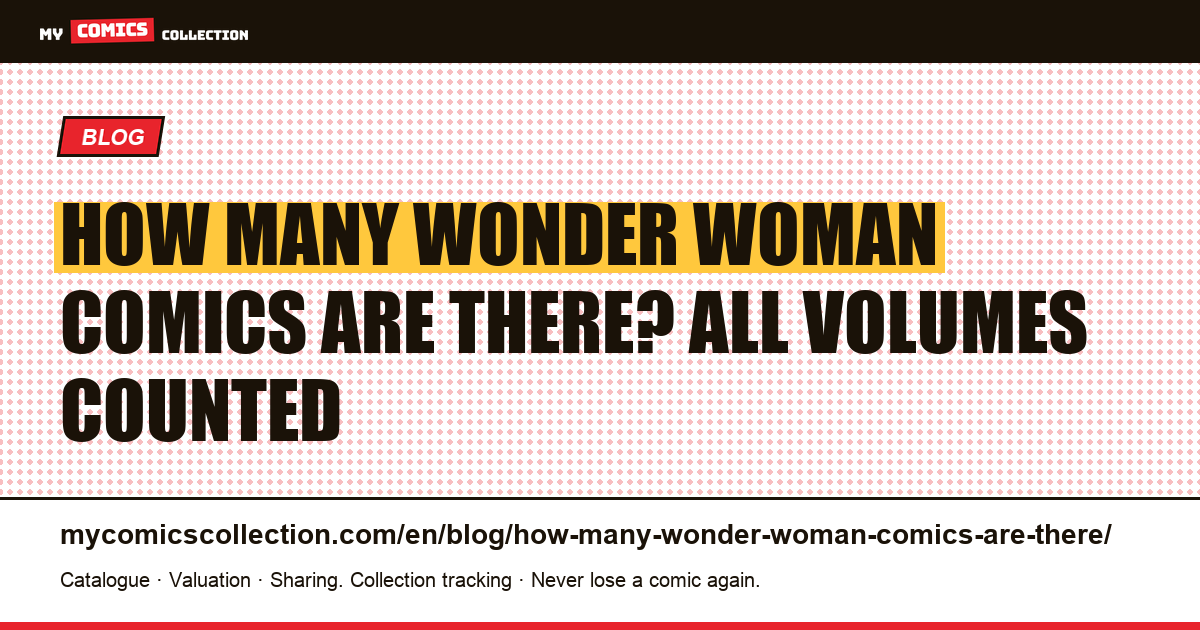
How many Wonder Woman comics are there? Wonder Woman has seven main series since 1942. The longest is the 1942 series, issues #1 to #329, running until 1986. Today's legacy numbering then chains the 1987, 2006, 2011 and 2016 series onto the 1942 run: #750 arrives in 2020, the chain reaches #800 in 2023, and then the series restarts at #1 in September 2023. The #0 and #1,000,000 issues, the decimal issues and Diana's annuals are not included in these totals.
Asking how many issues Wonder Woman has means running into a series that has changed its counter many times, went back to an older number midway, and ended up merging its earlier lives into a single run. A "#600" from 2010 does not belong to the same story as a "#750" from 2020, so you have to reason series by series, with the boundaries of each.
As always in this guide, only verified information (creators, issue numbers, dates) is stated as fact; the analysis is our own, with no reproduction of protected art or dialogue.
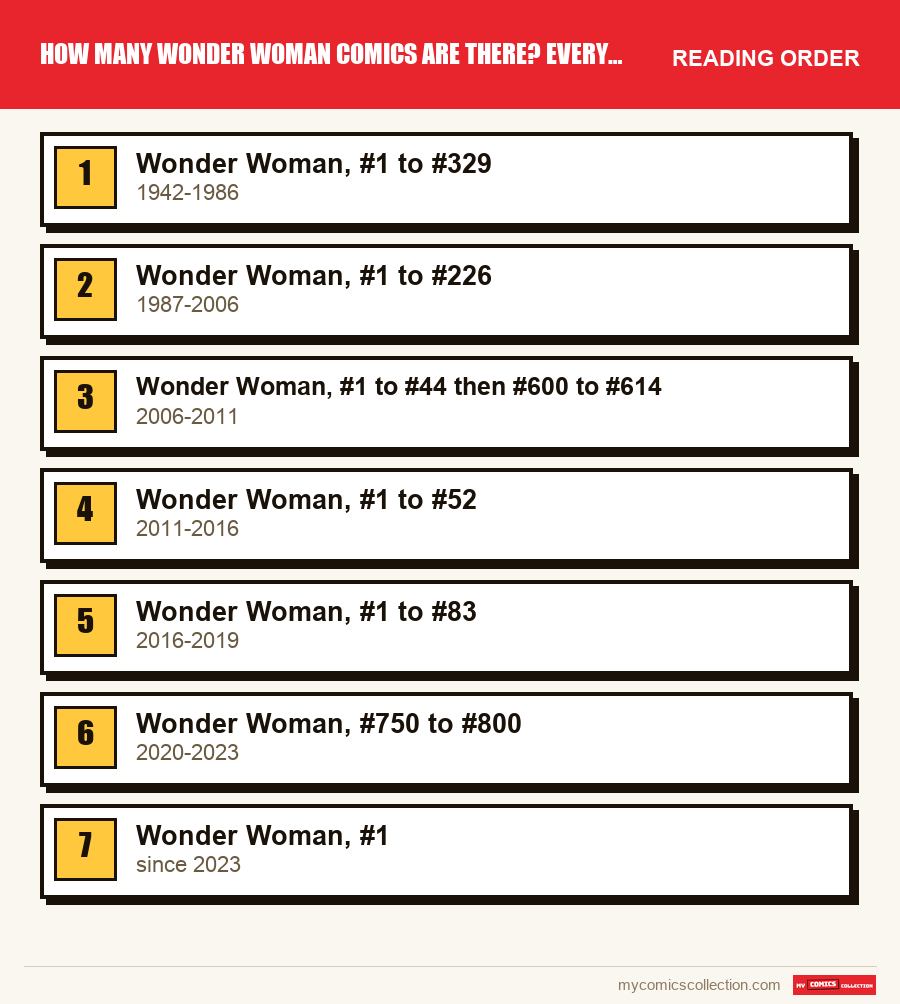
Series 1: Wonder Woman, #1 to #329 (1942-1986)
Before her own series, Diana appears in All Star Comics #8, dated December 1941: that first appearance in another magazine predates the counter and does not count toward the boundaries of the series. William Moulton Marston and Harry G. Peter created her, and Peter drew the first ninety-seven issues of Wonder Woman, whose #1 is dated summer 1942. The series ends with #329 in February 1986.
This long run of three hundred twenty-nine issues passes through many hands: Robert Kanigher writes a very large number of issues, Ross Andru, Mike Sekowsky and Don Heck are among the artists, and then Dennis O'Neil, Gerry Conway, Roy Thomas, Dan Mishkin and Paul Levitz take turns on the scripts. Gene Colan draws issues 288 to 305, eighteen consecutive issues in a series of more than three hundred. The so-called "new" period of 1968 stays within this same numbering, with no return to #1: for a collector, it does not create a separate series.
For value benchmarks from this period, our page on Wonder Woman #1 from 1942 details the opening issue, and the guide to the Silver Age extends the reading.
Forty-four years separate the 1942 #1 from its last issue in 1986, and a single chain of numbers links them. That is what makes this series simple to bound in an inventory: the numbering confusion comes from the later series, which all restart at #1 or skip numbers.
Series 2: Wonder Woman, #1 to #226 (1987-2006)
The reboot that follows Crisis on Infinite Earths brings Diana back to #1 in February 1987, twelve months after the 1942 series ended. George Pérez writes the first sixty-two issues and the first two annuals, and also contributes art to the series. Len Wein writes issues 3 to 16, and the opening story, Gods and Mortals, dates from 1987.
The rest of this two-hundred-twenty-six-issue series is a parade of recognizable creators: Mindy Newell (#36 to #46), William Messner-Loebs (#63 to #100), John Byrne (#101 to #136), Eric Luke (#139 to #159), Phil Jimenez (#164 to #188), Walter Simonson (#189 to #194) and then Greg Rucka (#195 to #226). John Byrne both writes and draws there; the John Byrne hub gathers his other series. The series ends in April 2006.
Series 3: Wonder Woman, #1 to #44 then #600 to #614 (2006-2011)
A new Wonder Woman restarts at #1 in 2006, with Allan Heinberg on issues 1 to 4, then Jodi Picoult (#6 to #10) and J. Torres (#11 to #13). Gail Simone takes the series from #14 to #44. Terry Dodson, Aaron Lopresti and Don Kramer are among the artists.
After #44, DC drops this counter: the series jumps to #600 in 2010, a number that extends the old chain. J. Michael Straczynski writes #600 to #614, and Gail Simone is still in the contents of #600. This series ends in October 2011; from there, the count switches to the legacy numbering described below.
Series 4: Wonder Woman, #1 to #52 (2011-2016)
After Flashpoint, the New 52 line relaunches the title in November 2011. Brian Azzarello writes issues 0 to 35, with Cliff Chiang on art; Meredith Finch and David Finch take over from #36 to #52. The series ends in July 2016.
The count demands precision: besides the fifty-two regular issues, the series includes a #0, two decimal issues (#23.1 written by John Ostrander, #23.2 written by Brian Azzarello) and an annual. In the legacy chain, only the fifty-two regular issues go into the sum.
Series 5: Wonder Woman, #1 to #83 (2016-2019)
DC's Rebirth puts a Wonder Woman back in motion in summer 2016, preceded by a Rebirth one-shot. Greg Rucka writes the first twenty-five issues, with Liam Sharp and Nicola Scott notably among the series' artists. Shea Fontana then takes #26 to #30, and James Robinson writes #31 to #50.
Steve Orlando writes #51 to #55, then #73 and the last two issues, #82 and #83; James Tynion IV writes issues 56 and 57, and G. Willow Wilson issues 58 to 72 and then 74 to 81. This series has four annuals on top of its eighty-three regular issues, and ends in late 2019. To go deeper into the G. Willow Wilson run, see the G. Willow Wilson hub.
Do you collect this series?
Track what you own, what you are missing and what your collection is worth. 7-day trial.
Start my trial →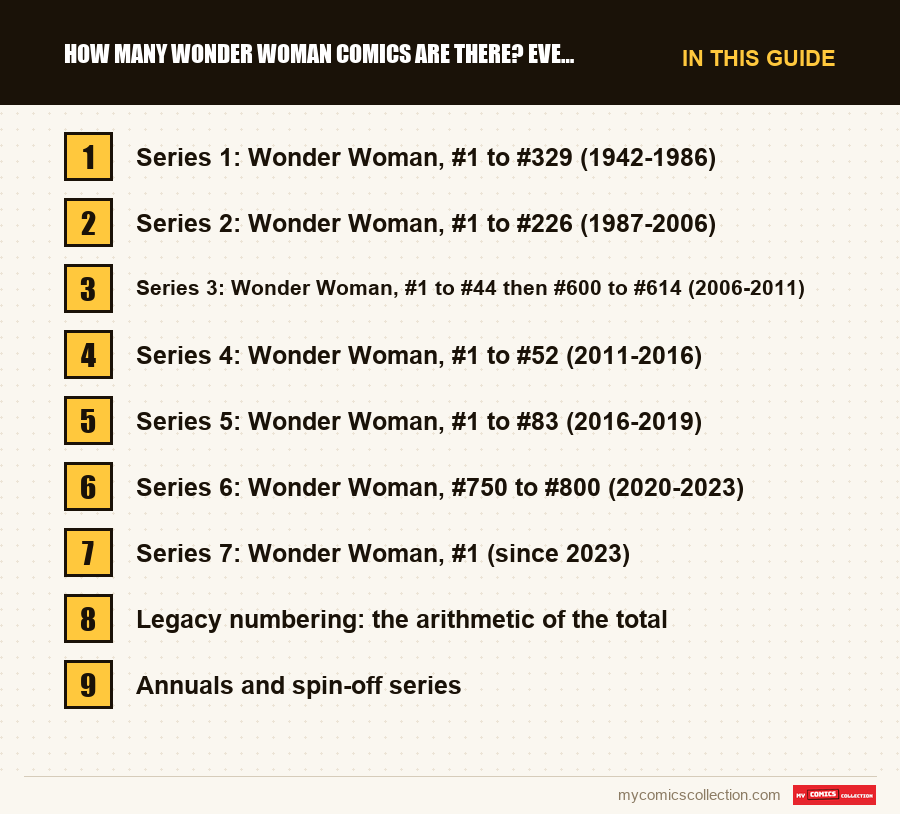
Series 6: Wonder Woman, #750 to #800 (2020-2023)
In 2020, DC announces the return to legacy numbering: the title resumes with #750, which adds up the earlier series. Steve Orlando writes issues 750 to 758, then Mariko Tamaki writes issues 759 to 769. Becky Cloonan and Michael W. Conrad take over from #770 to #800, with Jordie Bellaire on some of these issues and Vita Ayala on issues 781 to 784.
This period falls within the Infinite Frontier initiative of 2021, which begins with #770. It also includes an annual. #800, dated June 2023, closes the legacy chain: it is the last issue of that counter.
Series 7: Wonder Woman, #1 (since 2023)
In September 2023, Wonder Woman restarts at #1 in the Dawn of DC line. Tom King writes the series with Daniel Sampere on art for issues 1 to 28, 31 to 34 and from #37 onward. Stephanie Williams writes issues 29-30 and 35-36, drawn by Jeff Spokes and then by Clayton Henry.
This latest series is still running, so no end boundary can be written and its total grows with each release. If you follow it at the newsstand or at your comic shop, file it on a separate line from the legacy chain, whose counter is closed at #800.
Legacy numbering: the arithmetic of the total
To get back to the 2020 #750, add it up: three hundred twenty-nine issues for 1942, two hundred twenty-six for 1987, forty-four for 2006 plus the fifteen from #600 to #614, fifty-two for the New 52 and eighty-three for Rebirth. That makes seven hundred forty-nine regular issues, and the next one naturally takes the number 750.
This sum is exact only because the #0 issues, the #1,000,000 of the 1987 series, the decimal issues #23.1 and #23.2 and the annuals are set aside. If you count them, the figure climbs, and the chain loses its simplicity. The legacy chain then reaches #800 with fifty-one issues, from #750 to #800.
In practical terms, a #650 does not exist in the 2011 to 2019 series: you need an era-by-era counter to find your bearings. When a listing mentions an issue from the Rebirth era, the issue number is enough to identify the period; for an issue from 2010, the number 600 to 614 refers to the extended 2006 series, not today's chain.
The 2023 return to #1 closes the parenthesis: every issue of that series should be logged as "#1 from 2023" in an inventory, so it is not confused with the five other Wonder Woman #1s since 1942: those of 1942, 1987, 2006, 2011 and 2016.
Annuals and spin-off series
The 1987 series has eight annuals, a #0 and a #1,000,000, and its first two annuals are written by George Pérez. The 2006 and 2011 series have one annual each, and the 2016 series has four, plus a Rebirth one-shot. The most sought-after of these annuals are covered in our page on Wonder Woman annuals and specials.
Other titles orbit the main series, and this guide does not claim to list them all: Sensational Wonder Woman (2021), Nubia & the Amazons (2021) and the story Trial of the Amazons (2022) are among them. Each has its own counter and therefore stays outside this guide's totals.
A methodical collector therefore keeps two lists: one for the main series, the other for the spin-offs, each with its annuals. Without this separation, a short-lived title inflates the main list and distorts your sense of what you are really missing.
Completing the series: where to start
Start by choosing the period that interests you rather than the full run: the 1942 series demands a different approach, with patience and careful checking of each issue's condition, than the much more accessible 1987 series. Once you have picked a period, bound it with its first and last issue numbers, then list the #0 issues, decimals and annuals attached to it.
For recent series, aim for creator blocks: Gail Simone on issues 14 to 44 of 2006, Brian Azzarello with Cliff Chiang on the New 52, or Greg Rucka's twenty-five issues in 2016. Each run offers a limited goal and a verifiable boundary, which avoids the "just a few more issues" trap that drags on forever.
If you are unsure which block to target, compare them using the Diana reading guide and the ranking of her best runs. The complete collecting guide describes the pitfalls of each era; save the boundary issues of each series (#1, #329, #226, #614) for last, since they are often the hardest to find.
Frequently asked questions
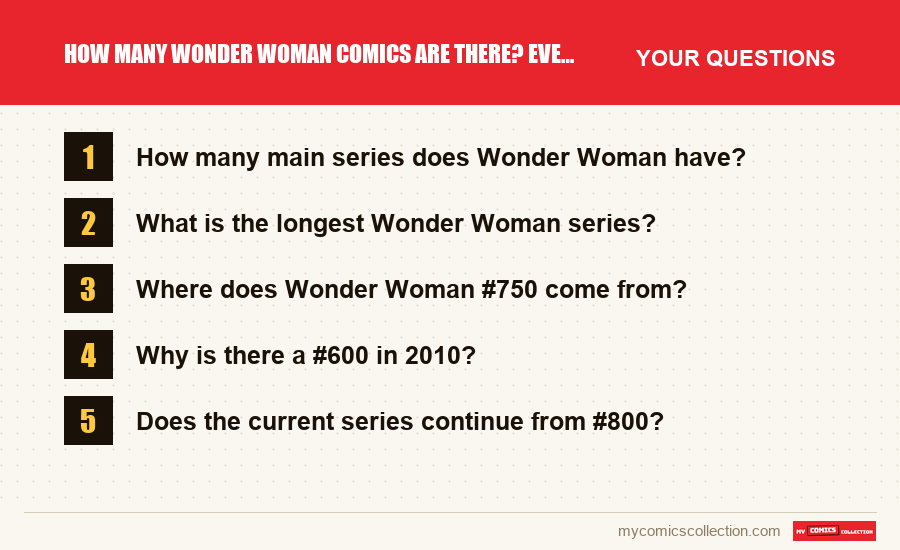
Seven main series, from the #1 of summer 1942 to the #1 of September 2023: 1942, 1987, 2006, 2011, 2016, the legacy chain from 2020 to 2023, and then the Dawn of DC series. Spin-off titles, such as Sensational Wonder Woman, are counted separately.
It is the 1942 series, which runs from #1 to #329 until February 1986. Next comes the 1987 series with two hundred twenty-six issues, the last of which dates from April 2006. Together, these two series make five hundred fifty-five regular issues out of the seven hundred forty-nine that precede #750.
It results from adding up the regular issues of the 1942, 1987, 2006 (#1 to #44 then #600 to #614), 2011 and 2016 series, for seven hundred forty-nine issues in all. The next one therefore carries the number 750, which comes out in 2020. No #0, no decimal issue and no annual goes into this sum.
After #44 of the series launched in 2006, DC jumps to #600: the series rejoins the old chain. J. Michael Straczynski writes #600 to #614, before the New 52 relaunch of November 2011. Issues 45 to 599 therefore do not exist in this series, which surprises newcomers.
No. #800, dated June 2023, closes the legacy chain. September 2023 brings Wonder Woman back to #1 in the Dawn of DC line, written by Tom King with Daniel Sampere on much of the art. In a checklist, log it as a separate series.
Have a 1942 issue or a 1987 run to place? Estimate the value of your copy before completing the rest of the series.
Estimate my comic