How many Punisher comics are there? We count seventeen The Punisher series, every series counted from the 1986 miniseries to the volume dated February 2026. The longest is the 1987 series, with one hundred four issues and seven annuals; Punisher MAX has seventy-five. The legacy numbering, which counts the 1986 miniseries, reaches #200 in 2015, then #228 in 2018, at the end of the series launched in 2016. The parallel series are not added into this counter.
Frank Castle has gone through periods when several monthly series were published at the same time, then relaunches under different publisher labels, Marvel Edge, Marvel Knights, or MAX. For a collector, the question "how many issues" therefore arises on several levels: the volumes, the legacy counter, the parallel series, and the annuals.
As always on this guide, only verified information (creators, issues, dates) is stated as fact; the analysis is our own, with no reproduction of panels or protected dialogue.
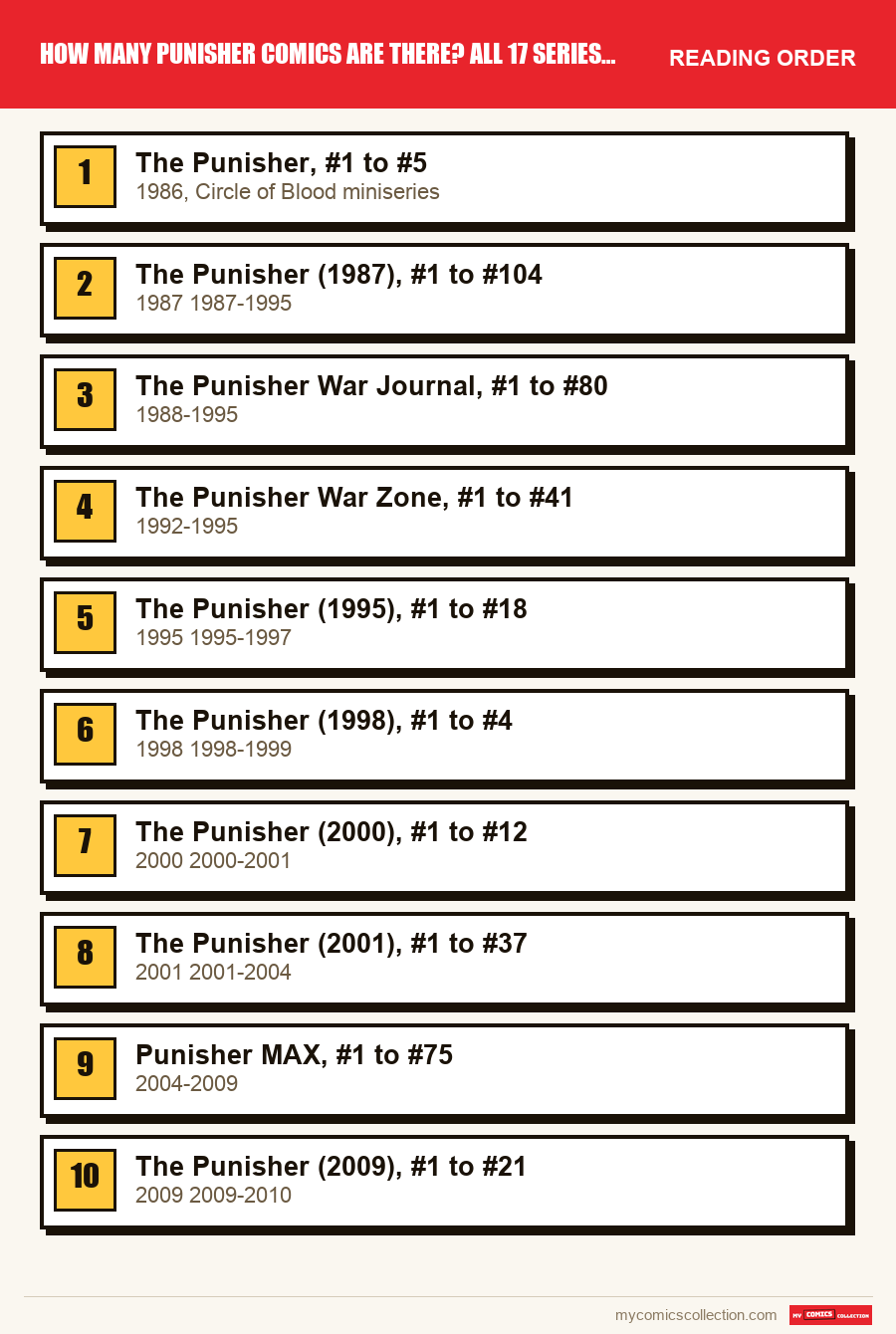
Series 1: The Punisher, #1 to #5 (1986, Circle of Blood miniseries)
The miniseries runs from January to May 1986, in five issues. Steven Grant writes, Mike Zeck draws. Frank Castle bursts onto the scene in February 1974 in The Amazing Spider-Man #129, written by Gerry Conway, with Ross Andru on art; here he gets a title of his own, twelve years later.
Our analysis of the 1986 miniseries details what buyers look for in these five single issues. For the legacy counter, remember that this miniseries counts for five.
Series 2: The Punisher (1987), #1 to #104 (1987-1995)
This is the reference series: one hundred four monthly issues from July 1987 to July 1995, plus seven annuals. Mike Baron launches the series on script, with Klaus Janson on art. In the legacy counter, these one hundred four issues occupy slots 6 to 109, right after the miniseries.
This longevity explains why the series serves as the foundation of the franchise: it gives rise to parallel titles that run alongside it. Also remember that it contains seven annuals, which are usually shelved after the matching volume.
Series 3: The Punisher War Journal, #1 to #80 (1988-1995)
This parallel monthly title appears in November 1988, a year after the main series, and stops in July 1995 at issue 80, the same month as the 1987 series. Eighty issues make it the second longest title of the period.
For the collector, the consequence is simple: this series is to be shelved next to the previous one, and counted separately in any addition. Our piece on issue 1 of War Journal gives an entry point.
Series 4: The Punisher War Zone, #1 to #41 (1992-1995)
One more monthly title appears in March 1992 and lasts until July 1995, with forty-one issues. It therefore runs at the same time as the 1987 series and War Journal, which explains why an ambitious collector's total swells quickly if the three titles are counted together.
During the same period, the catalog also includes The Punisher Armory, ten issues from 1990 to 1994, devoted to the character's arsenal. It is no more added to the legacy counter than War Zone is.
Series 5: The Punisher (1995), #1 to #18 (1995-1997)
The series begins in November 1995 and ends in April 1997, with eighteen issues. It appears under the Marvel Edge label for issues 1 to 6, then under the Marvel brand, and John Ostrander is its writer. In the legacy counter, these eighteen issues carry numbers 110 to 127.
This figure is no coincidence: it comes immediately after the one hundred four issues of 1987 and the five of the 1986 miniseries, for one hundred nine issues in all. The logic of the counter is readable from this series on.
Series 6: The Punisher (1998), #1 to #4 (1998-1999)
Four issues from November 1998 to February 1999, in the Marvel Knights line: the series, called Purgatory, is written by Christopher Golden. It carries legacy numbers 128 to 131, which continues the 1995 series without a break.
It is one of the shortest series in the counter, with four single issues to place between the 1995 series and the 2000 one.
Series 7: The Punisher (2000), #1 to #12 (2000-2001)
Garth Ennis and Steve Dillon take the character in April 2000, under the Marvel Knights label, for twelve issues that end in March 2001. The series carries legacy numbers 132 to 143.
Garth Ennis also writes the 2001 series and Punisher MAX. The legacy counter reaches issue 143 at the end of this volume: five plus one hundred four plus eighteen plus four plus twelve make one hundred forty-three.
Series 8: The Punisher (2001), #1 to #37 (2001-2004)
A new series starts in August 2001 and lasts until February 2004, for thirty-seven issues. Garth Ennis writes most of it and Steve Dillon draws most of it. The title follows on from the 2000 volume but restarts at 1, and it does not join the legacy counter: the next number in that counter will only arrive with the 2009 series.
The Born miniseries, published in 2003 by Garth Ennis with Darick Robertson, shelves with this period.
Series 9: Punisher MAX, #1 to #75 (2004-2009)
From March 2004 to October 2009, the series is published under the MAX label, aimed at an adult readership, and has seventy-five issues plus one annual. Garth Ennis launches the series in 2004 and writes most of it; other writers follow him for the last issues. From issue 66, the series changes its title, so the later covers no longer carry the name Punisher MAX.
For shelving, this title change is the only trap: the seventy-five issues form a single volume, to be shelved as one block with its annual, and they do not enter the legacy counter.
Series 10: The Punisher (2009), #1 to #21 (2009-2010)
Launched in March 2009, the series lasts until November 2010 with twenty-one issues and one annual. For a time it carries the title FrankenCastle. In the legacy counter, its issues run from 144 to 164, which continues the previous addition: one hundred forty-three plus twenty-one make one hundred sixty-four.
It appears during the last months of Punisher MAX, so two series of the character are on the stands at the same time in 2009.
Do you collect this series?
Track what you own, what you are missing and what your collection is worth. 7-day trial.
Start my trial →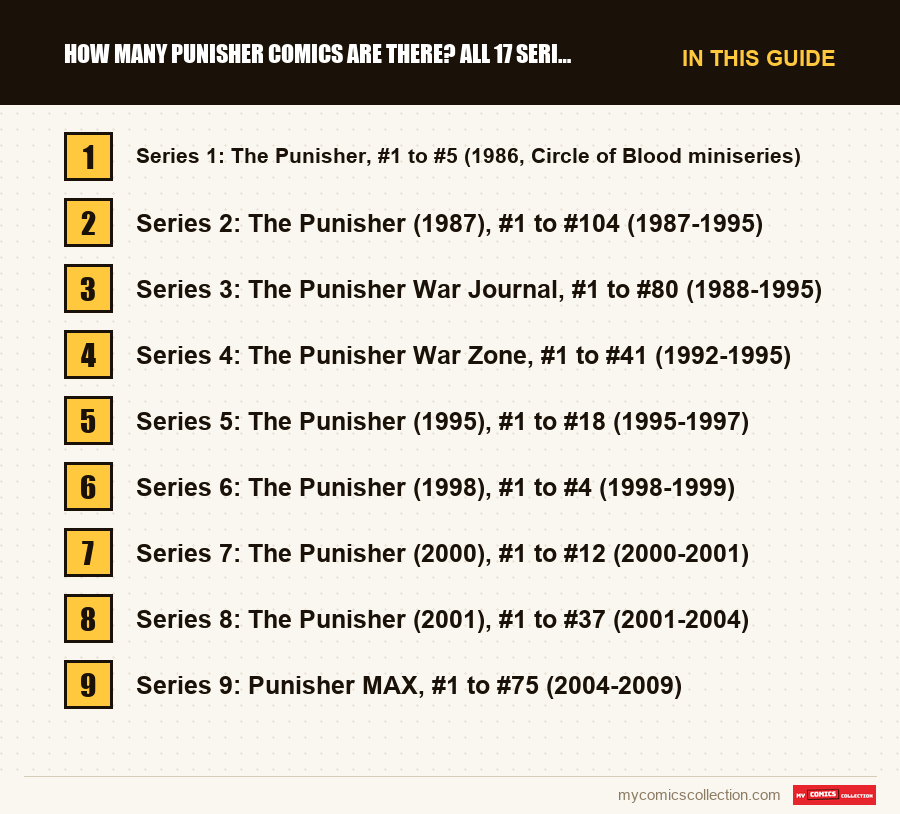
Series 11: The Punisher (2011), #1 to #16 (2011-2012)
The series runs from August 2011 to September 2012, with sixteen issues. Greg Rucka writes, and Marco Checchetto draws issue 1, where Rachel Cole-Alves appears. The legacy counter lines up with it, from issue 165 to issue 180.
With sixteen issues, it is completed faster than the 2009 and 2014 series.
Series 12: The Punisher (2014), #1 to #20 (2014-2015)
Nathan Edmondson writes and Mitch Gerads draws this series that runs from February 2014 to June 2015, over twenty issues. It carries legacy numbers 181 to 200, so it closes out the first two hundred issues of the counter.
One hundred eighty plus twenty make two hundred: the arithmetic works out, and issue 200 of the legacy line is therefore the last issue of this series.
Series 13: The Punisher (2016), #1 to #17 then #218 to #228 (2016-2018)
Relaunched in 2016, this series has seventeen issues, then at its eighteenth resumes the legacy numbering and shows number 218. It continues until issue 228, published in 2018, with one annual.
The useful point for a buyer: the first seventeen issues correspond to slots 201 to 217 of the counter, without displaying them, and the continuation starts directly at 218. A single volume must therefore be searched under two numberings, and a grid that jumps from 17 to 218 has no gap.
Series 14: The Punisher (2018), #1 to #16 (2018-2019)
Matthew Rosenberg writes and Riccardo Burchielli draws this series, which begins in August 2018 and ends in October 2019 with sixteen issues and one annual.
In the legacy counter, it occupies slots 229 to 244, immediately after issue 228 of the previous series: two hundred twenty-eight plus sixteen make two hundred forty-four.
Series 15: The Punisher (2022), #1 to #12 (2022-2023)
Jason Aaron writes, with Jesús Saiz and Paul Azaceta on art, a twelve-issue series published from March 2022 to April 2023. In the legacy counter, it occupies slots 245 to 256.
With twelve issues, it is a series you can complete quickly.
Series 16: The Punisher (2023), #1 to #4 (2023-2024)
David Pepose writes and Dave Wachter draws this volume from November 2023 to April 2024. It is canceled after four issues.
Four issues can be shelved in one evening, but they are harder to find in shops than the long series.
Series 17: The Punisher (2026), since February 2026
A new volume carries a first issue dated February 2026, with Benjamin Percy on script and José Luis Soares on art. The same Benjamin Percy signed, in 2025, the miniseries Punisher: Red Band, five issues with Marco Checchetto on art, which directly precedes this volume.
We give no final endpoint, because this series is still open and any limit written here would be out of date by the publisher's next announcement.
Legacy numbering: the arithmetic of the total
The Punisher's legacy counter can be reconstructed step by step, which is rare. Five for the 1986 miniseries plus one hundred four for the 1987 series make one hundred nine. The 1995 series therefore starts at issue 110 and ends at 127 with eighteen issues. The four of 1998 run from 128 to 131, the twelve of 2000 from 132 to 143, the twenty-one of 2009 from 144 to 164, the sixteen of 2011 from 165 to 180, and the twenty of 2014 from 181 to 200.
Beyond that, the 2016 series shows issue 218 at its eighteenth issue, which places its first issue at 201: two hundred plus seventeen make two hundred seventeen, and the eighteenth lands at two hundred eighteen. The series ends at 228. The sixteen issues of 2018 then occupy slots 229 to 244 and the twelve of 2022 slots 245 to 256. The 2023 volume, canceled after four issues, has no slot assigned in this counter.
The counter contains neither the 2001 series nor Punisher MAX nor the two parallel series of the early 1990s. It therefore answers a narrow question: how many issues in the main line. If you add everything, you get a much higher figure, which changes depending on whether you count the annuals and miniseries.
Annuals and spinoff series
The survey that follows remains partial. The annuals break down as follows: seven for the 1987 series, one for Punisher MAX, one for the 2009 series, and one for the 2018 one. The graphic novels of the late 1980s run from Assassin's Guild in 1988 to Return to Big Nothing and Intruder in 1989.
Other titles complete the picture: the second Punisher War Journal, twenty-six issues and one annual from January 2007 to January 2009, launched by Matt Fraction with Ariel Olivetti; the War Zone relaunches in 2008 and 2012; and Punisher: In the Blood, a five-part story published in 2010. Our page on the annuals and specials helps sort them out.
Completing the series: where to start
Begin by setting the scope. The issues of the main line, from the 1986 miniseries to the 2014 volume, form a coherent set of two hundred issues, and most collectors stop there. Then add the parallel series in publication order, starting with War Journal.
Use a two-column grid: the volume number and the legacy number. Many modern covers display both, and it is the only way to avoid duplicates. To choose an entry point before buying, see where to start reading the Punisher.
Finally, decide in advance where the miniseries, annuals, and MAX series fit, then write the rule down. It is that rule, more than the count, that will tell you whether the collection is complete.
Frequently asked questions
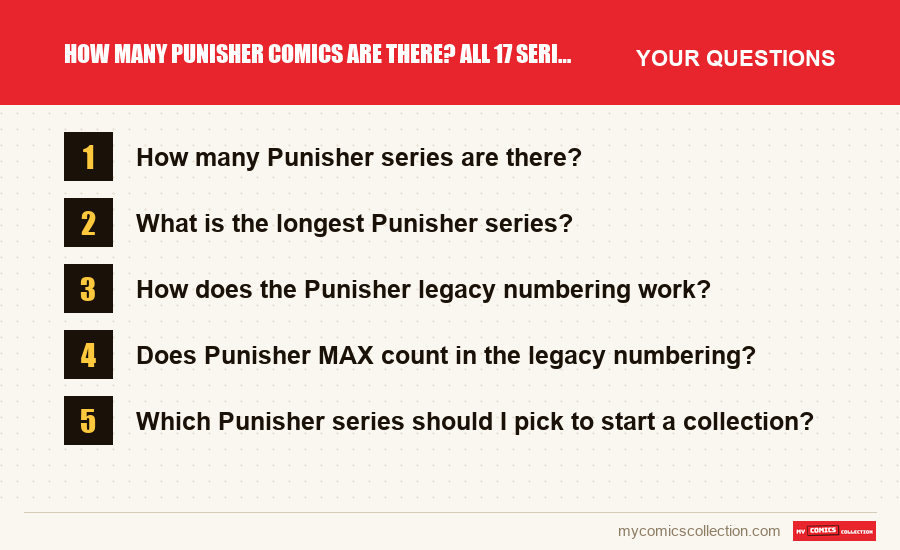
We count seventeen, from the 1986 miniseries to the volume dated February 2026, counting War Journal, War Zone, and Punisher MAX. The miniseries, one-shots, and annuals come on top of that and are not all listed here.
The series launched in July 1987: one hundred four issues through July 1995, plus seven annuals. Next come War Journal, with eighty issues from 1988 to 1995, then Punisher MAX, with seventy-five issues and one annual between March 2004 and October 2009.
It adds up the 1986 miniseries and the main-line series: five plus one hundred four make one hundred nine, and the 1995 series starts at issue 110. It reaches 200 with the 2014 series and shows 218 at the eighteenth issue of the 2016 one.
No. Neither Punisher MAX nor the 2001 series appears in the sequence we reconstructed: issues 128 to 143 are followed by 144, which belongs to the 2009 series. The counter describes the main line, not the character's whole output.
It is better to aim for a limited run: five issues for the 1986 miniseries, twenty for the 2014 series by Nathan Edmondson and Mitch Gerads. They are completed quickly and give you a first landmark before tackling the 1987 series and its one hundred four issues.
Not sure what a Punisher issue, a legacy-numbered issue, or an annual is worth? Get it appraised before you fill a gap.
Estimate my comic