Punisher War Journal #1, dated November 1988, opens the Punisher's second monthly series at Marvel. Carl Potts writes, Jim Lee draws: it is one of Lee's first notable works for the company, three years before X-Men #1. People look for it for Lee's hand at the start of that career, for the opening of an 80-issue monthly, and for its sensible price compared with the Punisher's historical keys. One danger only: confusing it with the 2007 volume.
November 1988: the Punisher has had a regular series for a year already, and Marvel decides that a single monthly is no longer enough for Frank Castle. The second title arrives with a war journal name, a writer who knows the character from the inside, and an artist whose name almost nobody yet remembers. Nearly forty years later, it is this last detail that gives the issue its place on collectors' lists.
As always on this guide, only verified information (creators, issue numbers, dates) is stated as fact; the analysis is our own, with no reproduction of protected pages or dialogue.
Punisher War Journal #1: date, creators and first issue
Dated November 1988, this first single issue inaugurates a volume that will end in 1995 after 80 releases. Carl Potts is the writer, and Jim Lee the artist. Potts is also, at the time, the person steering the character's releases at the publisher, which explains why the title takes on a tone distinct from that of the main monthly, entrusted to Mike Baron.
The first episode opens on the commemoration of the massacre of Frank Castle's family in Central Park, a ritual the character imposes on himself. We do not detail the rest of the story: the issue is worth more for setting up a more pensive Punisher, more attached to his role as a shadow in New York, than for any feat of arms to recount.
One point remains ambiguous for enthusiasts of precision: the split between pencils and inks between Potts and Lee in the first three issues. Sources diverge, some crediting Lee for the inks alone in the early issues, others for the full art. On a copy, look at the credits page rather than copying a listing.
The editorial context: two Punishers on the newsstand
To understand this launch, one has to go back to the chain of series devoted to the character. A vigilante crossed in the wake of Spider-Man in 1974 (issue 129), then relegated to the margins: that is the Punisher until 1986, when Steven Grant and Mike Zeck devote five episodes to him alone. The success of this miniseries paved the way for a regular series starting in 1987, with Mike Baron.
War Journal therefore arrives a little over a year later, when Marvel wants to test the character's capacity to carry more than one title. The formula works: the Punisher becomes one of the few heroes of the company to occupy three columns of new releases in the early 1990s, with War Zone in 1992 as the third monthly. This saturation largely explains the current stock, which we address further on.
The 1988 volume has another particularity: it serves as a crossing point. Several issues put the Punisher face to face with other heroes of the company, which widens its readership beyond fans of urban crime fiction.
Why this issue became a key
The main reason lies with Jim Lee. When Lee left Marvel in 1992 to found WildStorm as part of the creation of Image, the artist had become one of the most famous artists of the moment, notably thanks to Uncanny X-Men and then the first issue of volume 2 of X-Men in 1991. Everything Lee drew earlier benefits. Punisher War Journal #1 belongs to that category of single issues where you buy a hand as much as a character.
The second reason is the issue's place in the Punisher's history. It makes no major character appear for the first time and introduces no origin element, but it extends the reading of the character toward a long-series format. For a collector centered on Frank Castle, it is the entry door to a whole section of releases.
The third is the legibility of the launch. Unlike series where the key hides in #5 or #12, here #1 is unambiguously the issue to look for. Buyers do not have to choose between several candidates, which simplifies the work of pricing.
One must nevertheless keep a sense of proportion. Lee's appeal has pushed other issues of the series up more strongly, such as those where the Punisher crosses paths with Wolverine, which we detail below. #1 is the position key, not the popularity key.
The price of Punisher War Journal #1: condition, stock, demand
The single issue sits in the modest zone of the market. It has neither the scarcity of a 1974 issue nor the demand of a launch that introduces a character. Its price depends on two variables: the grade of the copy, and the general market trend for Jim Lee's early works, which rises and falls with the artist's current events.
The stock is abundant. With three monthlies devoted to the character, large quantities of single issues were sold and then stored without being read, and they resurface in numbers today. A simple rule follows: do not pay for scarcity, pay for condition. A copy with a clean spine, sharp corners and aligned staples is worth noticeably more than one that is merely readable, and the gap widens as you move up the grading scale.
Punisher adaptations have sustained general demand for the character. The series broadcast in 2017 brought readers back toward the releases of the late 1980s, but the effect on this particular issue is more diffuse than for the historical keys. Watch sold sales over several months, not over a week.
Telling one edition from another
This #1 exists in a shop version, with the illustrated box at the top left, and in a newsstand version, with a barcode. The price gap between the two is only worth discussing for very good conditions.
The major pitfall is volume confusion. The title Punisher War Journal covers several series: the 1988 one, which this article covers, and a series relaunched in 2007 whose first issue was scripted by Matt Fraction. Both have a "#1"; only the first has Jim Lee on art. Check the year on the cover and on the credits page.
As for collected editions, they reprint episodes of the 1988 series in softcover or hardcover volumes. They serve reading, but carry no weight as a first issue. Compare the edition mentions and the paper: an original single issue is more matte, a collected edition has a square spine and an ISBN code.
Do you collect this series?
Track what you own, what you are missing and what your collection is worth. 7-day trial.
Start my trial →
Buying pitfalls
First pitfall, already mentioned: the volume. A listing titled "Punisher War Journal #1" with no date may hide the 2007 series. Insist on the cover year, or failing that a photo of the credits page.
Second pitfall, upgrading through the "early Jim Lee" argument. The expression is accurate but it also serves as a sales label. No fact proves it by itself; what matters is the comparison with sold sales of similar issues at the same grade.
Third pitfall, the series lot. The 80 issues readily sell in blocks, and #1 sometimes appears in them in average condition. Examine the spine of each copy before accepting, since a lot that is advantageous on paper can hide a creased #1.
Fourth pitfall, confusion with the neighboring monthly. In the same boxes are the issues of Mike Baron's series, whose #1 dates from 1987. It is not the same single issue, nor the same price, nor the same artist.
The neighboring issues that also matter
Within the series itself, the immediate sequel to #1 forms the first arc by Potts and Lee. Issues #6 and #7 feature Wolverine, and they attract collectors of crossover characters. Issues #12 and #13 are tie-ins to Acts of Vengeance, the late 1989 event, and suit anyone following Marvel's great sagas.
Around the series, three landmarks mark out the file: the 1986 miniseries by Grant and Zeck, the #1 of Mike Baron's monthly in 1987, and Amazing Spider-Man #129 for the birth of the character. Each has its guide on this site.
If you want to follow Lee, the other milestones are X-Men #1 from 1991, covers for Marvel and then, later, Batman #608, the first issue of Hush at DC in 2002. They trade higher, but the artist logic is the same.
What grading changes
For a title whose stock remains vast, grading serves to make comparable copies whose condition is otherwise unverifiable from a distance. It does not create a shortage: it shifts value toward the rare copies that reach the top.
Before sending your copy for grading, compare what a flawless raw copy sells for and what an issue graded one notch below the maximum sells for, then set the gap against the cost of shipping. If the ratio is low, keep it raw and store it in a soft sleeve. If it is high, the step is justified.
Do not forget that a label that gives the title without the volume leaves room for error. Check the year field on the label, which must show 1988, not 2007.
How to track it in a collection
Two filing entries work. The first is the character: shelve #1 after the 1987 monthly, in the line of Frank Castle's series. The second is the artist: if you follow Jim Lee, this issue opens the Marvel period before the X-Men.
For each copy, note the volume (1988 or 2007), the edition, the condition and the purchase price. Add a line for the crossover issues, #6-7 and #12-13, which you can hunt individually if the rest of the series does not interest you. This targeted approach avoids buying 80 single issues to read five.
Finally, keep a reading volume next to the original single issue. The episodes by Potts and Lee read well in a collected edition, and the single issue can then stay protected.
Conclusion
Punisher War Journal #1 is an issue of position, not of scarcity. It is worth the name of Jim Lee, the opening of an 80-issue series and the fact that it remains within reach of most budgets. The only costly mistake is confusing it with the 2007 volume; the second is paying for a seller's argument rather than a grade. A clean copy, volume and edition checked, is a sensible purchase for a Punisher file or for a Lee file.
Frequently asked questions
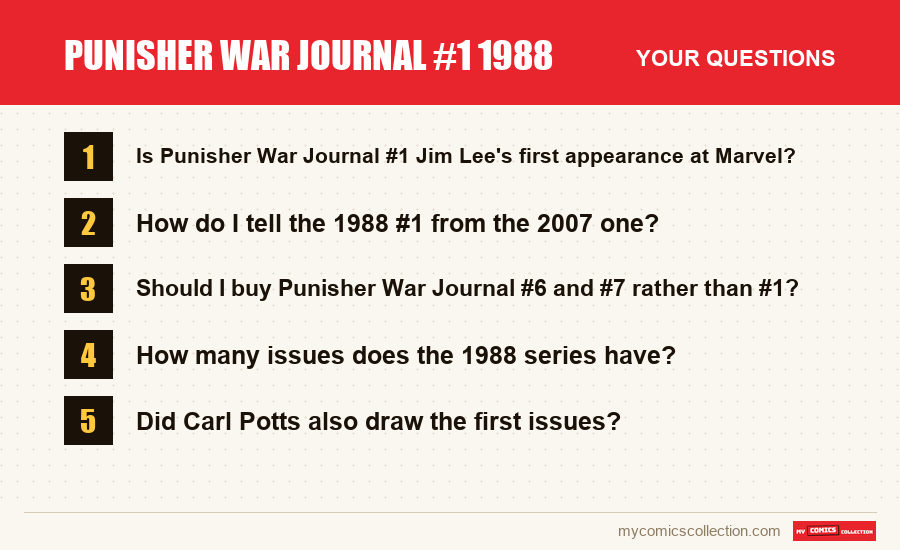
No, not in the strict sense: Lee had already worked for Marvel before November 1988, and sources diverge on the very first credit. It is, however, one of Lee's first notable works on a regular series, three years before the first issue of X-Men, which explains collectors' interest.
Look at the cover date and the credits page. The 1988 volume is the one by Carl Potts and Jim Lee, dated November 1988. The volume relaunched in 2007 was written by Matt Fraction and ties into Civil War. Both carry the same title, but not the same artist.
It depends on your file. Wolverine crosses paths with the Punisher in #6 and #7, which appeals to crossover hunters, while #1 remains the starting marker of the series. For a Punisher-centered collection, start with #1, then add the crossovers according to your budget.
It has 80, from November 1988 to 1995. It is the Punisher's second monthly series after the 1987 one, and it preceded the 1992 War Zone. The length makes it easy to rebuild a complete run, since the stock of most issues remains abundant.
Potts is credited as writer of #1. As for the art of the first issues, listings contradict each other on what belongs to Potts and to Lee, from pencils to inks. Consult the credits page of the copy you are after before buying it for a specific hand.
Do you have a Punisher War Journal #1 from 1988? Estimate it according to its volume, edition and condition before deciding to have it graded.
Estimate my comic