How many Justice League comics are there? The team has headlined eight main series since 1960. The longest is Justice League of America, which ran from 1960 to 1987 for 261 issues; the 1987 volume, which changes its title three times, reaches 113 issues, and JLA adds 125. No legacy numbering ties these volumes together: every relaunch starts again at #1, and the total depends on what you count.
Asking how many Justice League issues exist really means asking which team you follow: Gardner Fox's, Keith Giffen's, Grant Morrison's, or the twenty-first-century relaunches. Each era has its own title, its own counter and sometimes a new name along the way.
As always in this guide, we only state verified information (creators, issue numbers, dates); the analysis is our own, with no reproduction of protected art or dialogue.
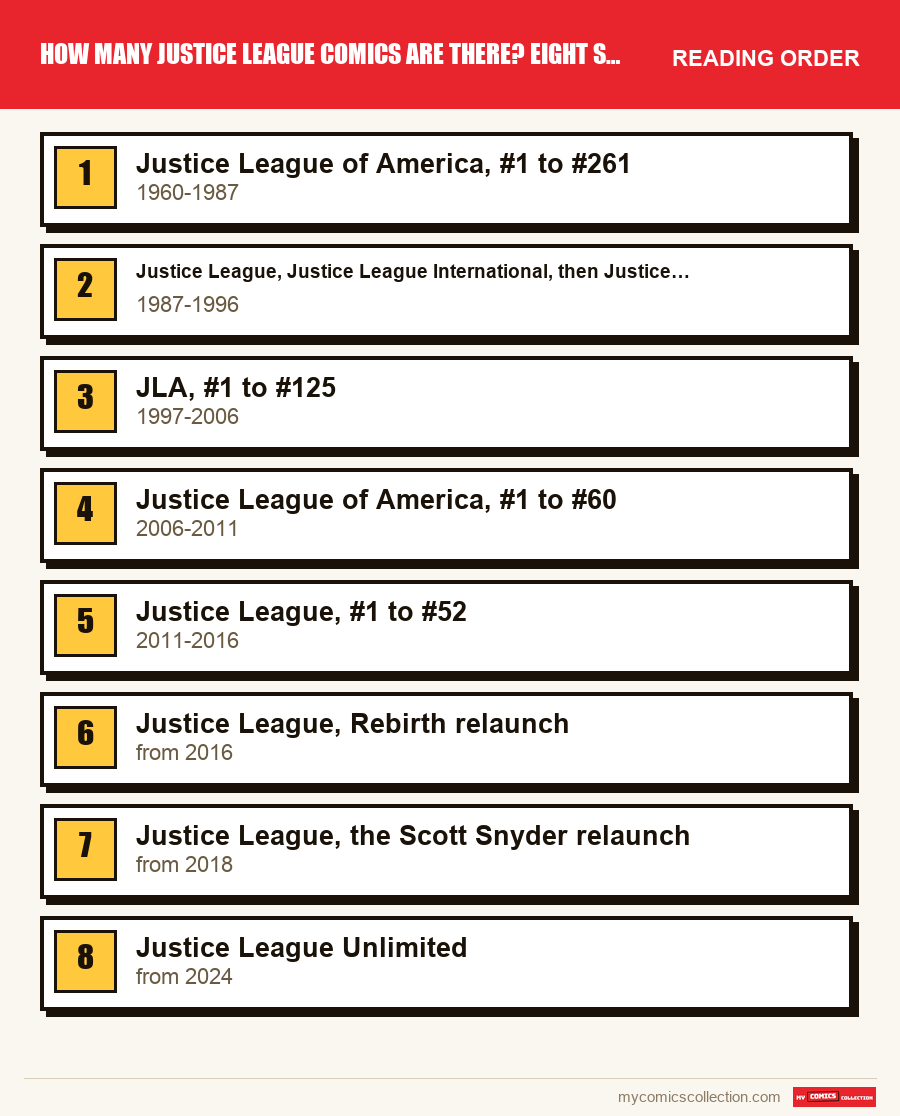
Series 1: Justice League of America, #1 to #261 (1960-1987)
The League makes its debut in The Brave and the Bold #28 in 1960, created by Gardner Fox. Those appearances in a neighboring magazine come before the series and fall outside its bounds; the details are in our entry on that #28. The League's own book starts the same year with a #1 and runs through #261, in 1987.
More than a quarter century of publication without a renumbering makes it the longest of the Justice League series. It hosted Gerry Conway and Len Wein, among others, who are covered in Gerry Conway comics and Len Wein comics.
In the 1980s the series goes through the so-called Justice League Detroit era, from Justice League of America Annual #2 in 1984 through 1986: the team is rebuilt around lesser-known characters such as Vixen and Vibe. That interlude still belongs to the same series and the same counter, so there is no numbering trap for this period.
Series 2: Justice League, Justice League International, then Justice League America, #1 to #113 (1987-1996)
The 1986 crossover Legends leads to a new team and a series that starts over at #1. Keith Giffen and J. M. DeMatteis are the first writers, with Kevin Maguire as the original artist. The title is Justice League for issues #1 to #6, from May to October 1987.
At #7, in November 1987, it becomes Justice League International, a title it keeps through #25 in April 1989. It then takes the name Justice League America starting with #26, in May 1989, just as Justice League Europe is launched, and continues through #113 in August 1996.
Three different cover titles, then, but one series and one run of issue numbers. To track these single issues down at a dealer, search under all three titles: the same issue can be filed under any of them depending on the seller.
Justice League Europe, launched in 1989, ends up being renamed Justice League International: the title thus comes back on a second series, with its own counter. Since that series branches off from the main volume without replacing it, we list it among the spinoff series below.
Series 3: JLA, #1 to #125 (1997-2006)
The JLA series starts over at #1 in early 1997. Grant Morrison writes the first four years, with Howard Porter as the original artist. Later the series hosts Mark Waid, Joe Kelly, Chris Claremont, Chuck Austen and Kurt Busiek on intermediate arcs, along with Geoff Johns and Allan Heinberg on #115 to #119.
Those five issues form the Crisis of Conscience arc, which leads directly into Infinite Crisis. Bob Harras writes the final arc, #120 to #125, and the series ends after Infinite Crisis: on that point, the Infinite Crisis reading order sheds light on the series' closure.
One off-sequence issue complicates the count: JLA #1,000,000, published during the DC One Million event, whose issue Grant Morrison writes. It does not fit into the run of #1 to #125. As for the miniseries Justice League Elite, twelve issues published after #100, it stands apart. You hunt for both separately.
Keep this three-step timeline in mind: 261 issues through 1987, 113 issues under three titles through 1996, then 125 issues of JLA through 2006. Each series ending sets up a fresh counter, and none of the three continues into the next, which makes the handoff from one volume to the next clean for filing purposes.
Series 4: Justice League of America, #1 to #60 (2006-2011)
A new series titled Justice League of America starts in July 2006 with a #0, then runs from #1 to #60, reached in 2011. Brad Meltzer writes the first thirteen issues, #0 included. It carries the name of the 1960 series, but not its counter: it is a distinct volume that starts again from zero.
That title detail matters for your collection: a search engine that returns "Justice League of America #1" can give you either the 1960 single issue or the 2006 one. Always check the cover year before you buy.
Series 5: Justice League, #1 to #52 (2011-2016)
The New 52 reboot produces a new Justice League by Geoff Johns and Jim Lee, which starts over at #1 in 2011 and reaches #52 in 2016. The pages on Geoff Johns and Jim Lee detail their work together.
This series brings back a lineup that counts Cyborg among its founding members, which sets it apart from earlier teams. At the same time, DC opens neighboring titles that we class as spinoffs: Justice League International (2011), #1 to #12 between 2011 and 2012, and a 2013 Justice League of America, #1 to #14 through 2014.
Series 6: Justice League, Rebirth relaunch (from 2016)
The DC Rebirth phase launches a new volume of Justice League, written by Bryan Hitch. It starts over at #1 and has no numbering link to the previous 52-issue volume. We list this series without issue bounds, since we could not verify them.
For a buyer the risk is the same as elsewhere: two series share the same title five years apart and get mixed up in listings. Collectors look for the first printings of each relaunch and are wary of alternate-cover issues when the condition is not detailed.
Do you collect this series?
Track what you own, what you are missing and what your collection is worth. 7-day trial.
Start my trial →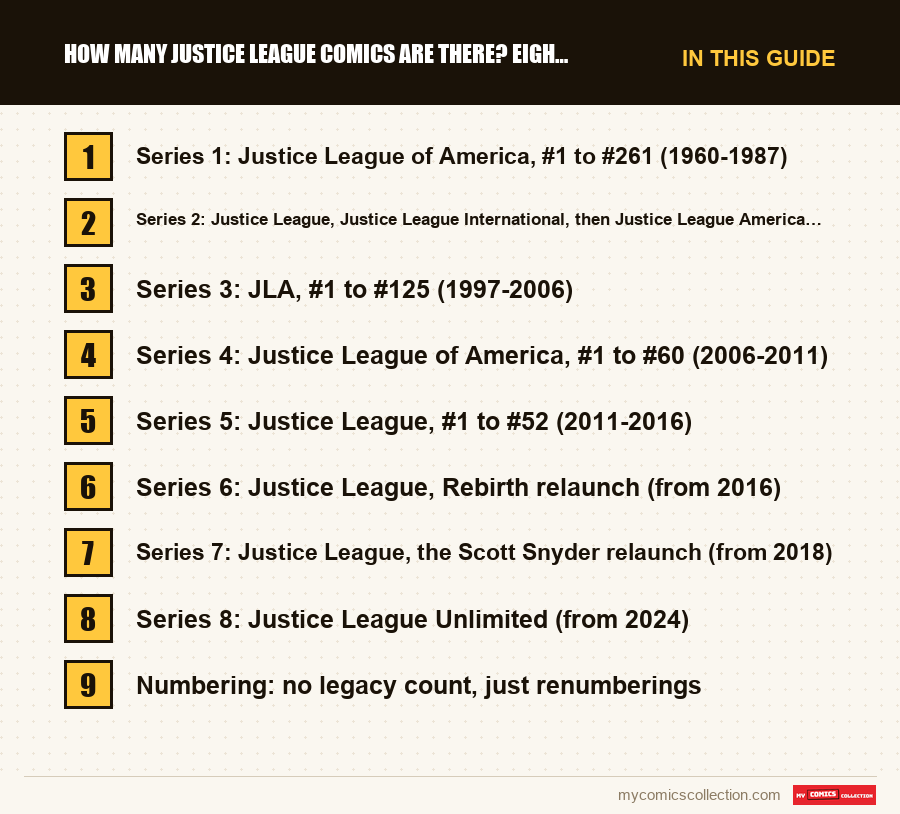
Series 7: Justice League, the Scott Snyder relaunch (from 2018)
In 2018, Justice League: No Justice sets up a new volume of Justice League entrusted to Scott Snyder, whose page you can read at Scott Snyder comics. That volume reaches 75 issues in June 2022.
The period unfolds alongside parallel series: Justice League Odyssey, which runs 25 issues from 2018 to 2020, and other titles with similar names. Each is filed under spinoffs and not in the main count, to keep a clear line.
To place this volume in the timeline, keep the bounds in order: 52 issues in 2011-2016, a Rebirth volume, then 75 issues in 2018-2022. These are three distinct counters that follow one another without carrying over.
Series 8: Justice League Unlimited (from 2024)
Justice League Unlimited is entrusted to Mark Waid on script and Dan Mora on art. It closes out the list and is still being published: it cannot be given any end bound.
In the meantime, 2023 saw the Justice League put on pause while the Titans took the lead in the catalog; that interlude explains the publication gap between the 2018 volume and this title.
Numbering: no legacy count, just renumberings
Unlike other major DC series, the Justice League has no continuous legacy numbering that would tie all the volumes together. Every relaunch starts over at #1, and it is the titles and the years that help you find your way.
What you can add up are the first five bounds written above: 261 issues for the 1960 series, 113 for the 1987 volume, 125 for JLA, 60 for the 2006 series and 52 for the 2011 Justice League. The total of those five series is 611 issues, not counting annuals, special issues, #0 issues or JLA #1,000,000.
Series 6, 7 and 8 have no final bounds here, and we do not add them to this total: writing a grand sum would mean ruling on issues we have not confirmed. The figure of 611 is therefore a floor, not a complete count: it stops at 2016 and leaves the recent series aside.
Depending on what you include, the figure moves: with annuals, with spinoff miniseries, with the #1,000,000 or with the recent ongoing series. So say which scope you are using before you compare your list with someone else's.
Annuals and spinoff series
A constellation of titles orbits the main series. In the 1980s and 1990s, Justice League Europe is renamed Justice League International mid-run, while Justice League Task Force and Extreme Justice are among the spinoff series of the period.
Around JLA, the miniseries Justice League Elite runs twelve issues and follows #100. The 2010s add Justice League International (2011, #1 to #12), the 2013 Justice League of America (#1 to #14), then Justice League Odyssey (25 issues, 2018-2020). This list makes no claim to be exhaustive: DC has multiplied the titles tied to the brand.
Annuals exist for several volumes, but we give no count for them, since we have not verified them series by series. To place the teams within the wider universe, the history of the Justice League in comics remains the best companion.
Completing the run: where to start
Start by choosing an era. A collector of the Giffen era will look for a long run of 113 issues under three titles; a fan of the Morrison era will aim for the 125 issues of JLA, with JLA #1,000,000 set apart. A list by volume, with a column for the title at the time, avoids duplicates.
Then proceed in chunks: the first ten issues of each volume are the most sought after, while the last ones are easier to find in lots. Note the condition of each single issue and check the cover, because two issues can share a number without being the same volume. To read each era in sequence, turn to the Justice League reading guide.
Set aside a last section for Justice League Elite, annuals and special issues. They are counted separately and bought separately, often after the regular series. The key Justice League issues guide helps you choose the ones that matter most.
Frequently asked questions
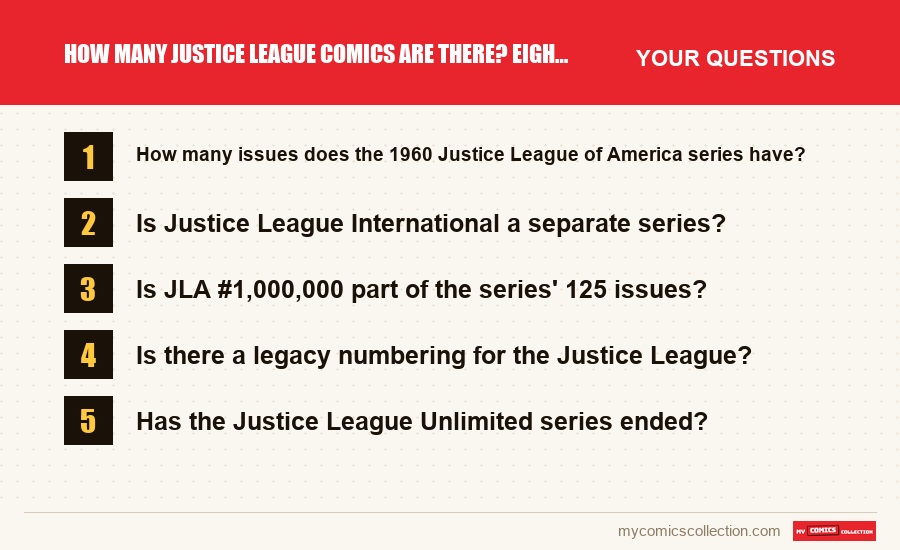
That series runs from #1 to #261 and ends in 1987, with no renumbering along the way. It is the longest Justice League series. It should not be confused with the 2006 volume, which carries the same title but starts over at #1 and ends at #60.
No, it is the same volume as the 1987 Justice League. It is called Justice League on #1 to #6, Justice League International on #7 to #25, then Justice League America from #26 to #113. The numbering is continuous; only the cover title changes.
No. That issue was published during DC One Million and does not fit into the run from #1 to #125. It is counted separately, like the annuals and the Justice League Elite miniseries. Collectors therefore hunt for it apart from the regular series.
No. Every relaunch starts over at #1 and nothing links the volumes together. You add up the bounds series by series: 261, 113, 125, 60 and 52 give 611 issues for the first five series, not counting annuals, specials, #0 issues and JLA #1,000,000.
No, it is still ongoing. Mark Waid is the writer and Dan Mora the artist; the title dates from 2024 and the DC All In phase. Its issue count grows every month, which rules out fixing a total while publication continues.
Found a Justice League single issue in a cardboard box? Get it appraised before you file it away.
Estimate my comic