In short
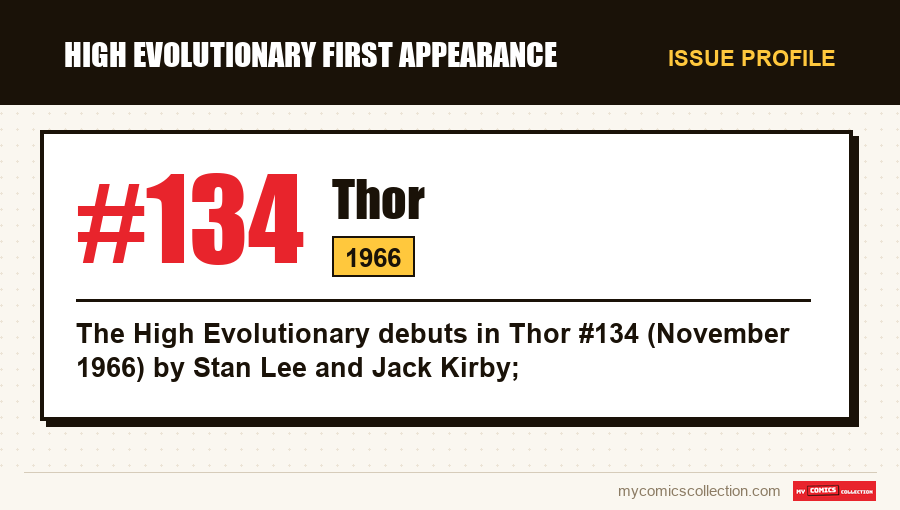
Wyndham makes his full debut in Thor #134 (November 1966 cover date), a Stan Lee script with Jack Kirby art. A single mention comes one issue earlier, in #133 (October 1966), so #134 is the issue collectors treat as the debut. He enters as the lord of Mount Wundagore, a geneticist who raises animals into the New Men, and the follow-up in #135 (December 1966) expands that setup.
Most readers meet the High Evolutionary through the cosmic stories of the 1970s or the 2010s, then discover that his debut is a quiet 1966 Thor adventure set on a mountain in Transia. This guide is about the physical issue: what #134 contains, what surrounds it on the shelf, and how to examine a copy before you commit to it.
Transparency note: the 1966 to 2013 dates and issue numbers tied to Wyndham were cross-checked, so #134 appears here without an inker or story title, and the advice on inspecting a copy is our own analysis.
The identity of Thor #134: cover date, creators and what is on the cover
On the shelf, the book reads The Mighty Thor #134 with a November 1966 date. The series had been renamed with #126 in 1966, when the title that had begun life as Journey into Mystery kept its numbering but changed its name. Catalogs and dealers list these issues as both Thor and The Mighty Thor. Anyone searching for a copy should expect both spellings and treat them as the same run.
Stan Lee scripted the book and Jack Kirby penciled it. By late 1966 the duo was deep into a long run: Lee's scripts on the Thunder God went back to 1963, and Kirby kept drawing the title until 1970. This guide does not name an inker. If you need the full credit block for a grading label or a listing, take it from the printed credits box inside your own copy rather than from a secondhand list.
A first-appearance listing can mislead on the date, and that is worth a paragraph. The first mention of the character sits in Thor #133, cover-dated October 1966, and the New Men are alluded to even earlier, in #132. The full, on-panel debut arrives in #134 in November 1966. A seller who writes "first appearance" on #133 is describing a mention, not an appearance, and the market prices the two issues as different objects for exactly that reason.
How the High Evolutionary is introduced
In Thor #134 the character appears as the master of Mount Wundagore, in the region of Transia. The issue sets down the elements that define him for the next sixty years: a mountaintop laboratory, a scientist who works on the idea of selection and improvement, and a population of animals raised to humanoid form.
The version of the character on the page is not yet the planet-builder of the 1970s. He has a domain, a set of servants and a philosophy, but no Counter-Earth and no cosmic rivals. That narrower first outing is the reason the issue is worth reading rather than only owning: it shows a Lee and Kirby idea at the moment it was still a Thor guest-villain concept, before other writers turned it into a pillar of Marvel's cosmic side.
The cast of the mountain also matters for how the issue is remembered. Wundagore is already tied in Marvel continuity to the entity Chthon, who is bound there, and the mountain is a location that later writers keep revisiting. Reading #134 with that in mind, the setting looks less like a one-off backdrop and more like a stage that Marvel kept reusing across decades.
Who created him, and the editorial moment
The creation credit goes to Stan Lee and Jack Kirby, and it belongs to a very specific stretch of Marvel history. In 1966 the same pair was producing Fantastic Four, Thor and several other books in parallel, and cosmic and scientific ideas were arriving at a pace that left later writers years of material to develop. The High Evolutionary is one of those ideas: introduced with a few strong images and a name, then left open for others.
That openness is what distinguishes the character. Lee and Kirby gave him a laboratory, servants and a motive, and the ongoing story did not close any of it. When Roy Thomas and Gil Kane relaunched Adam Warlock in Marvel Premiere #1 in April 1972, the character was available to be pulled into a new cosmic setting, and that move is what linked him with Counter-Earth and The Power of Warlock, which started in August 1972.
It helps to separate the creators from the developers when you talk about the issue. Lee and Kirby created him; Thomas and Kane wired him into the Warlock mythology; and writers in the 1980s, 2000s and 2010s pushed him into crossovers and team books. The 1966 issue is the root, and each later appearance adds a layer without changing the fact that #134 is where he first walks on stage. For more on the artist, the Jack Kirby author page collects the guides on his work.
Why Thor #134 is a key issue, and what followed
An issue earns key status when its character stays relevant and its debut is clear; Wyndham passes both tests. He drives a company-wide crossover in 1988, returns in a major cosmic storyline in 2008 and appears in Uncanny Avengers from 2012. Each of those stretches sends a new wave of readers back to the debut.
The follow-up in Thor #135, cover-dated December 1966, matters to the story as well. It develops the Knights of Wundagore and gives Wyndham his "Lord High Evolutionary" title, which is the name that stuck. For a reader or a collector it is the natural companion, and the two issues work as a two-part introduction even though the character's weight rests on #134.
If you want a reading order that puts the debut in context, the guide to the best High Evolutionary comics walks through the later stops. This page stays focused on the issue itself, so it does not repeat that ranking.
Do you collect this series?
Track what you own, what you are missing and what your collection is worth. 7-day trial.
Start my trial →
Reprints, collections and issues that get confused with it
Three confusions come up repeatedly with this debut, and each has a clear resolution.
The first is #133 versus #134. As covered above, #133 holds the mention and #134 holds the appearance. The second is Thor #134 versus Fantastic Four #66 and #67 (1967), where Lee and Kirby, with Joe Sinnott on inks, present "Him," the artificial being who later becomes Adam Warlock. Those issues belong to a different character, and the tie to the High Evolutionary is made in the 1970s, in Marvel Premiere #1 and #2. Buying the Fantastic Four issues for a High Evolutionary run is a category mistake.
The third confusion is between the debut and the 1988 "Evolutionary War" annuals. That crossover, which includes Fantastic Four Annual #21 (September 1988) and Avengers Annual #17 (November 1988), is a late-1980s event with its own collecting logic. It features the character as the antagonist but is not an origin issue. If a listing mixes the two, check the year and the series number.
On reprints, the safest approach is to check the credits and the printing information on the copy in your hands rather than rely on a title that says "first appearance." A later collected edition of the Lee and Kirby Thor stories gives the reading experience without being the issue. If you want the original book, confirm the cover date November 1966 and the number 134 on the cover and in the indicia. A reprint will show a different publication date and, usually, a different format.
Inspecting a 1966 copy before paying
A 1966 Marvel single is a fragile object, and the checks are the same ones that apply to any Silver Age book, with a few details that matter for this issue.
Start with the cover. Look for color breaks along the spine, creases that run through the Kirby artwork, and any sign of cleaning or pressing. Silver Age covers were printed on thin stock, and a spine roll or a small tear at the top edge is common. These flaws reduce the grade, and the visible ones matter more on a cover where large color areas show every mark.
Next, the staples and the spine. Original staples should sit in clean, matching holes. Rust halos around the staples can mean humidity exposure; fresh, shiny staples on an old book can mean it was taken apart. A repair or a replacement that is disclosed is acceptable if the price reflects it, but an undisclosed one is the reason to prefer a copy with a clear history.
Third, the interior pages and the centerfold. Paper of this age yellows and becomes brittle. Gently check whether the pages are cream to light tan and whether the margins chip when you handle them. Missing pieces, pen marks, a clipped coupon or a name written on the first page are all documented condition notes, and a seller who lists them is doing the work for you.
On graded copies, read the label as a record and not a verdict. On a slab, the label lists grade, page quality and notes, and restoration shows up as a distinct label color that buyers weigh separately. The explanation of restored-copy labels covers the reasoning. For this debut, whether a copy is restored, how many pages are present and what the notes field says are as important as the number itself.
Finally, compare the same issue across several copies. A simple method is to record, for each copy, the cover date, the grade or your own condition notes, the page quality and whether the label or the seller flags restoration. Over a few weeks that record gives you a feel for how copies of the same issue differ, and it protects you from judging an expensive purchase from a single photo.
The appearances that matter after the debut
A small set of later issues does most of the work in his story, and each can be checked against the publication record.
Marvel Premiere #1 and #2, cover-dated April and May 1972, bring him into the Adam Warlock storyline. The credits on that book are Roy Thomas as writer and Gil Kane as artist, with Dan Adkins inking, and the series that follows, The Power of Warlock, begins in August 1972. That is the point where the High Evolutionary becomes tied to Counter-Earth.
The Avengers #187, cover-dated September 1979, is a lesser-known stop in which a lance of his, wielded by the Beast, damages the Darkhold; it is a curiosity for completists rather than a priority. The 1988 crossover, which runs through that year's annuals, including Fantastic Four Annual #21 and Avengers Annual #17, is the point where the character is the company-wide antagonist, and it is the right target for a reader who wants his villain years.
The 2008 storyline Annihilation: Conquest returns him to the cosmic stage, and Uncanny Avengers #1 and #2, from December 2012 and January 2013, with #4 (April 2013) continuing his arc, reintroduces him to a modern audience. Rick Remender wrote that series. A reader who arrived through those modern books will find that walking backward to Thor #134 is the logical collecting route.
The history of Adam Warlock explains the relationship that grows from the 1972 issues, and the Thor hub lists the other major issues in the series where he first appears. Together they give the context that a single-issue guide cannot.
Frequently asked questions
Look for The Mighty Thor #134 from November 1966, the work of Stan Lee and Jack Kirby. He is mentioned once earlier, in #133 from October 1966, and that issue is a mention rather than an appearance. Collectors and dealers treat #134 as the debut and #135 as its direct sequel.
He is first mentioned in Thor #133, cover-dated October 1966, and his full appearance waits for the following month. The New Men are alluded to even earlier, in #132. The on-panel debut is #134. When a listing says first appearance on #133, read it as a first mention and compare the price with that distinction in mind.
Stan Lee and Jack Kirby created him in Thor #134. Lee wrote and Kirby drew the debut. Later creators developed him: Roy Thomas and Gil Kane tied him to Adam Warlock and Counter-Earth in Marvel Premiere #1 and #2 (1972), and Rick Remender used him in Uncanny Avengers from 2012.
No. Fantastic Four #66 and #67 (1967) introduce "Him," the artificial being who later becomes Adam Warlock. The connection to the High Evolutionary is made years afterward, in Marvel Premiere #1 and #2 in 1972. The High Evolutionary himself debuts in Thor #134 in November 1966.
Confirm the number 134 and the November 1966 cover date, then check the cover for color breaks and creases, the staples for rust or replacement, and the pages for brittleness. On a graded copy, read the notes field and the label color, since a restored book is valued differently from an unrestored one.
Holding a copy of Thor #134 or another 1966 Lee and Kirby issue? Describe its condition and get an estimate.
Estimate my comic