The Heroes in Crisis reading order is simple: it is a nine-issue DC miniseries, published from September 2018 to May 2019, written by Tom King and drawn mainly by Clay Mann, with Mitch Gerads, Travis Moore, Lee Weeks and Jorge Fornés. Read the nine issues in order, then the collected edition The Price and Other Stories (Batman #64-65, The Flash #64-65, The Flash Annual #2). No prelude is required, but reading Tom King's Batman helps set the scene.
Although its title echoes DC's tradition of "Crisis" events, this one has nothing of a cosmic threat: it is a police investigation set against a backdrop of trauma, centered on a single location. Here is how to work through it without getting lost between the main series and its satellites.
As always in this guide, we only state verified information (creators, issue numbers, dates); the analysis is ours, with no reproduction of protected panels or dialogue.
What to read before
The good news: Heroes in Crisis can be read with no prerequisites. The series presents its central location, the Sanctuary, as a secret rehabilitation center for superheroes marked by their battles, such as post-traumatic stress, and founded by Batman, Superman and Wonder Woman. A reader discovering the DC universe with this story is therefore not lost.
There is, however, a prelude that is a matter of taste rather than a prerequisite: the Sanctuary was introduced by Tom King in his run on Batman, then developed here. If you already know this writer's style, you will recognize in the miniseries his favorite themes, notably the psychological weight of the hero's job. Tom King has also acknowledged drawing on his own experience of therapy, and the idea came to him in 2016, after a personal crisis; the Sanctuary house on the cover of #1 is inspired by his grandmother's house. To place this work within the rest of his bibliography, our page Tom King: where to start offers a complete path.
A second landmark helps you read in the right frame of mind: DC announced the series on June 12, 2018, after rumors of a "Crisis" event appeared in May and were denied by co-publisher Jim Lee. In other words, the miniseries was not announced as a return to the great cosmic tradition, but as a more intimate story.
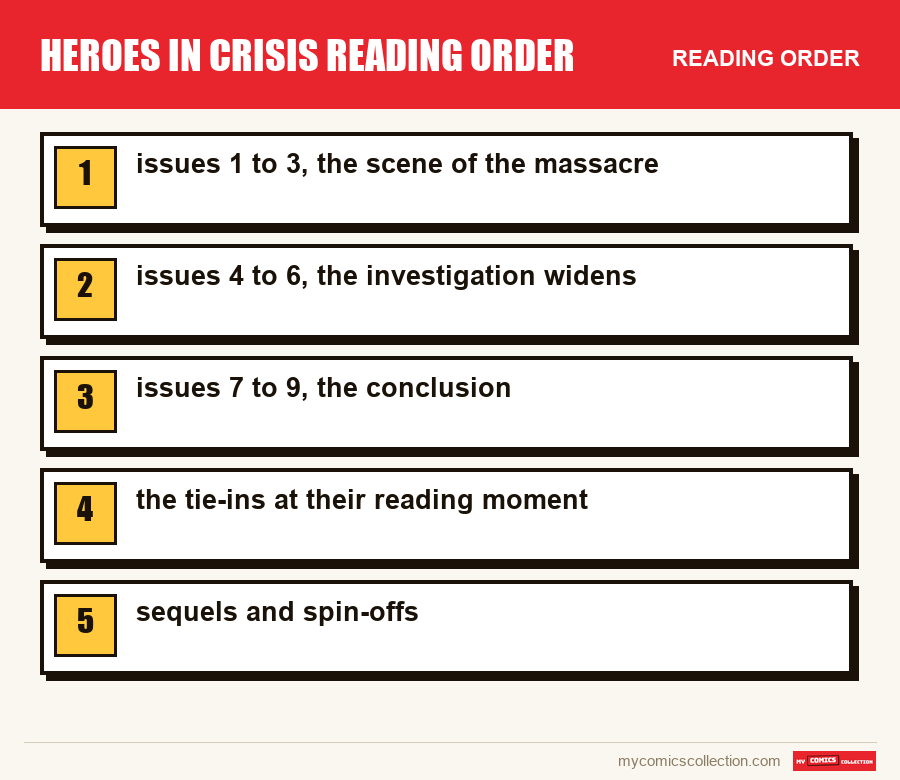
Phase 1: issues 1 to 3, the scene of the massacre
The first issue came out on September 26, 2018. It stages a massacre at the Sanctuary, where only Booster Gold and Harley Quinn survived. Neither remembers what happened, and each suspects the other, which makes them protagonists and suspects at once. Several heroes are among the victims of the first issue, and it is these losses that feed the tie-ins in the regular series.
Issues 2 and 3 set up the investigation. Batman, in the third issue, concludes that a patient of the Sanctuary is responsible and sets off after a mysterious figure that the story calls "the Puddler." He runs into the location's artificial intelligence, which he cannot manage to access. Harley Quinn, for her part, escapes by tricking Wonder Woman and threatening Batman. Remember the method more than the detail: these three issues lay down suspects, a location and a question, and the rest of the series turns them upside down.
On the art side, Clay Mann is the credited artist of the series, but the pencils credits also include Mitch Gerads, Travis Moore, Lee Weeks and Jorge Fornés. The covers are by Clay Mann, J. G. Jones, Mark Brooks and Francesco Mattina. The exact breakdown by issue matters little for reading: remember that Clay Mann sets the visual tone of the whole.
Phase 2: issues 4 to 6, the investigation widens
We don't go into detail on this part: the series presents itself as a mystery, and every issue summary would risk giving away its mechanics. Just remember that the reading follows release order, with no tie-in to slot in, and that the nine issues form one continuous block.
A tip on method: take these three issues in a single sitting. In a mystery with suspects, reading spread over several weeks makes you lose the thread of who knows what. Along the way, note the names of characters, places and nicknames such as the Puddler, because they are the landmarks that matter when the story retraces its steps.
Phase 3: issues 7 to 9, the conclusion
The miniseries ends in May 2019. The last three issues close the story, and the series received a mixed critical reception, with praise for Clay Mann's art and reservations about the pacing and the ending. It is up to you to judge: read the whole series before forming an opinion, because the ending only makes sense through the construction that precedes it.
If you want to stay spoiler-free to the very end, avoid reading the series page or reviews before the ninth issue. The rest of this article reveals no solution.
Phase 4: the tie-ins at their reading moment
The official tie-ins extend the event into a few regular series. The most useful ones are read after the miniseries, because they detail its repercussions rather than shed light on it.
- Batman #64-65: the "The Price" arc, written by Joshua Williamson, with Guillem March and Rafa Sandoval on art.
- The Flash #64-65 and The Flash Annual #2: the repercussions on Flash's side, with The Flash #63 as a related issue.
- Green Arrow #45: the tie-in from Oliver Queen's series.
- Red Hood and the Outlaws #27: the tie-in from Jason Todd's series.
- Titans: another series also linked to the event.
These issues read well as a block once the miniseries is finished. For Batman and The Flash, the collected edition Heroes in Crisis: The Price and Other Stories, released in October 2019, gathers Batman #64-65, The Flash #64-65 and The Flash Annual #2 in a single volume.
Do you collect this series?
Track what you own, what you are missing and what your collection is worth. 7-day trial.
Start my trial →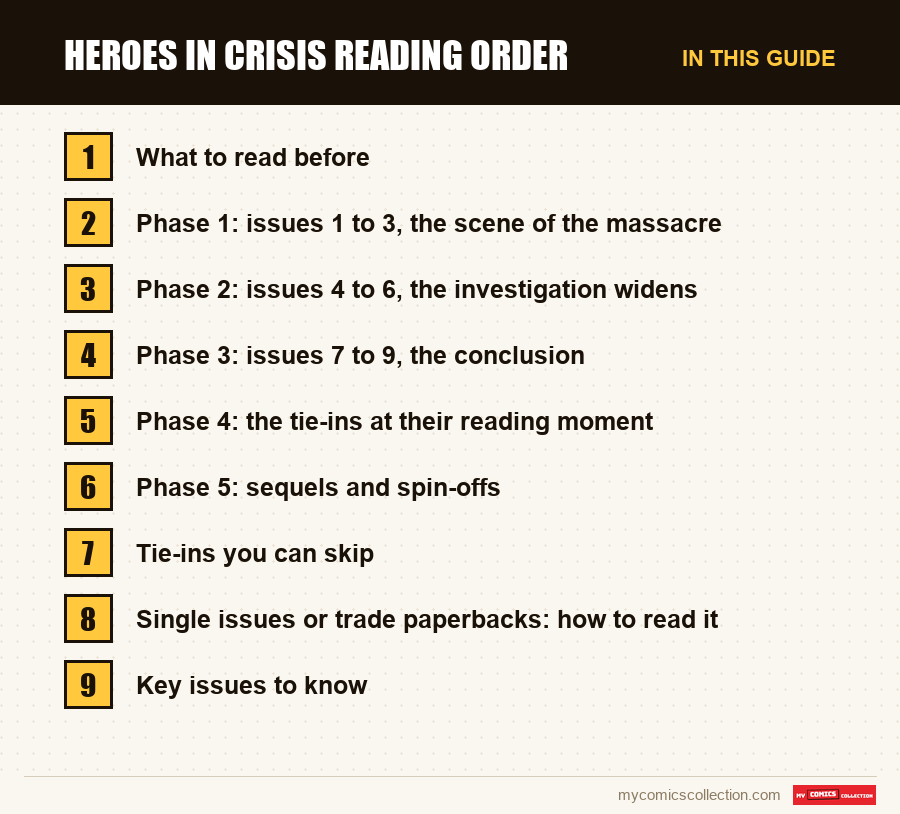
Phase 5: sequels and spin-offs
The event gave rise to two spin-off series. Harley Quinn and Poison Ivy, written by Jody Houser and drawn by Adriana Melo, began on September 4, 2019 and ended on February 12, 2020. Flash Forward, written by Scott Lobdell and drawn by Brett Booth and Norm Rapmund, began on September 18, 2019 and ended on the same date as the previous one, February 12, 2020. Its epilogue, planned for the Generations series, ultimately appeared in the Flash Forward collected edition, because of the COVID-19 pandemic.
These two series are read after the nine issues and the The Price and Other Stories collection, never before: they start from the situation left by the end of the miniseries. Their release, two weeks apart in September 2019, lets you follow them in parallel up to their shared final issue in February 2020.
Tie-ins you can skip
For a reader who only wants the main story, no tie-in is required: the miniseries tells its investigation from start to finish. Green Arrow #45 and Red Hood and the Outlaws #27 extend the event into two regular series, and they mostly interest those who already follow those series.
The 2019 spin-offs are optional for the same reason: they extend the story of specific characters, and reading them makes more sense if you like those characters. And if you don't follow Joshua Williamson's The Flash, you can settle for the collection The Price and Other Stories for the main repercussions.
Single issues or trade paperbacks: how to read it
The miniseries has nine issues, and the trade paperback allows continuous reading, which serves the construction of a mystery well. The volume Heroes in Crisis collects issues 1 to 9 and was released in October 2019; it is the simplest choice for the main series.
For the tie-ins, the collection The Price and Other Stories, released the same month, covers Batman #64-65, The Flash #64-65 and The Flash Annual #2. The issues of Green Arrow and Red Hood and the Outlaws remain to be found in the collected editions of their respective series, which we don't detail here.
Our method: read the main series trade, then the tie-in volume, then the spin-offs if you want to keep going. If you collect single issues, group the nine issues in one box and note the covers, which are by several artists. Before buying a trade, check the exact table of contents of the edition you chose.
One last practical tip for this nine-issue mystery: if you are reading Heroes in Crisis in single issues, take them strictly in order and do not flip ahead to the final issues, because the whole series is built around the investigation at Sanctuary and its final resolution.
Key issues to know
For a recent event, the sought-after issues are spotted by their place in the story and by their covers, not by a historic first appearance. Here are the most useful landmarks.
- Heroes in Crisis #1: the start of the event, released on September 26, 2018.
- Heroes in Crisis #9: the last issue, in May 2019.
- Batman #64 and #65: the two issues of the "The Price" arc, tied to the event.
- Heroes in Crisis #3: the issue where Batman sets off on the Puddler's trail, a useful landmark in the middle of the investigation.
How do you evaluate a copy? Before buying an issue, check which cover it carries: the miniseries has several by different hands, those of Clay Mann, J. G. Jones, Mark Brooks and Francesco Mattina. Our evaluation tips are in the page on key issues of events.
Recap: the complete order
- Optional: Tom King's Batman, where the Sanctuary is introduced
- Heroes in Crisis #1 to #3: the massacre and the start of the investigation
- Heroes in Crisis #4 to #6: the investigation widens
- Heroes in Crisis #7 to #9: the conclusion
- Batman #64-65, The Flash #63 to #65 and The Flash Annual #2
- Green Arrow #45 and Red Hood and the Outlaws #27
- Spin-offs: Harley Quinn and Poison Ivy and Flash Forward
- Optional: Titans, another series linked to the event
Frequently asked questions
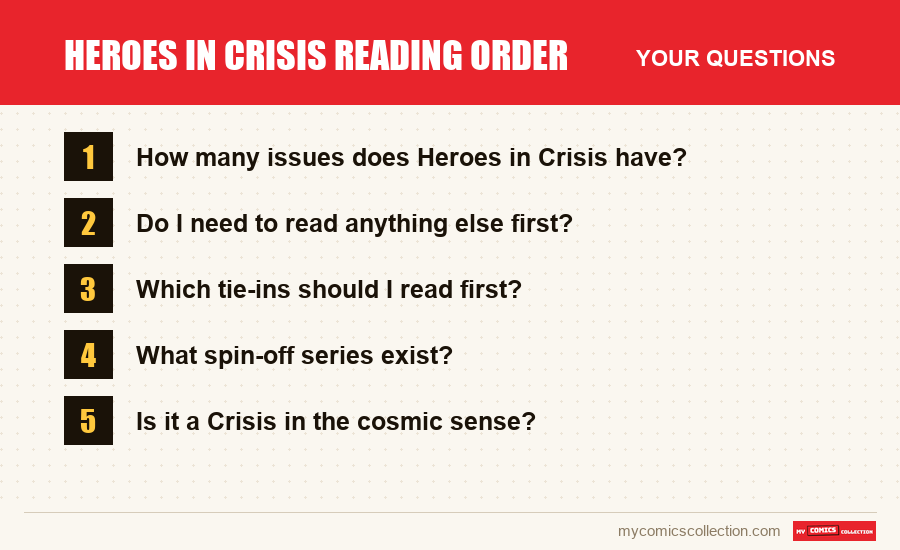
Nine issues, published between September 2018 and May 2019. The first came out on September 26, 2018. Tom King is the writer; Clay Mann draws, backed by Mitch Gerads, Travis Moore, Lee Weeks and Jorge Fornés. The collected edition that gathers the nine issues was released in October 2019.
No, the miniseries can be read with no prerequisites. The Sanctuary, the central location of the story, was introduced by Tom King in his run on Batman, but the story presents it as a secret rehabilitation center, founded by Batman, Superman and Wonder Woman. Reading that run beforehand is a bonus, not a requirement.
The easiest to find are Batman #64-65, The Flash #64-65 and The Flash Annual #2, collected in the trade The Price and Other Stories. Next come Green Arrow #45 and Red Hood and the Outlaws #27, tie-ins to two regular series. None is required to understand the main series.
Two spin-offs came out in fall 2019: Harley Quinn and Poison Ivy (Jody Houser and Adriana Melo), from September 4, 2019 to February 12, 2020, and Flash Forward (Scott Lobdell, Brett Booth and Norm Rapmund), from September 18, 2019 to February 12, 2020. They extend the story of specific characters from the main series.
No. The title follows DC's "Crisis" tradition, but the series is presented as a police investigation, with no cosmic threat. It unfolds around a massacre in a secret rehabilitation center. It is therefore a more intimate read, closer to a crime story than to the publisher's big crossovers.
Do you own the Heroes in Crisis miniseries or its tie-ins? Get your copy appraised.
Appraise my comic