
In short
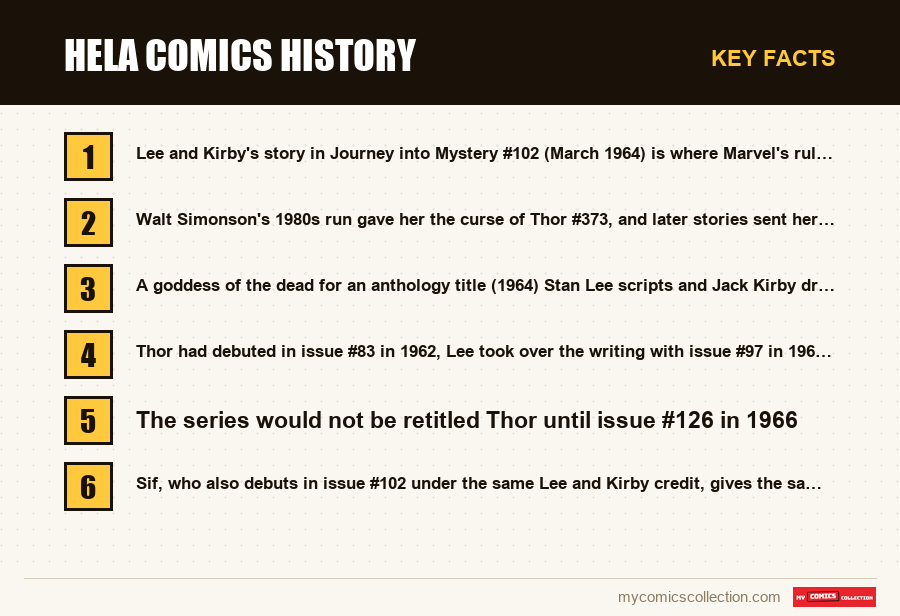
Lee and Kirby's story in Journey into Mystery #102 (March 1964) is where Marvel's ruler of the dead first walks on. She began as a ruler of the dead whom Thor had to face, then spent the Silver and Bronze Ages stealing pieces of Odin's soul and killing Thor. Walt Simonson's 1980s run gave her the curse of Thor #373, and later stories sent her through the New Mutants, Siege, Angela's conquest of Hel and the Thanos alliance of The Unworthy Thor.
Most villains earn their place by fighting a hero. Hela earned hers by owning the place where heroes end up. From the moment she walks into Journey into Mystery, the question around her is not only whether Thor can beat her, but what Asgard owes to the dead and what Odin will pay to keep a soul out of her hands. That makes her trajectory unusual: she stays tied to one pantheon for sixty years, yet she keeps wandering into other corners of the Marvel universe.
Every issue number, cover date and creator credit in this timeline was matched against published listings one entry at a time; where a run's writer or artist could not be matched, the entry names the issue and stops there. The reading of what each period changes for the character is analysis.
A goddess of the dead for an anthology title (1964)
Stan Lee scripts and Jack Kirby draws the story that opens the door to Hel, in the issue dated March 1964. The book is still an anthology by name. Thor had debuted in issue #83 in 1962, Lee took over the writing with issue #97 in 1963, and Kirby became the regular artist with #101 in 1964, so Hela comes one issue after the artist who would define Asgard's look settled into the strip. The series would not be retitled Thor until issue #126 in 1966.
What changes for Marvel's Asgard is scope. Hela is a function of the cosmology rather than a rival with a personal grudge: she rules the dead of Hel and Niflheim, with no power over the dead of Valhalla, and she is adapted from Norse myth rather than invented from scratch. Sif, who also debuts in issue #102 under the same Lee and Kirby credit, gives the same cover date a second lasting Asgardian. For anyone building a timeline, that single issue holds two characters whose stories will be tangled together for decades.
Her threat in these early pages is structural. She is written as a ruler defending her realm rather than a conqueror after a throne. That framing is why she keeps returning whenever a story needs a stake bigger than a fight, and it explains why creators in every later decade could pick her up without having to reinvent her.
Tempting Thor in the Kirby years (1966 to 1970)
The title becomes Thor with issue #126 in 1966, and Hela's next notable stretch falls inside Kirby's run. In Thor #150, dated March 1968 and drawn on the cover by Kirby, the Wrecker's attack leaves Thor dying and Hela appears to him. In Thor #154 Thor refuses her temptation. In both she offers Thor the end of the fight instead of forcing it.
This is also the period in which the book's tone stabilizes. The "Tales of Asgard" back-up feature ran until Thor #145 in 1967, and Thor #159 in 1968 revealed that Donald Blake was a fabrication created by Odin. Each of those changes pushed the series away from a hero's double life on Earth and toward the family drama of the Asgardian court, which is where Hela is most useful. Kirby stayed on the title until Thor #179 in 1970, so the central stretch of Hela's Silver Age presence belongs to the artist who drew her debut.
Stealing Odin's soul: Infinity and the early Bronze Age
Kirby's last issues and the years after him, when Gerry Conway writes the series with John Buscema and Sal Buscema on art, turn Hela's attention to Odin. In Thor #177, still before Kirby's exit at #179, she steals a portion of the sleeping Odin's soul, creating the entity called Infinity, and in Thor #184 Infinity takes control of Odin. The story shifts her from a figure who waits at the end of a hero's life to one who actively reaches into the royal family.
Then the stakes get personal for Thor himself. In Thor #186 she kills him, and he is restored after the Silent One's sacrifice. In Thor #189 and #190 she kills him again by endangering humans, and he is restored after Sif offers to die in his place; the art for #190, dated July 1971, is credited to John Buscema. Each death is reversed, which keeps her usable. A last chapter of the sequence comes in Thor #199 and #200, where she battles Pluto for Odin's soul after the Mangog kills Odin, and in #201, where she restores Odin to keep Pluto from claiming him. By the end of that run she has been both the thief of the king's soul and the one who gives it back.
Plotting Ragnarok with Loki
The next appearance worth tracking is a partnership. In Thor #277 and #278 Hela schemes with Loki to bring about Ragnarok, and the plot is foiled when Odin prevents the death of Balder. Thor #301 then shows Balder restored after a battle with the Celestials.
This is the moment where Hela stops being a solo antagonist and becomes part of an ensemble of Asgardian threats. Loki supplies the strategy, Hela supplies the cosmic leverage, and the pairing shows how Marvel's Asgard works as a closed ecosystem of schemers who keep running into the same gods. Her reading list overlaps heavily with that of Loki's own history: when a Ragnarok story is told, both of them are usually at the table. What changes is her role: from a threat that visits to a participant in the long plan to end the world.
The Simonson years and the curse of Thor #373 (1983 to 1987)
Simonson's tenure on Thor starts at issue #337 (November 1983); Simonson leaves the art with issue #367 (May 1986), after which Sal Buscema takes over, while the scripts continue to #382 (August 1987). Hela's best-known stretch of the 1980s sits inside that window. In Thor #373 she curses Thor with eternal life, brittle bones and no ability to heal, a punishment that is more elaborate than killing him because it removes the exit she usually controls. In the Mephisto miniseries, issue #4, she contests Mephisto over Thor's soul.
The curse then runs through the book. In Thor #378, dated April 1987, Thor creates mystical armor to protect himself. In #380, dated June 1987, he is pulverized after defeating the Midgard Serpent. In Thor #382 he uses the Destroyer to force Hela to lift the curse and restore him, which closes the arc in the issue where Simonson's writing run ends. For the character, the lesson of the Simonson years is that Hela can be made to bargain.
Hel's armies reach the New Mutants
Hela's most unexpected crossover is in a different book. In The New Mutants #77 and #78 she corrupts the Valkyrior, and Danielle Moonstar is turned against her teammates. Issues #79 and #80, then #82 through #85, carry the clash between Hela's forces and the New Mutants: she forces Eitri to forge an uru sword, and she is defeated when that sword is destroyed.
For the character's trajectory, the story proves she can carry a story outside Thor's own title. It also plants a thread that later writers pull. Moonstar returns to Hela's orbit in Dark Avengers #8, where she seeks Hela's boon, and in X-Force vol. 3 #23 Hrimhari asks Hela to save Wolfsbane's child. A collector who follows Hela only through Thor's series misses that these issues sit in other titles, with other volume numbers, and that the New Mutants run in particular lives in a different series entirely.
Do you collect this series?
Track what you own, what you are missing and what your collection is worth. 7-day trial.
Start my trial →
From Heroes Return to Ragnarok and the 2007 relaunch
Dan Jurgens and John Romita Jr. started a new Thor volume during Heroes Return. Its Ragnarok arc (#80 to #85, 2004), came from Michael Avon Oeming and Andrea Di Vito. A third volume began in 2007 with J. Michael Straczynski writing and Olivier Coipel drawing.
Hela's marker in that third volume is Thor vol. 3 #5, where she is awakened from her mortal guise after Ragnarok, and #12, where she lives in Las Vegas and agrees to help Loki return to Asgard. The mortal guise is the interesting part: after the world-ending event, the goddess of death has to be recovered rather than simply continued. X-Infernus #1 also belongs to these years, where she meets Mephisto, Blackheart, Satannish and Dormammu, a scene that shows how far her standing extends among the other rulers of afterlives. The numbering restarts with Heroes Return and again in 2007, so the same character appears under three numbering schemes in about a decade.
Siege, Avengers Prime and the Chaos King (2010 onward)
Loki's deal-making ties Hela into Siege. In Siege: Loki #1 he makes a deal with Mephisto that gives Hela part of Mephisto's netherworld for 1,001 years, and she erases Loki from the Books of Hel. Thor #611 to #614 show the Disir attacking her new realm before Thor and Tyr kill or banish them.
The next chapter takes her out of Thor's book. In Avengers Prime #1 to #5 she wields Surtur's Twilight Sword; Thor takes the sword from her, restores the Nine Worlds and banishes her. Afterward, Chaos War #2 shows her warning Pluto about the army of Amatsu-Mikaboshi, and Chaos War: Ares #1 shows her, with other rulers of netherworlds, enslaved by the Chaos King. The New Mutants line returns in volume three, issues #11 and #29 to #30, the latter in the Fear Itself period. What changes for Hela across these books is her status: she becomes a character who can lose a realm, be banished by a named weapon and be reduced to a slave.
Angela, Thanos and Knull: the recent turns
The Angela: Queen of Hel series, issues #1 to #5, takes the character's own domain away. Angela defeats Hela and takes her crown, then abdicates and installs Balder as ruler of Hel, while Hela is taken prisoner. Balder, whose death she had plotted with Loki in Thor #277 and #278, ends up on her throne.
Jason Aaron's The Unworthy Thor, illustrated by Olivier Coipel, picks her up in a different register: in issues #3 to #5 she allies with Thanos and kisses him after revealing her identity. Later still, in the Queen in Black storyline, she drains Knull's powers and takes control of the symbiotes, before Knull kills her and regains his power. Her recent arc is a reversal of her Silver Age function: the figure who once waited for heroes at the end is now the one forced to maneuver for survival.
The key issues across her history
- Journey into Mystery #102 (1964): the debut of Hela and of Sif, a Lee and Kirby issue.
- Thor #150 (March 1968): Hela appears to Thor while he is dying after the Wrecker's attack, with a Kirby cover.
- Thor #177 (Kirby's run, before his exit at #179 in 1970): she steals a part of Odin's soul and creates Infinity.
- Thor #190 (July 1971): she kills Thor again, and Sif offers to die in his place; John Buscema is credited with the art.
- Thor #277 and #278: Hela and Loki plot to bring about Ragnarok, foiled when Odin prevents Balder's death.
- Thor #373 (Walt Simonson's writing run, 1983 to 1987): she curses Thor with eternal life, brittle bones and no healing.
- The New Mutants #77: she corrupts the Valkyrior and sets Danielle Moonstar against her team.
- Avengers Prime #1: the start of the series in which Hela wields Surtur's Twilight Sword before Thor banishes her.
How to follow Hela in a collection
Start with the debut and the Kirby run, then read forward by the numbering of each volume rather than by character name. The original run covers Journey into Mystery through #125 and Thor from #126; later volumes restart at #1 with Heroes Return, in 2007 and again in later relaunches, so a loose issue number without a volume is not enough to identify a book. The New Mutants issues are in their own series and are easy to overlook.
Collected editions give the Simonson curse in sequence, and the four-issue Balder the Brave miniseries (1985 to 1986) sits beside it. For wider context, the companion pages on Thor's Silver Age key issues and the key numbers of Asgard show where she sits among the other debuts of the period.
Frequently asked questions
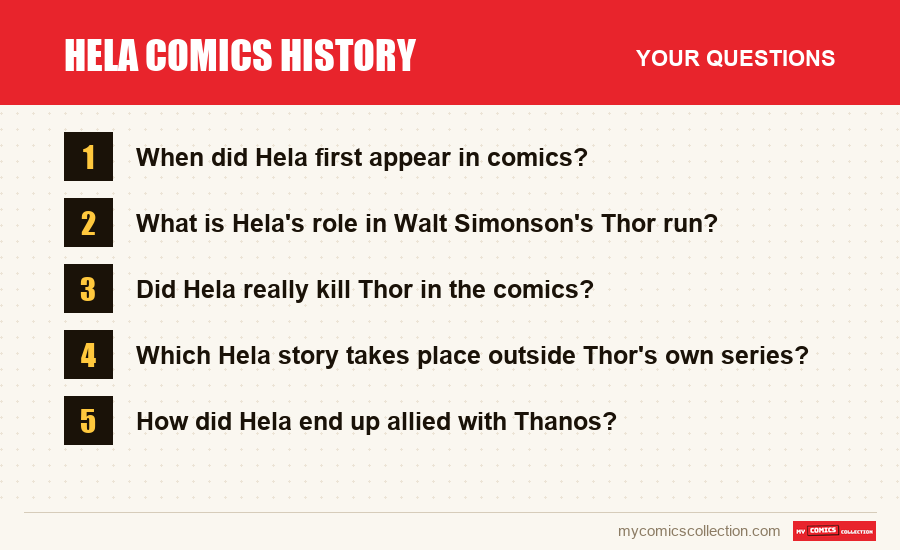
The goddess of death debuts in Journey into Mystery #102 (March 1964). It is a Lee and Kirby story. She is adapted from Norse myth as the ruler of the realm of the dead, and the same issue also introduces Sif.
Simonson wrote Thor from issue #337 in 1983 through #382 in 1987. In #373 Hela curses Thor with eternal life, brittle bones and no healing, and in #382 Thor uses the Destroyer to force her to lift the curse. The curse is the best known Hela storyline of that decade and runs across several issues.
In the Bronze Age she did, more than once. Thor #186 has her kill him, and he is restored after the Silent One's sacrifice. In #189 and #190 she kills him again, and he is restored after Sif offers to die in his place. Each time, the death is reversed.
The best known is The New Mutants #77 to #85, in which Hela corrupts the Valkyrior and sets Danielle Moonstar against her team. She also drives Avengers Prime #1 to #5, Chaos War #2 and the Angela: Queen of Hel series, so a Thor-only reading misses real chapters.
In Jason Aaron's The Unworthy Thor, drawn by Olivier Coipel, her alliance with Thanos runs through issues #3 to #5, where she kisses him after revealing her identity. It follows her loss of Hel in the Angela: Queen of Hel storyline, where Balder is installed as ruler.
If a Journey into Mystery or a Simonson-era Thor is sitting in your boxes, you can get an estimate before deciding how to store or sell it.
Estimate my comic