
In short
The goddess of death makes her entrance in Marvel's Journey into Mystery #102, dated March 1964. Stan Lee and Jack Kirby created her, adapting her from Norse myth into the ruler of the dead in Hel and Niflheim. Sif, credited to the same writer and artist, also debuts in the same issue, which is part of why collectors prize it: one cover date, two lasting Asgardian characters.
Some debuts belong to a hero's origin, and some belong to a threat that only makes sense once the hero has grown. Journey into Mystery #102 is the second kind: the goddess of death walks into the Thor title less than two years after the hero's own debut, while the book still carried the name of a monthly anthology. That context shapes everything a buyer should know about the book.
The credits and dates in this guide are limited to the cover date, the creators of the character, the series numbering around the issue and the issue numbers of her later appearances; nothing else is asserted. Inkers, letterers and colorists are omitted on purpose, and the commentary on market behavior and buying method is analysis.

The issue at a glance: March 1964, Lee and Kirby
Journey into Mystery #102 carries a cover date of March 1964. Stan Lee is the writer and Jack Kirby the artist of the story that introduces Hela, and the two are the creators credited with the character.
The anthology matters. Journey into Mystery had been a Marvel title for years before Thor arrived in issue #83, dated August 1962, and it kept its name until issue #125 of February 1966, when the series was retitled The Mighty Thor from issue #126 (March 1966). Issue #102 therefore belongs to the long middle of the title's life, between Thor's debut and the renaming, a period in which the God of Thunder shared the cover with a feature that was still growing. The feature grew from thirteen pages to eighteen with issue #105 (June 1964), which gives you a sense of how small the Thor story still was when Hela made her entrance.
A second Asgard feature had started a few months earlier. Tales of Asgard began in issue #97 (October 1963), and its early installments updated Norse mythology before turning to adventures of a younger Thor. By issue #102 the title therefore carried two Asgardian features, a sign of how quickly Lee and Kirby were widening the cast around the hero.
One more fact belongs in the identity of the book: Sif makes her debut in this same issue, also credited to Lee and Kirby. A collector who buys the issue therefore holds two Asgardian debuts at once, a point that is easy to miss if you read the title only as "the Hela issue".
What happens when Hela arrives
What matters for a buyer is the role the issue gives her. Hela enters Marvel as the ruler of the dead, a figure the Asgardians must reckon with rather than a conqueror who wants a throne, and that function is in place from her first story. She is a threshold more than a monster, a being whose power is tied to death itself rather than to armies or weapons.
Her entrance also comes with Sif, which gives the book a second point of interest that later stories would build on. Sif would become one of the central figures around Thor, and the fact that both characters arrive under the same cover date is the kind of detail that makes a single copy carry two collecting stories at once.
That portrait, a ruler who is stern but not cruel for its own sake, runs through her later appearances. She is the one the heroes must reckon with when death touches the story, and she is not the sort of villain who schemes for conquest. The distinction explains why this 1964 first appearance carries so much weight in the collector world: the character came fully formed in function, even if her design and her powers were refined later.
Look at the lineage as it developed. In Marvel's continuity Odin appointed her goddess of the dead when she came of age, giving her rule over Hel and Niflheim. She holds no power over the dead in Valhalla, a limit that shapes many of her later clashes with Thor. She is the daughter of Loki and the giantess Angrboda, born in Jotunheim, which is how she links to the god of mischief in the comics. Those details come from later stories, not from the 1964 issue, and a reader opening issue #102 expecting all of it will find only the first sketch.
Who made her, and why this setting
Lee and Kirby adapted Hela from Norse myth, keeping the role of a ruler of the dead and giving it a Marvel face. The choice fits the editorial moment. By 1964 Marvel had a stable of heroes that fought in the street and in space, and the Thor material was one of the few places where the publisher could draw directly on a mythological storehouse. Asgard let the pair test what a mythic setting could look like on the page, issue after issue.
For the collector, the creators' pairing is the point. Kirby's Asgard pages of the period are a showcase for the architecture, creatures and cosmic scale that came to define his later work, and the guide to Jack Kirby places those years in the context of his whole career. Lee's part in the issue is the scripting and the shaping of the story's moral, which is why the two names appear together on the character.
Why issue #102 is a key issue
The issue earns its place for three overlapping reasons: it is the debut of Hela, it is the debut of Sif, and it belongs to the Lee and Kirby era of the title, when the Thor mythology was being built issue by issue. Any one of them would make the book interesting; together they make it a standard stop for anyone assembling a Thor or an Asgard collection.
The character's afterlife in the comics is also long. The Mighty Thor #150, cover-dated March 1968, has her appear to Thor after the Wrecker injures him. She tries and fails to tempt Thor into Valhalla in #154, and in #177 she steals part of Odin's soul, an act that creates the entity called Infinity. She kills Thor in #186, and in #189 and #190 Sif offers to die in his place before he is revived. From #199 to #201, she battles Pluto for Odin's soul.
The 1980s add a second wave. In Thor #373 she places a curse on the hero, and the curse is lifted in issue #382. Her role in The New Mutants #77 to #80 and #82 to #85, where she corrupts the Valkyries and sets them against the young team, widens the character's reach into the X-Men corner of the line. More recent comics bring her into Avengers Prime #1 to #5 and Angela: Queen of Hel #1 to #5.
That list explains the shape of demand. Hela is the sort of character who is easy to find in later issues and hard to find at her origin, which concentrates attention on the debut. The 2017 film Thor: Ragnarok put her in front of a broad audience and sent many readers looking for the equivalent on paper; the guide to the best Hela comics sorts what they will find.
Do you collect this series?
Track what you own, what you are missing and what your collection is worth. 7-day trial.
Start my trial →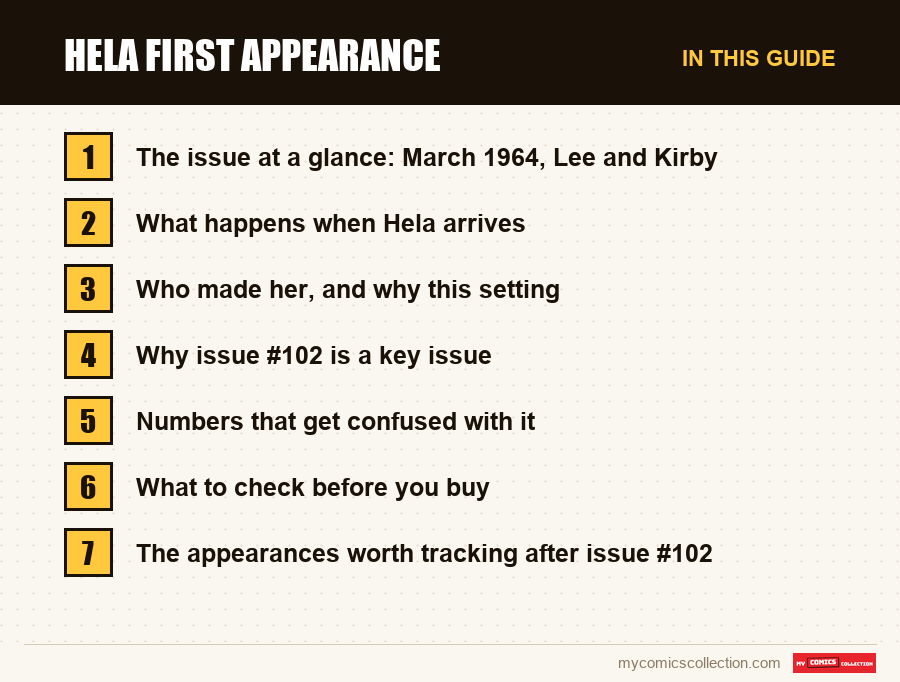
Numbers that get confused with it
Because the Hela debut is easy to overlook in a Thor title, buyers run into a handful of mix-ups.
- Journey into Mystery #83 (August 1962) is the debut of Thor himself, not of Hela. The guide to issue #83 covers that book.
- Journey into Mystery #97 (October 1963) is where Tales of Asgard begins as a backup feature, so it is an important issue for that feature but not for Hela.
- The Mighty Thor #150 (March 1968) is a major later Hela appearance, but it is a return, not the debut.
- Journey into Mystery from issue #126 is The Mighty Thor, so a seller who lists issue #126 or higher under the old title is describing a different run.
- Later volumes called Journey into Mystery reuse the title, so check that the cover date reads 1964 and not a later year.
The simple filter is the date: the debut is the March 1964 book. Everything else on the list is a neighbor that shares a title or a character with it.
What to check before you buy
An anthology comic from 1964 is a different object from a modern single-character title, and the differences determine how you inspect a copy. The most important one is that the title on the cover still reads Journey into Mystery, not Thor or Hela, so the seller's listing must name the issue number and the cover date, not just the title and a character.
Next, look at the staples and the spine. Silver Age Marvel books from this period often show stress lines near the staples, a lean in the spine and edge wear along the fold, and they are worth viewing in raking light. Many copies were read, rolled and stored in damp places, so check the paper for browning and brittleness at the edges, particularly on the interior pages. A pressed or cleaned copy can look bright and still hide a repaired spine, and a graded label should say so in the notes.
Check completeness too. Order forms and cut-out ads sat in these pages, and a missing corner or a clipped coupon reduces a book's appeal. Confirm the page count and the integrity of every interior page, because a missing leaf changes what the copy is.
For a slabbed copy, the label's grade and notes describe one physical book. To judge the 1964 market, use completed sales matched on grade and restoration, because asking prices record nothing but intentions. Our free comic valuation page helps you frame the question before you spend anything.
The appearances worth tracking after issue #102
A short list of verified follow-ups gives a shape to the hunt.
The Mighty Thor #150 (March 1968). The issue in which Hela appears to Thor after the Wrecker injures him. It is the natural second purchase, because it is the first time after her debut that she stands at the center of a Thor crisis.
Thor #186 to #190. Hela kills Thor in #186, and in #189 and #190 Sif offers to die in his place before he is revived. It is the best stretch for seeing Hela and Sif, the two debuts of issue #102, meet again.
Thor #199 to #201. The Pluto storyline, in which Hela battles the lord of the Olympian underworld for the soul of Odin.
Thor #373 to #382. The curse Hela places on Thor, and the issue that lifts it. It is the entry point most modern readers take, and it reads well on its own. Our best Thor runs guide places it within the full series.
Avengers Prime #1 to #5. A self-contained, modern version that brings her into an Avengers team story.
Buy in that order if you collect the character: debut, issue #150, the #186 to #190 stretch, the curse and the modern miniseries. It builds a coherent shelf and lets you stop at any step. The Thor side of the plan lives in the Thor key issues guide.
Frequently asked questions
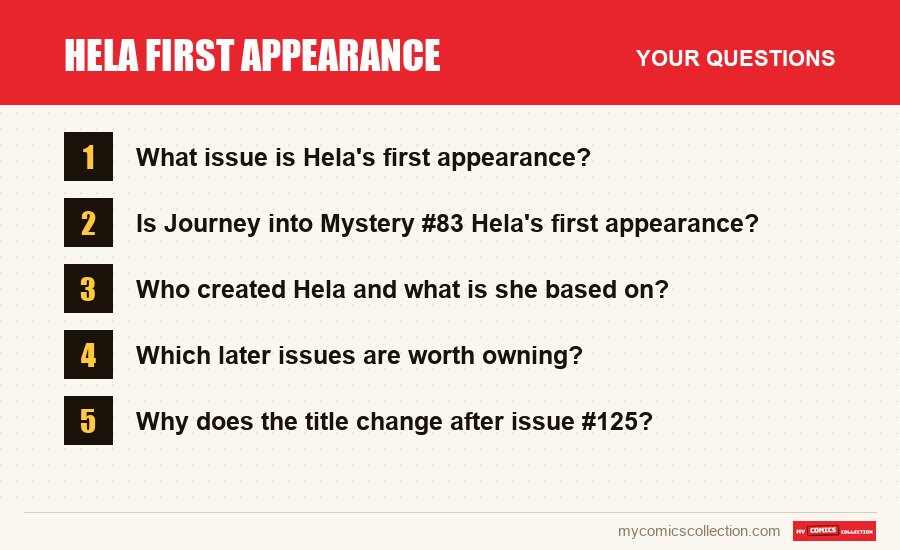
The book to find is Journey into Mystery #102 from March 1964. Stan Lee and Jack Kirby created her. The same issue also carries the debut of Sif, so the book holds two Asgardian debuts under one cover date.
No. Issue #83, dated August 1962, is the debut of Thor. Hela arrives about two years later in issue #102, under the same Journey into Mystery title. Listings often blur the two, so read the number and the year before you commit.
Stan Lee and Jack Kirby created Hela, adapting her from Norse myth. In Marvel's stories she is the goddess of the dead appointed by Odin, with rule over Hel and Niflheim, and she is the daughter of Loki and the giantess Angrboda.
Start with The Mighty Thor #150 (March 1968), then #186 to #190, the Pluto story in #199 to #201 and the curse that runs from #373 to #382. Avengers Prime #1 to #5 is the modern pick.
The series ended its Journey into Mystery run with issue #125 in February 1966. From issue #126, dated March 1966, it was retitled The Mighty Thor on the cover, with the interior numbering continuing. The 1964 debut therefore sits in the last stretch of the old title.
Holding a Silver Age Journey into Mystery and unsure how its condition and restoration affect it?
Estimate my comic