A French magazine could add a commercial subtitle to its title highlighting its star. The survey carried out on August 30, 2026 on the French market, in euros, for the query “Strange journal of Spider-Man Lug” shows 78 advertisements, between €4.00 and €29.00, with a median of €10.00. These are amounts claimed by sellers on this date on a general auction site, not completed transactions, and none of the 78 announcements relate to a copy verified by an independent body. The point to remember lies in the labels: the five cheapest ads designate the same publication in three different word orders, and the same number 195 appears twice, at €5.00 then at €6.99. Look for the main title alone, then the subtitle alone: the two lists do not overlap.
The French collector who follows the trail of the Green Goblin in the publications of his country very quickly comes up against an obstacle which has nothing to do with rarity. The object he is looking for exists in quantity, it circulates, it is cheap, and yet it escapes him half the time. The reason is purely typographical: the magazine that interests him is not always called the same depending on the person who puts it on sale. A publisher could, at one point in the life of a title, add a subtitle intended for sale on newsstands, a formula which highlighted the best-selling hero of the summary. From there, one and the same booklet has two perfectly legitimate names, and each seller chooses the one that comes to him first, or both, in the order that he likes.
The following is based on a statement dated August 30, 2026, carried out on the French market and denominated in euros, which distinguishes it from the American measurements in dollars to which this site has accustomed you. The query “Strange journal of Spider-Man Lug” returned 78 ads that day. The prices displayed range from €4.00 for the cheapest to €29.00 for the highest, with half of the ads placing themselves below €10.00. These numbers must be read for what they are: amounts that sellers were hoping to obtain at a given time. None proves that a buyer accepted them. And because the measurement was taken only once, it says absolutely nothing about an increase or a decrease: there is no second point of comparison, therefore no curve, therefore no trend.
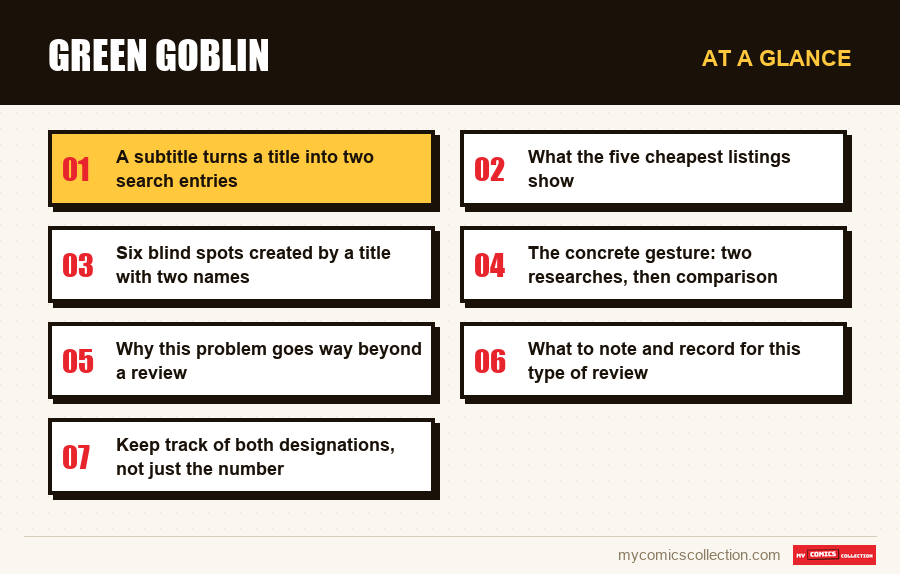
A subtitle turns a title into two search entries
The mechanism is simple to state and costly to ignore. A journal title is a string of characters. A marketplace search engine compares this string to what the seller typed in their label. If the seller wrote the main title, your main title query finds it. If he wrote the subtitle alone, your query on the main title does not find it, even though the subject is exactly what you are looking for. The subtitle does not add a nuance: it opens a second entrance door to the same stock, and the two doors do not open onto the same room.
In the statement of August 30, 2026, this phenomenon can be seen with the naked eye on the five least expensive advertisements. A first offers “STRANGE 181 from 1985 SPIDER-MAN diary in very good condition” at €4.00: the main title opens, the subtitle follows. A second poster “STRANGE N°189, LUG edition, MARVEL, the spider-man journal, good condition” at €4.00: same order, but the publisher and the original house are interposed, and the case changes completely. A third, “Comics Strange The Avengers No. 212 Marvel Lug 1987 The Spider-Man Diary” at €5.00, stacks three layers of information: the main title, cited content, then the rejected subtitle at the very end.
The last two are the most informative, because they concern the same number. “The Spider-Man Journal: Strange monthly n°195 V.F: March 1986” sells for €5.00 and places the subtitle at the top, even before the title of the magazine. “Strange 195 The Spider Man Diary Marvel Lug March 1986” sells for €6.99 and restores the usual order. A buyer who would have typed only the main title would have seen the second and missed the first, and would therefore have paid two euros more for an identical booklet available a few lines away.
What the five cheapest listings show
Three word orders, one object
On five low-cost ads, the main title and its commercial subtitle appear in three distinct arrangements: subtitle second, subtitle rejected at the end of the wording after cited content, and subtitle placed very first. None of these wordings are wrong. They all correctly describe the same post, but they don't answer the same queries.
The same number at two prices
Number 195, dated March 1986, appears twice in this short sample: at €5.00 and at €6.99. Nothing in the wording justifies the discrepancy. It is the same booklet, put on sale on the same day, on the same site, by two people who do not agree on what it is worth. An amount claimed remains an individual opinion, even on an abundant item.
Floating punctuation and capitalization
The subtitle is found with or without a hyphen, in full lowercase, in capitals, or with initial capitals. A search that requires the exact string, including quotation marks, automatically excludes some of the ads. In this segment, the spelling tolerance of the engine is one of the result variables.
A third layer: cited content
One of the announcements inserts the mention of the content of the issue between the title and the subtitle. The label then carries three pieces of information at different levels. This practice is useful to the human reader and destabilizing for search: it moves the keywords away from each other and shifts the ad to results other than those targeted.
One detail is worth emphasizing: these five ads are the five least expensive, not five ads taken at random. They therefore constitute a tiny subset of the 78 recorded, and there is nothing to confirm that the rest of the lot behaves in the same way. What they establish is modest and solid: the dispersion of wording does indeed exist, including on the most visible offers in a list sorted by increasing price, those that a buyer looks at first.
None of the 78 lots noted on August 30, 2026 concerns a copy verified by an independent organization. On this segment, no one outside has attested to the title, number, integrity of the booklet or its condition. It all depends on the seller's description and the photographs he provides.
This absence is neither a defect nor a signal: it describes a market where the cost of an external verification would greatly exceed the amounts involved, since half of the advertisements are below €10.00. It simply requires reading the photos carefully rather than relying on a condition statement.
Six blind spots created by a title with two names
The single query
Looking for just one of the two names seems sufficient as long as you don't know that the second exists. This is the central trap: the list obtained seems complete, it displays dozens of results, it gives all the appearances of exhaustiveness, and yet it leaves out of scope a part of the offer that no indicator indicates.
The period of use of the subtitle
A commercial subtitle does not necessarily accompany the entire life of a magazine. It can appear, last, disappear. Until you note which issues you actually saw it on, you won't know if its absence on an ad indicates an issue from another period or simply a laconic salesman.
The literal form
Hyphen present or absent, random capital letters: the same expression takes several written forms. A search between quotes, which imposes the exact string, excludes part of it without saying so. In this corpus, several spellings coexist in only the five cheapest ads.
The unattested state
Zero copies verified out of seventy-eight advertisements. The condition statements read in the descriptions noted all come from the seller. They may be accurate, but they are not confirmed by anyone, and no two sellers use the same vocabulary to describe the same issue.
The invisible duplicate
The number 195 is present twice in two formulations. If you don't match the ads by number, you don't see that they are two competing offers of the same item, and you lose the only element of direct comparison you had that day.
Content cited misleadingly
When a seller adds the name of content in the issue to the label, this mention competes with the title of the journal in the results. It can bring up the ad on queries unrelated to your search, and make it disappear from yours.
Collecting this series?
Track what you own, what you are missing and what your collection is worth. 7 day trial.
Start my trial →The concrete gesture: two researches, then comparison
The practical conclusion takes two minutes of additional work. Start a first search on the main title alone, without the subtitle. Run a second one on the subtitle alone, without the main title. Sort both listings by ascending price. Then compare them by identifying the numbers that appear in one and not the other. You'll almost always get two partially overlapping sets, and the union of the two is larger than each in isolation.
A third query is often worthwhile: one that combines the two formulas, like the query used for this statement. It favors sellers who have written both designations in the same wording, and it de facto excludes those who have only retained one. This is useful for getting a clean, well-described core, but it is never an exhaustive search, and it would be wrong to take the number of listings it returns as the actual size of the bid.
Then match the announcements by number rather than by wording. This is the only comparison that makes sense: the wording varies depending on the seller, the number does not vary. The case of 195 alone demonstrates this: two announcements, two prices, one item. Without this comparison, no comparison is possible, and the buyer takes the first offer he sees believing that it is the only one.
Finally, keep the measure at its true value. A median of €10.00 calculated on 78 listings claimed on a given day indicates where seller requests are on that date, on that site, in that currency. It does not say what the buyers paid, it does not say what the same statement would give a month later, and the maximum of €29.00 reflects the hope of an isolated seller much more than a market level. These reservations are not stylistic precautions: they delimit exactly what the data allows us to assert. Using the same logic, our article devoted to buying Spider-Man at a low price details how abundant supply shifts the question of budget to that of selection.
Why this problem goes way beyond a review
The commercial subtitle is just one of the ways in which the same object acquires several names. A publication may change formula, format, periodicity, be reproduced under another format, or simultaneously bear a publisher designation and a usage designation. Each time, the consequence is identical: the catalog has a single entry, and the market produces two or three. The seller writes what he reads on the cover, what he remembers from his childhood, or what he believes is most wanted.
This dispersion works in both directions. It makes you miss deals, but it also makes you find cheaper ones, precisely because other buyers miss them too. A poorly worded ad is an ad that is rarely seen. Little seen, it attracts fewer bidders, and its seller often ends up putting it back online at a lower price. The difference between €5.00 and €6.99 on number 195 illustrates on a small scale what visibility does to the asking prices, without either announcement being abnormal.
The same reasoning applies as soon as a booklet is identified by something other than its number. An episode title, a guest character's name, a cover teaser: all strings of character that can serve as an entry point for a buyer and be absent from an otherwise perfectly honest ad. Our analysis of the value of a number carried by a first appearance shows to what extent the identification of a booklet and its displayed price depend on two independent logics.
Remember it as a method rather than an anecdote. Before concluding that a booklet is unobtainable or expensive, ask yourself under how many names it may have been offered for sale. The answer is rarely “just one.” It is almost always “two”, and sometimes more when the wording also includes a mention of content, a date, a periodicity or a name of publisher.
What to note and record for this type of review
The main title and the subtitle, separately. Note the two strings in two separate fields, never merged into a single line. This is what will allow you to restart each search independently later, and find your own copy in your inventory whatever name comes to mind that day.
The number, isolated from everything else. The number is the only stable data between two announcements which are not spelled the same. The 195 of March 1986 remains the 195 whether the seller opens his description with the title or the subtitle. Record it alone, without prefixes or abbreviations, so you can sort and reconcile effortlessly.
The period during which you noticed the use of the subtitle. Don't make it up: just write down the numbers where you saw it with your own eyes, with their date when it appears. A list of observations is better than an approximate range, and it is corrected as your collection grows.
The actual content of the number, as you verified it. A seller label can cite content, such as that of 212 noted on August 30, 2026. This mention is seller information, not a table of contents. Open the booklet, note what it actually contains, and keep that note separate from what the ad said.
The price paid, including shipping, with the date and currency. In this French segment, the amounts are expressed in euros and the shipping costs are heavy compared to a booklet costing €4.00. A price noted without its shipping and without its date cannot be compared to anything. Add the name under which you found the ad: this is what will tell you, in the long run, which of the two searches brings you the most.
Because a publisher could add to its title a commercial subtitle intended for sale on newsstands, highlighting the star character of the summary. Both names are correct and appear on the object itself. Sellers then choose one, the other, or both, in the order that suits them.
78 advertisements, noted on August 30, 2026 on a general auction site, French market, amounts in euros. These are prices asked by sellers that day, not closed sales. A measurement taken on a single date does not allow any price movement to be observed, either upwards or downwards.
No. The maximum is the amount the most optimistic seller hoped to get by that date. There is no indication that a buyer accepted it. The median of €10.00, which divides the 78 advertisements into two halves, describes the level of demand in this segment much better than the extreme value.
We must take it into account, not be suspicious of it. None of the 78 advertisements concerns a copy certified by an independent body: neither the title, nor the content, nor the condition are confirmed by a third party. On amounts half of which are below €10.00, this is expected. This simply shifts the review to the photographs and description.
By the fact that a displayed price is a seller's opinion. The two announcements concern issue 195 of March 1986, the same day, on the same site, with different wording. One places the subtitle at the top, the other the main title. Nothing in the descriptions justifies the difference of two euros.
Keep track of both designations, not just the number
My Comics Collection lets you record a booklet with its title, subtitle, date, verified content and the price paid, shipping included. You find your copy whatever name comes to mind, and you know immediately if the ad you are looking at is a duplicate of what you already have.