An ad whose entire title is three words and a number is not a good deal: it's an empty box. On the August 30, 2026 statement for the query "Green Goblin Amazing Spider-Man 14", an ad labeled "AMAZING SPIDER-MAN #14" was asked for $4.74 with no year, no state, no mention of edition. The same wording can designate the issue from the sixties or a number 14 from a series relaunched since. As long as these three unknowns are not resolved, no opinion is possible: neither "it's expensive", nor "it's cheap". Three questions to the seller are enough to decide, and his silence also decides.
There is a category of advertisements in front of which the experienced buyer and the beginner are exactly equal: those which describe nothing. The seller typed in the series name, number, and stopped there. No year. No condition, even approximate. No indication of edition or reprint. The price is well informed, and it is low. It is precisely this combination that makes the ad dangerous: it occupies the bottom of the ranking by increasing price, where the eye lands first when trying not to pay too much, and it provides absolutely no information allowing you to know what you are looking at.
The August 30, 2026 statement on a general auction site in the American market provides a textbook case. The following amounts are those claimed by sellers on this date for copies still offered, not completed transactions, and copies passed by a verification body are counted in a separate population. A measurement taken on a single day does not tell any trajectory: it photographs a state of demands, nothing more. This is sufficient for what is being discussed here, because the demonstration does not relate to a price level but to a lack of description.
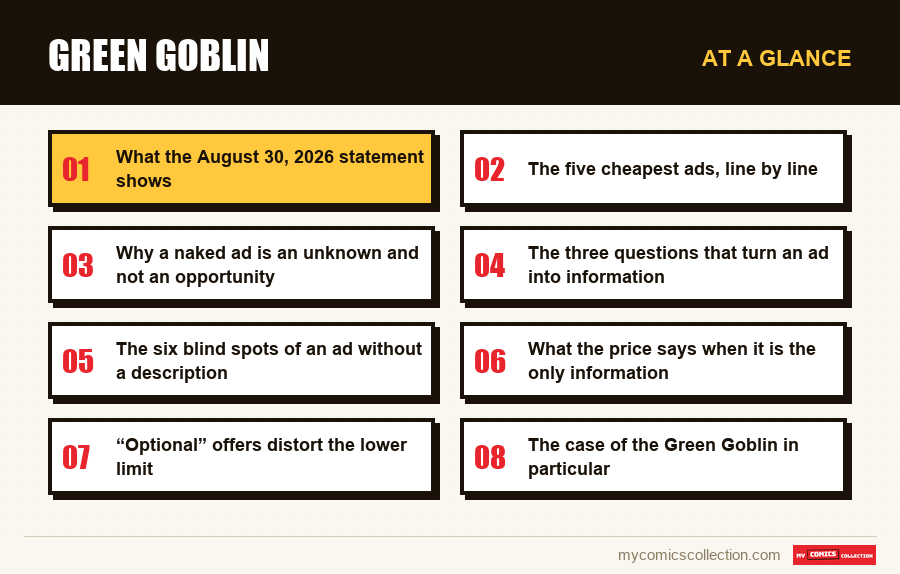
What the August 30, 2026 statement shows
The query “Green Goblin Amazing Spider-Man 14” returned 109 unverified listings that day, with a claimed minimum of $2.95, a median of $21.88, and a maximum of $8,250.00. Counted separately, the copies passed through certification form a set of 53 advertisements: minimum $74.99, median $2,500.00, maximum $14,900.00. The two populations do not overlap, and that is the essential thing: on one side there are objects whose identity or state no one has established, on the other side objects whose two points have been decided by a third party. The maximum of $14,900.00 says nothing about an observed price; it says what a seller hopes to get, which is information about him, not the market.
The five cheapest ads, line by line
The first in the ranking, at $2.95, is called “Amazing Spider-Man Vol 1 2 3 4 5 Multiple Back Issues [...] PICK & CHOOSE.” This is not an ad for a specific item: it is a stock offered to choose from, the displayed price of which corresponds to the cheapest item in the lot, not the one you came to pick up. It appears at the top of the ranking by construction, without anything guaranteeing that the coveted number appears there, or in what condition.
The second and third, at $3.99 and $4.24, designate the same item: “The Superior Spider-Man #27 [...] NM (2014 Marvel Now)” and “The Superior Spider-Man #27 NM 2014”. They concern a title other than that of the request. They are returned because a search engine matches words, not bibliographic identities. These two are at least descriptive: they announce a year, a state and an editorial context. We can disagree with them, but we can judge them.
The fourth, at $4.74, is the one that concerns us. Its full title is “AMAZING SPIDER-MAN #14”. That's all. No vintage, no condition assessment, no edition accuracy. The wording is compatible with the old issue as well as with a number 14 belonging to one of the series since relaunched under this name. Nothing in the title allows us to decide between the hypotheses.
The fifth, at $4.95, is a second offer of your choice: “Amazing Spider-Man Vol 1 2 3 4 5 6 Multiple Back Issues [...] PICK & CHOOSE.” It works exactly like the first, with a slightly larger catalog.
The overall picture deserves to be clearly stated. Of the five cheapest ads in the survey, two are choice offers, two are for another title, and only one has the desired wording: without saying anything about it. In other words, the lower part of the ranking does not contain, on that day, any proposition that is both identified and described.
Why a naked ad is an unknown and not an opportunity
One wording, several possible objects
“AMAZING SPIDER-MAN #14” is not a unique designation. The series name has been used several times, and each cover has produced its own number 14. The title alone therefore does not allow us to know which object we are talking about, or even to which decade it belongs.
State is half the value
For an old booklet, the gap between a worn copy and a preserved copy can be measured in orders of magnitude. An announcement that says nothing about it leaves no ground: we can neither evaluate, nor negotiate, nor compare to what we see elsewhere.
Editing is never a detail
The same content may have been printed several times. Without mention of edition or year of printing, nothing distinguishes the original edition from a later reprint, and this distinction is often the essence of what we pay.
The price does not fill the void
Low amount is not a description. It is at best a clue to what the seller believes he has, and this clue almost always points to the least flattering hypothesis. It never replaces identification.
The numerical comparison makes it brutal. Between the listing at $4.74 and the median of verified copies at $2,500.00, the ratio exceeds five cents. Such a discrepancy has no single reading: either the two advertisements relate to different objects, or they relate to the same object in incomparable states, or one of the two is seriously mistaken. The important point is that none of these three readings can be ruled out from the information displayed. This is exactly what “unknown” means: several worlds remain possible, and nothing in the announcement allows a single one to be eliminated.
A useful reflex: when an ad is significantly less expensive than everything around it and significantly less informed, it is not a coincidence. The lack of description and the low price describe the same reality seen from two sides.
A seller who has the old booklet in good condition would describe it. This is his most direct interest: each precision added to the title increases what he can ask for. The lack of precision is therefore information in itself, even if it is not proof.
The three questions that turn an ad into information
Everything is in one sentence to send to the seller: what year, in what condition, what edition. Three unknowns, three short answers. A serious seller responds in two lines, because he has the item on hand and this information appears on it. There is no research to do, no expertise to mobilize: just read the cover and the legal information page, then look at the copy.
The question of the year is the first because it decides identity. As long as we do not know which series the number comes from, everything else is irrelevant: discussing the condition of an object that we have not identified is an empty exercise. Formulate it unambiguously and ask for the year on the copy itself, not that of the story or the character.
The question of state comes next, and it benefits from being asked by asking for photographs rather than an adjective. The terms used by salespeople vary greatly from person to person; pictures of the four corners of the cover, the spine and the stapling say more than any verbal assessment. The refusal to photograph an object that we have physically in front of us is, again, a response.
The edition question closes the file. It concerns the possible presence of a reprint mention and the conformity of the printed cover price to what is expected for the announced period. It is the most technical of the three, but also the most discriminating when the first two answers seem correct.
There remains the case of silence. A lack of response is not neutral and should not be treated as such: it is an exploitable result, which allows you to classify the ad and move on to the next one without hesitation. You haven't lost anything, on the contrary, you have obtained in a few days the least expensive information to collect: the information that tells you not to continue.
The six blind spots of an ad without a description
The identity of the series
The name alone does not designate a unique series. Without a year, the number 14 floats between several distinct editorial groups, whose values have no relation to each other.
Year of publication
It is the data that locks everything else. It is printed on the object, it does not require any research from the seller, and its absence in an ad is hardly unintentional.
The material state
Neither overall assessment, nor mention of the usual defects: folds, discoloration of the spine, corners, staples, missing page. None of this is remotely verifiable without images.
Shipping method
An old booklet travels poorly if it is poorly packaged. The announcement does not say whether it will leave protected and stiffened or slipped into a simple envelope, which is not a detail on a fragile object.
The nature of the offer
The survey shows that optional offers are included in the results. The price displayed corresponds to the cheapest item in the lot, not the one you are looking for, which is not clearly indicated anywhere.
The actual content
A number without context doesn't say what's in it. Two buyers can aim for the same figure for different reasons and find themselves, upon receipt, in front of two unrelated objects.
What the price says when it is the only information
In a complete ad, the price is a conclusion: it comes after the description and is judged in relation to it. In a bare ad, it changes status and becomes the only data available. It must then be read as such, that is to say as an implicit declaration by the seller on what he thinks he holds.
This reading is not a certainty, but it has a direction. A seller who had in his hands a properly preserved old booklet would have no reason to offer it at $4.74 when the median of verified copies was $2,500.00 on the same day. The hypothesis which most simply explains this price is that of a recent, current or very damaged object. It's a guess, not a verdict, but it's the one we should default to.
However, we must be careful not to draw a mechanical rule from this. Sometimes a seller doesn't know what they're selling, and interesting items actually fly under the radar. Simply, this configuration is rare, it cannot be recognized by the price alone, and it is verified in exactly the same way as the rest: by asking the three questions. Betting on seller ignorance is only a good bet when it is confirmed by photographs.
One final point about the numbers themselves. The median of unverified ads, $21.88, reads as the center of today's requests for this query, as the engine constitutes it: that is, including other titles and offers to choose from. It describes an ad feed, not the value of an item. None of these measurements, taken on a single date, makes it possible to say that a price is rising or falling: for this to happen, several measurements would be required spaced out over time, and the subject of this article is elsewhere.
Collecting this series?
Track what you own, what you are missing and what your collection is worth. 7 day trial.
Start my trial →“Optional” offers distort the lower limit
Two of the five least expensive listings in the survey are choice offers. This is not a statistical accident, it is a construction effect: these ads display the price of their cheapest item, which structurally places them at the top of any ranking by increasing price, regardless of the query. They are not misleading in themselves, the seller really offers what he advertises, but they do not answer the question asked.
The practical consequence is immediate. If we discard them, the lower limit of the reading rises, and the image of the market that we form changes. A buyer who notes "we can find them for less than $3" has memorized a number that does not correspond to anything they are looking for, and will then judge all correctly described listings as excessive. This is a pretty sure way to never buy anything, or buy the wrong thing.
The cleaning to be done before looking at a price classification consists of three exclusions: lots and offers of your choice, advertisements relating to another title, and advertisements without any description. On the August 30, 2026 statement, these three exclusions completely empty the first five positions. What remains is more expensive, but it is the only set on which reasoning is possible.
This precaution also applies to reading ad populations. Here, 109 unverified advertisements form a comfortable number; the 53 verified ads as well. On narrower requests, we frequently fall under ten announcements, and we must then refrain from deducing a price level: a few isolated requests do not draw any whole, they align particular cases.
The case of the Green Goblin in particular
The character concentrates three characteristics which aggravate the problem described here. The first is the seniority: the episodes which established it belong to a period when the fascicles were read, folded and stored without precaution, which makes the question of the state decisive and its non-mention particularly embarrassing. The second is editorial longevity: the name has been carried by several successive figures, and this identité longtemps tenue en suspens has produced an unusual amount of numbers for different buyers to aim for. The third is the notoriety of the character, which guarantees an abundance of announcements and therefore an abundance of poorly made announcements.
Added to this is an effect specific to significant episodes. Certain passages in the series have taken on, over time, a particular status; this is the case of those where a disappearance changed the conventions of the genre. These episodes attract buyers who know the story without knowing the bibliography, and who are therefore looking for a number rather than a specific object. It is this audience that nude ads most easily capture.
The same mechanism is found elsewhere in the series, each time an issue has become identifiable by something other than its editorial content: the appearance of a character, a recognizable cover, a reputation. The logic of analysis does not change from one case to another: what we read about the value of a popular number applies as is here, provided we start by establishing that the ad actually speaks about the object we believe.
Finally, we must accept an unspectacular conclusion: in the vast majority of cases, the naked ad for a few dollars is not a find. It is simply a poorly written ad for an ordinary item. Verification work is not about finding gems, it is about not spending money and attention on proposals that cannot be evaluated.
What to record and when
Record what you received, not what was advertised. This is the central rule when the purchase related to a poorly described ad. The title of the ad does not constitute a source: it said nothing, which is even why you had to ask questions. Upon receipt, the object is in front of you and you can finally enter the year, series and condition from the item itself. If you copy the wording of the ad into your form, you keep the gap instead of filling it.
Do this when opening the package, not later. This is the only window where all the information is gathered in the same place: the item, the packaging, the slip, the amount paid and the precise memory of what was promised. A few weeks are enough for no one to know whether the state observed is that of sale or that of transport, and this question then becomes definitively insoluble.
Note the discrepancy between the ad and the item, even if it suits you. If you had identified a reprint and you receive something else, or the opposite, this difference is the most valuable information of the whole operation: it teaches you to read this seller and, more generally, to evaluate what an ad without description is worth. One line in the notes field is enough, but it should be written while the memory is fresh.
Keep the photographs obtained before purchasing. When you have asked all three questions and received images, those images are the stated condition as of the date of sale. Attached to the item's file, they serve as a point of comparison if the object deteriorates, if a dispute opens, or simply if you resell it later and must describe it in your turn. Without them, you're starting from scratch.
Explicitly mark the copies whose identification remains uncertain. It happens that after receipt a doubt remains about the edition. Rather than deciding at random so that the sheet is clean, indicate the doubt and what is missing to resolve it. A collection that contains three specimens marked as doubtful is infinitely more useful than a collection where all three have been wrongly asserted, because the reported doubt may one day be resolved, while the asserted error is no longer seen.
No, and it's important to say it. Most of the time it's just a salesperson in a hurry, clearing out inventory and doing minimal writing. The object often corresponds to what the price suggests, without the intention of deceiving. The problem is not dishonesty, it is the impossibility of evaluation: you cannot judge a proposition whose object you do not know. The right reaction is therefore not distrust, it is the question.
Proceed to the next ad. The three questions (year, state, edition) relate to information that the seller has physically in front of him; answering it takes two minutes. Prolonged silence means either he doesn't want to elaborate or he isn't able to, and neither situation puts you in a position to buy with peace of mind. You haven't lost anything: you got an answer, in another form.
Because they are not comparable to others. A copy passed by a verification body has had its identity and condition established by a third party, and it is sold in packaging which attests to them. Mixing these ads with ads where these two points are unknown would produce an average that would not describe any reality. Keeping them apart allows us to compare what is comparable: 109 ads on one side, 53 on the other, with medians that do not have the same meaning.
No. An isolated maximum amount expresses what a single seller hopes to obtain, on a given date, for a given item. No transaction necessarily corresponds to it, and the ad can remain online indefinitely without ever finding a buyer. These extreme values are useful for situating the extent of requests, never for estimating an object. The median, which holds up to isolated cases, is a more honest reading: provided we remember that it also describes demands and not sales.
They are indicated by labels which list volumes or ranges of numbers, by formulas inviting you to choose, and by a mention of the lot or numbers available. The most reliable sign remains the discrepancy: a price significantly lower than everything else, associated with a title that does not cite a unique number. On the August 30, 2026 statement, two announcements of this type occupied first and fifth place in the ranking by increasing price.
Keep track of what you really received
A form filled out when opening the package (year noted, condition noted, photographs of the seller, possible doubts) is better than ten copied advertisements. My Comics Collection lets you record the copy as it arrived, and find this information years later, when no one will remember what the title of the ad said.