A masked antagonist whose civilian identity remains secret for years is a deadline device: it produces its value as long as it remains open, and its closure always impoverishes the character, even when the answer is right. The Green Goblin, who appeared masked in 1964 and only unmasked later, is the textbook case. On the market side, a statement taken on August 29, 2026 lists 115 unverified advertisements displayed between $1.34 and $15,999.99 for a median of $28.99, and 54 verified advertisements between $99.99 and $23,995.00 for a median of $2,475.00. These are asking prices on a single date, not completed sales, and the unverified lot mixes too many different things for its median to describe the original fascicle.
There are a handful of devices in serial writing whose effectiveness does not depend on their execution but on their duration. Deferred identity is one of them. An author introduces an antagonist whose face is covered, uses it several times without ever discovering it, and leaves this absence to work alone. The reader who closes the booklet takes away a question that fiction has not closed for him. This is no ordinary thriller: ordinary suspense is resolved in the same episode. It is a debt contracted towards the reader, with a due date that no one has set but that everyone knows is inevitable.
The Green Goblin is the most studied example of this mechanism because it shows both sides of it at once: the open period, where the lack of response does all the work, and the closure, which was successful and yet cost the character exactly what it brought him. Understanding this device means understanding why certain masked antagonists survive their revelation and why the vast majority do not. It is also, very concretely, understanding which issues in a series focus attention and why the collection notebooks classify this type of continuity so poorly.
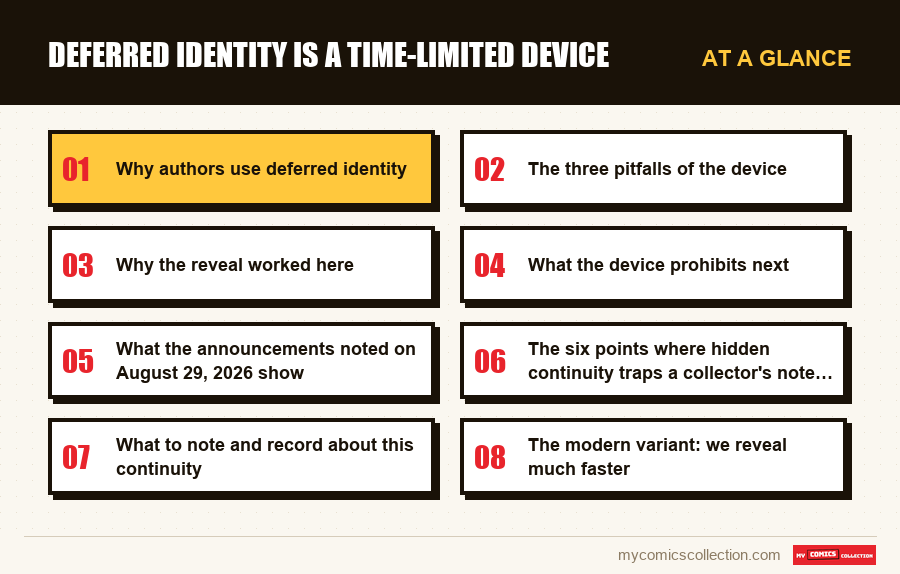
Why authors use deferred identity
The first reason is mechanical: the mask transforms each appearance into a clue. Once a question is asked and left open, everything the character does ceases to be just action and also becomes potential information. A line that is a little too informed about the hero's private life, an allusion to a place that the reader recognizes, a disproportionate reaction to a trivial detail: none of this would have any weight without the open question, and everything gains weight with it. The author gets a free second layer of reading on pages he would have written anyway.
The second reason is economic in the editorial sense of the term. A masked antagonist creates a reason to come back that doesn't depend on how good the next episode is. A good episode makes you want to read the next one; an open question requires reading it. In a monthly publishing model where the reader decides each month whether to buy, this difference is not rhetorical. She explains why the device appeared so early and why it has been reused so often, including by authors who had no idea of the answer when they asked the question.
The third reason is the most interesting: deferred identity involves the reader. It puts him in the position of an investigator facing material that he already possesses: the booklets stacked in his home. Rereading becomes a productive activity: each old page can contain the clue that we hadn't seen. It is one of the rare constructions which gives a narrative reason to go back in a collection, and this is also why it leaves a lasting trace in the readers' memory, long after the answer has been given. We rarely remember a confrontation; we remember having searched.
Finally, the device protects the author. As long as the face is not shown, the antagonist has no civilian life to manage, no housing, no entourage, no motivations to justify in detail. It is pure function. This economy of means allows it to be used often without ever wearing it out, because a character without interiority cannot be contradicted. The price of this freedom will be paid later, all at once, at the moment of unmasking.
The three pitfalls of the device
The answer must be a familiar face
If the revealed identity belongs to a character the reader has never met, the revelation reveals nothing: it adds a name to a list. All the value accrued during the wait is in recognition: the reader must be able to re-read their papers and see this person differently. An unknown person does not modify any previous pages, so there is no feedback, therefore there is no revelation.
Retroactive consistency must hold
The appearances of the mask were written without the answer being fixed, sometimes by different authors. On the day of the unmasking, these dozens of pages must remain readable: the designated character must not have been shown elsewhere at the same time, nor make comments that their double life makes absurd. The longer the wait, the larger the corpus that must not be contradicted.
Waiting Creates Proportionate Debt
A question open for three months results in a correct answer. A question open for several years demands an answer that turns the series upside down. The reader does not judge the answer in absolute terms, he judges it against the time he spent waiting. This is the most fatal trap, because it closes without anyone seeing it coming: the author who inherits the file did not choose the duration of the wait and must nevertheless honor it.
And a fourth, silent: the after
Once the mask has fallen, the antagonist must exist through something other than his question. Many have never had anything else. They were built like functions, and a function whose value is known no longer has a reason to return. This is the true cost of the device, and it does not appear until the next number.
These traps are not independent. They reinforce each other: the longer the wait, the more important the candidate must be to honor the debt, and the more previous appearances an important candidate has that may conflict with the answer. The device stiffens as it ages. This is why a deferred identity unresolved after several years is no longer a narrative asset but a constraint: the series can neither keep it indefinitely without tiring, nor close it without disappointing. Authors who inherit such a situation have, in practice, three options (to decide, to circumvent, or to prolong it by changing the subject) and all three leave a mark.
A point that we systematically forget: during the hidden period, the series does not have to be good to retain the reader. The question is enough. This creates an illusion of retrospective quality, where one remembers a period as strong when what one remembers is the tension of expectation, not the episodes themselves.
This illusion has a practical consequence for the collector: the issues of the open period are often less sought after than one imagines, because their interest was collective and momentary. Demand is concentrated on the two terminals, the opening and closing, and much less on the long middle.
Why the reveal worked here
The vast majority of deferred identities end in disappointment, and the reason is almost always the same: the response affects the hero's work, not his life. An antagonist who we learn was a professional rival, a competitor, a hierarchical superior, produces a revelation which remains in the register of the file to be handled. It is interesting once, it does not change anything in the way in which the hero returns home.
The case of the Green Goblin escapes this rule because the answer lies in the intimate sphere. By designating someone belonging to the hero's private entourage, the revelation has modified not the antagonist but the hero himself: his relationships, his confidence, his ability to separate what he is during the day from what he fights at night. The unmasking did not add information, it contaminated a previously protected territory. It's the difference between learning who the culprit is and finding out the culprit was dining at your table.
This success is due to a structural property and not to a stroke of genius: the revelation was irreversible in both directions. The hero could no longer look at those around him as before, and the reader could no longer reread previous appearances as before. A good deferred identity closure must necessarily produce these two effects together. If it only produces one, it is felt as an artifice; if it produces none, it is felt as a betrayal.
We must add a nuance that the popular narrative glosses over. A successful disclosure does not cancel the cost of the device, it makes it acceptable. The character lost his main function that day. What saved him was that the revelation gave him in exchange a relationship: a common story with the hero, transmissible, reusable. The masked antagonists who survive are exactly those whose unmasking creates a bond rather than a simple label.
What the device prohibits next
After the reveal, the show loses a tool it can't get back. We don't put an identity back into the mask. Any attempt to replay the mystery with the same character clashes with the reader's memory, who knows the answer and knows that the new question is artificial. The authors then circumvent in three ways, all legible: making someone else wear the mask, which shifts the question without reopening it; suggest that the original answer was incomplete, which retroactively undermines what worked; or give up the mystery and play the relationship, which is the only sustainable way.
This constraint explains a phenomenon that long-time readers observe without always naming it: the second life of an unmasked antagonist is almost always weaker than the first, unless the story agrees to completely change register. The character must now be someone, with a daily life, explicit motives, a psychology that can disappoint. It becomes contradictory. Many antagonists who were perfect as functions turn out to be mediocre as people, and the series that unmasked them finds that it has exchanged a question machine for an ordinary individual.
It is also worth mentioning a less obvious side effect. Once the answer is known, the previous appearances freeze. They cease to be pages open to interpretation to become pieces of a closed file. The pleasure of rereading changes in nature: we no longer search, we check. This shift is irreversible and it specifically impoverishes the middle of the hidden period, the one which opens nothing and closes nothing.
Collecting this series?
Track what you own, what you are missing and what your collection is worth. 7 day trial.
Start my trial →What the announcements noted on August 29, 2026 show
A survey taken that day reveals two very different populations. On the unverified side, 115 listings range from $1.34 to $15,999.99, with a median of $28.99. As for copies passed by a verification body, 54 listings range from $99.99 to $23,995.00, with a median of $2,475.00. All of these values are amounts claimed by sellers on a single date. None correspond to a concluded transaction, and a reading taken on a single day cannot by construction show any evolution: it would take at least two spaced readings to speak of movement, which these data do not allow.
The unverified segment's median of $28.99 requires an explicit caveat, because it is easy to misread. This segment is extremely heterogeneous: it brings together reissues, recent booklets, batches of several issues and isolated copies in very diverse states. There is no guarantee that a significant portion of these 115 announcements concerns an old issue. This median therefore describes the composition of a sales catalog at a given moment, not the level at which the original 1964 booklet would trade. Opposing it head-on to the median of $2,475.00 of the verified segment would amount to comparing two sets which do not contain the same objects, and to attributing to the certification alone a difference which comes primarily from what each segment contains.
The maximums deserve the same caution. A price of $15,999.99 or $23,995.00 displayed in isolation does not establish a market level: it reflects the expectation of a particular seller, on a particular copy, without proof that a buyer has joined it. A single high number does not make a reference. It is more honest to remember that the two sets are large, several orders of magnitude difference between the minimum and the maximum in each, which indicates above all that the object designated by the research is not homogeneous.
A final remark on method. Fifty-four verified announcements, this is a modest number but usable to situate an order of magnitude; it would be insufficient to divide this segment by state, by circulation or by subcategory, where we would very quickly come across only a few advertisements. As soon as a subset drops below ten, no conclusion on a price level is tenable, and it is better to say it than to produce a reassuring figure without a basis.
The six points where hidden continuity traps a collector's notebook
The character does not have a single name
During the masked period, the antagonist is referred to by his alias; after the revelation, he can be indexed under his civil identity. The same arc is then cut into two entries which do not speak to each other, and a search by name misses half of the issues concerned.
Reading order is not publication order
The clues sown during the wait take on their meaning in retrospect. A strictly chronological classification loses the logic of the system; you must be able to mark separately the numbers which ask the question and those which close it.
Verified and unverified do not belong together
The survey of August 29, 2026 shows this: the two segments do not describe the same population of objects. Mixing in the same line a copy passed by a verification body and a raw copy makes any subsequent estimate uninterpretable.
Batches dissolve unity
Some of the unverified advertisements concern sets of several numbers. Recorded as a single line, a lot distorts both the count of numbers owned and any value reported for the item.
The reissues bear the same number
A reissued booklet often retains the original numbering. Without a field distinguishing the edition, a notebook displays a complete collection even though it is made up of reprints, and the difference in level between the two is considerable.
The collections hide the gaps
The Hidden Period is frequently republished in volumes. The reader who has read it in a collection believes he possesses the bow; his notebook does not contain any of the fascicles. This is the most common and costly source of error when completing.
What to note and record about this continuity
Distinguish between opening and closing the device. These are the only two terminals that have an independent narrative value, and they are the ones that the request targets. Mark them explicitly in your notebook rather than leaving them buried in a continuous range of numbers: the middle of the hidden period has neither the same meaning nor the same research.
Note the double designation of the character. Provide in your annotations a place for the alias and a place for the civil identity, with the mention of the number from which the two join. Otherwise, any future searches in your own collection will depend on the name you thought of that day, which is the most discreet way to lose papers you own.
Save verification status as an attribute, never as a comment. The two populations recorded on August 29, 2026 behave differently; confusing them in the same line makes any subsequent comparison impossible. A dedicated field, entered at entry, costs a few seconds and avoids a complete re-inventory.
Date any value you enter. An amount without a date is dead information: we no longer know if it corresponds to a price asked, a price paid, or when. The figures cited here are for August 29, 2026 and for current announcements, and they must carry this date next to them to remain usable in six months.
Separate the playback format from the owned format. Clearly indicate whether you have read the period in collection or if you have the fascicles. This is the most common confusion about ancient continuities, and it only reveals itself when we believe we are completing an already complete series, or the opposite.
Because the device produces nothing once closed. As long as the question remains open, each appearance of the character carries an additional layer of information and gives a reason to return that doesn't depend on the quality of the episode. Closing immediately transforms the mask into a simple costume.
In practice, no. The debt owed to the reader grows over time, while the corpus of apparitions not to be contradicted also grows. Past a certain point, no response can both honor the expectation and remain consistent, and the series finds itself having to choose which of two demands it sacrifices.
A good revelation changes two things at once: the way in which the hero perceives those around him, and the way in which the reader rereads the previous issues. If it only reaches the professional domain of the hero, it remains information; if it affects his private life, it becomes an event.
No, and that's important. This median comes from a set of 115 unverified announcements which mixes reissues, recent issues, lots and isolated copies. It describes what a sales catalog contained on August 29, 2026, not the level of a precise old booklet. Reading it as a reference value for the original edition would be a misreading.
Yes, but not by the same means. It can no longer function as a question; it must function as a relationship. The characters who survive their revelation are those whose unmasking has created a lasting link with the hero, reusable by other authors. Those which were only a function disappear from the series in the months that follow.
The modern variant: we reveal much faster
The device still exists, but its time scale has been divided. Publishers today close a hidden identity in a few issues, sometimes within the same arc, where the old practice left the question open for years. This is not a change in narrative taste, it is an adaptation to a readership that no longer buys monthly. A long wait assumes a reader present at each issue, ready to accumulate clues over dozens of publications. When a significant part of the public discovers the stories in volumes, several months later, or discontinuously, a question left open for too long no longer creates tension: it creates forgetting.
The consequence is twofold. On the one hand, the system is safer: a question open for a short time generates a low debt, so an ordinary answer is enough to settle it, and the risk of retroactive contradiction is minimal since there is almost nothing not to contradict. On the other hand, it no longer produces the same effect. What made Deferred Identity memorable was precisely the duration: the time spent searching, the rereadings, the conversation between readers. Compressed over three issues, it becomes a simple twist again.
For today's reader, this means that a contemporary identity mystery must be read as a structural element and not as a long-term promise. For the collector, this means that recent continuities focus much less attention on a pair of terminal numbers, since the opening and closing are often separated by very few issues. The geography of demand is flattening.
And this retrospectively sheds light on the case of 1964. What happened with this character is not reproducible today, not because the authors are less skillful, but because the material conditions of reading have changed. The system required a captive, regular audience, waiting monthly. This audience existed then. The form remained available; his land has disappeared.
Follow your series without losing track of identities
Alias, civil identity, opening number, revelation number, verification status, possessed format: hidden continuity cannot be classified in a simple list of numbers. My Comics Collection allows you to record these distinctions as soon as you enter the booklet, and then find an entire arc whatever name you think of.