The 1973 booklet associated with the Green Goblin is not sought because a character disappears there, but because it proves that a character in this category (someone close to the hero, until then kept out of reach) could disappear. This issue moves a tacit boundary of the medium: after it, any story of the same kind is written knowing that protection no longer exists. On the market, this scope is reflected in an unusual offer structure. As of August 29, 2026, there are 58 listings without certification, from $7.00 to $2,110.00, with a mid-range at $175.00, and 53 listings of verified copies, from $19.95 to $5,000.00, with a mid-range at $699.99. These are sums requested that day, not completed transactions, and a single measurement says nothing about a trajectory.
A superhero story is based on promises that no one writes down in black and white. The reader knows, without being told, that the hero will return the following month, that the villain will be arrested without being eliminated, and that the civilian entourage of the main character (family, friends, loved ones) occupies a zone where nothing irreversible happens. These promises are not a matter of laziness in writing: they constitute the reading contract for a monthly serial. A soap opera that is to last for decades needs a stable setting, and the stability of the setting is precisely that its inhabitants are not expendable.
The 1973 issue attached to the Green Goblin file breaks this contract in a single gesture, and it is for this rupture that it is still cited today. Not for what it tells in detail, but for what it now makes possible elsewhere. A reader who opens an issue published after him no longer has the same starting point: he no longer knows who is safe. This uncertainty, once introduced, cannot be removed. This is the reason why an ordinary issue by its format has become a milestone in the editorial history of the medium, and why it maintains a demand that dozens of comparable episodes have never obtained.
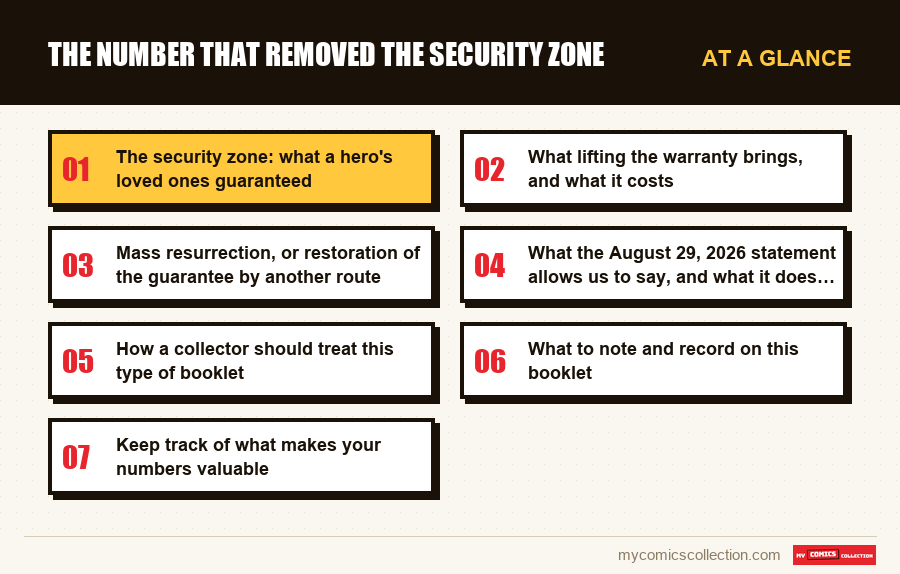
The security zone: what a hero's loved ones guaranteed
Before this rupture, a hero's civilian entourage fulfilled a precise narrative function, and this function presupposed his intangibility. Those close to us serve to give human weight to the main character's decisions: they are the reason why he acts, the measure of what he risks, the place where he becomes an ordinary person again between two confrontations. To play this role, they must be there at the next number. A human setting that is constantly renewed does not create any attachment, and without attachment, the role of the hero weighs nothing.
This guarantee also produced a reading comfort rarely expressed. The reader could become emotionally involved in the series without fearing a definitive loss on each page. The tension existed, but it was limited: we could fear the pain, the failure, the humiliation of the hero, never the disappearance of the structure around him. This terminal made reading sustainable for years. A monthly soap opera demands loyalty, and loyalty does not sit well with a permanent threat to everything we hold dear.
It should be added that this security zone also protected the editor. A lasting secondary character is an asset: it allows for repeated intrigues, spin-off series, twists and turns. To remove it is to extinguish a source of future stories. Editorial prudence and narrative logic therefore went in the same direction, which explains the solidity of the rule and the absence of debate around it. No one needed to state it because no one planned to transgress it.
It is the context which gives its significance to 1973. A booklet does not become a milestone because it is violent or spectacular; he becomes so because he does, for the first time, something that economic logic and narrative logic jointly prohibited. The transgression is editorial before being dramatic, and it is this dimension that the market ended up valuing, long after the episode itself ceased to be a surprise to anyone.
What lifting the warranty brings, and what it costs
An issue that has become real again
When the protection falls, each scene of danger regains meaning. The reader can no longer deduce the outcome solely from the category of the threatened character. This is the immediate gain: a tension that comes from the story itself and not from a staging effect.
A credible threat for the villain
An opponent who never achieves anything ends up being nothing more than a decorative obstacle. Lifting the rule makes the antagonist capable of inflicting a real loss, which retroactively enhances all his appearances, both previous and subsequent.
Le mécanisme d'inflation
An effect obtained once by transgression does not reproduce identically. To find the same intensity, you have to go further: closer character, broader loss. Each repetition consumes the surprise capital of the process.
L'émoussement
After a certain number of repetitions, the reader stops believing in the threat and begins to read the process rather than the story. The disappearance of a character becomes an identifiable editorial signal, and an identifiable signal no longer produces emotion.
These four movements describe a sequence, not four independent situations. The lifting of the guarantee first creates considerable narrative value, because it restores to the story an uncertainty that it had lost. Then this value is diluted as the process becomes commonplace, and the dilution is all the more rapid as the process is efficient: what works is imitated, what is imitated becomes predictable. The first issue to cross the line therefore benefits from a position that its successors cannot occupy, whatever their quality of writing.
A point of method, because it conditions the reading of this entire file: the disappearance of a fictional character is treated here as a fact of the story and nothing else. What interests us is the displaced rule, not the scene.
And a practical consequence: the value of a booklet of this type can never be deduced from the intensity of what it shows. It is deduced from its position in a sequence: first, or among the countless following. The two look the same on the shelf and are not at all similar on the market.
Mass resurrection, or restoration of the guarantee by another route
Once the process was blunted, the publishers found themselves faced with a problem that they had created themselves: a catalog of characters that had been cut, and a threat that no longer worked. The answer was the return of departed characters, on such a scale that it became a convention of the medium in its own right. This return not only recovered editorial assets; he restored the initial guarantee, but by another route. The reader no longer has the certainty that someone close to the hero is safe: he has the certainty that nothing is definitive.
The result is paradoxical. The pre-1973 reading contract said: this will not happen. The contract after the wave of returns says: this may happen, but will be canceled. In both cases, the reader's fear is defused, simply the defusing has changed place. He was upstream, he went downstream. The safety zone has not disappeared, it has moved in the time of the story.
This shift also explains why inflation has never stopped. Since everything is reversible, the only way to continue to produce an effect is to up the ante, which in turn accelerates wear and tear. The medium has thus established a stable and costly balance: many announced disappearances, few of them retaining a lasting impact, and a reader distrust that has become structural.
In this landscape, a booklet which belongs to the time when the rule was still intact occupies a place that nothing reproduces. It documents a state of the medium that no longer exists: one where the transgression was real because the rule was. It is this documentary quality, and not an emotional spring, which explains its longevity in the reference lists.
Why is this one cited and not the dozens of others?
Priority is not a judgment of quality
Later episodes are better written, better constructed, more ambitious. They arrive later. What is cited here is not a comparative artistic achievement, it is a dated tipping point, and a tipping point only happens once.
1973 works as a benchmark
The date serves as an articulation in editorial chronologies: we place the stories before or after. A booklet which becomes a unit of measurement of the medium's time is mechanically more cited than a booklet which is part of a period.
A reach that exceeds its series
Subsequent episodes have edited their own series. This one modified what other series, from other publishers, believed themselves authorized to do. The radius of influence is what separates a local event from a milestone.
Nothing to cancel
What gives this number its strength is not a disappearance but the establishment of a possibility. Even canceled on a narrative level, the possibility remains: we do not return to the fact that something has proven to be feasible.
Stable demand over time
The quote maintains the request, and the request maintains the quote. A booklet included in the reference lists is transmitted from generation of readers to generation of readers, independently of current editorial news.
Un objet lisible seul
We can understand it without having read the hundred preceding issues. This autonomy counts: a milestone that requires an extended context circulates poorly, a milestone that can be read in isolation is easily recommended.
Collecting this series?
Track what you own, what you are missing and what your collection is worth. 7 day trial.
Start my trial →What the August 29, 2026 statement allows us to say, and what it does not allow
The record from that day distinguishes two groups. On one side, 58 listings without certification, distributed between $7.00 and $2,110.00, with a mid-range at $175.00. On the other, 53 listings for verified copies, spread between $19.95 and $5,000.00, with a mid-range at $699.99. All of these amounts are amounts requested by sellers on a given date. None attests that a transaction took place, at this level or any other.
The most instructive fact is not an amount, it is a ratio of volumes. Fifty-three verified copies against fifty-eight unverified, this amounts to almost parity between the two segments. On most issues, the uncertified offer largely overwhelms the verified offer, because the verification process is only economically justified on a minority of objects. A parity therefore indicates that verification is considered profitable by a large number of holders: in other words, that the object is circulating and that its holders anticipate a resale.
The difference between the two standard mids, $175.00 on one side and $699.99 on the other, should not be read as the price of certification. It combines two inseparable things in this statement: the supplement requested for a copy whose condition has been evaluated by a third party, and the fact that the best preserved copies are more often subject to verification. A mediocre certified specimen and a mediocre uncertified specimen are not four times apart; the composition of the two populations differs as much as their status.
The extremes call for the same caution, in both directions. A demand at $2,110.00 in the unverified segment, or at $5,000.00 in the verified segment, expresses the expectation of a particular seller on a particular specimen; it does not constitute a reference level. Symmetrically, the low $7.00 and $19.95 almost certainly correspond to objects that are not what the title of the ad suggests, or to very degraded examples. The middle of the series remains the indicator least distorted by these edges.
One last, essential limitation: this reading was taken only once. A single measurement describes a state, it does not describe any movement. Nothing in these figures allows us to assert that the level is rising, falling or stagnating, and any sentence which would claim this would go beyond what has been observed. To speak of a trend, there would need to be at least two surveys separated in time and constructed in the same way.
How a collector should treat this type of booklet
The practical consequence of all of the above is that a milestone number does not evaluate like a rare number. Rarity is measured by the difficulty of finding a copy; here the offer is abundant and immediately available in both segments. What is paid for is not the difficulty of access, it is the position in the history of the medium, and this position is known to everyone. There is therefore no inside information to hope for: the asking price already includes reputation.
This shifts the only ground on which a buyer keeps a margin: the condition, and the honest description of this condition. Between two copies of the same booklet, the price difference is almost never explained by the content, always by the conservation and credibility of what the seller claims. A collector who devotes his attention to this matter rather than chasing an unlikely bargain is making the best use of his time.
Finally, we must accept that this booklet fulfills two distinct functions which do not obey the same criteria. As a reading, it does not need to be a fine copy: a reissue or a complete provides the same service. As a collector's item, it does not need to be read. Confusing the two uses leads to overpaying for a copy that one is going to handle, or to depriving one's library of a text on the pretext that the original object is expensive.
What to note and record on this booklet
The verification status, separately from the price. On this specific number, the two segments coexist with comparable numbers (53 verified against 58 unverified as of August 29, 2026) which is not ordinary. Recording which segment your copy belongs to will help you avoid comparing it later to ads that are not in the same market.
The exact date of each statement viewed. Since an isolated measurement shows no trajectory, the only way to obtain information about time is to stack dated readings. Note the date along with the amounts, otherwise your observations become unusable as soon as they become a few months old.
The distinction between requested amount and successful transaction. The figures cited here are seller requests. If you record a reference value for your copy, explicitly indicate what nature it is: a price displayed and a price paid cannot be compared, and mixing them permanently distorts the estimate of an entire collection.
The documentary role of the issue, not just its bibliographic identity. This booklet is valid for an editorial shift from 1973 that no numerical reference restores. A line of note explaining why it is in your collection preserves the information that underpins its value, and makes it transferable to someone unfamiliar with the record.
The points of fragility specific to the fascicles of this period. A 1973 print ages predictably: the paper, the staples, the cover folds. Describing the condition of your item when you acquired it, rather than relying on memory, gives you a basis for comparison to spot slow deterioration and to write an accurate announcement the day you resell it.
No, and this is precisely what should guide the reading. As of August 29, 2026, there are simultaneously 58 unverified announcements and 53 verified announcements: the offer is abundant and accessible. What supports the request is not the difficulty of finding a copy, but the place of this booklet in the editorial history of the medium.
Two causes overlap and the reading does not allow them to be separated. On the one hand, verification by a third party reassures the buyer about the condition; on the other hand, it is mainly well-preserved copies that are subject to this process. The difference between $175.00 and $699.99 in the middle of the series therefore measures a difference in populations as much as a difference in status.
No, not from this data. The reading was carried out only once, on August 29, 2026. A single measurement describes a state at a given time and does not, by construction, contain any movement information. It would take several spaced and identically constructed surveys to evoke a direction.
No. The highs of the range: $2,110.00 without verification, $5,000.00 with: reflect a seller's expectation of a specific item, never an observed level. The middle of the series is clearly more representative, because it is not distorted by the extreme positions of the two edges.
Rarely, and for a structural reason. This number establishes a possibility; those who follow exploit it. The first crossing of a boundary changes reading expectations for the entire medium, repetition wears them down. This is why a booklet dated 1973 remains cited while many later stories, sometimes better written, are not.
Keep track of what makes your numbers valuable
A milestone booklet is documented as much as it is preserved: verification status, original state, date of each statement consulted, and the editorial reason which distinguishes it. My Comics Collection gathers this information on each copy, so that the value of your collection is based on dated observations rather than memories.