The anniversary issue of The Green Goblin ticks all the boxes of the exceptional piece: round number, doubled pagination, cover with effect, concluding story. And he doesn't pay himself. On a general American auction site, a survey carried out on August 30, 2026 counted 183 advertisements for unverified copies, with a floor at $4.99, a midpoint at $12.00 and a ceiling at $149.00. These amounts are those that sellers are displaying at this time, not completed transactions. The copies with independent verification are counted separately and number only eleven: too few to make anything out of them. The lesson is in one sentence: a factory-programmed rarity is not a rarity.
There is a category of issues whose speculative failure can be predicted before even opening them: those that the editor has explicitly designed as events. The round number is the archetype. When a title approaches a three-digit milestone, production switches to another regime: we double the number of pages, we order technical coverage that is unlike any other in the series, we program the conclusion of a plot that has been in reserve for months. The reader receives an object visibly heavier, brighter, more important than that of the previous month. Everything is there for him to keep. And that's exactly the problem.
The Green Goblin offers a textbook case here, because its anniversary issue combines the three event markers on a single object: the digital milestone, the extraordinary pagination, the cover effect. The market is not mistaken, or rather, it is mistaken in the other direction than what we expect. The amounts claimed on August 30, 2026 by five independent sellers are within a range of less than one dollar and fifty. This compactness is not an accident of measurement: it is the signature of a market without tension, where no one has any reason to outbid because no one has difficulty finding the object. This article contrasts two rarities which have nothing to do with each other: that which is decided at the time of manufacture, and that which is suffered after the fact.
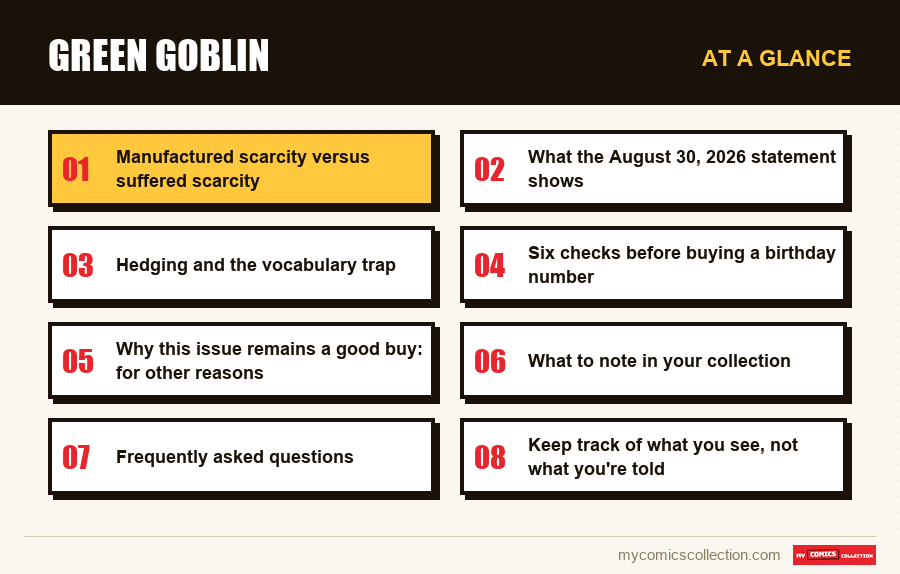
Manufactured scarcity versus suffered scarcity
An suffered rarity is born from an accident: an issue printed at a time when the title interested no one, a cover damaged during transport, a period when the fascicles were used as recycled paper, a readership who read then threw it away. Nobody decides these things. They are seen decades later, when demand returns for an object whose surviving examples have been destroyed out of indifference. The scarcity experienced has a fundamental property: it is irreversible. Missing stock cannot reappear.
A manufactured scarcity works the exact opposite. The publisher announces in advance that the issue will be special. The timing chain adjusts. Buyers, warned, move. And above all, a significant proportion of them buy the object not to read it but to keep it: sometimes in duplicate, sometimes in a pile. Conservation behavior is triggered by marketing itself. Mechanical result: the more the publisher succeeds in convincing people that the number counts, the higher the number of copies carefully stored flat in a box. The promise of scarcity produces abundance.
This contradiction is not a theory: it can be read in the statement. One hundred and eighty-three advertisements available simultaneously for a single issue, on a single platform, on a single date, describe an object that is easy to find. A collector who is looking for it does not have to wait: he is spoiled for choice, and he therefore chooses on something other than availability: on the condition, on the shipping price, on the trust he places in the seller.
It is necessary to add a precision of methodological honesty, because it changes the scope of everything that follows. An ad report measures requests, not agreements. The seller who displays an amount expresses what he hopes to obtain; there is no guarantee that anyone will give it to him. An ad can stay online for months. The central figure of $12.00 therefore describes the midpoint of the expectations displayed that day, not the midpoint of the amounts actually exchanged. This is useful information, but you have to read it for what it is.
Finally, this entire reading was taken only once, on August 30, 2026. A single measurement cannot by construction describe any movement: it does not say that the number is rising, nor that it is falling, nor that it is stagnating. To speak of evolution we would need at least two spaced measurements, done in the same way. Any sentence like “this number is progressing” would be a pure invention here. The following describes a state, at a time.
What the August 30, 2026 statement shows
183 annonces non vérifiées
The volume is the first information, before any amount. One hundred and eighty-three simultaneous bids for the same number describe an abundance of stock, not a chase. A buyer looking for this booklet does not wait for it to appear: he or she chooses between dozens of competing proposals.
From $4.99 to $149.00
The amplitude seems large, but it can be read from both ends. The $4.99 floor corresponds to regular copies sold at the price of a regular issue. The ceiling at $149.00 is an amount claimed by a single seller: it reflects an individual expectation, never a market level.
A central point at $12.00
The median value of unverified listings is $12.00. On such an available item, this figure describes the amount that half of the sellers consider reasonable to ask. It remains in the order of magnitude of a reading purchase, not an investment.
11 exemplaires vérifiés seulement
Copies passed by a verification body are counted separately: minimum $48.00, central value $109.99, maximum $950.00. Eleven announcements are too small a number to conclude anything on this segment. This handful of numbers is mentioned for discarding, not for reference.
The most instructive detail of the statement, however, is none of these four figures. It fits in the list of the five listings themselves: $4.99, $5.00, $5.99, $6.00 and $6.40. Five sellers who don't know each other, who describe different states, who write their ad titles with different vocabularies, arrive at the same amount to the nearest dollar forty-one. None try their luck much higher. None are selling out either. This spontaneous convergence is the best indicator that can be obtained on an object: it means that the price is not discussed, because there is nothing to discuss.
A low ceiling is information in its own right, and it is rather reassuring. On an abundant item, the fact that the most optimistic seller stops at $149.00 means that the difference between listings remains explainable by ordinary causes: the condition of the cover, the presence or not of a reading fold, the quality of the photos, the shipping cost included or not. No speculation is necessary to account for the observed dispersion.
This is the opposite of a tight market, where the cap takes off unrelated to condition and the buyer has to wonder what exactly they are paying for. Here, the question does not arise: we pay for paper, in the condition in which it is found.
Hedging and the vocabulary trap
Two advertisements noted on the same day describe exactly the same cover, with two different words. One talks about a holographic cover. The other uses a technical manufacturing term, a compound name which designates the metallized printing process used by the publisher at the time. It is not a variation: it is the same object, designated in two ways.
The practical consequence is immediate and costs money to those who ignore it. A collector who enters just one of these two words into a search engine sees only a fraction of the available listings. He then concludes, wrongly, that the object is rarer than it is, and he accepts a higher amount, whereas another formulation would have shown him examples worth a few dollars. The seller's vocabulary becomes an involuntary barrier.
The resulting rule is valid well beyond this number. For any special coverage, you must query the market with several formulations: the generic word describing the visual effect, the commercial name of the process if one exists, and the simple mention of the number without any qualifier at all. The latter search is often the most productive, because many sellers don't mention the effect-either because they ignore it or take it for granted.
This lexical dispersion also explains part of the gap between the lowest and highest announcements. A seller who accurately describes the nature of his cover and the condition of his copy attracts an informed buyer; a seller who writes three words sells to the first comer, cheaper. The quality of the description is a price factor independent of the quality of the object.
There is a broader lesson there on the way in which information circulates around a character. Announcements aren't the only thing floating around in the vocabulary: publisher communications around big issues cultivate the same ambiguity, a subject covered in the ad that says nothing. When an object is described in several ways, we must always ask ourselves who benefits from the vagueness.
Six checks before buying a birthday number
Search with multiple words
Question the market with the generic word describing the effect, with the name of the process used by the publisher, then without any qualifier. The three searches do not return the same ads. The third is often the richest.
Dater votre relevé
A number without a date is worthless. Note the day you viewed the marketplace and the number of listings viewed. Without this information, you will never be able to usefully compare with a subsequent reading, and you will be tempted to believe in movements that you have not measured.
Separate claimed and concluded
An amount displayed in an ad is a request, not an agreement. Keep the two records separate. An object can remain on display for months at a price that no one accepts, without it appearing anywhere.
Compter le port
On a five dollar issue, the shipping may be more than the item itself. Comparing ads without including the port distorts the entire ranking. The only amount that matters is the amount you pay in total.
Ignoring low numbers
Eleven verified advertisements do not allow any conclusions. Below ten offers, a single atypical seller moves all the statistics. Refuse to derive a price level, even when the result suits you.
Watch content
An anniversary issue usually contains double the pages of a regular issue and completes a long story line. At five dollars, it's one of the best ratios between reading volume and price that you can find. Buy it for that.
Collecting this series?
Track what you own, what you are missing and what your collection is worth. 7 day trial.
Start my trial →Why this issue remains a good buy: for other reasons
All of the above describes an object of no speculative interest. This does not mean that it is without interest. The anniversary issue is structurally the most generous of a series: the doubled pagination is a material reality, not a selling point, and the story behind it is almost always conclusive. There we find the end of an arc, the resolution of a tension maintained over months, sometimes a lasting change for the character. This is, from the reader's point of view, the issue to read.
Put in front of its price, this observation becomes frankly favorable. Five dollars for twice as many pages as a standard issue, with the added bonus of a technically unusual cover, places this item among the best content-price ratios available to the beginning collector. There is no contradiction in saying of the same number that it is worth nothing financially and that it is worth buying.
This dissociation between reading value and market value deserves to be installed as a reflex. An expensive issue doesn't read any better; a plentiful number is no less readable. The two scales are independent, and confusing one with the other is probably the most common mistake made by those beginning to build a collection. The case of introduction number of a character who has come of age illustrates the other end of the spectrum: there, the request concerns an editorial history event that no one had planned as such.
It should also be observed that anniversary numbers occupy a special place in the trajectory of a character. They are often the ones who make the structuring decisions: those which render previous hypotheses obsolete. The Green Goblin has experienced several of these shifts; some have permanently redefined the balance of power with Spider-Man, as recalled in our article on the episode that changed the rules. The round issue is a prime narrative location for this kind of break, simply because the editor devotes more pages to it.
Finally, an anniversary issue is a great, practical entry point. As he concludes, he recapitulates. A reader who discovers a character finds a compact overview, even if it means going back to the episodes that lead to it. Combining it with a thoughtful reading order avoids paying dearly for intermediate numbers whose function is only to make the link.
What to note in your collection
Pagination, when it's out of the ordinary. Note the number of pages whenever the issue deviates from the usual format of the series. This is not a vanity: it is what materially distinguishes an event number from a current number, and this is what justifies that it cost you a little more. A card that does not mention this doubling will later leave you unable to understand why this copy is thicker than its neighbors in the box.
The exact nature of the coverage and the wording used by the seller. Record the two separately: on one side what you see yourself (metallic, reflective, embossed), on the other the term that the seller used in his ad. The survey shows that the same cover circulates under at least two names. Keeping track of both will allow you to find the item whatever the wording, and to explain to a future buyer that it is indeed the same thing.
The conclusive nature or not of the story. Indicate whether the number completes an arc, opens it, or simply extends it. This is the information that determines whether you can lend it alone, whether it is an entry point for someone else, and whether you absolutely need neighboring numbers. For an anniversary issue, the answer is frequently "it concludes", but frequently it is not always, and only reading confirms this.
The state that you have observed yourself. Do not copy the notice from the ad. Open the booklet, look at the spine, the corners, the reading folds, and write what you see, in your own words. On this particular issue, condition is the only factor that honestly explains the difference between a five dollar ad and a significantly higher ad. A state observed by you is infinitely better than a state declared by a stranger.
The price paid, shipping included. Record the total charged, not the amount shown on the ad. On a booklet costing a few dollars, shipping can double the expense, and a collection whose cards do not include postage gives a false image of what it cost. Add the date of purchase: this will give meaning to a future comparison, since an amount without a date cannot be compared to anything.
Frequently asked questions
Because the event announcement worked. Warned that an issue would be special, buyers came in droves and kept it instead of reading it and then abandoning it. Three decades later, there are numerous examples in good condition. The August 30, 2026 statement counts 183 simultaneous announcements of unverified copies on a single platform, with a floor at $4.99. The scarcity decided upon in manufacturing produces abundance: it is a mechanism, not bad luck.
It means that half of the sellers were asking less and the other half more, on August 30, 2026, on listings for unverified copies. These are amounts claimed, not sales concluded: a seller displays what he hopes to obtain and there is no proof that a buyer gives it to him. This figure therefore describes the midpoint of the expectations displayed that day, which remains a useful indication for establishing an order of magnitude, but does not constitute an observed market price.
No, not in this case. The survey found only eleven advertisements for copies passed by a verification body. Such a small number does not allow any conclusions: a single atypical offer is enough to move all the benchmarks. The amounts observed in this segment are mentioned for the record, but they should neither be used to estimate your item nor to justify a purchase. Below ten announcements, honesty consists of saying that we don't know.
The survey does not provide an answer, and no one should claim otherwise based on this data. All observations were taken on the same day, August 30, 2026. A single measurement describes a state, never a movement: it would take at least two measurements spaced over time, carried out with the same method and on the same perimeter, to speak of a trend. Any assertion of evolution based on a single date would be fabricated.
By searching with several formulations. The statement shows two advertisements which describe the same effect cover with two distinct words, one generic and the other borrowed from the printing process. So question the market with the visual term, with the name of the process, then with just the number without a qualifier. Then compare the photos rather than the titles, and note in your file the two names encountered: you will save yourself the same confusion next time.
Keep track of what you see, not what you're told
Pagination, nature of the cover, word used by the seller, condition observed with your own eyes, price paid including shipping, date of the statement: these are the six pieces of information that make a collection readable years later. My Comics Collection records them issue by issue, without you having to keep a spreadsheet at the same time.