In short
Gorilla Grodd is a sentient, telepathic ape who debuts in The Flash #106 (1959), created by John Broome and Carmine Infantino alongside Solovar and Gorilla City. He begins as a Silver Age menace to Barry Allen, becomes a founding name in the Secret Society of Super Villains in 1977, and is rebuilt in the Wally West years. The decisive turns are his role in creating Zoom (2003), the New 52 rewrite of Gorilla City (2012), and the Forever Evil invasion of Central City (2013 to 2014).
Grodd is an odd case for a collector. He carries a famous name, yet his story is scattered over annuals, crossovers, and guest spots instead of one long run. Following him through time means following a character who is repeatedly reinvented while keeping the one idea that made him: an ape that thinks, and can make others think what he wants.
The Grodd timeline sticks to credits and years matched against catalog entries, with unverified months left out; what each stage says about the ape is interpretation on our part, and nothing from the pages is quoted.
1959: The Flash #106 opens a city and a villain
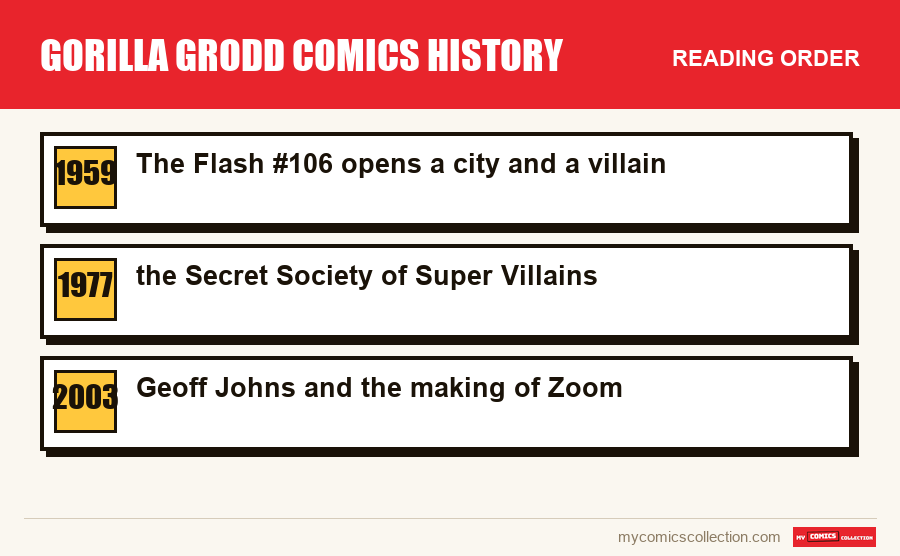
The ape first shows up in The Flash #106 (1959), a book scripted by John Broome with art by Carmine Infantino and Joe Giella. The Grodd story is "Menace of the Super-Gorilla," and the same issue introduces Solovar and Gorilla City. A second story in the issue, "The Pied Piper of Peril," introduces the Pied Piper, which gives the book two lasting debuts for a character-minded collector.
The setup is a compact piece of Silver Age science fiction. A group of gorillas gains sapience and psychic powers after an alien spaceship crashes in their area, and they live in peace until explorers discover their home. Grodd forces one of the explorers to kill the alien and takes over Gorilla City, planning to conquer the world. Solovar, a fellow gorilla, contacts Barry Allen telepathically to warn him of the plans, and Grodd is defeated. What matters is the structure: the villain is not only a fighter but a ruler with a hidden society behind him, and the hero's greatest weapon is speed, which has no direct answer to a mind that reaches into other minds.
The series itself is the continuation of the old Flash Comics numbering: the Barry Allen book starts at #105, so #106 is the second issue of the new run, and a collector looking for the debut is looking at the very beginning of that volume. The page on Gorilla Grodd's key issues goes deeper into the copy-level questions of that single issue.
Gorilla City as a character in its own right
From the first issue, the place matters as much as the ape. Gorilla City gives Grodd a motive and a kingdom, and it gives Solovar a role as a counterweight: a civilization of apes that mostly lives apart from humans, with one of its own turning against that peace. This rivalry is the story's emotional spine and the reason later writers keep returning to the setting rather than treating Grodd as a stand-alone brute.
That choice shapes how his history reads. The core conflict of many later Grodd stories is political: who rules the apes, who controls minds, and how far an outsider like Barry Allen should intervene. When the 2012 reboot changes the setting's rules, it does so by rewriting that political center, as discussed below.
1959 to 1985: Barry Allen's series and a patient villain
The first Flash series runs from #105 to #350 (1985), and Grodd returns across its life as one of the hero's recurring enemies. In one early confrontation he probes Solovar's mind to learn mind control, and after another defeat he uses a burrowing machine to escape prison. The details of every Silver Age sequel are less important than the pattern: Grodd is the villain who keeps coming back, and each return adds to the sense that Gorilla City is a permanent corner of the DC universe.
The period also gives him a different kind of stage. In the Super Friends franchise, a version of Grodd voiced by Stanley Ralph Ross is a member of Lex Luthor's Legion of Doom, and in that telling he develops a means of time travel for the group. This is animation rather than comics, but it explains why a generation that never read a Barry Allen issue still recognizes the name.
1977: the Secret Society of Super Villains
In 1977, Grodd is one of the original members of the Secret Society of Super Villains. The book lets him leave the Flash's orbit and share a stage with heavy hitters. In #4, he beats Kalibak in combat but loses to Captain Comet; in #9, he escapes Wally West using the Quadro-Mobile; in #10, he knocks Captain Comet unconscious; and in #11, he hypnotizes Star Sapphire.
That list matters because it shows Grodd's power set as a team villain: he is a controller of other people's bodies and a fast talker, not a brawler. The same issues also place Wally West, later the lead hero of the second Flash series, in conflict with the ape years before he inherits the title.
1983 to 1991: a villain used by other books
After the Silver Age, Grodd becomes a character other titles borrow. In Captain Carrot and His Amazing Zoo Crew #20 (November 1983), the final issue of that series, the Zoo Crew and Changeling stop his attempt to conquer Earth-C-Minus. In Son of Ambush Bug #5 (November 1986), his attempt to erase human evolution is foiled. In Swamp Thing vol. 2 Annual #3 (1987), he controls the minds of Congo Bill, Congorilla, Djuba, Gorilla Boss, Monsieur Mallah, and Sam Simeon, and then suffers brain damage that frees them. In the Angel and the Ape limited series (1991), Grodd is revealed as Sam Simeon's grandfather.
This is the least glamorous but most useful part of the history for an advanced collector, because it is where a complete list is hard to make. Many of these appearances are in humor titles, annuals, and books by other characters. They do not change Grodd's status in a lasting way, but each is a data point on his reach: if a DC book needs a sentient primate or a mind-controlling menace, he is the first name on the list.
The Wally West years: animals, minds, and a personal enemy
The second Flash volume begins in June 1987 with Wally West as the hero. Grodd's most notable stories in that series involve a confrontation in which he raises the intelligence of Central City's animals and is stopped by the Flash with help from the Pied Piper, Vixen, and Rex. This is the kind of large-scale idea that suits the character, since it turns an entire city into a field for mind control.
From the Wally years onward, the ape also becomes a figure in the Rogues' own history. In the Rogues' own backstory, Grodd breaks the gallery out of jail to keep the Flash busy. Grodd is therefore an indirect founder of the crew that later defines the book, which gives the character a role even when he is not on the page.
Do you collect this series?
Track what you own, what you are missing and what your collection is worth. 7-day trial.
Start my trial →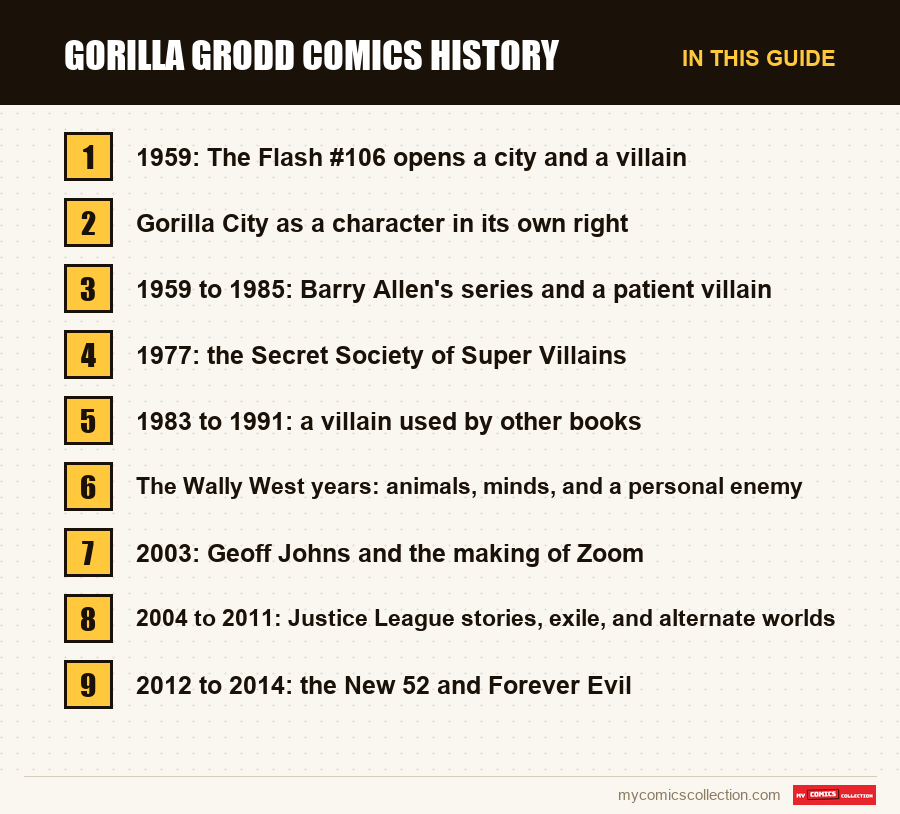
2003: Geoff Johns and the making of Zoom
Geoff Johns scripts the monthly Flash from #164 (2000) through #225. During that run, The Flash vol. 2 #193 (February 2003) has Grodd cripple Hunter Zolomon, the injury that leads to Zolomon becoming Zoom. It is one of the most consequential things Grodd does in the comics, because he does not defeat the hero: he creates the hero's next archenemy. The Zoom guide covers the character who emerges, and the Geoff Johns page places the run among his other Flash work.
The effect on Grodd is subtle. He stops being only a threat to the Flash and becomes a cause of the hero's later misery, a villain whose damage keeps spreading after he is gone from the scene.
2004 to 2011: Justice League stories, exile, and alternate worlds
Grodd's 2000s appearances range widely. In JLA Classified #1 to #3 (2004), he attacks the Ultramarine Corps. In Justice League of America vol. 2 #21, he is placed in Libra's new Secret Society. In Salvation Run #3 (March 2008), he teams with the Joker; in #4 (April 2008), he kills Monsieur Mallah and Brain, and the Joker knocks him off a cliff; in #7 (July 2008), he is seen alive and seeking revenge. In Final Crisis #4, he is transformed into a Justifier, and the Final Crisis: Resist one-shot has him failing to apprehend Snapper Carr and Cheetah.
The alternate versions begin to matter too. An Earth-3 Grodd appears in JLA Secret Files (2004), as part of the Justice Underground. In Flashpoint: Grodd of War (June 2011), an alternate Grodd conquers Africa, and he also appears in Flashpoint #5 (August 2011). These show that the writers see Grodd as a character who can be dropped into any timeline and still work.
2012 to 2014: the New 52 and Forever Evil
The New 52 reboot brings the most visible change since 1959. In The Flash vol. 4 (2011 to 2016), #7 (March 2012) and #14 (January 2013) tie his powers to the Speed Force, which the gorillas call the "Light"; in #8 (April 2012), Barry Allen reaches Gorilla City just after Grodd has killed his own father and become king; and in #9 (May 2012), Grodd tries to kill him, but a cave collapse lets Barry escape. Issue #17 (April 2013) then spells out how hard this version is to hurt. The reboot ties the ape directly to the hero's own mythology, since the Speed Force becomes a spiritual idea for the gorillas.
The step up in scale arrives with Forever Evil (September 2013 to May 2014), a Geoff Johns and David Finch crossover. The ape levels both Central City and Keystone City and crowns himself king of the first. His reign ends when Snart's crew, with Lisa Snart at their side, shuts him and a group of Society villains inside the mirror world, and the city can begin to rebuild. The Flash vol. 4 #23.1, a Villains Month issue written by Brian Buccellato, also shows him conquering Central City. For a long-term reader, this is the payoff of the Gorilla City idea: the hidden kingdom becomes an open occupation.
Rebirth, the Legion of Doom, and Absolute Flash
In the Rebirth volume (The Flash vol. 5, which began in August 2016), #40 and #42 to #43 have Grodd found Black Hole and mind-control Meena Dhawan into the Negative Flash. Later, in the We Are Yesterday story, he leads the Legion of Doom and calls himself "Gorilla God" after absorbing Omega energy, and Air Wave defeats him. Afterward, he works with Time Trapper and the World Forger on Darkseid's return.
The newest variation is in Absolute Flash #2 and #3 (2025), where Grodd is a small green monkey experimented on by Project Olympus, who bonds with Wally West after a psychic connection. It is a deliberate reversal of the classic image, and it shows that the character's core, a mind that talks to other minds, is still strong enough to support a new take.
The key issues across his history
- The Flash #106 (1959): the debut of Grodd, Solovar, and Gorilla City, by John Broome and Carmine Infantino, with the Pied Piper's debut in the same issue.
- Secret Society of Super Villains #4 (1977): Grodd as a founding member who defeats Kalibak.
- Captain Carrot and His Amazing Zoo Crew #20 (November 1983): the series finale, with Grodd as the villain defeated.
- The Flash vol. 2 #193 (2003): Grodd's role in the crippling that leads to Zoom.
- Salvation Run #4 (2008): Grodd kills Monsieur Mallah and Brain before the Joker knocks him off a cliff.
- The Flash vol. 4 #8 (2012): Barry Allen meets Grodd in Gorilla City in the New 52 version.
- Forever Evil #1 to #7 (2013 to 2014, Johns and Finch): with the League presumed dead, the ape rules a ruined Central City.
How to follow Gorilla Grodd in a collection
Begin with The Flash #106, then read The Flash vol. 2 #193 to see what he does to Hunter Zolomon. After that, choose by theme rather than by series: the New 52 Gorilla City story in The Flash vol. 4 #7 to #9, and finish with Forever Evil for the occupation of Central City.
The main trap is numbering. The first Flash series runs #105 to #350, the second begins again at #1 in 1987, and the New 52 volume restarts in 2011 with a fresh #1 and even includes issues numbered #23.1 to #23.3. When you list a copy, write the volume as well as the number, and expect many Grodd appearances to sit inside books that carry another character's name. The Flash key issues guide and best Flash runs help with the surrounding order.
Frequently asked questions
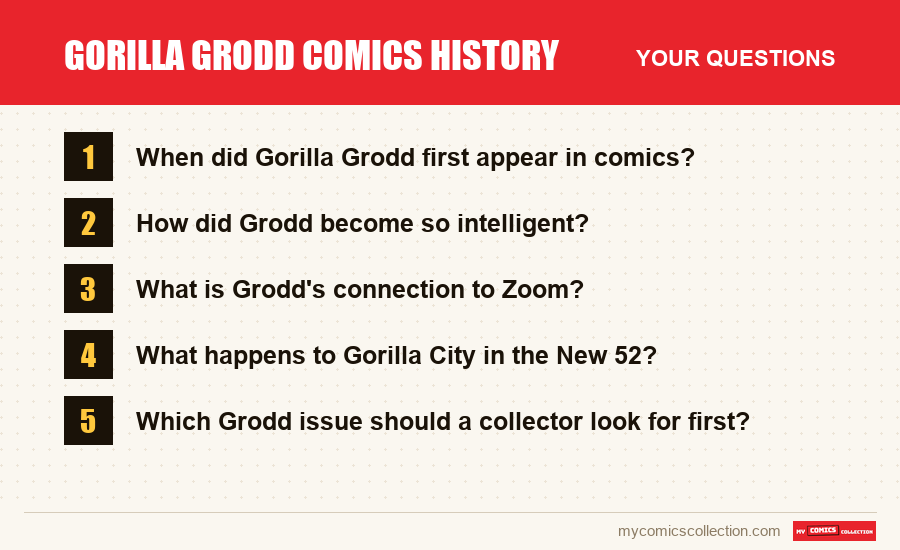
The ape's debut sits in The Flash #106 (1959), made by John Broome and Carmine Infantino. The same issue introduces Solovar and Gorilla City, and a second story in it introduces the Pied Piper, which makes the book a double debut.
In the original telling, Grodd and other gorillas gain sapience and psychic powers after an alien spaceship crashes in their area. Grodd then forces an explorer to kill the alien and takes over Gorilla City, planning to conquer the world, until Solovar warns Barry Allen telepathically.
In The Flash vol. 2 #193 (February 2003), Grodd cripples Hunter Zolomon. That injury leads to Zolomon becoming Zoom, Wally West's archenemy. The story ran during Geoff Johns's tenure on the series, which lasted from #164 to #225.
In The Flash vol. 4, Barry Allen meets Grodd in Gorilla City in #8 (April 2012), and Grodd tries to kill him in #9 (May 2012). In this version, Grodd has killed his father to take the throne, and the gorillas call the Speed Force the "Light."
Start with the 1959 Flash #106, the second issue of Barry Allen's run, since the ape, his rival Solovar, their city, and the Pied Piper are all introduced in it. For the character's later arc, add The Flash vol. 2 #193 (2003), The Flash vol. 4 #8 (2012), then the Forever Evil miniseries.
If you own a Silver Age Flash issue, check what your copy of the book is worth before you decide how to store it.
Estimate my comic