The American romance comic was born in the fall of 1947 with Young Romance #1, published by Crestwood under the Prize label and signed by Joe Simon and Jack Kirby. The success was such that in the first half of 1950, more than one comic book in four published belonged to the genre, with more than one hundred fifty titles on newsstands at the same time. The genre survived until July 1977, the date of the last issue of Young Love. Today, this enormous output trades at paltry levels compared with contemporary superhero titles, for a structural reason: these magazines almost never have a recurring character, so no "first appearance" to claim. What sets an issue apart lies elsewhere: an identified artist, a first issue, a cover that became the source of a work of art, or a historically singular subject.
There is, in the history of the American comic book, an entire continent that almost nobody visits. For thirty years, thousands of issues devoted to love stories rolled off the presses, in volumes that dwarf those of the heroic titles of the same period. Then the genre died out, and with it the buyers' interest. The result: you can today build a coherent, old and documented collection for the price of two or three well-priced modern issues.
This article is not trying to sell you a bargain. The modesty of prices in this segment is not a market anomaly nobody noticed: it is the exact reflection of weak demand, and that weakness has very concrete consequences the day you want to resell. Honesty demands showing both sides of the coin. On one side, seventy-year-old newsstand objects, often in good condition, accessible without budget strain. On the other, a narrow, slow market where liquidity is never guaranteed.
Between these two realities, a minority of issues pulls clearly upward. Understanding which, and why, is the whole point of what follows.
A genre invented in a single publication
The birth date is known to the month, which is rare. Young Romance #1 appeared in the fall of 1947 at Crestwood Publications, under the Prize label; records date it to September, sometimes October. The creators are Joe Simon and Jack Kirby, the same duo that had launched Captain America six years earlier. This detail is not anecdotal: the two men were not improvising, they were transposing to the illustrated booklet a recipe already working in the confession magazines, namely the sentimental story told in the first person and presented as authentic.
The mechanism is explicit even on the cover, which announces a magazine designed for a more adult readership than that of usual comics. It is an editorial strategy, and it works beyond all forecasts. The figures reported for this first issue state that ninety-two percent of the print run sold, an exceptional performance for a time when unsold copies were the norm. At the peak of their operation, the duo's romance titles are said to have reached a pace of five million copies a month.
A caveat on that last figure, because it holds for the rest of the article: print runs of the era are declarative data, drawn from testimony and partial circulation records. They give an order of magnitude, not a measurement. Where official statements exist, they speak even louder because they are verifiable: the circulation statement published in Young Romance #196, in November 1973, announces one hundred nineteen thousand five hundred eighty-three copies, against two hundred four thousand six hundred thirteen about a decade earlier. There, in two numbers, is the summary of the genre's decline.
The 1947 success immediately triggers duplication. Young Love follows in February 1949, at the same publisher. And above all, the whole profession rushes into the breach.
The scale of the phenomenon, in one statistic
This is the point most collectors ignore, and it deserves to be laid out coolly. In the first half of 1950, more than one comic book in four published in the United States is a romance comic. More than one hundred fifty titles of the genre compete simultaneously for the racks. No other genre, at any time, has occupied such a share of the market while superheroes were going through their postwar desert crossing.
The targeted readership explains this dominance. These magazines are mainly aimed at teenage and young adult female readers, an audience the industry had never served on this scale, and the records of the time indicate that women aged seventeen to twenty-five were then reading more comics than men. This is very far from the image of an adolescent, male medium that would take hold later.
This rush has an immediate and brutal consequence: the market cannot absorb that many titles. The collapse comes in the second half of 1950, with a wave of series cancellations. The genre then rebuilds on more reasonable foundations between 1951 and 1956, with fewer titles and stronger publishers. For anyone buying today, this chronology is useful: the issues of 1949 and 1950 often come from short-lived series, sometimes stopped after two or three issues, which makes them objectively less common than those of the big series of the 1960s.
What you actually hold in your hands
Before talking value, the object must be described, because its nature determines everything else. A 1952 romance comic is not an episode of a serial: it is an anthology. You find three or four short, independent stories, unconnected to one another, often completed by an advice page, a readers' letters page and sometimes a fashion column. The characters change with each story and never return.
This structure has a decisive implication, and it explains the price level far better than any theory about public taste. A superhero comic is worth what it is worth, essentially, because it contains the first appearance of someone whose name still circulates today. Remove that possibility, and nothing is left to hang a price on. In romance, there is no first appearance, no recognizable costume, no character a film could wake up in ten years. The usual engine of appreciation is structurally absent.
Second material particularity: photographic covers. Several publishers made them a selling point, with the faces of actors or models full page. They behave differently from printed paper: the surface marks more, creases show more clearly, and a copy that would look fine in a drawn series quickly drops a notch when it is a photo. If you buy remotely from a mere description, this is the first point on which to demand a sharp image.
Third point, and it works in the buyer's favor: the paper. These magazines come from the same supply chain as the rest of newsstand production, so from non-deacidified newsprint that yellows and breaks. But they were often read once and then put away, not reread a hundred times by a child. You more frequently find than you would think complete, flat copies with no rusted staple. They still have to have been stored properly since, which is another matter.
The publishers that matter
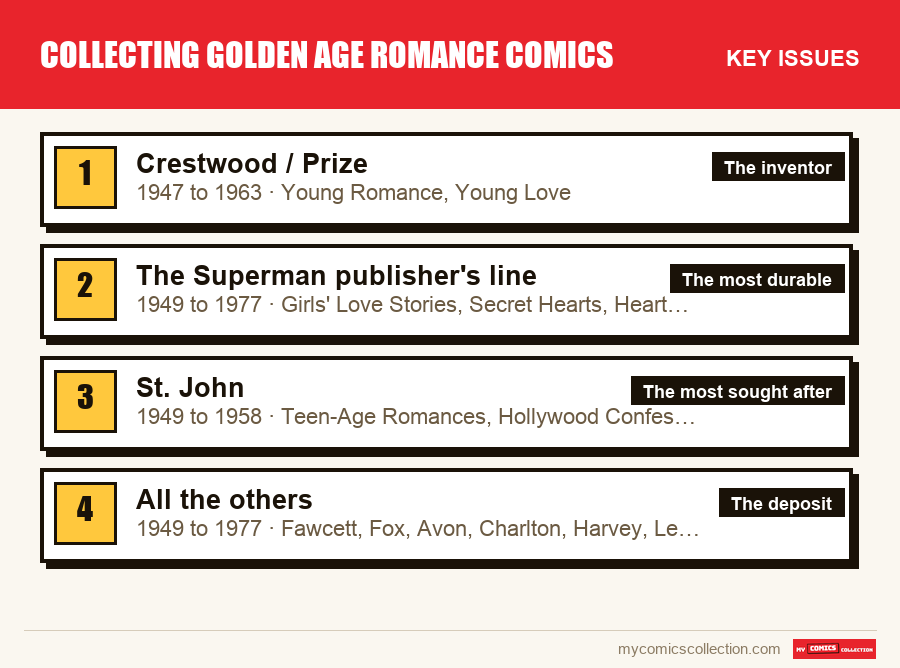
Four families of publishers structure the catalog. Knowing them avoids buying at random.
Crestwood / Prize
This is the founding house, and its catalog concentrates the genre's historical interest. Young Romance runs one hundred twenty-four issues there before being sold, Young Love seventy-three then a second series after an interlude published under the title All for Love. The Simon and Kirby signature covers the early years.
The Superman publisher's line
Girls' Love Stories opens the line in August-September 1949 and will last one hundred eighty issues, until November-December 1973. Secret Hearts starts a month later and reaches one hundred fifty-three issues, until July 1971. Heart Throbs, born at Quality Comics in August 1949, changes hands when it closes: the revival begins at issue 47 in April-May 1957 and continues until issue 146, in October 1972, before six final issues under the title Love Stories.
St. John
Teen-Age Romances #1 appears in January 1949, Hollywood Confessions #1 in October of the same year. The house buys two series from Ziff-Davis in 1953, Cinderella Love and Romantic Love. Its comic book activity ceases in 1958.
All the others
The list is long because nobody resisted. The ancestor of the Spider-Man publisher is there too, with titles like Love Romances and My Own Romance. It is in this mass that the short series of 1950 are found, those the collapse killed after a few issues.
The artists, the only real driver of price
Since there is no character to collect, it is the hand that makes the difference. And the genre employed, often between two more prestigious jobs, a list of names that would make many heroic series blush: Alex Toth, Wally Wood, Frank Frazetta, Mike Sekowsky, Gil Kane, Gene Colan, George Tuska, Jay Scott Pike, Bill Draut, Bob Oksner, John Rosenberger, Tony Abruzzo. Women artists also worked there, among them Ruth Atkinson, Valerie Barclay and Ann Brewster, which is rare enough in the industry of the time to be noted.
Two particular cases deserve development, because they alone structure the top of the market.
The first is Matt Baker, born December 10, 1921 in Forsyth County, North Carolina, died of a heart attack in New York on August 11, 1959. He is one of the first African American artists to break through in the comic book industry, and he entered the medium's professional pantheon, the Hall of Fame that bears Will Eisner's name, in 2009. He worked for Fiction House, Fox, Quality, St. John, Charlton and Atlas, and signed on the romance genre series such as Love Romances, My Own Romance and Teen-Age Romance; his last attested work appears in My Own Romance #73, dated January 1960. He also drew, in 1950, a separate editorial object: It Rhymes with Lust, a complete digest-format story written by Arnold Drake and Leslie Waller for St. John, retrospectively regarded as an ancestor of the graphic novel, the term not yet existing.
The second name is not that of a comics artist, and that is the whole point. Tony Abruzzo, regular illustrator of the Superman publisher's romance line, drew in November 1962 the opening page of a story titled "Run for Love!" in Secret Hearts #83. Roy Lichtenstein took it, cropped and repainted it: that is Drowning Girl, one of the most reproduced paintings of twentieth-century American art. The same issue supplied the material for a second painting, Hopeless. Other canvases by the painter, including Crying Girl and Ohhh… Alright…, come from the same stable of romance magazines.
This creates a collecting category that exists nowhere else: the source issue. An ordinary newsstand issue, printed at large scale, becomes the archive piece of a major work hanging in museums. Demand then comes from an audience that is not the comics one, which completely changes the price dynamic.
Why the genre disappeared
Three causes overlap, and it is important not to confuse them, because two of them are often forgotten in favor of the third.
Saturation, from 1950
This is the first cause, and it is purely economic. One hundred fifty titles for the same audience is too many. The collapse of the second half of 1950 precedes any regulatory intervention by four years: it has nothing to do with censorship, and everything to do with oversupply.
The Code, in September 1954
The text adopted that year notably forbids relationships outside marriage from being depicted or even suggested. For a genre whose narrative driver is precisely sentimental turmoil, the constraint is heavy: it does not kill production, but it smooths its content. The detail of the regulatory context is covered in our article on Golden Age horror, a genre that the same text purely liquidated.
Cultural competition, in the 1960s and 1970s
This is the final blow. The targeted audience finds elsewhere what it came looking for: on television, in teen magazines, in pocket romance novels. The series try to keep up, even importing the codes of the TV serial: the Secret Hearts line thus publishes, from issue 110 in March 1966 to issue 138 in September 1969, a continuous serial of twenty-nine episodes signed Jack Miller, openly inspired by a small-screen hit. The evolution of manners also makes the genre's template, already constrained by the Code, increasingly out of step. Circulation drops, and the last issue falls in July 1977.
What makes an issue worth something
Let's recap in decreasing order of importance, keeping in mind that in this segment the gaps are measured in multiples, not percentages.
The artist, first. A cover attributed to Matt Baker, Frazetta or Toth changes the nature of the object. It is the only factor that turns a common issue into a sought-after piece, and it operates even on series whose title nobody knows. A cautionary corollary: attribution is the weak point. Many unsigned covers circulate with authorship asserted by the seller and contested elsewhere. Before paying the premium for the name, look into what the attribution rests on.
Founder status, next. Young Romance #1 is not just a first issue: it is the birth certificate of a genre that dominated the industry, by two creators who rank among the most important in the medium. It is the absolute reference piece of the segment, and it behaves accordingly. The first issues of the big series that followed occupy the next rank.
The source issue, a case apart. Secret Hearts #83 and the other issues that fed pop painting are not valued on the comics grid. They interest a parallel market, and their price level cannot be deduced from any comparable series.
The subject, when historically singular. The best example is Negro Romance, three issues published by Fawcett between June and October 1950, directed by Roy Ald and drawn by Alvin Hollingsworth, the first African American artist hired by that house. These issues told romantic stories with Black characters, at a time when the industry showed practically none outside the caricature register. Only three issues, an obvious documentary scope: the combination is rare in an otherwise very abundant genre.
Condition, finally, and more than elsewhere. On a production deemed disposable at the time, copies that stayed flat, complete and untrimmed are a minority. The price gap between a reading copy and a well-preserved copy is, proportionally, more violent here than on a heroic title of the same age, simply because the top of the spectrum is almost empty. And since these fragile magazines traveled a lot, undisclosed restoration is a permanent risk.
The dark side: a narrow market
All the above might make you want to dive in. Here is what must temper it.
The first limit is liquidity. Buying is easy, and that is precisely what should raise a flag: if the issues are easy to find and cheap, it is because there are few buyers on the other side. The day you want to sell a lot, you will discover that the number of people truly interested in a 1960s romance series is counted in dozens, not thousands. An object can be old, rare and without a buyer. That is not a contradiction, it is the definition of a niche market.
The second limit is the ratio between costs and value. Certifying an issue costs an amount that does not depend on its price, and neither does shipping it from the United States. On nearly all of this production, these costs far exceed what the object is worth. Certification only makes sense on the handful of pieces described above, and buying in a grouped lot is almost always preferable to buying one by one, precisely to spread out the transport.
The third limit is the absence of a catalyst. A genre whose appreciation depends on reactivatable characters benefits from adaptations, announcements, anniversaries. Here, nothing of the kind can happen: there is nobody to adapt. Any eventual revaluation of this segment will come only from heritage or academic interest, that is, from a slow movement, and nothing guarantees it will happen.
In other words: approach this field as a collector of documents, not as a buyer waiting for a capital gain. If the object interests you for what it is, the ratio between what you pay and what you get is one of the most favorable in the whole medium. If you buy it hoping for an exit, you are in the wrong aisle, and our guides on the Golden Age from a realistic investment angle and on the Golden Age collection in general explain why.
Where to start, concretely
An entry method that holds up comes down to four decisions.
Choose an axis rather than a series. Wanting to complete one hundred eighty issues of the same magazine is a beginner's mistake in this genre: it is long, costly in transport, and the result has no more value than the sum of its parts. The axes that work are transversal: an artist, a year of publication, a publisher, or a cover motif. Ten covers signed by the same hand tell something; ten consecutive issues of an anthology tell nothing.
Read before buying. The genre has been widely reprinted in modern collections, and it is the cheapest way to know if these stories truly interest you. Many discover at this stage that historical curiosity does not survive three stories. Better to learn it on a book than on a stack of issues.
Date before paying. Long series cross several eras and several publishers. The Code seal on the cover places a copy after September 1954; a change in numbering or label signals a buyout. A 1950 issue and a 1970 issue with the same title have neither the same scarcity, nor the same interest, nor the same price. Our landmarks on the ages of the comic book help avoid confusion.
Log everything from the first purchase. This is the most boring and most profitable advice. With no character to serve as a memory landmark, a romance collection quickly becomes unreadable: titles that all look alike, numberings that restart at one, publishers that change mid-series. An inventory kept from the start, with publisher, date, number, presumed artist and condition, is the only way to know what you own after two years.