G.I. Joe: A Real American Hero #21 (Marvel, March 1984) is Larry Hama's legendary "silent issue": 22 pages without a single speech balloon, without a single caption, in which Snake-Eyes battles Storm Shadow and reveals for the first time their shared bond through the Arashikage clan. An underrated key issue from the Hama run, raw VF/NM runs $80-150, CGC 9.8 between $1,500 and $2,500 in 2026, and a serious sleeper candidate should Hasbro relaunch the Snake-Eyes franchise on the big screen.
⚠️ For reference only: This information is provided for informational purposes only. My Comics Collection is not an investment advisor. Values vary based on condition, rarity, and market trends. Check recent sales on eBay or GoCollect before making any purchase decision.
There is a handful of comics that market veterans always cite when you ask them which 1980s Marvel key issue remains unjustly undervalued in 2026. G.I. Joe: A Real American Hero #21, subtitled "Silent Interlude," is one of the three or four names that come up every single time. Published in March 1984 by Marvel Comics, written and drawn by Larry Hama, this issue accomplished something unprecedented in the American mainstream: telling a 22-page story entirely without dialogue, without written sound effects, without a single narrative caption. Pure sequential storytelling, where everything is conveyed through the art.
For years, the market underestimated this issue because of the Hasbro license, which scared off "serious" Marvel collectors who were convinced that a comic based on a toy line couldn't carry any real collectible value. That perception began to crumble in the 2010s, as the collector community reassessed the Hama run and the Snake-Eyes / Storm Shadow mythology earned its own narrative legitimacy, independent of the toy franchise. This complete guide explains why G.I. Joe #21 deserves a place in any serious collection of 1980s Marvel key issues, breaks down its value by grade, and lays out the 2026 strategy for locking it down before the Hollywood spotlight puts Snake-Eyes back at center stage.
Background: Marvel G.I. Joe 1982-1994, Larry Hama, the Hasbro license
To grasp what G.I. Joe #21 represents in Marvel's editorial history, you have to go back to 1982. Hasbro relaunches its G.I. Joe line as 3.75-inch articulated action figures and signs a partnership with Marvel Comics that would change the way publishers view toy licenses. The very first issue of G.I. Joe: A Real American Hero hits stands in June 1982, and the series quickly establishes itself as a massive commercial success. Marvel handed the writing to Larry Hama, a former soldier turned writer and artist, who transformed what was supposed to be a simple marketing vehicle into a dense, fast-paced military saga that was surprisingly mature for its time.
Hama would write the main series for 155 consecutive issues, from 1982 to 1994, a run of exceptional longevity that places G.I. Joe among the most enduring works in Marvel's 1980s catalog. He invented nearly the entire mythology that still defines the franchise today: the heroes' military code, the rivalry between Snake-Eyes and Storm Shadow, the Arashikage ninja clan, the two characters' shared past, and the whole samurai dimension that contrasts with the "Pentagon thriller" tone of the rest of the series. Hama is to G.I. Joe what Chris Claremont is to the X-Men of the same decade: the architect of a universe no one else could have built.
The publishing context also explains why the market long turned its nose up at these comics. Within the collector ecosystem of the 1990s and 2000s, "toy tie-in" titles were scorned by default: Transformers, Micronauts, ROM Spaceknight, G.I. Joe: all filed under "second-tier comics" because they supposedly existed to sell plastic. That lens structurally devalued the Hama run for two decades, even as the narrative quality far exceeded that of many superhero titles Marvel was publishing at the same time.
The reassessment began slowly in the 2010s, driven by the hardcore fans who had never let go of the series, then amplified by the arrival of IDW Publishing, which took over the license and revived the Hama mythology in direct continuity. By 2026, the 1982-1994 Marvel run is officially enshrined as a classic, and the key issues, including #21, are finally recognized at their true historical value. But the financial market hasn't fully absorbed that reassessment yet. That lag is precisely what makes #21 a credible sleeper.
The silent issue: a 1984 dialogue-free narrative gamble
The idea of telling a story without any words wasn't new in 1984. Eisner, Kurtzman, and a few European comics creators had already explored the technique, but never in the American superhero or military mainstream. Larry Hama pitched his editor on trying the experiment with #21 and, to everyone's surprise, got the green light. The result: 22 interior pages without a single balloon, without a single narrative caption, without a single written sound effect. Even the weapon sounds, normally rendered as the "BLAM" or "TAK-TAK" so characteristic of action comics, are absent.
The gamble was risky for several reasons. First, commercially: a 10-year-old who bought G.I. Joe every month to follow the story might feel cheated discovering an issue where "nothing is said." Then, editorially: Marvel didn't control all of the G.I. Joe marketing, and an experimental issue could be seen as poor brand positioning in Hasbro's eyes. Finally, artistically: clearly conveying a complex military infiltration, a katana duel, and a mythological revelation without any text support demands a command of visual language that few artists possess. Hama is both the writer and the illustrator of the breakdowns (inked by Steve Leialoha), which gave him the total control needed to pull off the gamble.
The success of #21 was immediately recognized by the industry. The issue inspired numerous later silent issues in the mainstream: Daredevil , Quartet , The Walking Dead, and even some DC experiments. It also became a reference taught in American comics schools as a canonical example of pure visual storytelling. To understand the historical importance of the technique, look at the opening page: Snake-Eyes parachuting over a mansion, nighttime snow, the silhouettes of ninjas standing guard. No text, yet the reader instantly understands the situation, the objective, and the stakes. That level of visual clarity is what defines the greatness of #21.
For spec collectors, that "first major mainstream silent issue" status is one of the most powerful arguments in favor of long-term value. Unlike a character's first appearance, which can erode if the IP loses relevance, a historical narrative record like this one cannot be erased. A hundred years from now, #21 will always be "the issue that proved a mainstream comic could work without dialogue." That heritage permanence is a rare form of protection against the fashion cycles of the collector market.
The story: Snake-Eyes vs Storm Shadow and the dojo flashbacks
The plot of #21, despite its silence, is dense. Snake-Eyes leads a rescue operation at Destro's mansion to recover Scarlett, a teammate captured by Cobra. During the infiltration, he crosses paths with Storm Shadow, the white ninja in Cobra's service. The fight begins. But after a few katana exchanges, the two men hesitate: something isn't right. Storm Shadow notices a detail on Snake-Eyes's forearm: a hidden tattoo. And everything changes.
The sequence that follows is one of the most moving in the entire Hama run. Storm Shadow remembers. Dojo flashback, the 1960s-70s, two young ninja apprentices trained by the same Hard Master, the same Arashikage clan. Snake-Eyes and Storm Shadow were sword brothers, raised in the same Japanese tradition, sharing the same oath of loyalty to their master. The tattoo is the mark of the clan. Back to the present: the two men, now aware of their bond, suspend the fight. Storm Shadow lets Snake-Eyes complete his mission, in silence. That half-truce becomes the launching point for the entire central arc of the series: Storm Shadow's quest to discover who really murdered the Hard Master.
This mythological content is crucial to understanding the collectible value of #21. The issue isn't just formally remarkable (the silence): it is narratively foundational. Everything that comes after in the Snake-Eyes / Storm Shadow mythology: the Arashikage clan, the revenge, Storm Shadow's eventual redemption, the cursed friendship, the samurai dimension that defines the franchise: is born here. Across these 22 silent pages, Hama plants the seeds of the next decade of storytelling. For collectors who value "first revelations" as much as "first appearances," #21 is quite simply the most important issue in the entire Marvel G.I. Joe series.
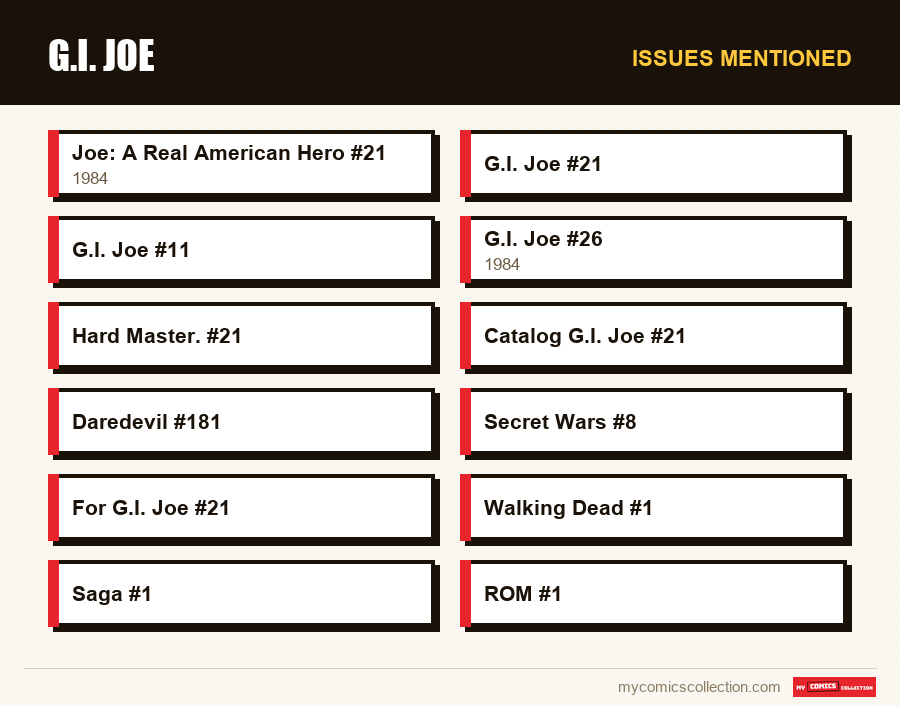
Note carefully: #21 is not Storm Shadow's first appearance. Storm Shadow first appears in G.I. Joe #11, in May 1983. The flashback sequence in G.I. Joe #26 (August 1984) would later expand more fully on the history of the Arashikage clan and the death of the Hard Master. #21 holds the central spot: it is the issue of the revelation and the narrative pivot, the one that transforms Storm Shadow from a generic antagonist into a fully tragic character in his own right. The market increasingly tends to value this kind of "key moment" as much as strict first appearances, which works in #21's favor. If you want to dig into the distinction between the different types of keys and how they're valued, check out our guide on comic print runs and their impact on rarity.
Estimated print run and CGC 9.6/9.8 rarity
Marvel never published exact print run figures for G.I. Joe in 1984, but cross-referencing the series' Statement of Ownership data, Diamond Distribution archives, and industry sources lets us estimate the range with solid confidence. G.I. Joe #21 was likely printed in 250,000 to 350,000 copies, which made it at the time one of Marvel's highest-printed titles of the year, just behind X-Men, Spider-Man, and the leading brand carriers. The high print run may seem paradoxical for a "sleeper," but it has to be put in perspective with the massive destruction rate.
The 1984 comics sold on newsstands (kiosks, supermarkets, drugstores) were mostly read by kids, folded, torn, sometimes kept in disastrous conditions, and often thrown out in their teens. The G.I. Joe franchise heavily targeted the 8-13 age group, which amplifies this phenomenon. The survival rate in Near Mint grade for newsstand copies of G.I. Joe #21 is estimated below 0.5%, meaning potentially 1,500 viable copies out of the 300,000 printed. The split between newsstand and direct edition leans heavily toward newsstand (probably 70/30, even 75/25) because the series targeted the general public, not specialty comic shops.
On the CGC side, the 2026 census gives a precise picture of high-grade rarity. For G.I. Joe #21 (all editions combined, white copies only), the CGC census shows roughly 600 units in grade 9.8, about 1,100 in 9.6, and about 1,800 in 9.4. These figures are climbing steadily (between 30 and 50 new 9.8 slabs per year since 2020) because the growing awareness of the issue's sleeper status is pushing more and more collectors to have their copies graded. The newsstand vs direct edition distinction is becoming an important premium factor for the high-end market. The direct edition (white UPC box on the cover, comic shop distribution) is slightly rarer in very high grade because comic shops ordered fewer of them, but the collector market pays a modest premium (10-20%) on direct CGC 9.8 copies compared to newsstand copies of equivalent grade.
To understand the precise mechanics of newsstand vs direct edition and how they apply to 80s comics, read our dedicated guide to these two distribution formats and their impact on CGC rarity. This distinction is one of the most important, and most misunderstood, value levers in the 2026 Copper Age market.
Collecting this series?
Track what you own, what you are missing and what your collection is worth. 7 day trial.
Start my trial →2026 value: raw, CGC 9.4, 9.6, 9.8
The values below reflect the European and North American market in the first half of 2026, based on recent sales on eBay, Heritage Auctions, ComicConnect, and GoCollect. All ranges are indicative and can shift quickly at the slightest Hollywood or Hasbro announcement about Snake-Eyes. The euro values include standard shipping but exclude auction fees and import VAT, which can add 15 to 25% to the real acquisition cost for a French or European buyer.
- Raw VF/NM (estimated 8.0-9.0): $80 to $150 for a clean newsstand copy. Equivalent direct edition: $100 to $180. These ranges have doubled since 2020 but remain very accessible compared to other 80s keys.
- CGC 9.4: $200 to $300. The step up from raw to 9.4 reflects both the cost of grading and the confidence the slab gives the buyer. It's often the sweet spot for collectors who want a certified grade without paying the very-high-grade premium.
- CGC 9.6: $400 to $700. The 9.6 is becoming the market's pivot grade: copies are still readily available, but the range is climbing steadily as buyers anticipate what's coming.
- CGC 9.8: $1,500 to $2,500. This is where rarity starts to bite. 9.8 sales on Heritage and ComicConnect in 2025 ranged from $1,700 to $2,800 depending on the period and cover quality (white, no spine wear, centering). A newsstand white-pages 9.8 will clear $2,500 easily in the event of a film announcement.
A few important notes for interpreting these ranges. The 9.8 grade sees higher volatility than the 9.4 and 9.6 because the buyer pool is smaller and more speculative. A single Hasbro or Paramount announcement about a new Snake-Eyes film can take the 9.8 from $2,000 to $4,000 in a matter of weeks, as we saw with Walking Dead #1 or Saga #1 during equivalent announcements. Conversely, in a broad bear market, the 9.8 can correct more sharply than the intermediate grades. If your profile leans more toward "defensive long-term collector," the 9.6 grade generally offers the most attractive risk-reward ratio for this kind of comic.
For a precise, personalized estimate based on your specific copy (condition, edition, purchase context), use our free estimation tool, which reads current eBay listings to deliver a low-median-high range in under 30 seconds. Before any purchase over $500, also systematically check the CGC census to confirm the rarity of the grade you're targeting.
Worth noting: Grading a comic like G.I. Joe #21 with CGC costs between $55 and $85 (Modern/Economy tier, excluding shipping to the U.S.) if you send it from Europe. For a raw copy bought at $100 that could come back as a 9.6, the math gets interesting. For an average raw copy (VF, $60-80), grading may not be economically justified. To dig into this calculation, check out our CGC vs CBCS vs PGX comparison.
2026 strategy: why this is a serious sleeper
The term "sleeper" is overused in the comics market, wrongly applied to sell any speculative obscurity. A true sleeper checks three boxes: (1) it has objective, lasting historical or narrative importance, (2) its current value is disconnected from that importance for identifiable reasons, and (3) there is a credible future catalyst that could correct that disconnect. G.I. Joe #21 checks all three boxes with rare clarity.
On the historical criterion, we've seen it: pioneering mainstream silent issue, mythological foundation of Snake-Eyes / Storm Shadow, peak of the Hama run. These three statuses are permanent and cannot be undone by any external event. On the disconnect criterion, the diagnosis is simple: the Hasbro license long disqualified the series in the eyes of the "pure" Marvel market, and that outdated lens artificially keeps values below their equilibrium level. Compare, for example, G.I. Joe #21 to Daredevil #181 (Elektra's death, February 1982): #181 is worth 4 to 7 times more in CGC 9.8, even though the narrative and historical arguments carry comparable weight. That market anomaly is precisely what a sleeper investor is looking for.
On the catalyst criterion, several scenarios are credible over the 2026-2030 horizon. Hasbro has publicly reiterated its intention to relaunch G.I. Joe on film after the relative failure of the Snake-Eyes movie (2021), and several announcements of projects in development at Paramount and Hasbro Entertainment regularly fuel the rumor mill. A Snake-Eyes streaming series, a relaunch film with a stronger cast, even an integration of the franchise into Hasbro's NFT/video game ecosystem: each of these catalysts would mechanically trigger a re-pricing of the Marvel G.I. Joe keys. The market doesn't need a blockbuster: a single confirmed announcement of a major project historically triggers a +30 to +80% move on the associated keys in the following weeks.
As for France and Europe, the G.I. Joe market is even more undervalued than in the United States. The series never achieved in France the cultural penetration it had across the Atlantic, which keeps local values low on the raw copies circulating at fairs, flea markets, and on Leboncoin. A methodical French buyer can still acquire VF/NM copies for around $50-80 by searching patiently, while the same copies would sell for $100-150 on eBay US. This geographic inefficiency is a second layer of opportunity, one that closes a little more year after year as the European market gets up to speed.
To structure this sleeper strategy properly, there are several practical steps. Identify your targets: don't buy at random, but target 3-5 copies at a grade compatible with your budget. Verify authenticity and condition, especially spine integrity, centering, and the absence of brittle creases or yellowing. Catalog at the moment of purchase with the acquisition price, date, source, and estimated condition, so you can track your return precisely later. Our methodical cataloging guide details the full procedure. Plan for grading on your best-preserved copies, without rushing: a poorly prepared submission can destroy the premium you were counting on. And finally, monitor the Hollywood announcements via specialized sources: Deadline, Variety, The Hollywood Reporter, and the dedicated threads on CBR or Bleeding Cool.
To place this G.I. Joe #21 strategy within a broader spec framework covering the Marvel and DC keys rising in 2026, read our complete analysis of the key issues set to rise in 2026, where the silent issue is cited among the Bronze/Copper Age sleepers to watch first.
Track 80s Marvel sleepers with the app
G.I. Joe #21, Daredevil #181, Secret Wars #8, ROM #1: My Comics Collection helps you catalog the Copper Age keys and track their value. Target prices, daily-updated eBay estimates, grading tracking.
Start my 7-day free trial7-day trial
How to build your G.I. Joe #21 position methodically
Start with a raw VF/NM copy
Aim for a newsstand or direct edition between $60 and $120 on eBay, Catawiki, or Leboncoin. Inspect the photos carefully: flat spine, crease-free cover, intact staples, white or pale cream pages. It's the entry ticket to understanding the copy before investing more.
Assess the CGC potential before submitting
If your copy looks Near Mint, compare it to public photos of CGC 9.6 and 9.8 copies (Heritage Auctions has a useful archive database). A failed grading at 9.0 will cost $80 for an uncertain return. A successful grading at 9.6 multiplies your stake by 3 to 5.
Store the copy in optimal conditions
Mylar sleeve with an acid-free backing board, vertical storage, temperature 64-72°F, humidity 40-50%, away from direct light. A sleeper is built over 5-10 years, not 6 months. Preservation is the most profitable investment in the portfolio.
Catalog and track the value in the app
Import your G.I. Joe #21 into My Comics Collection, note the purchase price, the estimated grade, the edition (newsstand or direct) as a tag, and follow its estimated value from there. For news of a Hasbro announcement or a sharp market move, add an eBay saved search on the issue.
Frequently asked questions about G.I. Joe #21 silent issue
Why does a silent issue have collectible value?
A mainstream silent issue is a rare object in the history of American comics. G.I. Joe #21 is the first emblematic example of the technique in a mass-market Marvel commercial title, which gives it permanent historical status. That heritage value is independent of IP fashion cycles and protects long-term value, unlike a simple character first appearance, which can lose relevance if the franchise fades. #21 is studied in comics schools and cited as a reference by contemporary writers, which durably anchors its importance.
Is #21 Storm Shadow's first appearance?
No. Storm Shadow first appears in G.I. Joe: A Real American Hero #11 (May 1983), a separate issue that collectors also seek out. G.I. Joe #21, on the other hand, is the issue where the Storm Shadow / Snake-Eyes / Arashikage clan mythology is revealed for the first time through the dojo flashbacks. The market increasingly considers this kind of "first major story moment" as valuable as a strict first appearance, which puts #21 at a level comparable to #11.
Should you look for the newsstand or the direct edition?
For a long-term collector, both versions have their appeal but with different profiles. The newsstand edition (full UPC barcode on the cover) was distributed at newsstands and supermarkets, so printed in greater numbers but with a much lower high-grade survival rate. The direct edition (white UPC box or Spider-Man logo) was distributed in comic shops, better preserved but printed in smaller numbers. In CGC 9.8, the direct edition commands a slight premium (10-20%), but newsstand 9.8 copies are structurally rarer and some specialists consider them a better long-term play.
How much does CGC grading cost for this kind of issue?
For a Copper Age comic (1984) under a declared value of $400, the CGC Economy tier runs about $30 to $40, plus shipping to the U.S. ($40-60 from Europe via insured shipping) and the return. Budget $80-120 all-in for an Economy submission, with a 4-to-8-month turnaround. For copies valued above $1,000 (a suspected 9.8, for instance), the Modern tier becomes relevant at around $55-65 each. Our CGC comics grading guide details the full procedure for European shipments.
Are there other Marvel silent issues to collect?
Yes, several other Marvel silent issues deserve collectors' attention. Quartet #1 (1976) had already experimented with the format in a low-profile title. Daredevil #205 (1984) contains a memorable wordless sequence but is not a fully silent issue. Wolverine Origin reused the technique across several key sequences. But the true direct heir to the Hama technique is Marvel Knights Hulk #1 (2014), entirely silent, along with several issues from Mark Waid's modern Daredevil run. None of these successors, however, carry the foundational historical status of G.I. Joe #21, which keeps it in a category of its own.
Anticipate Copper Age sleepers with the app
Catalog your 80s comics, track values, updated daily, and keep your sleepers' values in view when a Hollywood or Hasbro announcement hits. My Comics Collection is the tool for collectors who invest smartly for the long term.
Anticipate sleepers with the app7-day trial