
Newsstand editions are almost always rarer than their direct edition counterparts, and the value gap has been widening dramatically since collectors began tracking the distinction around 2015. For key issues from the 1980s-2000s, newsstand copies can command a 2x-10x premium over direct editions in equivalent grade.
For decades, most collectors did not distinguish between newsstand and direct edition comics. They were the same stories, same art, same everything, except for a small difference on the cover. Today, that small difference represents one of the most significant value multipliers in the hobby. Understanding why newsstand editions are rarer, how to identify them, and which ones command the biggest premiums is essential knowledge for any serious collector or investor.
The history: how two distribution systems created a rarity gap
To understand the newsstand vs. direct edition divide, you need to understand how comic book distribution worked from the late 1970s through the early 2000s.
The direct market revolution
Before the late 1970s, all comics were sold through newsstands, drugstores, grocery stores, and convenience shops. The direct market emerged when specialty comic book shops began ordering directly from publishers through distributors like Diamond. These shops ordered comics on a non-returnable basis: meaning they bought at a deeper discount but could not return unsold copies.
Publishers began printing two versions of each comic: one for newsstands (with a UPC barcode on the cover) and one for direct market shops (with the publisher's logo or a different marking where the barcode would be). The content inside was identical.
The gradual shift in distribution ratios
Through the 1980s, the split between newsstand and direct edition copies was roughly 50/50. As comic shops proliferated, the ratio shifted dramatically:
- Early 1980s: Approximately 50% newsstand / 50% direct edition
- Late 1980s: Approximately 30% newsstand / 70% direct edition
- Mid 1990s: Approximately 15-20% newsstand / 80-85% direct edition
- Early 2000s: Approximately 5-10% newsstand / 90-95% direct edition
- 2013-2017: Newsstand distribution virtually ceased for most publishers
This progressive decline means that later newsstand editions are exponentially rarer than their direct market counterparts.
How to identify newsstand vs. direct editions
The difference is almost always visible on the cover, though the specific markings vary by publisher and era.
Marvel Comics identification
- Newsstand copies: Feature a standard UPC barcode in the lower left corner of the cover.
- Direct edition copies: Feature the Spider-Man head logo (or other character head) where the barcode would be, sometimes with a small barcode beneath it.
- Later Marvel direct editions (2000s): May show a barcode but with a different code structure. Look for "Direct Edition" text or the absence of a standard retail price point.
DC Comics identification
- Newsstand copies: Feature a standard UPC barcode on the cover.
- Direct edition copies: Feature the DC bullet logo or a blank rectangle where the barcode would be.
- 1990s-2000s DC: Direct editions often show a barcode with different pricing information or a "Direct Sales" indicator.
Key identification tips
- Price variants: Some newsstand editions have higher cover prices (particularly Canadian price variants or UK price variants). These are especially collectible.
- CGC labels: CGC now notes "Newsstand Edition" on their labels for qualifying copies, which has significantly boosted collector awareness and demand.
- Look carefully: The differences can be subtle, especially on later issues. Always examine the barcode area closely.
Why the value gap is exploding
Several factors have converged to make newsstand premiums grow faster than almost any other segment of the market.
The survival rate problem
Newsstand comics suffered dramatically higher attrition rates than direct edition copies. Comics sold at newsstands, grocery stores, and gas stations were handled by non-collectors. They were read, folded, left in rain, thrown away. Unsold copies were stripped of their covers and returned for credit, then destroyed. By contrast, direct edition copies went to comic shops where they were bought by collectors who stored them carefully.
This means the already lower print runs of newsstand copies are further reduced by far higher destruction rates. For a comic from the late 1990s where only 10% of copies were newsstand editions, the actual surviving population in collectible condition might be 2-3% of total surviving copies.
CGC census awareness
When CGC began noting newsstand editions on their labels and tracking them separately in their census, it created a quantifiable rarity metric. Collectors could now see exactly how many newsstand copies existed in the census versus direct editions. For many key issues, newsstand copies represent less than 5% of graded copies: concrete proof of their scarcity.
Price multipliers by era
- 1979-1985 newsstand editions: 1.2x-1.5x premium over direct editions. Newsstand copies were still common in this era.
- 1986-1992 newsstand editions: 1.5x-3x premium. The ratio was shifting but newsstand was still significant.
- 1993-1999 newsstand editions: 2x-5x premium. Newsstand distribution was declining rapidly.
- 2000-2010 newsstand editions: 3x-10x premium. Newsstand copies are genuinely scarce.
- 2010-2017 newsstand editions: 5x-20x+ premium. The final years of newsstand distribution produced extremely rare copies.
The most valuable newsstand editions to hunt
Not all newsstand premiums are equal. The biggest multipliers occur when genuine rarity meets strong demand for the key issue.
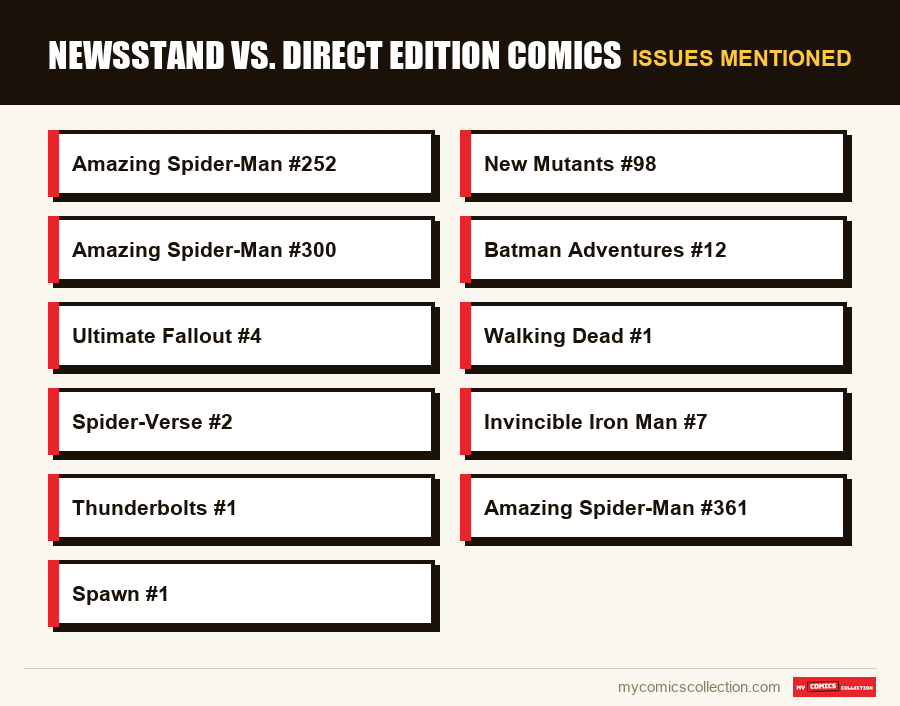
- New Mutants #98 newsstand (1991): First Deadpool. Newsstand copies in CGC 9.8 can command $8,000-12,000 versus $3,000-4,000 for the direct edition.
- Amazing Spider-Man #300 newsstand (1988): First Venom. Newsstand premium of 2-3x in high grades.
- Batman Adventures #12 newsstand (1993): First Harley Quinn. Newsstand copies are extremely scarce and command 3-5x premiums.
- Ultimate Fallout #4 newsstand (2011): First Miles Morales. One of the most desirable modern newsstand editions, with premiums of 5-10x.
- Walking Dead #1 newsstand (2003): Extraordinarily rare. Newsstand copies in any grade command massive premiums.
Canadian and UK price variants
A subset of newsstand editions:Canadian Price Variants (CPV) and UK Price Variants (UKP): command even higher premiums. These were distributed exclusively in Canada or the UK respectively, with different cover prices reflecting local currency.
- Canadian Price Variants (1982-1988): Feature a higher Canadian dollar price (e.g., "$1.00 CAN" versus "75 cents US"). These are estimated to represent only 2-5% of total print runs for many issues.
- UK Price Variants: Feature pence pricing instead of cents. These are especially scarce for Marvel titles from the late 1970s and early 1980s.
- Combined rarity: A Canadian price variant of a key issue can command 5-15x the direct edition price, making them among the rarest variants of commonly collected comics.
Investment outlook for newsstand editions
The newsstand premium trend shows no signs of reversing. As more collectors become aware of the distinction, and as CGC census data continues to reveal how scarce newsstand copies truly are, premiums are likely to continue expanding. For investors, newsstand copies of key issues from the 1990s and 2000s represent one of the most compelling opportunities in the current market.
Condition matters even more for newsstand copies
Newsstand copies faced harsher conditions than direct edition copies from the moment they left the printer. Understanding this helps explain both their rarity in high grade and their premium pricing.
The newsstand condition problem
- Spinner rack damage: Newsstand copies were displayed in metal spinner racks that bent spines, dinged corners, and created rolling creases.
- Multiple handling: Unlike a comic shop where books might be pulled from a box, newsstand copies were handled by store employees, browsing customers, and casual readers before purchase.
- Non-collector buyers: The person buying a comic from a drugstore was typically a casual reader, not a collector. They read it, folded it, and stored it carelessly.
- Strip-cover returns: Unsold newsstand copies had their covers stripped (torn off) and returned for credit. The remaining interior pages were supposed to be destroyed but sometimes survived: these are coverless copies with no collectible value.
Census implications
Because newsstand copies were treated so roughly, the survival rate in high grade is dramatically lower than for direct editions. For a book from 1995 where the CGC census shows 200 copies in 9.8, perhaps 10-15 are newsstand editions. This extreme concentration of scarcity at the top of the grade spectrum is the fundamental driver of newsstand premiums.
Building a newsstand-focused collection
For collectors who want to specialize in newsstand editions, here is a prioritized acquisition strategy:
Priority 1: Key issues from 2000-2013
These are the rarest newsstand editions because print runs were at their lowest. Focus on first appearances of characters who are now popular: Ultimate Fallout #4 (Miles Morales), Edge of Spider-Verse #2 (Spider-Gwen), and Invincible Iron Man #7 (Riri Williams).
Priority 2: Major keys from 1993-1999
Books like Batman Adventures #12, New Mutants #98, and Thunderbolts #1 from this era offer a strong scarcity premium without the extreme prices of the 2000s newsstand copies.
Priority 3: Iconic keys from 1986-1992
Amazing Spider-Man #300, Amazing Spider-Man #361, and Spawn #1 newsstand editions offer the most recognizable names at more accessible (though still premium) price points.
The future of newsstand collecting
The newsstand premium trend is still in its early stages. Several factors suggest continued growth:
- Growing awareness: As more collectors learn about the newsstand distinction, demand for newsstand copies increases while supply remains permanently fixed.
- CGC label visibility: Every new newsstand copy that gets graded and labeled by CGC increases market awareness and validates the premium.
- Generational shift: Younger collectors who did not experience the newsstand era often find these copies fascinating as historical artifacts of a distribution system that no longer exists.
- Price guide adoption: As price guides begin listing newsstand and direct editions separately, the market infrastructure for sustained premiums strengthens.
Frequently Asked Questions
Not necessarily. Newsstand premiums are most significant for key issues (first appearances, major storylines) from the late 1980s onward. For non-key issues, the newsstand premium may be small or nonexistent because collector demand is low regardless of distribution type. The premium is driven by the intersection of rarity and desirability.
Yes. CGC now notes "Newsstand Edition" on their labels for qualifying copies and tracks them separately in their census. This has been a major catalyst for the newsstand premium trend, as collectors can now quantify the relative scarcity of newsstand versus direct edition copies for any given issue.
If you own a newsstand copy of a key issue in good condition, grading is highly recommended. The CGC "Newsstand Edition" label significantly enhances marketability and establishes the copy's provenance. For newsstand copies of major keys from the 1990s and later, the increase in value from grading typically far exceeds the grading cost.
The best sources are estate sales, garage sales, and collections from non-collectors who purchased comics at grocery stores and newsstands. Online, search eBay specifically for "newsstand" in key issue listings. Convention dealers who acquired old newsstand stock can also be excellent sources. Many collectors still do not check for newsstand editions, so underpriced copies surface regularly.