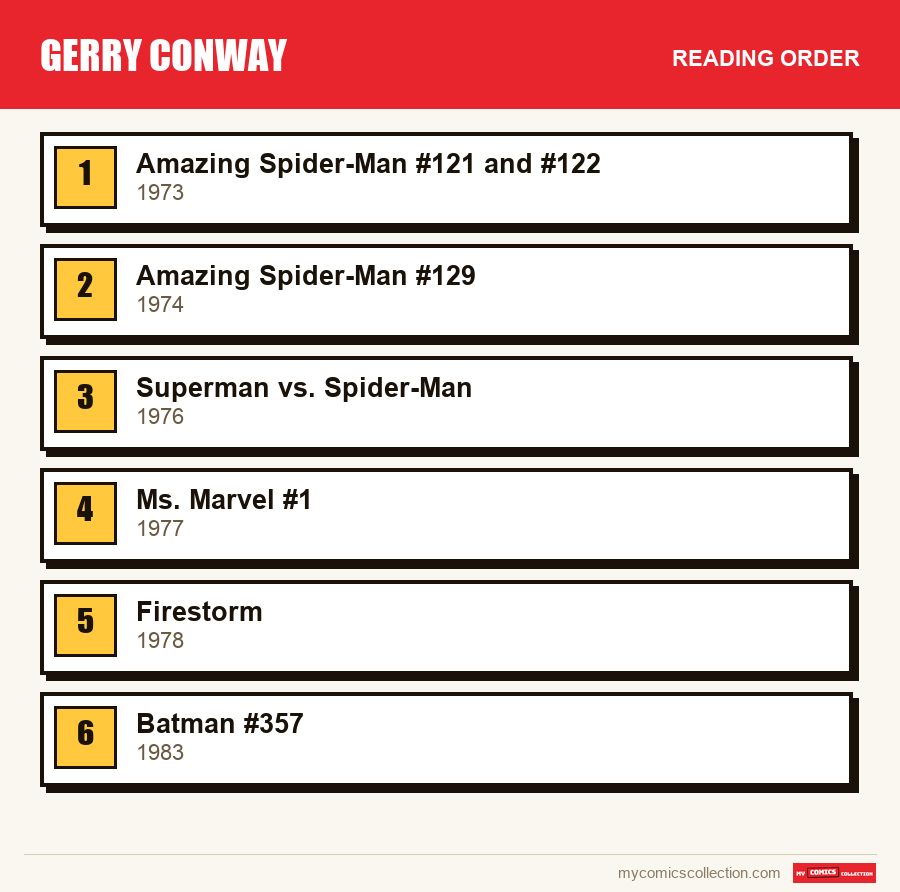
To read Gerry Conway, open The Amazing Spider-Man #121 and #122 (1973) first, the death of Gwen Stacy, drawn by Gil Kane. Continue with #129, which introduces the Punisher and the Jackal, then Superman vs. Spider-Man (1976), Ms. Marvel #1 (1977), Firestorm (1978) and Batman #357 (1983). Six steps, from the most accessible, a closed two-parter, to the most demanding, a project spanning several series.
Gerry Conway is a rare case: a writer who signed foundational moments at Marvel and then at DC, without ever being locked into a single character. Reading Conway in one block makes no sense, since the output stretches across decades and dozens of titles; reading by milestones, on the other hand, gives a faithful picture of what the 1970s and 1980s invented in the American comic book.
As always on this guide, only verified information (creators, issue numbers, dates) is stated as fact; the analysis is our own, with no reproduction of protected pages or dialogue.
This is not a biography: no career timeline, only an itinerary. The logic is to start with the stories that can be understood without notes, move on to those that founded a character, and finish with series that require familiarity with an editorial universe. The first stop has its own page, the page on issue #121 and Gwen Stacy, where questions about copies are settled.
Step 1: Amazing Spider-Man #121 and #122 (1973)
Conway took over the Spider-Man series in 1972, with issue 111, after Stan Lee stepped away as writer. With Gil Kane on art, Conway delivered in June and July 1973 a famous two-parter: in the first issue, the Green Goblin kidnaps Gwen Stacy; in the second, Peter Parker has to live with the aftermath. The story is short, closed, and requires only a basic knowledge of the character: a student, a masked vigilante, an enemy who knows who he is.
Why this entry point? Because the intensity is packed into two issues, which lets you judge with no commitment whether Conway's tone suits you. The writing does not look for flashy effects: the drama lies in decisions, in what Peter does next. The choice not to bring the lost character back was long regarded as a break with the conventions of the genre. Issue #122 is just as important as #121, but less often cited; for its part, our study of the death of the Green Goblin in Amazing Spider-Man #122 details what is at stake there.
Effort level: low. Two single issues, or a collected edition of the period; no prior reading required.
Step 2: Amazing Spider-Man #129 (1974)
Issue 129 is dated February 1974. Conway wrote it with Ross Andru on art. It features the first appearance of the Punisher, who is at this stage merely an adversary of Spider-Man sent by the Jackal, another character who debuts in this same issue. Neither is yet what he will become: the Punisher is first a hired killer with a Texan accent, not the vigilante of the series that will later be devoted to him.
The reason to read this issue is not just the curiosity of a first appearance. It shows how Conway builds an antagonist by contrast with the hero: Spider-Man refuses to kill, the adversary does not, and the difference is enough to make a story. For the collecting side, the article on the value of Amazing Spider-Man #129 remains the reference; the study of the best Punisher runs shows what this character became after that first fight.
Effort level: low. A single issue, but it is best read right after #121 and #122 to feel the continuity of the series. Note also that the Jackal, introduced in this issue, will return in Spider-Man's clone storylines, which gives this issue a reach far greater than its apparent simplicity: a first chapter whose consequences extend across decades of publications.
Step 3: Superman vs. Spider-Man (1976)
In 1976, the two major publishers collaborated for the first time on a large-format album. Conway wrote the script; Ross Andru drew it. The story brings together Superman and Spider-Man against common enemies, including Lex Luthor and Doctor Octopus. The book has the status of a historical curiosity as much as a comic: it is an editorial event before it is a story.
It is for those who want to see how a writer used to both houses handles two universes: Conway's prose stays clear, the dialogue is shared well between the two heroes, and the plot does not collapse under the weight of the meeting. It is not Conway's best work, but it is a good example of what the writer can do when the brief is heavy.
Effort level: low to medium. A single album, but its unusual format (the large format of the time) makes searching for the original edition harder; reprints make reading easier. The Superman hub helps place the album within the character's series.
Step 4: Ms. Marvel #1 (1977)
Ms. Marvel #1 came out in January 1977, with Conway on script and John Buscema on art. Carol Danvers, who already existed as a supporting character in the Marvel universe, becomes a heroine in her own right, with powers and a title of her own. The series looks for a tone halfway between superhero adventure and the drama of a woman who does not remember how she acquired her abilities.
This step interests two kinds of readers: those who follow Carol Danvers through her many identities, and those who want to see how a 1970s writer builds a female-led series in a genre that was then male-dominated. It is more uneven than the previous ones; the first issue is the best entry, and there is no need to continue beyond it if it does not click.
Effort level: medium. The start of the series is easy to follow; what comes after requires knowing the character. For collecting, remember that Carol Danvers' first appearance predates the series, which separates the launch issue from the first-appearance issue.
Do you collect this series?
Track what you own, what you are missing and what your collection is worth. 7-day trial.
Start my trial →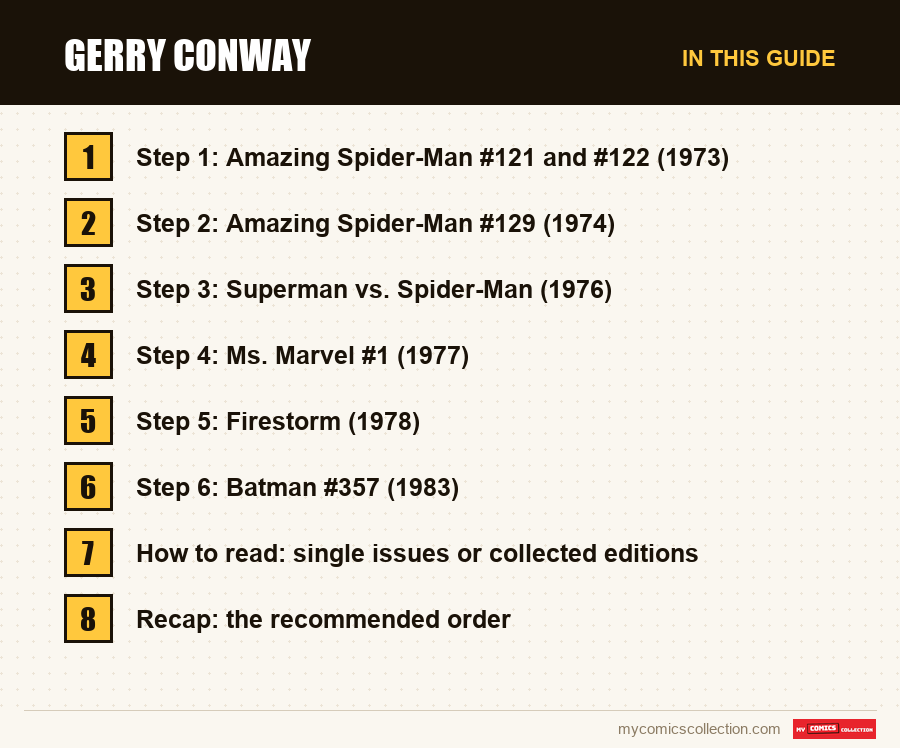
Step 5: Firestorm (1978)
At DC, Conway co-created Firestorm with Al Milgrom. The series began in March 1978: a high school student, Ronnie Raymond, and a physicist, Martin Stein, accidentally merge into an elemental hero. The formula is simple: two minds in one body, a fusion that creates problems as much as it solves them.
This is the step that best shows Conway's ability to found a character within a constrained framework. The series was soon hit by the cancellations of the era, which kept it from developing its potential; it should therefore be read as a beginning rather than an accomplishment. The hero would return elsewhere, in other series, and the comparison is instructive.
Effort level: medium to high. The original series is short, but the character's place in the DC universe assumes some continuity landmarks. If you are discovering DC this way, proceed carefully and do not read in a row more than what interests you.
Step 6: Batman #357 (1983)
In Batman #357, dated March 1983, Conway wrote, with Don Newton on art, the first appearance of Jason Todd, who would later become the second Robin. The issue itself is modest: the interest lies elsewhere, in the way Conway sets up a character destined to carry an entire arc several years later. The guide devoted to Batman #357 and the first appearance of Jason Todd details the collecting stakes.
Why this step last? Because it calls for cross-reading. In isolation, this issue says little; placed within the long run of the Batman series, it becomes the starting point of an arc that would only conclude in 1988. It is also the step that demands the most patience: you are reading a beginning whose meaning you will only see much later.
Effort level: high. You have to accept reading an episode for what it announces more than for what it tells. For what comes next, the Batman hub offers useful landmarks.
How to read: single issues or collected editions
Conway's output, spread across decades, makes the question of format particularly concrete. The Marvel issues of the 1970s exist as original single issues that are easy to find in average condition, but their paper ages poorly; the collected editions of the Spider-Man series from the period cover them well, with better print quality. The DC issues of the 1980s are easier to preserve as single issues, since paper and printing had improved.
Our method: read the whole thing in collected editions, then keep the single issue for the numbers whose object you want. When the single issue is a first-appearance number, like Spider-Man #129 or Batman #357, check the copy closely before buying: the condition of the spine, corners and cover matters more than the title of the listing. To decide between a bound volume and a period issue, the piece on omnibus or original single issues sets out the terms of the choice.
The three years between the death of Gwen Stacy and the Superman vs. Spider-Man album also show a writer comfortable with long formats as well as with monthly twenty-page issues, which eases the passage from one step to the next along the path. Each milestone stands on its own, and that is a valuable quality when you read out of order or out of curiosity.
One last point of method: since Conway writes for very different artists, from Gil Kane to Ross Andru to Don Newton, visual quality varies from one issue to the next. Do not expect graphic unity; expect unity of voice.
Recap: the recommended order
- Amazing Spider-Man #121 and #122 (1973), with Gil Kane. Low effort.
- Amazing Spider-Man #129 (1974), with Ross Andru. Low effort.
- Superman vs. Spider-Man (1976), with Ross Andru. Low to medium effort.
- Ms. Marvel #1 (1977), with John Buscema. Medium effort.
- Firestorm (1978), with Al Milgrom. Medium to high effort.
- Batman #357 (1983), with Don Newton. High effort.
If you could keep only two readings, take step 1 and step 2: three Spider-Man issues that give the measure of the writer and his era. If the style speaks to you, continue in order; otherwise, you will at least have read what mattered most.
Frequently asked questions
With Amazing Spider-Man #121 and #122, published in 1973 with Gil Kane on art. The two-parter is closed and requires almost no prior knowledge. Then follow with #129, which introduces the Punisher and the Jackal.
His first appearance is in Amazing Spider-Man #129 (February 1974), script by Gerry Conway, art by Ross Andru. The character is there an adversary of Spider-Man, hired by the Jackal. The series devoted to him come only later.
Yes. At Marvel, Conway wrote Spider-Man starting with issue 111 and launched Ms. Marvel in 1977. At DC, Conway co-created Firestorm in 1978 and wrote the first appearance of Jason Todd in Batman #357, in 1983. This double footing explains the diversity of the career.
Not to understand the best stories, but to see how Conway founds a character at DC. The 1978 series is short, interrupted by the cancellations of the era, and reads as a beginning. It mainly interests readers who already follow the DC universe.
As objects, yes, especially for first appearances like Spider-Man #129. For reading, a collected edition is more comfortable: period paper browns and becomes fragile. A period copy should be bought after examining the spine, corners and cover, never on the listing title alone.
Do you have an Amazing Spider-Man from the Conway era, #121 to #129 for example? Get a free estimate before selling or insuring it.
Estimate my comic