A French magazine from the 1960s to the 1990s is not a translated American comic: it is an assembly. Several episodes from different series sit alongside editorial pages, letters, games, documentary features and adverts for the publisher's other titles. A checklist of issues records only part of this package. To know what a specific copy contains, you need the contents page printed inside it.
You have a pile of magazines at home, and for each issue you can only tell one thing: the title on the cover. That is very little. The cover announces a character, sometimes a scene, often a slogan; it says almost nothing about the pages it protects. The French issue was designed as a popular periodical, with a magazine logic rather than the logic of a single-story collection. As long as you reason as you would about an American comic, one issue in two stays unreadable in your own inventory.
As always on this guide, only verified information (creators, issue numbers, dates) is stated as fact. The analysis is our own, with no reproduction of any panel or protected dialogue.
A package of several episodes, not a translation
The economic model of the French newsstand required a generous page count and a regular publication schedule. To fill it, publishers could not rely on a single episode: they assembled several, often drawn from series with no connection to one another. A single issue could thus place an urban vigilante, a cosmic hero and a creature of the night side by side, each with its own creative team.
This structure is visible in any serious checklist, provided you look at the credits rather than the titles. For a single story title, you very regularly find three writers and three artists listed on the same line. This is not a data entry error: it is the trace of three different stories compressed into one entry.
Across a set of more than three thousand French issues in the checklist, the artist line carries three names in nearly eight cases out of ten. A reader who takes this line for the team of a single story is wrong every time; a reader who sees in it the signature of an editorial assembly finally understands the object in hand.
The checklist caps at three names, the issue does not
There is something more troubling. In the catalogue, the list of artists for an issue never exceeds three names. Never four, never five. This limit has no printed reality: nothing prevented a magazine from publishing four segments, and many did. The limit is a data-entry convention, not a property of the magazine.
The consequence is direct for anyone searching. If an issue contained four episodes, the fourth is simply absent from the checklist, with its title, its writer and its artist. You can therefore search for a long time for a story you have read, without ever finding it linked to the issue where it actually appeared.
At the other end, more than two hundred issues have no artist recorded, and seventy have neither writer nor artist. These gaps do not mean the pages were empty: they mean nobody has yet opened the copy to describe it. Your pile is sometimes worth more than the online record.
Headings that are really service pages
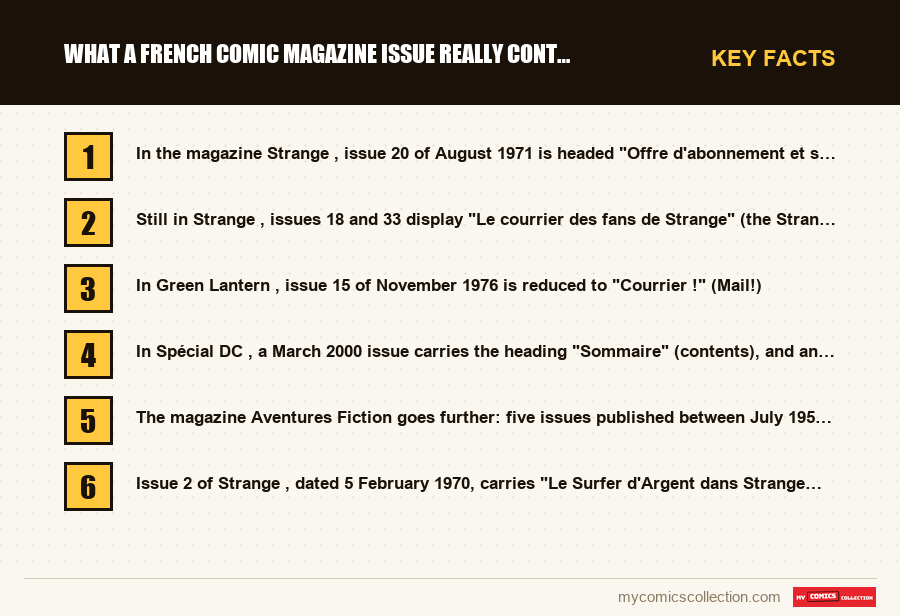
Get into the habit of reading story titles with caution, because many are not stories at all. In the magazine Strange, issue 20 of August 1971 is headed "Offre d'abonnement et sommaire" (subscription offer and contents). It is not a story: it is the magazine's commercial page, slipped by mistake into the slot reserved for fiction.
The case is not isolated. Still in Strange, issues 18 and 33 display "Le courrier des fans de Strange" (the Strange fan mail). In Green Lantern, issue 15 of November 1976 is reduced to "Courrier !" (Mail!). In Spécial DC, a March 2000 issue carries the heading "Sommaire" (contents), and another from August 2002 "Courrier DC et d'ailleurs…" (DC mail and more…). All these features take up the space of a story without being one.
The magazine Aventures Fiction goes further: five issues published between July 1959 and February 1960 all carry the same heading, "Tarif des abonnements annuels (12 numéros)" (annual subscription rates, 12 issues). If you look for a story behind that title, you are looking for a price table. An entry like this actually tells you something useful: the magazine devoted a fixed share of its pages to its own business.
Cross-references to the publisher's other titles
The second family of misleading headings points not to a story but to another publication. Issue 2 of Strange, dated 5 February 1970, carries "Le Surfer d'Argent dans Strange n°3" (the Silver Surfer in Strange No. 3): it is an advert for the next issue, not a story from the copy in hand. A few months later, issue 6 is content with "Marvel n°3", the name of a neighbouring title.
This practice became systematic. Between 1976 and 1977, Strange ran headings such as "Titans n°2", "Spécial Strange n°4", "Album Conan n°1 : le colosse noir" (Conan Album No. 1: the black colossus) or "Planète des Singes n°3" (Planet of the Apes No. 3). In Nova, the first issue of February 1978 carries "Album l'Araignée numéro 2 : la nuit du Lézard" (Spider-Man Album No. 2: the night of the Lizard), and issue 3 of April 1978 "Album Conan n°6 : le château hanté" (Conan Album No. 6: the haunted castle). These are internal advertising pages, meant to move the reader from one title to another.
The same mechanism runs across decades and publishers. Captain America displays "Epic n° 4" on two issues from 1984, and the magazine 2099 points in October 1993 to "X-Men Saga n°14". In Sidéral, the tagline "Artima vous offre la collection la plus variée d'illustrés récréatifs" (French slogan: Artima offers the most varied collection of recreational comics) serves as a heading across several issues from the early 1960s.
Documentary features and games
The French issue was not only a vehicle for fiction: it also aimed to entertain and inform. The proof is in headings that have nothing superheroic about them. In December 1982, Spécial Strange carries a heading such as "Un four solaire dans votre cour" (A solar oven in your yard), which clearly belongs to a popular-science feature, not to a mutant story.
In the same vein, Spécial Strange elsewhere displays "Jeu de dés" (Dice game), the magazine L'Araignée offers "L'Araignée aux jeux olympiques d'hiver" (The Spider at the Winter Olympics), and Nova announces "Le mois prochain… le nouveau et fabuleux Mustang" (Next month… the new and fabulous Mustang). The reader of the 1980s therefore bought, in the same object, translated episodes, game pages, a documentary piece and the programme for the following month.
For a collector, this heterogeneity has its own value. The French editorial pages exist nowhere else: they have no equivalent in the original editions and have never been reprinted in modern collections. A complete issue, with its features and adverts, therefore preserves information that the most beautiful album cannot restore.
Do you collect this series?
Track what you own, what you are missing and what your collection is worth. 7-day trial.
Start my trial →
Cross-checking French illustrators credited alongside American authors
The covers and part of the linking pages were produced in France. That is why the checklists place American and French names on the same line. Jean Frisano appears on more than six hundred listed issues, and Jean-Yves Mitton on more than five hundred: two massive presences that do not match any translated interior page.
The mixing is explicit in nearly a thousand entries, where a French name sits next to American names in the same artist list. The magazine Facteur X gives a clear illustration from its very first issue in 1989, where Ciro Tota appears alongside Walt Simonson. Ciro Tota returns across nearly one hundred and fifty issues in the catalogue, almost always in that position.
If you read these lines as creative teams, you attribute to a French illustrator episodes he never drew. If you read them for what they are, you learn to distinguish two layers in your copy: the pages that came from elsewhere, and the packaging assembled here.
Why a checklist of issues is not a contents page
A checklist of issues answers a simple question: which issues existed, on what date, under which series title. It is valuable for checking that a collection is complete, for placing a change of frequency, for spotting the last issue of a format. It was never designed to describe the internal content of an issue.
A contents page does exactly the opposite: it lists what a given object contains, segment by segment, with page numbers. It is the only source that can tell you that a copy contains a particular story, a particular feature, a particular letters page. Confusing the two leads to false statements, and in particular to the constant temptation to infer the presence of a specific episode from an entry heading.
In this guide, we therefore hold to one rule: what is stated comes from a verified checklist, and what belongs to the full contents remains to be confirmed on the copy itself. Honesty is not a stylistic precaution here; it is the only way to make an inventory reusable by someone else.
Ask for a photo of the contents page before buying
This composite nature leads to a very concrete buying practice. Before paying for an issue advertised for its content, ask the seller for a sharp photograph of the contents page, not only of the cover. In a few seconds you will know whether the episode you are looking for is there, and whether it is complete or split across two parts.
This request also helps check the physical integrity of the issue. Centre pages, games and colour plates were often torn out by readers of the time. A copy missing its double-page centre spread is still readable, but it is no longer complete, and that should weigh in the discussion. The contents page lets you compare what should be there with what remains.
If the seller refuses or stays vague, treat it as buying an unknown object. For a common issue, the risk is low. For a sought-after issue, buying without a contents page amounts to paying for a cover in the hope of finding content.
Two copies of the same issue, two descriptions
Here is the point that most confuses buyers. Two listings for the same series and the same issue can describe different contents, with nobody lying. One describes the cover, another the first episode, a third the best-known story in the contents, a fourth copies an online record that kept only one entry.
The checklists themselves carry the trace of this instability. They include issues recorded in square brackets, such as this Captain America issue dated the second quarter of 1979, whose recorded heading is an advert for albums on sale at retailers. Depending on who describes it, the same object is therefore called a story, an advert, or nothing at all.
The right reaction is not to look for who is right, but to change reference. Between two conflicting descriptions, the photograph of the contents page settles it, because it comes from the copy itself and not from a record. Everything else is interpretation.
What to note when you inventory your collection
If you go back to your pile with this principle in mind, note for each issue four things that nobody notes: the number of segments present, the series they belong to, the non-narrative features, and the presence or absence of the centre pages. These four lines turn a list of issue numbers into a genuinely useful inventory.
Add the date carried by the copy, as printed, in its exact form. French magazines vary the format: a day-level date for the monthly newsstand titles, a quarter for some special formats, a bare year elsewhere. This form is a clue to the edition and the format, and copying it exactly will keep you from confusing two printings.
Finally, note in one sentence what you saw with your own eyes as opposed to what you read elsewhere. This is the discipline that separates a documented collection from one that is merely listed, and it is also what will give value to your work on the day you sell, insure or pass on the whole.

Frequently asked questions
It varied by magazine, page count and period, and sources differ on the special cases. What is certain is that several episodes shared the pages of most newsstand titles, alongside non-narrative pages. Only the printed contents page of the copy can give an exact number for a given issue.
Because the credits line describes not a story but an entire issue. The names match the different segments assembled in the same issue, plus the cover illustrator. The list stops at three names by data-entry convention, which means a fourth segment may exist without appearing anywhere.
No. It is the name of another publication from the same house, used on an internal promotional page. A run of these appears in Strange in the mid-1970s, with variants such as "Spécial Strange n°4" or "Album Conan n°1 : le colosse noir". These entries flag an advert, not a story.
It keeps some value, but it is no longer complete, and that must be disclosed. The game pages, features and adverts are part of the issue as it was sold. An attentive buyer asks for them, because they were never reprinted elsewhere and they date the object precisely.
Open the copy at the contents page and read the headings one by one, with their page numbers. No online record replaces this check, since none claims to reproduce the full contents. If the copy is not in your hands, ask the seller for a photograph of that page.