The Fall of the Mutants reading order has no central series: it's three parallel stories published from January to March 1988 by Marvel in The Uncanny X-Men #225-227, X-Factor #24-26 and The New Mutants #59-61, written by Chris Claremont and Louise Simonson and drawn by Marc Silvestri, Walter Simonson and Bret Blevins. Read the three blocks of three issues, preferably alternating series by issue position, then add the tie-ins if you want full coverage.
The 1988 event is a special case in the history of crossovers: no miniseries sits on top of it, no issue serves as a pivot, and each of the three teams faces its ordeal in its own title. You need a reading plan, and this guide offers one.
As always on this site, we only state verified facts (creators, issue numbers, dates); the analysis is our own, with no reproduction of protected pages or dialogue.
What to read first
A three-front crossover assumes you know three teams. No prior reading is required, but the hardcover collection released in 2011 gives a valuable hint: it reaches back to New Mutants #55, Uncanny X-Men #220 and X-Factor #18, which outlines the lead-up period the edition considers useful. Here's how to use it.
For the X-Men, revisit the end of the stretch before The Uncanny X-Men #225: issues 220 to 224 set up the team's situation and that of Storm, who has lost her powers and goes looking for Forge on the threshold of the arc. Issues 220 to 224 fit into the general X-Men reading path, and the Uncanny X-Men collecting guide helps you track them down.
For X-Factor, issues 18 to 23 come before the arc and take stock of the team before its confrontation with Apocalypse. For the New Mutants, issues 55 to 58 show the group under Magneto's guardianship, which it will leave at the end of the event. If you're in a hurry, jump straight to the next phase: each block can be understood without preparation, at the price of a few references.
The political context helps too. Marvel ran, in issues dated November 1987 and in bookstores, fake postcard-format ads for a "Mutant Registration Act," drawn by Jon Bogdanove and featuring Franklin Richards; the campaign recalled the dark future of Days of Future Past. This promotional wink foreshadows the theme of distrust toward mutants.
Spoiler warning: the event includes the death of a character and the destruction of a headquarters. The sections below name the ordeals in a very restrained way.
Phase 1: the immediate prelude, the issues that come before
The first phase is the one we recommend without imposing it. It gathers The Uncanny X-Men #220-224, X-Factor #18-23 and The New Mutants #55-58, which is exactly what the 2011 hardcover places before the three arcs. It's a simple way to get to know the three teams without having to read their whole history.
The method is as follows: read each series separately, from the oldest issue to the most recent, then move on to the next phase. Avoid mixing the three series at this stage: their tones differ, and alternating only makes sense once the main arcs open. The work on X-Factor continues in our file on the best runs of the series, and the best New Mutants runs are a companion for the other team.
Note also that these preludes don't form an event: they're ordinary issues that you can read for their own sake or skip without penalty. Our collector's advice: if you have a volume that already contains these issues, read them in the volume before hunting for single issues.
Phase 2: The Uncanny X-Men #225-227
The first front is the X-Men's. Chris Claremont is credited among the event's writers and Marc Silvestri among its artists; in these three issues the team travels to Dallas in search of Storm, stripped of her powers, and faces Freedom Force. The city then tips into chaos.
Spoiler warning: Forge seals away once more a demon tied to his past, the Adversary, at the cost of the lives of nine X-Men, whom the goddess Roma then brings back to life by making them invisible to any surveillance; she also hands them the Siege Perilous. We won't detail more: these three issues are the ones that matter most for the rest of the series, and they deserve to be discovered without a manual.
A reading tip: read these issues as a block, before moving on to X-Factor. They're the ones most tied to what comes after. Beyond 1988, the key issues of Uncanny X-Men mark out the series' next turning points.
Phase 3: X-Factor #24-26
The second front is X-Factor's. Walter Simonson is among the event's artists, Louise Simonson among its writers. The team faces Apocalypse aboard his ship, and Angel, now Death, one of the four Horsemen, rises against it.
Spoiler warning: an ice statue shaped by Iceman pushes Death to turn against Apocalypse, then X-Factor sets the doomed ship down with the help of Power Pack, at the cost of its headquarters. The series thus carries a very clear shift in tone: the team comes out of these three issues without its usual setting and with a long-term adversary.
Read these issues after the X-Men's, because they offer a counterpoint: here, the stakes are a single adversary's strategy, not the ordeal of an entire city. Our Apocalypse reading guide places this character in his own path, which helps you gauge what his offer represents.
Phase 4: The New Mutants #59-61
The third front is the New Mutants', drawn for the event notably by Bret Blevins. The team goes to Bird-Brain's island, where the Ani-Mator mistreats the Ani-Mates, and then the Right attacks it.
Spoiler warning: Cypher is killed in this arc. At the end of the three issues, the team leaves Magneto's guardianship and stays faithful to Professor Xavier's dream of peace. These events weigh on the group for a long time; they deserve to be read after the other two blocks, because they're the most intimate of the three.
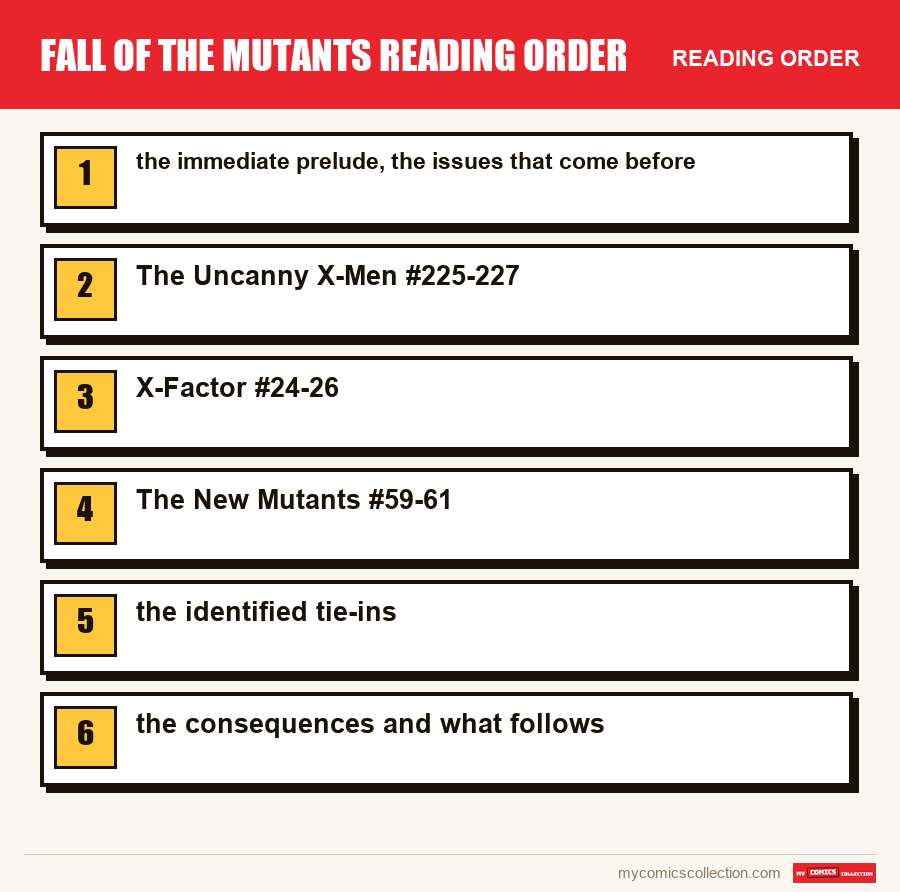
As with the two previous series, read the three issues in one go. For an alternation by issue position (the first issue of each series, then the second, then the third), the order is: #225, #24, #59, then #226, #25, #60, then #227, #26, #61. This formula respects the parallel publication from January to March 1988 without ever making you wait for a resolution.
Phase 5: the identified tie-ins
Five tie-ins, which are not officially part of the crossover, appeared in other Marvel series: Captain America #339, Daredevil #252, Power Pack #35, Fantastic Four #312 and The Incredible Hulk #340. The last one doesn't carry the tie-in logo despite the announcement made for it.
These issues read easily apart from the three main blocks. We suggest reading them after the block of three series, in the following order: Captain America, Daredevil, Power Pack, Fantastic Four, then Hulk. This order has no chronological value: the five issues are independent of one another.
A mention of the 2011 hardcover: it adds The Incredible Hulk #336-337 to the tie-ins, which aren't among the tie-ins but are part of the edition's contents. If your goal is to read the whole thing as a publisher gathered it, include them. Otherwise, they belong to the Hulk series.
Do you collect this series?
Track what you own, what you are missing and what your collection is worth. 7-day trial.
Start my trial →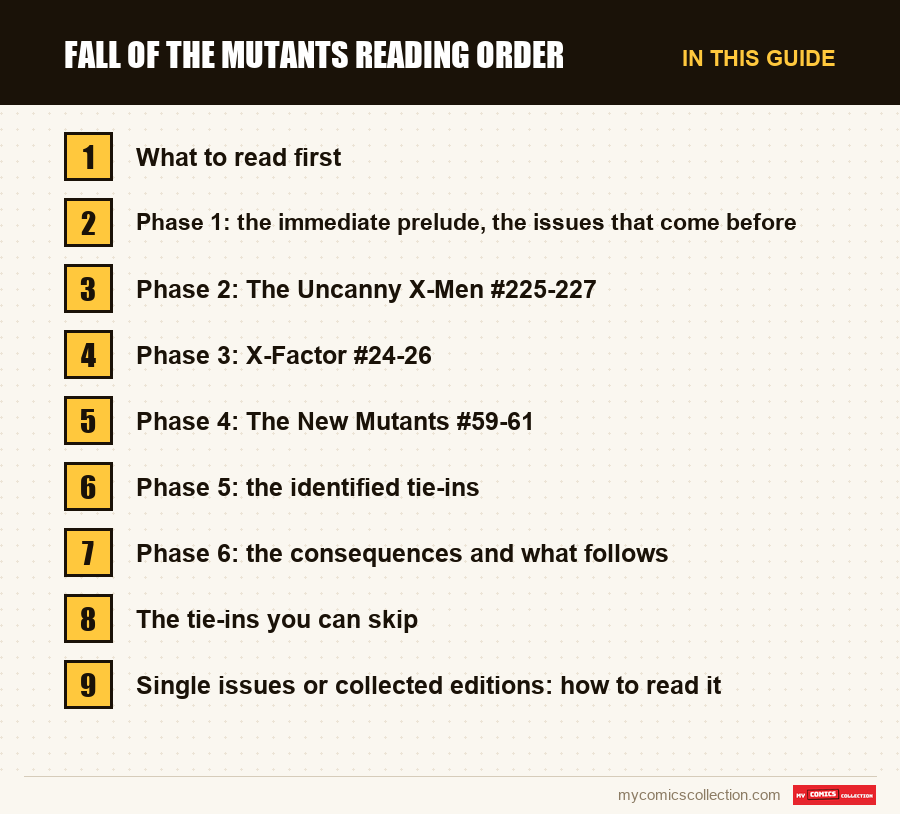
Phase 6: the consequences and what follows
The event doesn't close an era, it prepares the next one. For the X-Men, the natural sequence is to continue the series up to the 1989 event: our guide to Inferno (1989) extends this path very directly and tells you which issues to read next.
For X-Factor and the New Mutants, it's mostly a matter of continuing each series in its normal order. These are the best moments to return to our run files, which detail each team's following arcs, and to the list of X-Men crossovers to place the next shared events.
The tie-ins you can skip
The five tie-ins from the previous phase can be skipped without harm: they concern other series, and the story in the three main titles stands on its own. They're issues that reflect the atmosphere of the moment in the rest of the universe, not essential chapters.
We keep them on the list all the same, because a collector often wants to complete an entire sequence. If you're hesitating, start with the three blocks of the main series, check that you like the story, and then add the tie-ins one by one depending on your interest in Captain America, Daredevil or the Fantastic Four.
Single issues or collected editions: how to read it
For single issues, there are nine main issues, three per series, spread across three titles. That means three runs to cross-reference, which complicates the hunt a little: each issue sits in a different bin, and the full list takes patience.
Collected editions have the advantage of bringing everything together. A trade paperback titled Fall of the Mutants, at 272 pages, came out in February 2002. A large-format hardcover, X-Men: Fall of the Mutants, at 824 pages, came out in May 2011 and contains New Mutants #55-61, Uncanny X-Men #220-227, X-Factor #18-26, as well as Captain America #339, Daredevil #252, Fantastic Four #312, Incredible Hulk #336-337 and #340 and Power Pack #35. An 817-page omnibus, released in May 2022, reprints the same content.
The contents of the 2011 hardcover were also split into two trade paperback volumes. The choice depends on your goal: the omnibus for the whole thing, the volumes to spread out your purchases.
A tip on method: always compare a collected edition's contents to the list in the recap below. This habit avoids duplicates and tells you, before you buy, what you'll need to hunt down as single issues. If you collect the parent series, our X-Men collecting guide details the other landmarks.
The key issues to know
Here again, the term calls for caution. The event isn't centered on first appearances, and we don't claim any. The landmarks come rather from the content and the role of the issues in their series.
- The Uncanny X-Men #225: the opening of the X-Men block.
- The Uncanny X-Men #227: the last issue of the block, which closes the X-Men's ordeal.
- X-Factor #24 to #26: the confrontation with Apocalypse and the loss of the team's headquarters.
- The New Mutants #59 to #61: the block of Bird-Brain's island and the break with Magneto's guardianship.
The evaluation method stays the same as for any sequence: we compare the condition of the copy to completed sales rather than to listings, we check the spine, back and corners, and we don't buy an issue solely for belonging to an event. Fans of the New Mutants cycle will also want to consult the page on New Mutants #87 as a landmark on the neighboring series.
Recap: the complete reading order
- The Uncanny X-Men #220-224, X-Factor #18-23, The New Mutants #55-58: the prelude (optional).
- The Uncanny X-Men #225, X-Factor #24, The New Mutants #59: the three openings.
- The Uncanny X-Men #226, X-Factor #25, The New Mutants #60: the middle of the three stories.
- The Uncanny X-Men #227, X-Factor #26, The New Mutants #61: the three conclusions.
- Captain America #339, Daredevil #252, Power Pack #35, Fantastic Four #312, The Incredible Hulk #340: the tie-ins (optional).
- What follows: the 1989 event, see the Inferno guide.
Frequently asked questions
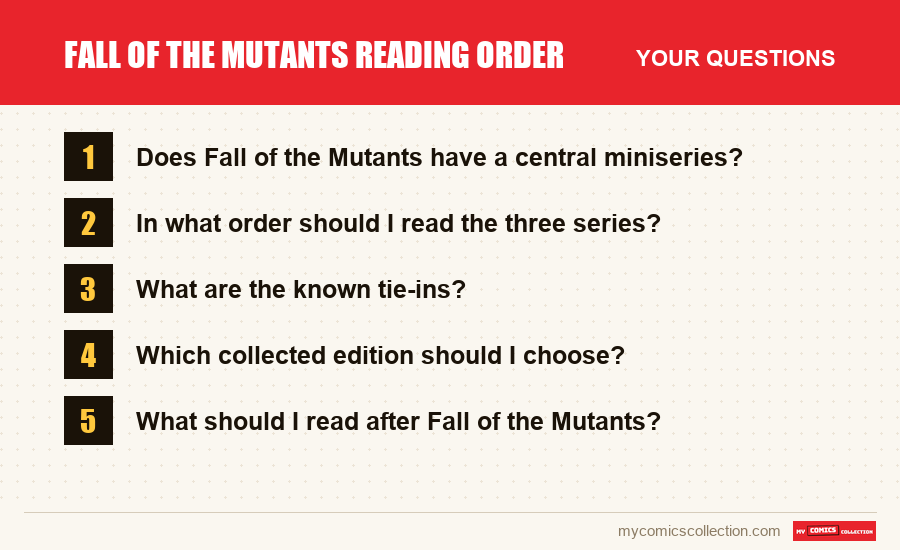
No. The event is made up of three parallel stories in three series: The Uncanny X-Men #225-227, X-Factor #24-26 and The New Mutants #59-61, published from January to March 1988. No title sits over them, so there's no issue to hunt for outside these nine single issues.
Each series reads straight through, but alternating by issue position follows the publication: #225, #24, #59, then #226, #25, #60, then #227, #26, #61. You can also read an entire block in a row if you'd rather follow one team before the next.
Five issues are tied to the event: Captain America #339, Daredevil #252, Power Pack #35, Fantastic Four #312 and The Incredible Hulk #340. None is essential to understand the three main stories; they're for readers who want full coverage.
The 2022 omnibus and the 2011 hardcover gather the same issues, New Mutants #55 to #61, Uncanny X-Men #220 to #227 and X-Factor #18 to #26, with the tie-ins. The 2002 trade paperback is more compact. Always compare the contents to your list before buying.
For the X-Men, the natural follow-up is the 1989 event, detailed in our Inferno guide. For X-Factor and the New Mutants, continue each series in normal issue order. The X-Men crossovers guide helps you place the next steps.
Do you own The Uncanny X-Men #225 to 227, X-Factor #24 to 26 or The New Mutants #59 to 61? Get the condition of your copies appraised before completing the sequence.
Estimate my comic