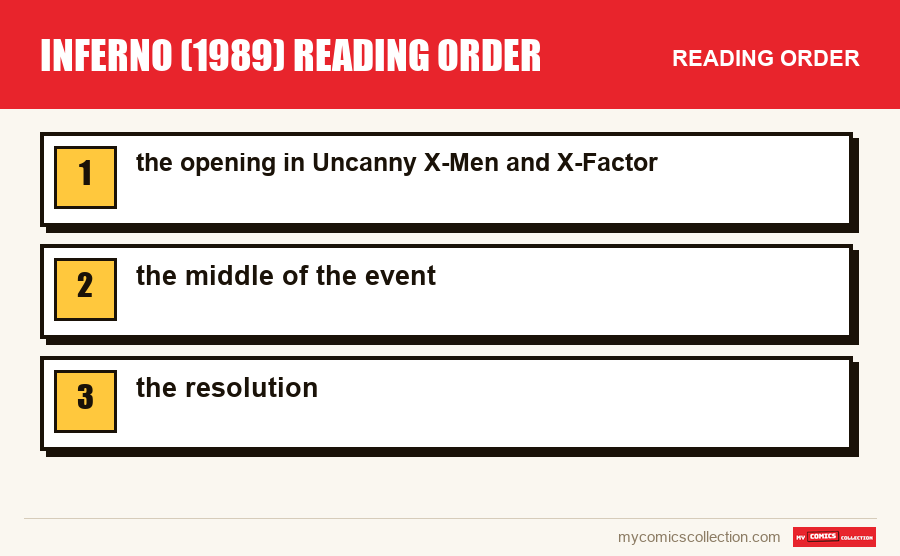
The Inferno (1989) reading order covers the classic X-Men crossover of 1988 and 1989, carried by The Uncanny X-Men #239 to 243, X-Factor #36 to 39 and The New Mutants #71 to 73, with X-Terminators #1 to 4 and Excalibur #6 and 7. Read the prelude to the three series first, then alternate the issues by cover date. The series outside the X-Men line (Avengers, Fantastic Four, Spider-Man) are optional.
Published from October 1988 to August 1989, Inferno plays out first in the mutant books: New York is overrun by demons, everyday objects come alive, and everything converges on a broken family at the center of the story. This article does not retell the plot; it gives you the order of the single issues, the blocks you can skip and the points to check before you buy.
As always on this guide, only verified facts (creators, issue numbers, dates) are stated as fact; the analysis is our own, with no reproduction of protected art or dialogue.
What to read before
Inferno is a destination: it pulls together threads laid down in the preceding years, and it reads far better with those threads in mind. Marvel has in fact collected pre-event issues in X-Men: Inferno Prologue Omnibus, released in December 2021. Here are the blocks that come directly before the crossover.
- The Uncanny X-Men #228 to 238. The series is indeed titled The Uncanny X-Men in this period. These eleven issues set up the X-Men's situation before the invasion.
- X-Factor #27 to 32 and Annual #3. The side of the original X-Men team, regrouped under another name.
- The New Mutants #62 to 70 and Annual #4. The group of young mutants, one of whom, Illyana Rasputin, is at the heart of the crossover's stakes.
- X-Men Annual #12. A standalone single issue that completes the picture.
For a reduced reading budget, the minimal plan comes down to four blocks: The Uncanny X-Men #239 to 243, X-Factor #36 to 39, The New Mutants #71 to 73 and X-Terminators #1 to 4. These twelve issues of regular series and four single issues of a miniseries tell most of the story, with no detour through the House's other series.
If that volume of reading feels heavy, keep two priority reads: the last issues of Uncanny X-Men before the crossover and the last issues of X-Factor before issue 36. To place 1988 within the long history of the mutants, open the X-Men reading guide; to get into Claremont's writing, see where to start with him.
The creators of the event
Inferno is a collective effort. The writers of the main series are Louise Simonson and Chris Claremont, and the main artists are Bret Blevins, Marc Silvestri and Walt Simonson. Several other creators work on the associated series: Alan Davis, Steve Englehart, Gerry Conway, David Michelinie, Ann Nocenti, Jon Bogdanove and Terry Austin are among them. This list is mainly useful for choosing your tie-ins: if you follow one of these creators, their issue is the natural entry point.
The split follows the series: Chris Claremont writes The Uncanny X-Men, which Marc Silvestri draws at the time; Louise Simonson writes X-Factor, drawn by Walt Simonson, and The New Mutants, drawn by Bret Blevins. Walt Simonson is therefore on art here, not on the script. The profiles of Chris Claremont, Marc Silvestri and Walt Simonson on this guide gather their articles.
Phase 1: the opening in Uncanny X-Men and X-Factor
The crossover kicks off in The Uncanny X-Men #239 and in X-Factor #36. These are the two series that carry most of the story, and you will read them in alternation: one issue of one, then the issue of the other with the next cover date. This alternation is the key to the event: each single issue answers the one before.
Before these issues, you can read X-Factor #33 to 35, which belong to the first collected volume devoted to Inferno. That volume, released in 2016, collects Uncanny X-Men #239 and 240, X-Factor #33 to 36, X-Terminators #1 to 4, The New Mutants #71 and 72 and the X-Factor Annual #4. It makes a good reading plan for the first third.
The X-Terminators miniseries runs four issues and is included in this first collected volume; its single issues slip in between those of the main series, according to their cover date.
Phase 2: the middle of the event
The second part is read in Uncanny X-Men #241 and 242, X-Factor #37 to 39 and The New Mutants #72 and 73. This is where the stakes of the family at the center of the story come into focus. Spoiler warning: Madelyne Pryor turns and becomes the Goblin Queen, and her son Nathan is threatened.
For the detail of the tied-in series, the second collected volume released in 2016 is a good guide: it contains Uncanny X-Men #241 to 243, Excalibur #6 and 7, X-Factor #37 to 40, The New Mutants #73, Cloak and Dagger #4 and Power Pack #44. That gives you the list of series that slot into the final stretch.
Read Excalibur #6 and 7 at this point: the British series ties into the event through only two issues, which are easy to add without losing the thread. Our page on X-Men crossovers shows where Inferno sits relative to the other great mutant sagas.
Phase 3: the resolution
The ending is read in The Uncanny X-Men #243 and The New Mutants #73, once X-Factor #39 is closed. Spoiler warning: Madelyne Pryor tries to drag Jean Grey down with her and dies; N'astirh is destroyed by the joint action of the X-Men and X-Factor; Illyana Rasputin gives up her demonic powers by creating a disc that sends most of the demons back to Limbo, then seals the passage with her soulsword. The New Mutants then find Magik turned back into a child, inside the shell of her demonic armor.
The consequences are many: Jean Grey's mind stays linked to Madelyne's, which makes her determined to take revenge on Mister Sinister. Once the invasion is over, New York returns to normal and many survivors believe they shared a collective hallucination. Mister Sinister appears here as a central figure; our reading guide devoted to Mister Sinister lets you follow the character beyond this point.
For Jean Grey, our reading guide to the character places these issues within her overall trajectory.
Do you collect this series?
Track what you own, what you are missing and what your collection is worth. 7-day trial.
Start my trial →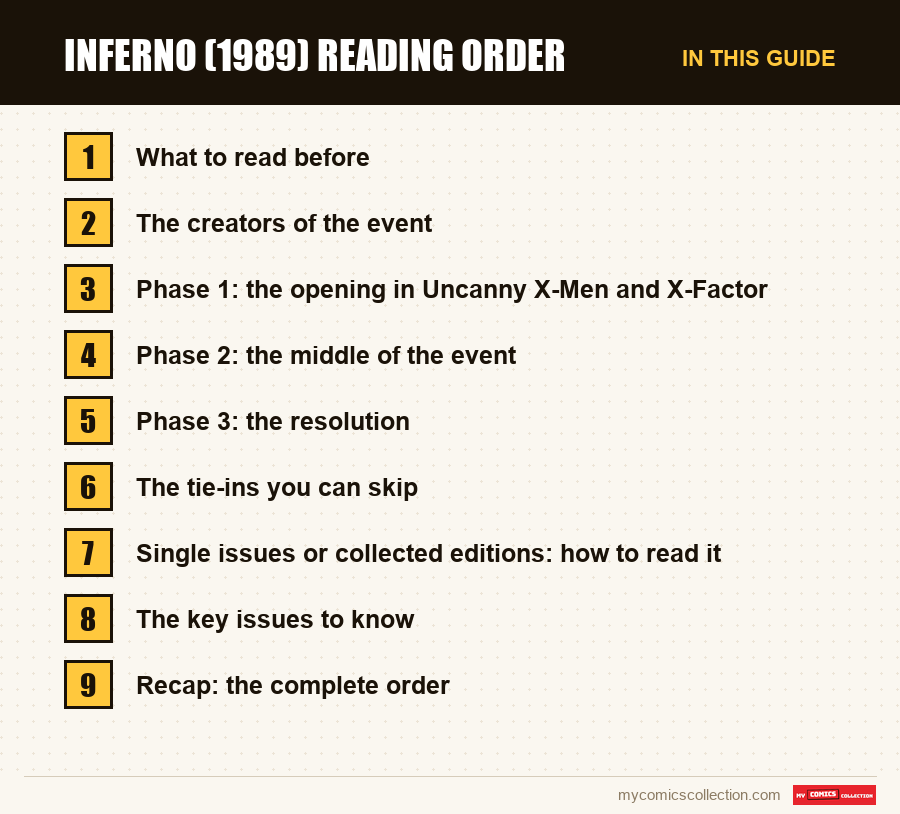
The tie-ins you can skip
Beyond the mutant books, Inferno touches several Marvel titles of the period: The Avengers #298 to 300, Fantastic Four #322 to 324, The Amazing Spider-Man #311 to 313, The Spectacular Spider-Man #146 to 148, Web of Spider-Man #47 and 48, Daredevil #262, 263 and 265, as well as Power Pack #42 to 44. Marvel gathered them in a separate collected volume, X-Men: Inferno Crossovers, released in 2016.
These issues are optional because they tell what the invasion does in other series, with their own heroes and their own creative teams. They do not contain the events that matter for the X-Men's future: the story of Madelyne, Jean Grey, Illyana and Sinister plays out in the mutant books. You lose nothing by ignoring them.
They are worth the effort, however, if you collect those series: an issue of The Amazing Spider-Man caught in the crossover is one more single issue for the run, and Fantastic Four #322 to 324 read like a small arc.
To place these mutant series in their wider context, our pages on the best X-Factor runs and on the best New Mutants runs give the background.
Single issues or collected editions: how to read it
Marvel has published several collected editions of the event: the first and second volumes of X-Men: Inferno in 2016, a crossovers volume the same year, and an X-Men: Inferno Omnibus in 2021 that combines these series and notably adds Power Pack #40, 42 to 44. The most practical way to read the story is to pick a collected edition whose table of contents you have checked, because the contents differ from one volume to another: the first stops at Uncanny X-Men #240, the second covers the ending, and the crossovers volume contains only the series outside the mutant line.
For single issues, the method is different. List the series you already follow, then complete the blocks of the issues that tie into them. A run of The Uncanny X-Men from #239 to 243 forms a coherent set, as does X-Factor #36 to 39. You can start with those two blocks and then fill in with the miniseries.
When buying, read the printing statement in the indicia and look at the spine: a badly stapled annual or a 1989 issue is spotted right away. If you are mainly building the Uncanny X-Men run, shelve these five issues by following our collecting guide for the series.
The key issues to know
The value of an event single issue is judged by method. Here are the benchmarks, without dollar figures.
- The Uncanny X-Men #239 to 243. The core of the event in the flagship series. Marc Silvestri does the cover of issue 240, a useful marker for anyone following this artist.
- X-Factor #36 to 39. The X-Factor team's side, with Annual #4 belonging to the same set.
- The New Mutants #71 to 73. The trio of issues that concentrates Illyana's journey: if you follow Magik, this is the priority block.
- X-Terminators #1 to 4. A complete miniseries, which you gather in full or not at all.
Also think about X-Factor Annual #4, which belongs to the set: an annual is shelved apart from the monthly issues, and its printing and grade are checked like any other single issue, through the indicia and the cover. The same logic applies to the two issues of Excalibur: they are short, but they complete a British run that many readers of the series already own.
To value a copy, compare it with sold listings for the same issue, the same grade and the same printing. To widen out to the rest of the series, see the key issues of Uncanny X-Men.
Recap: the complete order
- Prelude (optional but recommended): The Uncanny X-Men #228 to 238, X-Factor #27 to 32 and Annual #3, The New Mutants #62 to 70 and Annual #4.
- X-Factor #33 to 35.
- The Uncanny X-Men #239 and 240, X-Factor #36, X-Terminators #1 to 4, The New Mutants #71 and 72, X-Factor Annual #4.
- X-Factor #37 to 39, The Uncanny X-Men #241 and 242, Excalibur #6 and 7.
- The Uncanny X-Men #243, The New Mutants #73.
- Extras: Cloak and Dagger #4, Power Pack #42 to 44.
- Tie-ins outside the X-Men line, optional: The Avengers #298 to 300, Fantastic Four #322 to 324, The Amazing Spider-Man #311 to 313, The Spectacular Spider-Man #146 to 148, Web of Spider-Man #47 and 48, Daredevil #262, 263 and 265.
Frequently asked questions
Start with The Uncanny X-Men #239 and X-Factor #36, which carry most of the story. If you want the context, read the prelude issues of Uncanny X-Men, X-Factor and The New Mutants first. The series outside the mutant line come last, and only if you collect them.
Yes. In this period, the series is indeed titled The Uncanny X-Men. That is the title you will find on the Inferno single issues, numbered 239 to 243, and the title to search for in a list of listings.
No, they are optional. They show the demonic invasion in other series, with their heroes. The story of Madelyne Pryor, Jean Grey, Illyana and Mister Sinister plays out in the mutant books, which you can read alone without losing the essentials.
Marvel published two volumes of X-Men: Inferno in 2016, a crossovers volume the same year, then an Omnibus in 2021, not counting a Prologue Omnibus released in late 2021. Always check the table of contents of the edition you choose, because the split of the issues varies.
The main series are written by Louise Simonson and Chris Claremont, with Bret Blevins, Marc Silvestri and Walt Simonson as the main artists. Claremont and Silvestri handle Uncanny X-Men, Louise and Walt Simonson X-Factor. The associated series have other writers, such as Ann Nocenti, Gerry Conway or Alan Davis.
Do you own an Uncanny X-Men from the Inferno period or a New Mutants from the #71 to 73 run? Estimate it in a few minutes.
Estimate my comic