A sales engine does not look for an issue number: it looks for a sequence of numbers, wherever it is found in the description. On the query “Falcon Captain America 117”, noted on August 30, 2026 on a general auction site in the American market, the five cheapest advertisements do not concern any of them for the number sought: they all end with an internal storage code of the seller which contains, by pure chance, the requested digits. Result: the lower limit of the statement: $7.99 for unverified copies: describes nothing about the targeted number. Before choosing any numbers, open the five or ten cheapest ads one by one.
The scene is banal. We want to know what a booklet is worth, we type its title and its number in the search bar of a marketplace, we look at the range that appears and we remember the two ends: “it starts from this, it goes up to this”. This gesture seems neutral. He is not. Between the question we ask mentally: “how much is this specific number worth?”, and the question the machine actually addresses, “what ads contain these words and numbers?” »: there is a gap that nothing on the screen indicates. This gap is almost always in the same place: at the bottom of the list, on the side of the lowest prices.
The survey carried out on August 30, 2026 on the request “Falcon Captain America 117” provides a clear demonstration of this, because the mechanism is visible to the naked eye. This is not a rare case or a dishonest seller: it is the normal operation of a text search applied to labels that professionals write for their own needs. Understanding this mechanism permanently changes the way we read a list of announcements, and the way we record an amount in your own purchasing method.
What the August 30, 2026 statement contains, and what it does not contain
Let's start by setting the framework precisely, because the rest depends on it. The amounts quoted here come from current announcements as of August 30, 2026, on a general auction site, American market. These are sums that sellers ask for. None correspond to a concluded transaction: no one, to my knowledge, has paid these prices. A listing for $1,081.00 proves that a seller entered that number into a form, nothing more. It is a sales intention, not a market observation.
Second clarification, just as important: the copies passed by a verification body were counted separately from the others. Mixing the two populations would produce a range that describes neither. The query therefore gave two distinct blocks, and by chance they were of exactly the same size: 83 advertisements on one side, 83 on the other. This symmetry is a coincidence of the day, not a property of the market; it does not authorize any conclusion.
For unverified copies: minimum $7.99, median $220.00, maximum $1,081.00. For verified copies: minimum $49.00, median $377.00, maximum $5,500.00. Eighty-three ads on each side is a comfortable number: the median has real statistical meaning, unlike what happens on queries which only return a handful of results. On this point at least, the survey is solid.
Finally, one thing that this reading does not say, and that no reading taken once can ever say: nothing about an evolution. A photograph taken on a Sunday in August shows no movement, neither rise, nor fall, nor stagnation. To talk about a trend, we would need at least two statements separated in time, obtained by the same query and filtered in the same way. Any phrase like “this number is going up” would be a pure invention here. So I stick to describing a state, on a given day, on a given query.
The five cheapest ads are not the number you are looking for
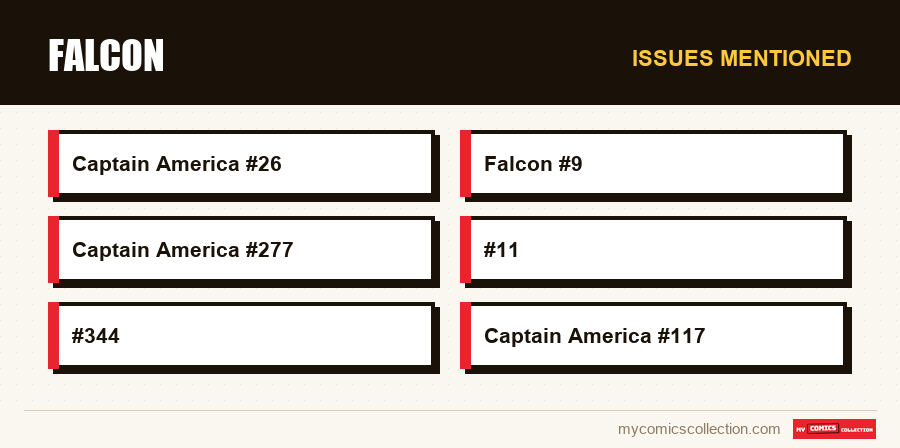
This is the heart of the matter. Of the 83 unverified advertisements, the first five in order of increasing price (those which, mechanically, set the lower limit and pull down any hastily calculated average) do not sell any of the number in question. However, they are legitimately returned, because each one does indeed contain the requested sequence of numbers. Simply, this sequence is not found in the part of the title which designates the booklet: it is found in the storage code that the seller pasted at the end.
A number found in the suffix, not in the title
The cheapest ad, at $7.99, is selling Captain America #26 from Volume 5, dated 2007. Nothing to do with the search. What brought it up was the mention V62-117 at the very end of the wording: the three digits sought appear there, the engine saw them, it responded. The seller has not done anything questionable; he put away his stock.
Sometimes a partial match is enough
Second ad at $7.99: a Captain America & the Falcon #9 from 2005, code A55-11. The label does contain the word Falcon and a similar numerical sequence, and this is enough to place it in the results. We see here that the overlap does not even need to be exact to influence the lower limit.
Four decades in the top five lines
A Captain America #277 from volume 1, dated 1983, code J71-11, at $8.00. A #11 from volume 2, 1997, code X117-84, at $9.99. A #344 from volume 1, 1988, code X117-51, at $9.99. Five announcements, five different issues, four decades of publication. No coherent whole there.
The lower limit therefore measures nothing
If the five lowest prices describe five issues that are not the one you are looking for, the minimum displayed: $7.99: is not a low price for the issue in question: it is the price of something else. Retaining it amounts to noting in its tracking a value which does not relate to any real copy of the line concerned.
We must emphasize one point, because the natural reflex is to see it as a deception: none of these wordings are misleading. Everyone correctly and completely designates the booklet they are selling, with its title, number, volume and year. A buyer who opens the ad immediately knows what they are looking at. The fault is not in the seller's writing, it is in the request: it is the one which treats an issue identifier as a simple character string, and which does not know how to distinguish a publication number from a bin number.
A storage code is a logistics tool, not a sales argument. It allows a professional who manages several thousand issues to physically find the sold copy in a few seconds, without searching through their entire reserve. The letter often designates a zone or a box, the numbers a position. The customer has no use for it, but it is printed in the title because it is the only field that the seller has complete control over.
The practical consequence is direct and without exception: the lower limit of a reading is almost always noisy. This is why a minimum should never serve as a benchmark until we look at it ad by ad. The maximum suffers from a symmetrical defect, of another nature: an isolated announcement at $5,500.00 reflects the hope of a seller, not an observed price. The two ends of a range are the two places where an automatic display should be trusted the least.
What brings up an ad unrelated to your search
The storage code is the most spectacular case, but it is not alone. An ad label is a free text in which several families of numbers coexist, and the engine treats them all in the same way. Knowing which ones exist allows you to spot a false positive in a second rather than three clicks.
The storage code
An alphanumeric sequence at the end of the title, typically one or two letters followed by groups of numbers separated by a hyphen. It has no meaning outside the seller's inventory, and two different professionals never use the same grammar. This is the first suspect when a price seems abnormally low.
Year of publication
Almost all serious labels mention it, and it contains four digits. A search for a three-digit number can therefore collide with a portion of a year, especially if the engine tolerates partial matches. The announcements noted here display 2007, 2005, 1983, 1997 and 1988: all opportunities for fortuitous overlap.
The volume number
The same series relaunched several times carries distinct volumes, and the volume is one more number in the title. Two of the five cheapest listings specify Vol. 5 and Vol. 2. Without careful reading, we quickly confuse a volume with an issue number, or the other way around.
Lots and groupings
A lot often announces the range of numbers it covers. Any sufficiently wide range ends up containing the number sought, and the price displayed is then that of the set, not of an issue. The amount can be very low, a lot of damaged copies, or very high.
Condition and rating information
The scales of appreciation of an exemplar are written with numbers, often decimal. They add to the digital noise of the wording and can also cross a query. They also make it difficult to read quickly because they look like numbers.
Titles that are similar
Two neighboring series can share almost all of their words. Here, Captain America and Captain America & the Falcon coexist in the results of a single query. The engine does not decide between them: it renders them both, and it is up to the reader to decide.
Collecting this series?
Track what you own, what you are missing and what your collection is worth. 7 day trial.
Start my trial →The parade takes just one minute to read
The correction is disarmingly simple, and that's precisely why we forget it: before remembering a number, we sort the list by increasing price and open the bottom five or ten ads, one by one. Not the sticker, not the price: the full wording. We check that the title corresponds to the desired series, that the number displayed is indeed the one we are looking for, that the volume matches, that it is not a lot. This check takes a minute and regularly invalidates the calculation we were about to make.
In the present case, the exercise would have eliminated the first five lines at once and raised the real lower limit to a completely different level. I am not giving this level, because the survey did not measure it: we would have to take the list again and redo the sorting after elimination. But we already know that $7.99 has no place in a tracking sheet dedicated to this number, and that's the main thing: recognizing that a number is wrong is better than substituting a freehand estimate.
The same gesture is applied symmetrically to the top of the list, with a different intention. At the bottom, we look for announcements that do not concern the correct issue; at the top, we look for isolated advertisements whose price is not based on anything observable. The maximum of $5,500.00 noted for verified copies belongs to this category as long as it has not been opened: it can correspond to an exceptional copy or to an advertisement placed without any real intention to sell. A single line never makes a price.
Once both ends have been cleaned, the median once again becomes the most honest indicator available. It has the advantage of ignoring extreme values by construction: a few storage codes at the bottom and a few dreams at the top barely move it. Out of 83 ads, it carries real information. This remains a median of amounts claimed, never sales concluded, but it is the only one of the three figures displayed that resists the noise described in this article.
Why this trap is more common than it seems
One could believe there was a curiosity linked to this particular request. It's the opposite: the configuration that produced it is extremely banal. All it takes is three ingredients, and they come together for a large part of the American publications. First ingredient, a long series: the more numbers a series has, the greater the probability that any sorting code contains one of them. A three-digit number is no more protected than a two-digit number: the codes found here contain both 117 and 11.
Second ingredient, a character or series name made up of common words. A word that appears in several series titles mechanically broadens the scope of the search, and this widening is invisible: nothing indicates on the screen that the query has just covered three families of publications instead of one. This is a subject in its own right, developed in the guide dedicated to nouns without qualifier.
Third ingredient, professional sellers. An individual who sells three booklets does not code anything: he writes the title and the number. A professional who manages thousands of them cannot do without them. However, it is precisely the professionals who provide the bulk of the results on well-identified queries, and therefore the majority of the lines that we will read. The noise increases with the seriousness of the seller, which is perfectly counterintuitive.
Let us add that editorial history itself multiplies the opportunities for collision. A series relaunched several times starts at one or starts at a high number depending on the era, derivative series have similar titles, double numbering coexists. Anyone who has ever tried to reconstruct a publication order knows: the numerical markers of a catalog do not form a unique and clean sequence. THE character's editorial journey like that of his contemporaries show the same thing: the same title can cover several superimposed numberings, and a search by number does not know in which it is working.
What to note when recording a value
Note the exact query you used.“Falcon Captain America 117” is not the same search as “Captain America 117”, nor is it “Captain America #117 Falcon”. Each brings a different set and therefore a different range. Without the request, a recorded figure is irreproducible: you will not be able to repeat the measurement in six months, and you will not know if a discrepancy observed comes from the market or from your formulation.
Note the number of ads the figure is based on. Eighty-three announcements and four announcements do not comment in the same way. Below ten lines, no conclusion on a price level is defensible, and it must be written in black and white in the form rather than leaving an orphan figure which will look solid in a year's time.
Write down which ads you skipped, and why. Five lines removed because they carried a storage code, two lots removed because they covered a range: this list is better than a bare result. It explains the gap between what the site displayed and what you retained, and it saves you from doing the same sorting work each time you consult it.
Note the separation between verified and unverified copies. Here the two populations had 83 ads each, with medians of $220.00 and $377.00: two figures that do not describe the same thing and do not average. A card that mixes the two produces a value that does not correspond to any real copy, neither yours nor anyone else's.
Note the date and nature of the amounts. August 30, 2026, announcements in progress, amounts claimed and no sales concluded, American market. These four mentions fit on one line and entirely determine the scope of the figure. Without them, over the months a statement becomes an assertion without a source, and this is how an approximate range ends up circulating like a rating.
On advertisements noted on August 30, 2026, it appears at the very end of the title in forms such as V62-117, A55-11, J71-11, X117-84 or X117-51: one or two letters, then groups of numbers separated by a hyphen. There is no agreement shared between sellers, everyone builds their own. Remember the position rather than the form: what follows the mention of the year and the state, to the far right of the wording, is almost always logistics.
Nothing in the statement suggests this, and everything indicates the opposite. The five labels concerned correctly describe the booklet they are selling, with title, number, volume and year. The code is intended to find the copy in a bin, not to attract the buyer. The fault is on the research side, which does not differentiate between a publication number and a storage number.
It helps sometimes, but it can't be relied on. Some engines ignore punctuation altogether, others treat it as a separator, and many sellers write the number without a brace anyway. Stricter syntax reduces noise, it does not eliminate it: reading the cheapest ads is still essential.
No, it's a coincidence of the day of August 30, 2026 and nothing else. A single reading only measures the instant it is taken; the next day, the two numbers may differ greatly. To derive a market property from a once-observed equality would be to mistake sample chance for structure.
The median of the segment which corresponds to your copy, after excluding the advertisements which do not relate to the correct issue, accompanied by the date, the request and the number of advertisements retained. Neither the minimum nor the maximum is suitable: the first is parasitized by storage codes, the second reflects the expectation of an isolated seller. And keep in mind that these are all requested amounts.
Keep track of your readings, not just the numbers
My Comics Collection allows you to associate with each copy the value you recorded, the date you recorded it and your own method notes. A year later, you'll still know where that number came from, and whether it was worth anything.