On a statement dated August 30, 2026, four advertisements describing the same issue: Captain America #133, the one where the Falcon shares the poster: attribute three different dates to it: two say January 1970, two say 1971, one of which specifies January 1971. Nobody cheats. A booklet carries one month of coverage in advance of its actual sale, and each seller retains one or the other of these two dates. The practical consequence is simple: the year read in an announcement title is not a source. If you copy it into your collection, you are entering data that no control will ever contradict.
The disagreement is visible to the naked eye, without tools and without expertise. Simply line up four labels side by side. The survey of August 30, 2026, carried out on a general auction site oriented to the American market, shows 67 unverified advertisements for the query “Falcon Captain America 133”. Amounts requested range from $5.95 to $109.99, with a median of $25.00. These are amounts claimed by sellers on the day of the statement, not completed transactions: no one has paid these amounts, and nothing in this statement says if anyone will pay them. The copies passed by a verification agency are counted separately: there are only four, between $86.29 and $150.00.
What makes this survey interesting is not its price level, on which it allows almost nothing to conclude. This is the textual content of the ads. Four of them, among the least expensive, explicitly describe the same number, and their authors do not agree on the year or the month. For those who keep a collection up to date, this divergence is more instructive than a price curve: it shows where a catalog error is made, at what precise moment it enters a personal database, and why it then remains there indefinitely.
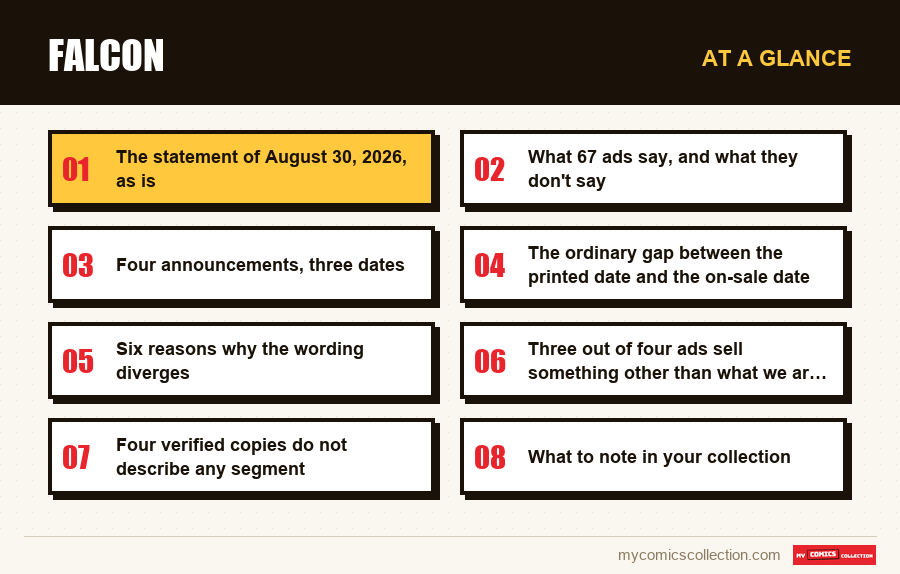
The statement of August 30, 2026, as is
Here is all of what was measured, without extrapolation. Query “Falcon Captain America 133”: 67 current unverified listings, minimum $5.95, median $25.00, maximum $109.99. Separately, four verified copy listings, from $86.29 to $150.00. All of these values are requests displayed on a single date. A measurement taken on a single day does not describe any movement: it does not say whether the number is rising, falling or stagnating, and to claim otherwise would be to invent a trend from an isolated point. The $109.99 maximum deserves the same caution: it's a seller's hope displayed on a label, not an amount someone has agreed to pay.
What 67 ads say, and what they don't say
Sixty-seven ads are enough to observe writing habits, but the purpose of the survey was not there. The median of $25.00 only indicates that on that date, half of the sellers were asking less than that. It is not an estimate, because a current ad can remain online for months without finding a buyer, and because nothing distinguishes, in such a count, a complete copy from a copy without its central page.
The bottom of the range illustrates exactly this trap. The minimum, $5.95, does not correspond to a copy of the issue sought: it is a choice offer entitled “AVENGERS VOL 1 PICK & CHOOSE ISSUES”, i.e. an advertisement for another title, in which the buyer selects the number he wants from a list. The price displayed is the entry price of the selection, not that of the booklet in question. The lower limit of the reading therefore describes something other than what we thought we were measuring.
This detail changes the reading of the whole. A range whose lower limit belongs to another product is no longer a range: it is a contaminated interval. The same phenomenon occurs constantly on textual queries, because a commercial search engine brings up any description containing the right words, without verifying that the object described actually corresponds.
It is therefore necessary to dissociate two uses of the statement. As a price indicator, it is weak: amounts claimed, single date, derisory verified workforce. As a corpus of labels, it is excellent, because it brings together in one place the way dozens of independent sellers spontaneously describe the same object. And it is this spontaneous description that ends up being copied and pasted into personal collections.
It is this second use that we exploit here. The issue is not how much this number is worth, the statement doesn't tell, but what information you are importing into your home when you rely on the headline line of an ad.
Four announcements, three dates
« … January 1970 (VG-) »: 7,20 $
The full wording mentions the origin of MODOK and dates the issue to January 1970. It includes a typo on the name of the series, which reminds us that an advertisement title is entered by hand, without proofreading, by someone who sells and not who catalogs.
« (Marvel, 1971) Co-Starring The Falcon »: 8,99 $
Same number, same series, year 1971. This is the only one of the four advertisements which highlights the presence of the Falcon as the main argument, which is nevertheless the reason why most readers are looking for this booklet.
« … Origin of MODOK Falcon 1970 »: 8,99 $
Year 1970, without month. The seller juxtaposes the two arguments, the origin of the MODOK and the Falcon, without hierarchy, which gives a wording that is machine readable but ambiguous for a human trying to know what the booklet contains.
“(Marvel Comics January 1971)”: $9.00
The fourth announcement combines the two competing versions: the month of the first, the year of the following two. This is the most seemingly precise formulation, and it is also the one that makes the disagreement impossible to ignore.
Placed end to end, these four lines give two advertisements for January 1970, two for 1971, including one for January 1971. None contradicts itself, none seems dishonest, and the four prices are narrowed between $7.20 and $9.00, a sign that their authors believe they are selling the same thing. The disagreement therefore does not concern the object, only its date.
One point to remember before going any further: this disagreement is not a local accident nor the symptom of a poorly informed lot. This is the normal behavior of a market where each seller writes alone, based on what he has in front of him or what he has read elsewhere.
In other words, there is no point in looking for which of the four announcements « a raison » to use as a reference. The right reflex is to consider that the title line of an announcement is never intended to serve as a documentary source, whatever it may be.
The ordinary gap between the printed date and the on-sale date
The cause of this kind of divergence is known and without mystery. A booklet bears a cover date which is not that of its arrival on newsstands: the printed notice is in advance of the actual sale. This lag was a common publishing practice, linked to distribution logistics and the length of time an issue had to remain on display without appearing stale.
I do not know the exact extent of this discrepancy for this specific issue, and the statement does not contain it. It would therefore be dishonest to announce a number of months. What is established, on the other hand, is that this gap exists as a general mechanism, and that it is sufficient to explain why the same object is attributed two neighboring years by people equally in good faith.
The mechanism deploys like this. A salesman opens the booklet, reads the printed date and copies it. Another relies on a secondary source that documents the actual publication date. A third mixes the two without knowing it, because he has taken a month on one side and a year on the other. All three get different wordings from the same card, and none of the three committed a foul in the strict sense.
This is precisely what makes the error lasting. False data produced maliciously often ends up being reported, because it is isolated and contradicted. Data resulting from a legitimate ambiguity is supported by as many announcements as the competing version. No signal distinguishes it. It propagates by copying until it becomes one of the two available truths.
For a personal collection, the consequence is direct. If you open a file, type the year read in the title of an ad and validate, you have a one in two chance of recording the version that the rest of the world does not use, and nothing, ever, will make you notice it. A date is not a field that you reread: you enter it once, and it survives all sorting, all exports, all subsequent migrations.
Six reasons why the wording diverges
The label is used to be found
An ad title line is an internal SEO tool, not an insert. The seller piles up the words he imagines typed by a buyer. Documentary accuracy is not his goal, and he is not punished when it is lacking.
Deux dates coexistent légitimement
The date printed on the cover and that of the actual sale do not coincide. Each is defensible. A seller who chooses one is not wrong, he simply made a choice that the other did not make.
Entry is manual and not proofread
One of the four advertisements noted contains a typo on the very name of the series. What is typed by hand without control contains mistakes; the year is no more an exception to this rule than the rest of the text.
Some advertisements do not relate to a copy
The choice offer raised to $5.95 concerns another title and lets the buyer select their number. It goes up in the results without describing the object sought, and distorts any automatic reading of the bottom of the range.
The number alone does not identify anything
A number only has meaning when attached to a specific series and period. Out of this pair, it designates dozens of different objects from the same publisher, and the ad wordings constantly take it out of this context.
The reason for selling is not the reason for buying
Three of the four advertisements sell this booklet for the origin of a character which is not that of the request. The seller highlights what he believes to be the seller, the buyer looks for something else, and the two vocabularies only come together at random.
Collecting this series?
Track what you own, what you are missing and what your collection is worth. 7 day trial.
Start my trial →Three out of four ads sell something other than what we are looking for
This is the least expected observation of the survey, and undoubtedly the most useful on a daily basis. Of the four labels that describe this booklet, three highlight the origin of MODOK. The request related to the Falcon. In other words, the booklet that we are looking for for one reason is mostly sold for another.
This asymmetry has a concrete translation: part of the available copies is invisible from the search which seems natural to you. A seller convinced that his number is worth the origin of an antagonist has no reason to mention the character that interests you. His ad exists, it is online, and your request does not bring it up.
The solution is to look through the motives of others, not just through your own. A booklet generally contains several reasons to be sought after: a first appearance, an origin, a change of costume, a designer, a crossover between series. Each of these reasons constitutes a distinct search vocabulary, and each uncovers a different subset of current ads.
This dispersion also explains part of the price differences observed. Two equivalent copies, described by two different vocabularies, are not seen by the same buyers and therefore do not undergo the same pressure. We cannot quantify this effect from a one-day reading, but we can learn a habit from it: before concluding that a number is expensive, check that you have looked at all the ways in which it is named. The same reasoning applies when we seek to buy Captain America at a low price: it is often the labels which do not mention the main character which offer the most affordable entries.
The logic goes beyond this one number. A booklet located at the intersection of several character trajectories carries several simultaneous commercial identities, as shown for example by the way in which the numbers linked to the story of Black Panther in comics. A single query never covers them all.
Four verified copies do not describe any segment
The statement includes four announcements of copies passed by a verification body, distributed between $86.29 and $150.00. We must clearly state what it is worth: nothing. Four observations do not constitute a sample, and the interval they draw describes four particular objects, not a price level of the number checked.
Each of these four advertisements may vary for its own reasons: the condition observed, the age of the posting online, the ambition of the seller, the presentation. With such a small number, a single atypical announcement moves the entire range. The relationship between the lower limit and the upper limit therefore has no interpretative value.
It should also be remembered that these four amounts are also requests posted on August 30, 2026, not sales concluded. A verified copy listed at $150.00 does not establish that a verified copy sells for $150.00; it establishes that a person was hoping for this amount that day.
The right posture is therefore to note the number next to the number, systematically. “From $86.29 to $150.00” is misleading; “four ads, from $86.29 to $150.00, amounts requested on August 30, 2026” is honest, and the weakness of the workforce is then obvious to anyone who rereads the form in six months: starting with you.
What to note in your collection
Note the date on the copy you are holding, not on the ad that sold it to you. This is the only source whose origin you can guarantee. The booklet is at home, the notice is printed on it, and you can check it as many times as necessary. A year copied from an ad title has, on this specific number, a one in two chance of corresponding to the version that the rest of the market does not use.
Note that the date is a cover date, not a release date. Simply adding this clarification in the comment field avoids future confusion. Without it, you will one day find yourself in front of two contradictory sheets without being able to determine which one described what, and you will then reopen the same debate as the four sellers of the statement.
Record other search reasons for the booklet, not just your own. This number is mainly sold for the origin of the MODOK and is sought after for the Falcon. Recording both labels in your sheet will prevent you, the next time you complete the series, from missing the examples described with vocabulary that you do not use.
Enter the headcount next to any amount reported.“Four verified advertisements” does not have the same weight as “sixty-seven unverified advertisements”, and a file which only retains the numerical limits loses exactly the information which made it possible to put them into perspective. Without numbers, an interval takes on the appearance of an estimate over time.
Date each reading and refuse to draw a trend from it. The figures cited here are valid for August 30, 2026 and for that day only. A single observation shows neither rise nor fall. As long as you don't have multiple statements spaced out over time, the only defensible sentence is the one that states the date and stops there.
The question is poorly posed, and this is precisely the lesson of the statement. Two dates legitimately coexist for the same issue: that printed on the cover and that of its actual sale, the first being in advance of the second. Depending on which a seller remembers, he writes one year or the other without making a mistake. For your collection, the only robust answer is to note the date on the copy you own, specifying that it is a cover date.
Because it does not relate to the booklet you are looking for. The floor amount of $5.95 corresponds to an offer of your choice entitled “AVENGERS VOL 1 PICK & CHOOSE ISSUES,” which is for another title and lets the buyer select a number from a list. The displayed price is the entry point for this selection. This type of ad regularly rises in the textual results and artificially lowers the lower limit of any automatically calculated range.
No. It summarizes amounts claimed by sellers on August 30, 2026, not completed transactions. An ad can remain online for a long time without finding a buyer, and yet its price continues to weigh in the calculation. Added to this is the fact that this count mixes very different states and, as we have seen, advertisements which do not even describe the correct object. The median therefore describes the level of requests posted that day, nothing more.
By searching for the reasons of others. Three of the four advertisements noted sell this booklet for the origin of a character which is not that of the initial request. These sellers have no reason to list the character you are interested in, so their ads escape your search. List the different reasons for which a number can be searched (appearance, origin, crossover of series, author) and query them separately.
The statement does not allow us to say this. It only has four listings for verified copies, between $86.29 and $150.00, which is far too small a count to compare anything to. Four observations describe four particular objects, not a market segment, and these are again amounts requested and not paid. Any comparison based on this figure would be an invented statement.
Keep your dates safe from ad labels
My Comics Collection lets you record, for each issue, the date you noted yourself, the reason why you were looking for it and the number of advertisements observed on the day of the statement. Your files thus keep their context, instead of being reduced to figures that no rereading will be able to interpret.