
On current advertisements noted on August 30, 2026 for the 1969 issue which presents Sam Wilson, a copy advertised in 2.5 was asking for $50.00 and a copy advertised in 3.5 was asking for $150.00. A single state point separated these two sellers, and a hundred dollars separated them too. On the same day, on a large issue from 1981, five advertisements of the same issue were within a range of less than a dollar while the states declared ranged from 4.0 to 8.0. These are two different price regimes, not two errors of assessment: where the supply is large, the state does not change its currency; where supply is scarce, it absorbs the entire gap. All amounts cited here are amounts requested by sellers, not completed transactions, and a statement made on a single day says nothing of a trend.
There is a phrase that every collector has heard and that no one ever checks: “condition is what counts”. It is true and it is unusable as is, because it does not say How much state matters. But this how much is not a constant. It depends entirely on the number of copies available at the time of viewing. On a booklet printed in profusion and still present everywhere, improving your copy by four points costs almost nothing. On an old and coveted booklet, earning a single point can triple the amount claimed. The collector who applies the same rule to both situations is wrong twice: he pays too much for a common example, and he gives up too quickly on a rare example, or the opposite.
The following is based on a single survey, carried out on August 30, 2026 on a general auction site oriented to the American market, looking only at current advertisements. In other words: sums that sellers hope to obtain, at a given moment, and not sales concluded. This distinction is not a detail of method, it is the condition for the figures to mean something. A sum requested describes an intention; a sum collected would describe an agreement. We only have the first one here. And since the measurement was taken only once, it shows no movement: it is impossible to deduce that anything is rising, falling or stagnating. It is used to compare advertisements with each other at the same time, nothing more, but that is already enough to reveal the mechanism.
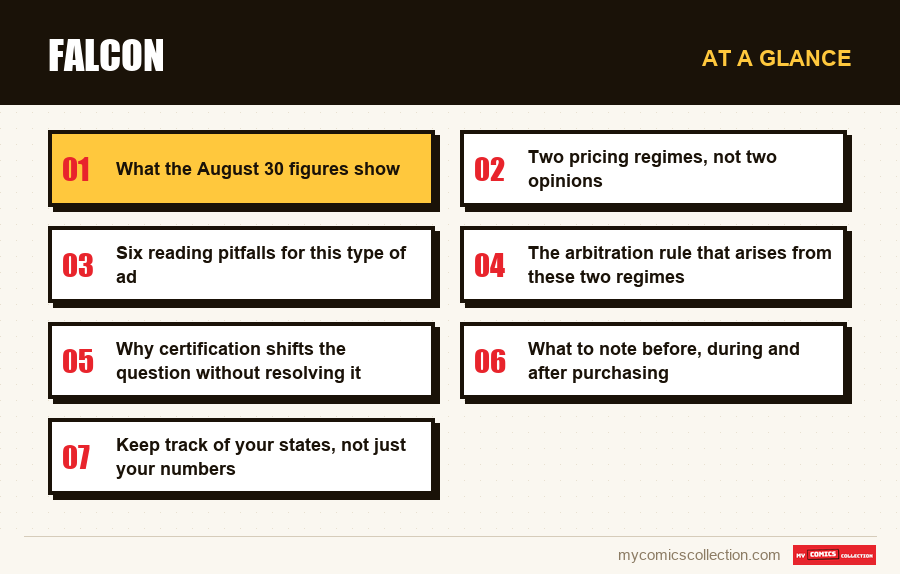
What the August 30 figures show
The request related to the 1969 issue in which Sam Wilson appears in the Captain America series. Two ad populations coexisted. On one side, the copies verified by an external organization: forty-three advertisements, a minimum claimed at $175.00, a median at $599.95, a maximum at $5,500.00. On the other, the unverified ads, where all the cheapest proposals were located. These two populations do not describe the same object: the verified examples form a separate segment, with generally superior conditions and a grade issued by a third party. Comparing their median to the price of ordinary ads would be like comparing two markets that have almost no overlap.
In the unverified advertisements, five propositions unambiguously concerned the same issue. The cheapest, described as rated 2.5, was $50.00. Another, described as rated 3.5, was asking for $150.00. Between these two, only one state point, and a hundred dollars. A third ad, without any numerical note, claimed $149.99, that is to say practically the price of the copy rated 3.5, without it being possible to know if the object is worth it. Finally, two advertisements with strictly identical wording, one claimed $150.00, the other $155.00. Same number, same printing date indicated, same elements highlighted: five dollars difference on descriptions that nothing distinguishes.
Two pricing regimes, not two opinions
Abundance diet
On the 1981 issue measured on the same day, five advertisements of the same number were within a range of less than a dollar while the states declared ranged from 4.0 to 8.0. Four points difference, less than a dollar difference. The state decides between interchangeable copies: it informs the buyer, it does not charge him.
Scarcity regime
On the 1969 fascicle, a state dot separates $50.00 from $150.00. When few copies are in circulation, the buyer can no longer choose between ten equivalent objects. The only variable that remains available to decide between the ads is the condition, and it therefore absorbs the entire price difference.
The verified segment
Forty-three verified copy listings, median $599.95, minimum $175.00. This is not the same market as the $50 or $150 ads: they are other states, and a rating issued by a third party. The two sets must be read separately, otherwise you might believe in a price gap that does not exist.
The maximum measures nothing
The top $5,500.00 is a asking price from a seller who hasn't found anyone yet. An isolated maximum describes an expectation, not a market level. It inflates the apparent magnitude and teaches nothing about what to plan to spend.
The lesson therefore does not relate to this particular booklet. It concerns the relationship between the rarity of a title and the weight that the state takes on it. The same rating difference, say two points, results in a negligible supplement in one case and a multiple in the other. Until we have identified which regime we are in, we cannot know if an ad is interesting: the same price can be a bargain or an absurdity depending on the number of competing copies visible next to it.
A single reading, on a single date, does not reveal any change. The figures cited here describe the state of an ad book on August 30, 2026, with sums claimed by sellers. Nothing in this data says that a price has increased, decreased, or stabilized, and it would be wrong to make it mean a trend.
The five unverified advertisements examined in detail form a very small number. We can read a mechanism there (a state point, a hundred dollars) but not a reliable price level. Five listings do not constitute a deal; they constitute a sample of which the next posting can move the minimum.
Six reading pitfalls for this type of ad
The call price without note
The $149.99 listing does not declare any encrypted status. It is placed between the copy rated 2.5 and the copy rated 3.5, in a gradient where each point weighs one hundred dollars, without giving the buyer a way to locate it. An absence of note, in a regime of scarcity, is not neutral information: it is the most costly information that is missing.
The year written in several ways
Some advertisements indicate the year alone, others an abbreviated month and year. Both designate the same issue, but sorting by date or searching by vintage can exclude part of it. This is a recurring problem, developed in the article dedicated to dating disagreements between sellers.
Two identical wordings, two prices
$150.00 and $155.00 for ad titles that are indistinguishable from each other. This gap does not describe any difference in object: it describes two sellers who do not have the same idea of what the same thing is worth. The asking price remains an opinion, even on a perfectly described object.
The port ignored in the comparison
Five dollars difference between two twin ads becomes trivial if the shipping costs differ by twenty. Comparing displayed amounts without reducing them to the total cost amounts to ranking proposals on a criterion which will not be the one we will pay.
The number taken for an internal reference
The number of an issue is not a universal identifier: it only takes on its meaning when associated with a series and a period. Some sellers add their own stock reference, which further confuses the reading: a fault detailed in the article on numbers that are actually stock codes.
The name used without a qualifier
A character name used alone brings back announcements that have nothing to do with the issue you are looking for. The query used here combined the name of the character, that of the series, the year and the civil name; this is what made it possible to obtain a homogeneous whole. The subject is addressed head-on in the article on this name used without qualifier.
Collecting this series?
Track what you own, what you are missing and what your collection is worth. 7 day trial.
Start my trial →The arbitration rule that arises from these two regimes
The practical consequence is simple to formulate and demanding to maintain. On a plentiful booklet, taking the best available condition costs almost nothing: when five advertisements of the same issue fit in less than a dollar despite a difference of four points, hesitating makes no sense. You have to take the best preserved one and forget about it. Giving up a clearly superior copy to save a pittance means condemning yourself to buying the same issue later, with a second postage to pay.
On a rare issue, the logic is completely reversed. Each point has to be paid for, and it has to be paid for dearly. The decision must therefore not be taken in front of the announcement, when the object is there and the desire speaks: it must be taken before, cold. This means setting in writing the state point below which one does not buy, and the amount above which one does not buy either. These two limits form a decision range. An announcement that falls out of range is not a missed opportunity: it is an announcement that does not correspond to what we had decided to do.
This discipline has a useful side effect. It transforms a price comparison, an endless exercise, into a binary verification. Faced with the five advertisements noted on August 30, a collector who would have set his stopping point at 3.0 minimum and $160 maximum would have immediately known what to do: discard the copy at $50.00 rated 2.5, discard the one without a rating due to lack of being able to locate it, and retain one of the two paired copies, preferring the least expensive under equal shipping conditions. None of these decisions requires expertise on the fascicle; all require having decided beforehand.
That remains the case of verified copies. With a median of $599.95 across forty-three listings, this segment is not comparable to the previous ones: it offers another item, with a rating from a third party and generally superior condition. Entering it is a separate decision, which answers another question: whether one wants to possess the object or secure its description. Mixing it with ordinary advertisements only produces confusion, including this misleading impression of a single “issue price”, while two distinct markets coexist under the same title.
Why certification shifts the question without resolving it
When a state point is worth a hundred dollars, the question of who gave the grade becomes central. In unverified listings, it is the seller who rates their own item; he is both judge and party, without this implying the slightest bad faith. Two sincere sellers may read the same crease or discoloration differently. In the verified segment, an outside agency issued the rating, and it is precisely this transfer of authority that the price difference between the two ad populations reflects.
But verification doesn't remove the problem, it moves it. It gives a stable, opposable rating, comparable from one ad to another; it does not say what this note is worth in money. The proof is in the numbers themselves: even among verified copies, the range is from $175.00 to $5,500.00. A common note does not align the asking prices. Disagreement between sellers survives certification, just as it survives identical wording in ordinary listings.
For the buyer, the conclusion is measured. On a plentiful issue, having it verified or buying verified makes little economic sense, since the state does not sell money in this regime. On a rare booklet, verification removes the most costly uncertainty, the one that made the ad without a note impossible to locate, but it transports the buyer into a segment where the amounts requested are counted in hundreds of dollars. It is neither an improvement nor a deterioration: it is a change of terrain, to be decided with full knowledge of the facts.
It is worth here to resituate the booklet in something other than its price. An issue is not just a market line: it is an entry point into a continuity of reading, and the interest we have in it is primarily due to what it tells. The reading paths, the extensions on the screen: including the comparison between the television series and the booklets: and author pages like the hub dedicated to Stan Lee serve exactly that purpose: to remind you that an old booklet is bought for what it contains, and that the discussion on the condition comes next, once you know why you want it.
What to note before, during and after purchasing
The state note and its author. Never log a state alone. Write the rating and who gave it: the seller in their ad, or an outside organization. On this booklet, the difference between 2.5 and 3.5 was worth one hundred dollars; a note from which we do not know where it comes from is not comparable to a note issued by a third party, and forgetting this precision makes any subsequent rereading unusable.
The stopping point set before purchase. Note the state limit and the price limit that you gave yourself Before to see the selected ad. This is the only way to know later whether you followed your rule or gave in to the object. On a booklet where a point weighs one hundred dollars, this trace is worth more than the price paid itself.
The number of ads compared. Write down how many proposals you had in front of you when deciding, and what type. Five unverified ads are not forty-three verified ads: the first figure is too low to establish a price level, the second describes another segment. Without this workforce, you will not be able to judge the solidity of your own decision.
The exact date of the statement. Date the comparison, not just the purchase. A statement from August 30, 2026 says nothing about what the announcements will be like three months later, and also says nothing about what they were before. Two dated statements, separated in time, would produce information that a single statement does not contain; without the date, even this possibility disappears.
The price paid, shipping included. Record the total actually charged, not the amount shown in the ad. This is what the two twin advertisements separated by five dollars reminded us: on proposals this close, it is the conditions of sending which decide, and a history built on displayed prices compares figures that no one has ever paid.
Because the state is only monetized when it becomes the only available variable. On a plentiful issue, the buyer chooses between numerous interchangeable copies and competition between sellers crushes the differences: on August 30, five advertisements of a 1981 issue were sold for less than a dollar despite declared conditions of 4.0 to 8.0. On an old booklet that is not widely available, there is no longer any competition to absorb the difference, and the condition difference absorbs the entire price difference.
No, and it's important not to use it that way. This median relates to forty-three announcements of copies verified by an external organization, a segment with generally superior states. Regular listings observed on the same day started at $50.00. These are not the same objects nor the same market, and there is no single “issue price” that would cover both.
In a regime of scarcity, yes, because the missing information is precisely the most expensive. The $149.99 ad noted on August 30 was between a copy rated 2.5 and a copy rated 3.5, in a gradient where a point weighs one hundred dollars, without allowing it to be positioned. This does not mean that the item is bad: it means that the buyer alone bears the rating risk.
That the amount requested remains a seller's opinion, even when the description leaves no room for interpretation. These two advertisements had strictly identical wording and displayed $150.00 and $155.00. No difference in object explains the discrepancy. This is a useful reminder: a displayed price is not a value, it is a proposition.
Absolutely not. All the data cited come from a single observation, made on August 30, 2026, and relate to sums claimed in current advertisements, never to concluded sales. A single measurement has no point of comparison in time: it describes a backlog of announcements at a moment, and any assertion of increase or decrease drawn from it would be invented.
Keep track of your states, not just your numbers
A collection that only records numbers loses exactly the information that costs a hundred dollars a point. Record the statement, its author, the date of the statement and the price paid including shipping, and your future decisions will be based on your own decisions rather than your memory.