The Ends of the Earth reading order is a six-issue arc of Amazing Spider-Man, #682 to #687, published in 2012: Dan Slott writes and Stefano Caselli draws. Read #681 first for the setup, then the six issues in order, then the one-shot Amazing Spider-Man: Ends of the Earth and Avenging Spider-Man #8. The arc leads into "Dying Wish" (#698 to 700) and then Superior Spider-Man.
Few Marvel events fit inside a single series, but this one almost does. There is no central limited series and no dozens of tie-ins spread across twelve titles, just six consecutive issues of Amazing Spider-Man and a very small number of extras. This guide tells you where to start, what to add, and in what order to open each issue.
As always on this guide, we only state verified information (creators, issue numbers, dates). The analysis is our own, with no reproduction of protected art or dialogue.
What to read before the arc
You can read Ends of the Earth without knowing forty years of Spider-Man, but the arc rests on one specific relationship: Peter Parker's history with Otto Octavius, a.k.a. Doctor Octopus, which Dan Slott has been developing in the series for several years. The recommended prelude is short. Start with Amazing Spider-Man #681, the issue that immediately precedes the arc and is listed among the setup episodes. It lays out where things stand before #682 opens.
If you have a little more time, issues #676 and #680 of the same series are also listed among the preparation milestones. Avengers Academy #14 and Invincible Iron Man #502 are also cited as background, but they count as extras: the arc works without them. The principle is simple. The further back you go, the better you understand why Octavius acts the way he does, but the useful minimum is #681.
If you are new to this era, a detour through the Spider-Island reading order sets the tone for the period: same writer, same series, but a far more sprawling event. The comparison shows how Ends of the Earth makes the opposite choice, that of concentration.
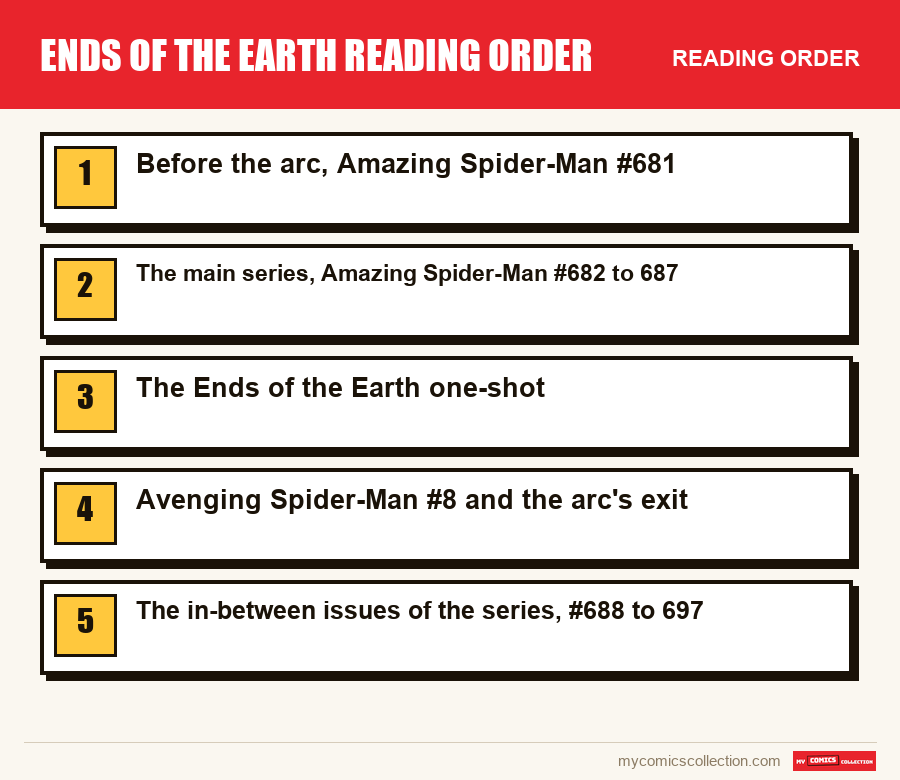
Phase 1: Before the arc, Amazing Spider-Man #681
This first step contains a single issue, and that is deliberate. #681 belongs to the regular series Dan Slott was writing at the time, and it works as a launch pad: it shows Peter Parker's situation as the arc begins. Read it like any ongoing issue, without trying to treat it as the start of the event itself, since the arc's starting issue is #682.
One point of method for collectors: the series carries continuous numbering across the whole "Big Time" era. Issues #677 to #687 form a coherent block that some collected editions reprint in one go. If you read single issues, you can therefore start at #677 and arrive at #682 without a break; if you read trade paperbacks, see below for how the volumes are divided.
The practical advantage of this short prelude is that a reader in a hurry avoids a long climb back through the series and can start the arc the same evening. The trade-off is that you have to accept running into a few references to earlier stories you have not all read. They do not get in the way of understanding.
Phase 2: The main series, Amazing Spider-Man #682 to 687
The heart of the event is here: six issues of Amazing Spider-Man, #682 to #687, published in 2012. Dan Slott writes all of them; Stefano Caselli is the artist on the arc. The narrative starting point is this: Doctor Octopus learns he has little time left to live and launches a planet-wide project, with the Sinister Six at his side (Chameleon, Electro, Mysterio, Rhino and Sandman, plus himself). Spider-Man has to take on the whole group, backed by allies who change from issue to issue.
Our reading advice is not to split the arc outside its own issues: the event fits entirely inside these six single issues, so there is no other series to slot in. Reading all six in a row gives the best sense of escalation. If you prefer two sittings, a break midway, between #684 and #685, breaks nothing and lets you come back fresh for the final assault.
Among the characters passing through, you meet Silver Sable, who joins Spider-Man at one point in the arc, Black Widow, and several allies Spider-Man rallies against Octavius's plan: Union Jack, Sabra, Kangaroo and Big Hero 6. This list is a landmark, not a summary: it helps you know who to watch for as the quest widens.
Spoiler warning: Silver Sable dies during the final confrontation, and the ending sees the Avengers escort Doctor Octopus to the Raft. If you want to approach the arc without knowing these points, skip straight to the next phase.
Phase 3: The Ends of the Earth one-shot
The only tie-in in the strict sense is a single issue: The Amazing Spider-Man: Ends of the Earth. What makes it distinctive is its rarity: unlike the series' previous event, Spider-Island, which multiplied the linked titles, this one has just one satellite issue. The arc's main collected edition places this one-shot after the six issues, which gives you a good guide: read it once the arc is finished, as an extension and not as a mandatory stop in the middle of the issues.
With a single satellite, completing the event stays simple for a collector. For a collection you are building, this one-shot is the only issue to hunt down outside the six issues of the regular series. Check it against the cover and the indicia so you do not confuse it with a neighboring issue of the series, since its title repeats that of the arc.
Phase 4: Avenging Spider-Man #8 and the arc's exit
The issue Avenging Spider-Man #8 appears in both of the event's collected editions, placed after the six issues and the one-shot. Read it at that point. It is not essential for understanding the ending; its presence in both tables of contents is enough to place it in the recommended reading for anyone who wants everything.
The arc's real follow-up is elsewhere, in the regular series: "Dying Wish," in November 2012, in Amazing Spider-Man #698 to 700. It is the direct sequel for anyone who wants to see Otto Octavius's story through. After that, The Superior Spider-Man opens and runs from 2013 to 2014; we have devoted a separate guide to it, which you can follow as soon as you finish #700.
Spoiler warning: the title Superior Spider-Man itself tells you what the series becomes after "Dying Wish." If you would rather not know, just read the list in the last section in order without trying to anticipate.
Do you collect this series?
Track what you own, what you are missing and what your collection is worth. 7-day trial.
Start my trial →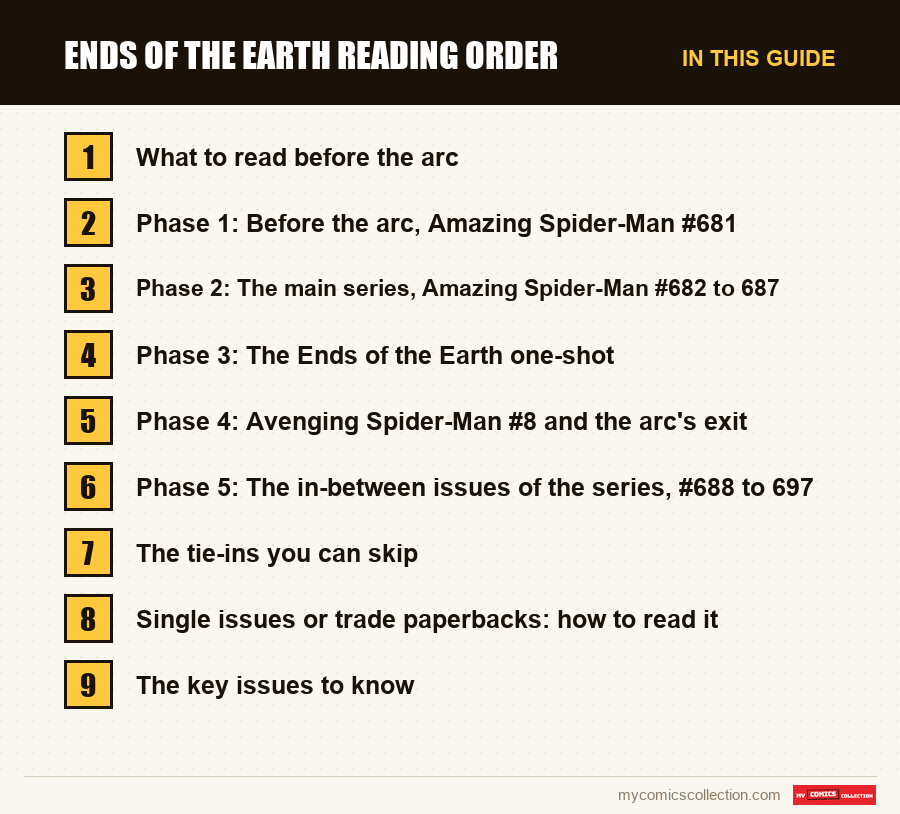
Phase 5: The in-between issues of the series, #688 to 697
Between the arc and "Dying Wish," the series continues for ten issues, #688 to #697. We do not detail this block here because it is not part of Ends of the Earth: it is the regular series, with its own stories. For a reader who only wants to follow the Octavius line, the advice is to skim these issues with an eye on the series' table of contents, or to read them straight through if you have followed Spider-Man since the start of the Slott era.
A collector's tip: do not treat this block as an empty zone. When you build your collection, these ten issues remain ordinary single issues, affordable one at a time, that keep the numbering continuous between the arc and its conclusion. If you are going for a complete run, it is better to buy them at the same time as the arc than to wait for a chance to fill the gap.
The tie-ins you can skip
In this event the list of what you can skip is very short, because the list of what you must read is too. Avengers Academy #14 and Invincible Iron Man #502, cited among the background pieces, count as extras: they shed light on Spider-Man's allies or on the Marvel environment of the moment, but the arc reads perfectly well without them. Ignoring them will not make you lose the thread.
The one-shot and Avenging Spider-Man #8 belong in the same optional category for the reader in a hurry. They contradict nothing, block nothing, and their absence leaves no hole in the plot. If you want the leanest reading, six issues of Amazing Spider-Man and #681 beforehand are enough; everything else is a bonus, to read out of taste or a wish for completeness rather than necessity.
Single issues or trade paperbacks: how to read it
The event has two clearly identified collected editions. The first, Spider-Man: Ends of the Earth, released in August 2012, gathers Amazing Spider-Man #682 to 687, the one-shot and Avenging Spider-Man #8: it is the most compact format if you want exactly the event's content, with no extras. The second, Spider-Man: Big Time: The Complete Collection volume 3, released in February 2015, covers a wider range: Amazing Spider-Man #677 to 687 and #679.1, Daredevil volume 3 #8, the one-shot and Avenging Spider-Man #8. It suits you if you are following the whole Big Time era.
The right method depends on your goal. To read the arc alone, the first collection saves you from buying extra single issues. For continuous reading of the period, the second saves you from jumping back and forth. As single issues, the difficulty is modest since the arc occupies six consecutive issues of the regular series: you can find them together in lots, but check every issue, because an incomplete lot is more common than you might think. Avoid opening a collected edition without looking at its table of contents, since the scope varies from one edition to another.
The key issues to know
For collector value, the logic here is unusual: the arc sells and gets shelved as a block, and the landmarks are reading landmarks first rather than first appearances. #682 is the opening issue, the one many readers look for first; #687 is the closing issue, the one that contains the ending. In between, the issues most often sell as a set.
The one-shot deserves separate attention: a satellite issue outside the series' numbering, it demands careful checking of condition and cover. For variants, the method is constant: identify the standard cover first, then check the marking of alternate editions, and compare current listings with sales that actually closed before setting a price. Do not rely on the seller's photo alone.
Finally, the series' #700, which concludes "Dying Wish," is the pivotal issue for any collection centered on Otto Octavius. A collector of the arc has every reason to shelve it next to #687, for reading consistency as much as for storage.
Summary: the complete order
- Amazing Spider-Man #681: immediate setup.
- Amazing Spider-Man #682 to 687: the main series, Dan Slott and Stefano Caselli.
- The Amazing Spider-Man: Ends of the Earth: the one-shot, to read after #687.
- Avenging Spider-Man #8: the extra reprinted in the collected editions.
- Amazing Spider-Man #688 to 697: the regular series, up to the sequel.
- Amazing Spider-Man #698 to 700: "Dying Wish," November 2012.
- The Superior Spider-Man: the 2013-2014 series that continues Otto Octavius's story.
Frequently asked questions
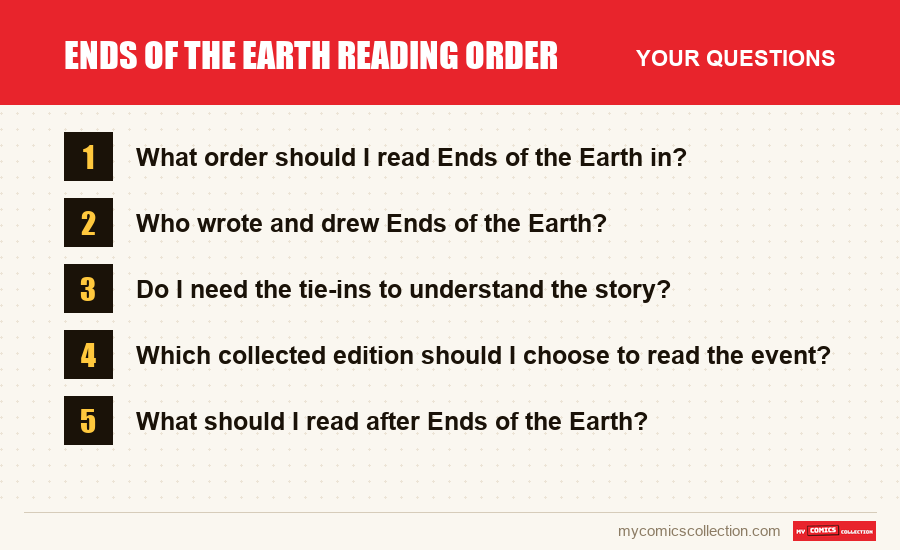
Start with Amazing Spider-Man #681, then read issues #682 to 687 without interruption. Next add the Ends of the Earth one-shot and Avenging Spider-Man #8 if you want the whole package. For the rest of Otto Octavius's story, move on to "Dying Wish" in issues #698 to 700.
Dan Slott is the writer of the arc, published in Amazing Spider-Man #682 to 687. Stefano Caselli is the artist. Stephen Wacker handled the editorial direction. It all ran in 2012, before the series' big turn toward Superior Spider-Man, which begins in 2013.
No. The arc fits entirely inside the six issues of Amazing Spider-Man, #682 to #687. The only satellite issue is the Ends of the Earth one-shot, which you read after the six issues. Avenging Spider-Man #8 is an extra reprinted in the collected editions, useful but not necessary.
For the event's exact content, Spider-Man: Ends of the Earth (August 2012) reprints #682 to 687, the one-shot and Avenging Spider-Man #8. To read the whole era, volume 3 of Big Time: The Complete Collection (February 2015) also covers #677 to 681 and other issues. Always check the table of contents.
The direct sequel is "Dying Wish," in Amazing Spider-Man #698 to 700 (November 2012), then The Superior Spider-Man, a series running 2013 to 2014. Between the arc and "Dying Wish," issues #688 to 697 are regular series, which you can read straight through or skim depending on your interest.
Found issues #682 to 687 in a lot or a box of single issues? Get them appraised before you sort them.
Estimate my comic