In short
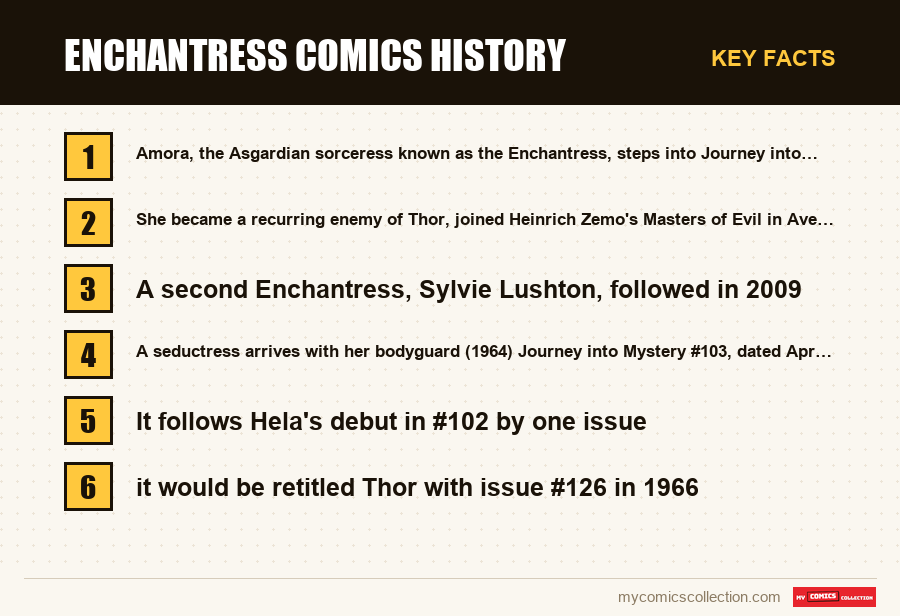
Amora, the Asgardian sorceress known as the Enchantress, steps into Journey into Mystery #103 (April 1964) from Stan Lee and Jack Kirby, with her servant Skurge the Executioner beside her. She became a recurring enemy of Thor, joined Heinrich Zemo's Masters of Evil in Avengers #7, posed as Valkyrie in Avengers #83, and has since crossed the Defenders, Walt Simonson's Asgard, the Sisterhood of Mutants and the Dark Council of the post Secret Wars era. A second Enchantress, Sylvie Lushton, followed in 2009.
Villains with a long run tend to be defined by one grudge. Amora is defined by a talent: she can make anyone want something, and the Marvel universe has spent sixty years finding new people for her to charm. That is why her history is easier to follow as a sequence of situations than as a single feud, and why the issues that matter to collectors are scattered across Thor, the Avengers, the Defenders and a handful of other books.
Each issue number, cover date and creator below was matched one entry at a time, and a credit appears only when it held up; otherwise the entry gives the issue alone. The remarks on what each era changes for Amora are analysis.
A seductress arrives with her bodyguard (1964)
Journey into Mystery #103, dated April 1964, introduces Amora in a story credited to Stan Lee and Jack Kirby. It follows Hela's debut in #102 by one issue. She does not come alone: Skurge the Executioner makes his own debut in the same issue, created by the same pair, and the two work together against Thor at Loki's behest. She tries and fails to seduce Thor away from Jane Foster, and Thor returns the pair to Asgard.
The setup matters because it contains the whole template. Amora is Asgardian, so she belongs to the same world as Thor rather than threatening it from outside. She is trained in magic; the character's backstory has her studying under Karnilla, Queen of the Norns, before she is banished. And she has a sister, Lorelei, with whom she keeps a rivalry. Skurge, meanwhile, is written as a man who has feelings for her, while she uses her charms to keep him under her thrall. That imbalance is the engine of the next sixty years.
At this point Journey into Mystery is still an anthology title by name; it would be retitled Thor with issue #126 in 1966. Collectors who want the original Enchantress material should note that her first appearance sits in the era when Lee wrote the series and Kirby had just become its regular artist, which is the same creative pairing responsible for most of the Asgardian cast.
Joining the Masters of Evil in the Avengers (from 1964)
Her next major move is to another team's book. Heinrich Zemo's Masters of Evil take the stage in The Avengers #6 (1964), a Lee and Kirby issue. In The Avengers #7 (August 1964) the Enchantress and the Executioner, exiled to Earth by Odin for attacking Thor, join Zemo's team. Across #7 to #10 she hypnotizes Thor into attacking the Avengers, Iron Man breaks the trance, and after a failed plot she reverses time. In the same stretch she recruits Wonder Man into the Masters of Evil after paying his bail.
Two more Avengers stories deepen her file. In The Avengers #15 and #16 she breaks the Black Knight and the Melter out of jail and escapes with the Executioner. In #21 and #22 she empowers Erik Josten as Power Man and uses illusions to turn the public against the Avengers. The Avengers Annual #1 places her in the Mandarin's plan: she and the Executioner attack Asia with trolls, and Hercules and the Scarlet Witch stop them.
What changes for the character is her audience. In Thor's book she is a nuisance with a bodyguard; in the Avengers she is a specialist hired for effects no one else on the team can produce: hypnosis, illusion, empowerment. That is a different career, and it explains why she keeps turning up in team-up books long after the original Thor stories have stopped needing her.
Valkyrie and the Defenders (from 1970)
With The Avengers #83 (December 1970), a Roy Thomas script drawn by John Buscema, the Enchantress changes shape. She poses as Valkyrie, forms the Lady Liberators from the female heroes of the Avengers' circle, and manipulates Arkon into fighting the male Avengers in The Avengers #83 and #84. Her identity is discovered and the plan is thwarted. The Valkyrie of these stories therefore begins as a disguise of the Enchantress.
The Valkyrie identity then leaves her control. In The Defenders #4, written by Steve Englehart with art by Sal Buscema, the Enchantress gives the Valkyrie's consciousness, appearance and powers to Barbara Norris so that she can help the Defenders escape the sorceress Casiolena, and leaves the spell in place afterward. She later battles the Defenders and the Thing, with the Executioner, in Marvel Two-in-One #7 and The Defenders #20.
For the character, this is the moment where she stops being only a villain and becomes a creator of heroes. The Valkyrie of the Defenders exists because Amora lent out a name and a power, and a collector who wants to understand how that identity travels needs the Enchantress as the source. It is also the period that links her to Marvel's non-Asgardian teams, which is what makes later cameos in books like the Sisterhood of Mutants make sense.
Walt Simonson's Asgard and the loss of Skurge (1983 to 1987)
Several Enchantress turns fall inside Walt Simonson's stretch on Thor, which runs from #337 (November 1983) to #382 (August 1987), with Sal Buscema drawing from #367. In Thor #350 and #352 to #353 Amora fights Surtur because his plan would destroy her too, a stance of enlightened self-interest that puts her on Asgard's side of that war. In Thor #362 (December 1985) Amora's servant ends his story at Gjallarbrú, giving his life holding the bridge so the others can leave Hel, and the 1964 partnership ends there.
The Enchantress is also placed on the villains' side during Secret Wars, and a later run of Thor issues, Thor #393 to #400, shows her aiding Asgard against the legions of Seth. In Thor #402 and #403 Lorelei dies after Amora refuses to sacrifice herself for her, and Amora empowers Brute Benhurst as a new Executioner. The pattern of those issues is that Amora can be an ally of convenience, but every alliance costs someone near her something. For a collector, the Simonson period and the issues just after it are where her relationships with Skurge and Lorelei are dramatized and then resolved, which makes these issues the emotional center of her history.
Thor, Heroes Reborn and Ragnarok (the 1990s and 2004)
In Thor #491 to #494 the Enchantress and Thor live together in New York as lovers, until Thor disappears and is presumed dead. It is an unusual turn for a villain who had spent three decades trying to seduce him by spell: this time the relationship is a plot in its own right, and the surrounding event changes what the book can do with her.
The Heroes Return event brought a fresh Thor series from Dan Jurgens and John Romita Jr. Its Ragnarok storyline came in 2004 (#80 to #85, Michael Avon Oeming and Andrea Di Vito). At Ragnarok, Amora is slain by a blast from a duplicate of Mjolnir wielded by Loki. After Thor's return, Thor: God-Sized Special #1 shows her trying to free Skurge from Valhalla, until Thor, Loki and Balder convince her that she is dishonoring his memory. Her death at Ragnarok and her return a few years later show how the Asgardian cast is handled: death is a plot beat.
Do you collect this series?
Track what you own, what you are missing and what your collection is worth. 7-day trial.
Start my trial →
Sylvie Lushton and the second Enchantress (2009)
A second Enchantress appears in Dark Reign: Young Avengers #1, dated July 2009, created by Paul Cornell and Mark Brooks. In #3 she admits that she is Sylvie Lushton from Broxton, Oklahoma, and that her powers came suddenly; in #4 the reader learns that Loki gave her those powers for his schemes, and her teammates expose her as a trap for the team's defenses; in #5 Wiccan reveals Loki's role and she helps the Young Avengers fight the Dark Avengers. She later joins the Hood's Illuminati in Illuminati #1 and is banished by the original Enchantress in #7.
The effect on the character is a doubling of the brand. Collectors have to keep two women under one name, and Sylvie is the center of Dark Reign: Young Avengers. That need to separate Amora from Sylvie is a recurring catalog problem for this character, and the cure is to look at the series title and the creative team rather than the cover logo alone.
Sisterhood of Mutants and the post Secret Wars Dark Council (2010s)
In X-Men vol. 4, issues #8, #11 and #12, Amora joins the Sisterhood alongside Lady Deathstrike and Typhoid Mary, and is later ambushed by the X-Man M. Avengers & X-Men: AXIS #2 has her fighting as part of Magneto's group against the Red Onslaught form of the Red Skull.
After Secret Wars (2015), The Mighty Thor #2 and #5 place her on Malekith's Dark Council, where she uses magic to force a Light Elf queen into marrying Malekith. Other appearances in this period include Journey into Mystery #504 and #509 to #511, Defenders vol. 2 #4 and Thor: Ages of Thunder #1, plus an alternate version in Old Man Logan vol. 2 #8. By now the Enchantress is a utility player: the creative teams of the 2010s use her as a recognizable name for a story about temptation, rather than building a new Amora plot from scratch.
The key issues across her history
- Journey into Mystery #103 (1964): the Enchantress and Skurge the Executioner debut, credited to Stan Lee and Jack Kirby.
- The Avengers #7 (1964): she and the Executioner join Heinrich Zemo's Masters of Evil after Odin exiles them to Earth.
- The Avengers #21: she empowers Erik Josten as Power Man.
- The Avengers #83 (December 1970): Roy Thomas and John Buscema show her posing as Valkyrie and forming the Lady Liberators.
- The Defenders #4: Steve Englehart and Sal Buscema give the Valkyrie's power to a new bearer through the Enchantress.
- Thor #402 and #403: Lorelei dies and Amora empowers Brute Benhurst as a new Executioner.
- Thor #362 (December 1985): Skurge dies holding the bridge Gjallarbrú, ending the partnership that began in 1964.
- Dark Reign: Young Avengers #1 (July 2009): Sylvie Lushton, the second Enchantress, debuts under Paul Cornell and Mark Brooks.
How to follow the Enchantress in a collection
Start with the debut, then follow the Masters of Evil issues of The Avengers, then the Valkyrie sequence. The Thor numbering splits at the Heroes Return and 2007 relaunches, and the Avengers and Defenders have their own second volumes, so always note the volume with the number: The Defenders #4 and Defenders vol. 2 #4 are different books that happen to share a number.
Collected editions are the practical route into the 1960s Avengers stories and the Simonson years. For related material on her relatives and rivals in Asgard, see the best Loki runs and the key numbers of Asgard.
Frequently asked questions
Her debut is Journey into Mystery #103 (April 1964), from Stan Lee and Jack Kirby. Skurge the Executioner debuts in the same issue, and Thor sends the pair back to Asgard after she tries to seduce him.
The Valkyrie of the Avengers and Defenders stories begins as a disguise of the Enchantress in The Avengers #83 (December 1970), written by Roy Thomas. In The Defenders #4, Steve Englehart and Sal Buscema have her give the Valkyrie's consciousness, appearance and powers to Barbara Norris.
Paul Cornell and Mark Brooks create Sylvie Lushton, the second Enchantress, in the July 2009 first issue of Dark Reign: Young Avengers. Loki is revealed as the source of her powers in #4 and #5, and she later joins the Hood's Illuminati in Illuminati #1.
Skurge the Executioner, who debuts with her in Journey into Mystery #103, has feelings for Amora and often helps her schemes, while she manipulates him with her charms. He dies in Thor #362 holding the bridge Gjallarbrú so heroes can escape Hel, and she later tries to free him from Valhalla in Thor: God-Sized Special #1.
Many. The Masters of Evil stories in The Avengers #7 to #10, the Lady Liberators in #83 and #84, The Defenders #4 and #20, Marvel Two-in-One #7, the Sisterhood in X-Men vol. 4 #8 to #12 and Dark Reign: Young Avengers are all in other series.
If a Journey into Mystery #103 or an early Avengers issue is in your boxes, you can get an estimate before deciding how to protect or sell it.
Estimate my comic