
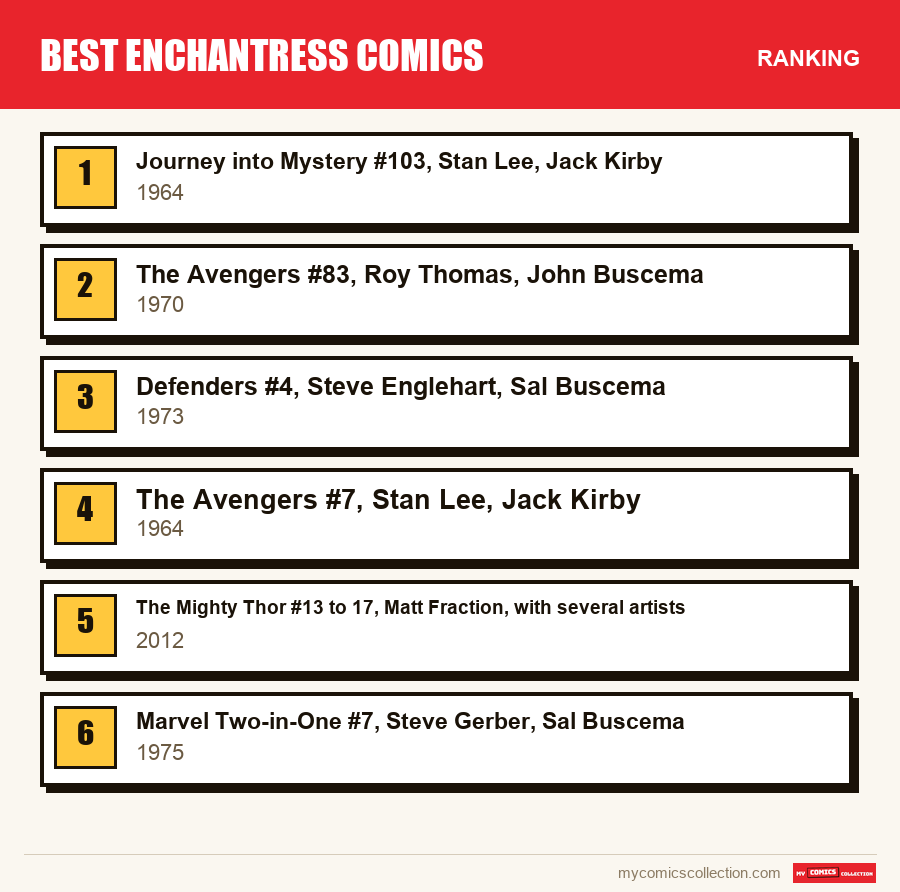
To read the best Enchantress comics, start with Journey into Mystery #103 (April 1964), where Stan Lee and Jack Kirby created Amora, then move on to The Avengers #83 (December 1970) and Defenders #4 (February 1973), which set up the Valkyrie ruse. Round it out with The Avengers #7, Marvel Two-in-One #7 and Matt Fraction's The Mighty Thor #13 to 17 (2012). Six ranked reads, all built around her.
Amora the Enchantress is an Asgardian whose weapon is suggestion rather than brute force. She has no ongoing series that follows her from start to finish, and that is exactly what makes reading her tricky. You have to hunt for her in the pages of Thor, the Avengers and the Defenders, and sometimes in a one-off issue of another title. We kept only six stories where Amora drives the plot, and we give the reading order that makes sense of them.
As always in this guide, we only state verified facts (creators, issue numbers, dates); the analysis is our own, with no reproduction of protected art or dialogue.
Her first appearance
Amora debuts in Journey into Mystery #103, cover-dated April 1964. Lee and Kirby created Amora, and the same issue introduces the Executioner, Skurge, who would stay at her side for a long time. The story title puts the two side by side right away, which is a useful hint: the Enchantress arrives with company. She is trying to pull Thor away from Jane Foster.
The very next issue, Journey into Mystery #104, is her second appearance, but she is not on the cover. That is the detail that separates, among collectors, the benchmark issue from its immediate neighbor. The context of the surrounding Thor issues can be found in our selection of key Thor issues from the Silver Age.
One useful orientation point before ranking anything: Amora was born in Asgard, she has a sister, Lorelei, and she trained under Karnilla before being banished and pursuing the study of magic on her own. That training explains what the best stories exploit: a sorceress who makes up with cunning what her surroundings deny her in raw power.
1: Journey into Mystery #103, Stan Lee, Jack Kirby (1964)
This issue ranks first for a simple reason: it is the one where the character is at the center of the story, not a guest. Amora tries to seduce the god of thunder to draw him away from his mortal love, Jane Foster. The Executioner, who also makes his debut here, is the ally who comes along with her.
What this story delivers: the complete template for the character, with her three levers of charm, manipulation and grudge. Everything that follows, from the Avengers to the Defenders, reuses this machinery and just moves it around. Who it is for: readers wondering why Amora keeps coming back to Thor's corner of the Marvel universe since 1964. How to read it: in a reprint volume covering the period rather than as a single issue, because the original comic is a collectible before it is a comfortable read. Then read Journey into Mystery #104, her second appearance.
The creators of the Thor series of that era are detailed on the page for Stan Lee, who co-created the character.
2: The Avengers #83, Roy Thomas, John Buscema (1970)
Cover-dated December 1970. Roy Thomas writes, John Buscema draws, Tom Palmer inks. The story is a sleight of hand: a warrior named Valkyrie shows up at Avengers headquarters, recruits the Wasp and the Scarlet Witch to form an all-female team, and takes on the Masters of Evil with them while the male heroes are away. At the end, Valkyrie is unmasked: she is Amora.
What this story delivers: the manipulative Enchantress at her best, since she wins her enemies' trust before revealing herself. The team, which the cover and the narration call the Lady Liberators, gathers the Black Widow, Medusa, the Wasp and the Scarlet Witch, and lasts for this issue only. Who it is for: readers of the Roy Thomas era of the Avengers who like group stories with a final twist. How to read it: on its own, in one sitting, then continue with Defenders #4, which picks up the Valkyrie name and plants it in another series.
To place this issue among the Avengers releases of the period, the page on key Avengers issues of the Bronze Age gives the framework.
3: Defenders #4, Steve Englehart, Sal Buscema (1973)
Cover-dated February 1973. Steve Englehart writes, Sal Buscema draws, Frank McLaughlin inks. Doctor Strange, Namor and Hulk head to a castle to protect Barbara Norris. The Executioner has become the companion of Queen Casiolena there; the Enchantress, who came to take him back, pursues her own revenge against her and turns the Black Knight into a stone statue along the way. She is the one who turns Barbara Norris into the Valkyrie who will join the Defenders.
What this story delivers: the move from Amora's disguise, seen in The Avengers #83, to a full character in her own right. The Enchantress had already given this role to another woman, Samantha Parrington, before Barbara Norris: this issue picks up that practice. Who it is for: fans of mismatched teams, since part of the fun is watching Strange, Namor and Hulk improvise in a castle held by the Executioner. How to read it: after The Avengers #83, and if possible in a collected edition of the series' first issues. Our entry on Defenders #1 (1972) rebuilds the context of the series.
4: The Avengers #7, Stan Lee, Jack Kirby (1964)
Cover-dated August 1964, titled Their Darkest Hour!. Stan Lee handles the script, Jack Kirby the pencils, Chic Stone the inks. This is the moment the Enchantress and the Executioner cross over from Thor's world to the Avengers': Odin banishes them to Earth, they team up with Baron Zemo and his Masters of Evil, and Amora's first instinct is to turn Thor against his teammates.
What this story delivers: a large-scale version of what Journey into Mystery #103 did on a small scale. Amora does not fight the heroes with her fists; she picks the one the team needs and breaks him. Who it is for: collectors of the period, since this issue belongs to the Avengers' earliest years. How to read it: after the series' founding issues, then continue straight on with the following ones. For the series as a whole, the key Avengers issues of the Silver Age offers a useful map.
If you want to understand why this series matters, the Avengers hub gives you an overview before you go further.
Do you collect this series?
Track what you own, what you are missing and what your collection is worth. 7-day trial.
Start my trial →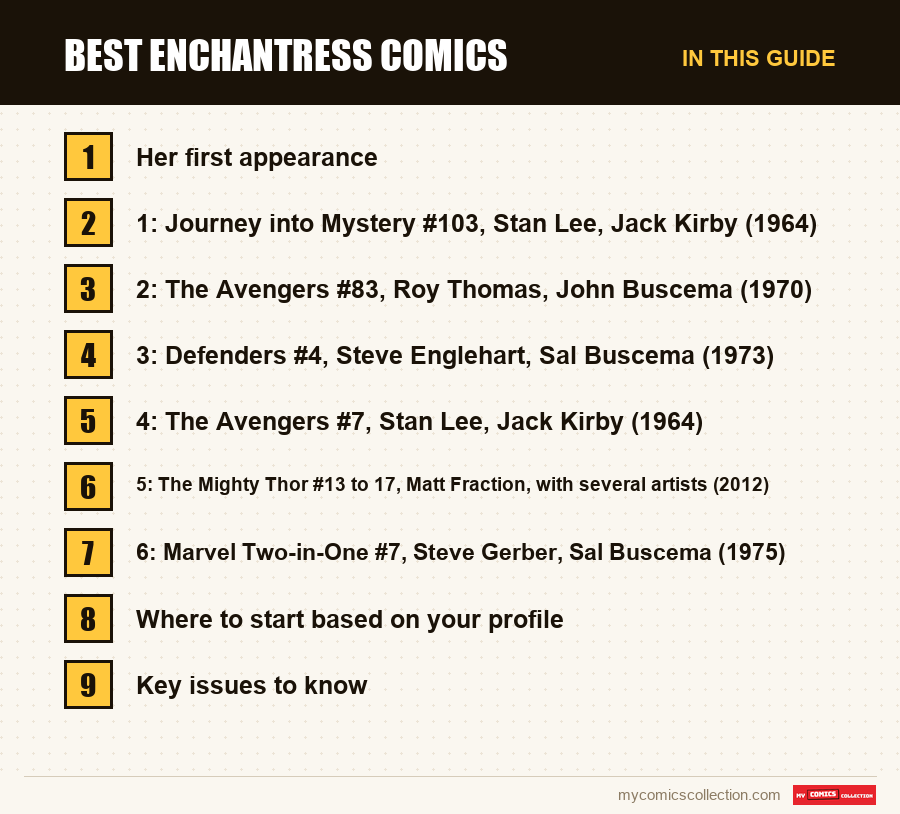
5: The Mighty Thor #13 to 17, Matt Fraction, with several artists (2012)
Issue #13 carries a June 2012 cover date, and the arc is collected in the third volume of Matt Fraction's The Mighty Thor, along with issue #12.1. Matt Fraction writes, Pepe Larraz draws issue #17 among others, and the covers are by Walter Simonson. Donald Blake, Thor's human identity, asks the Enchantress to make him divine again. The last issue sees Thor beat her and the Keep, while the Mares build Blake a dream life.
What this story delivers: an Amora who is offered a deal by a man who has lost what made him a god. It is a chance to see her in temptress mode rather than fighter mode, which ties back to her 1964 beginnings. Who it is for: anyone already following Thor under Matt Fraction; the page dedicated to this writer puts this stretch in the context of his career. How to read it: in the collected volume, since the arc is part of a larger whole.
This story comes late in the ranking because its appeal depends partly on what comes before it in Fraction's series. But it has the advantage of being recent, and therefore easy to find in collected form, and of showing the Enchantress in a register that the 1970s stories do not explore.
6: Marvel Two-in-One #7, Steve Gerber, Sal Buscema (1975)
Cover-dated January 1975. Steve Gerber writes and Sal Buscema draws. The Thing and Valkyrie take on the Enchantress and the Executioner, and the stakes are a supernatural harmonica both Asgardians want to seize. It is a self-contained issue, where the 1964 duo faces a heroine whose story runs through the Enchantress.
What this story delivers: a follow-up to the thread opened by Defenders #4, with the Enchantress and the Executioner as antagonists in an issue of the Thing's book. Who it is for: anyone who wants to follow Valkyrie without losing sight of what Amora has to do with her. How to read it: after Defenders #4, since the tension comes from knowing where Valkyrie comes from. You can also read it on its own, as an episode of the Thing's series, but the payoff is then smaller. For the period, the page on Sal Buscema helps you spot his other work.
Where to start based on your profile
You want the character at the source: take Journey into Mystery #103 and #104, then The Avengers #7. You like plot twists: read The Avengers #83, whose payoff rests on a disguise. You follow the Defenders: open Defenders #4, then Marvel Two-in-One #7 for the Valkyrie follow-up. You mostly read recent stories: choose the third volume of Matt Fraction's The Mighty Thor.
If you collect single issues, the reverse order is more realistic: the recent ones first, then the 1970s, and finally the 1964 releases, which demand patience and careful condition checks. On the trade paperback side, these stories appear in collections of their respective series, so there is no need to chase down the period single issues. In every case, our reading guide to Thor helps you place each story.
Key issues to know
This checklist is for deciding what to look for, and it puts no price on anything. Before valuing a 1964 or 1970 copy, only keep completed sales for your exact issue, with a grade close to yours.
- Journey into Mystery #103 (April 1964): first appearance of Amora, created by Stan Lee and Jack Kirby, along with the Executioner. This is the benchmark key issue.
- Journey into Mystery #104: second appearance of the Enchantress, not on the cover. It is the neighboring issue, not to be confused with the one before it.
- The Avengers #7 (August 1964): the Enchantress and the Executioner move over to the Avengers, and Thor is turned against the team.
- The Avengers #83 (December 1970): the Enchantress in the guise of Valkyrie, in the Lady Liberators lineup.
- Defenders #4 (February 1973): the making of the Valkyrie who joins the Defenders, built from Barbara Norris.
- Marvel Two-in-One #7 (January 1975): the Thing and Valkyrie against the Enchantress and the Executioner, by Steve Gerber and Sal Buscema.
- Thor #362 (December 1985): the expedition into Hel, during which the Executioner dies.
- Dark Reign: Young Avengers #1 (July 2009): debut of Sylvie Lushton, another Enchantress, created by Paul Cornell and Mark Brooks. Do not confuse her with Amora.
To place Amora within the parent series as a whole, open our page on key Thor issues.
Frequently asked questions
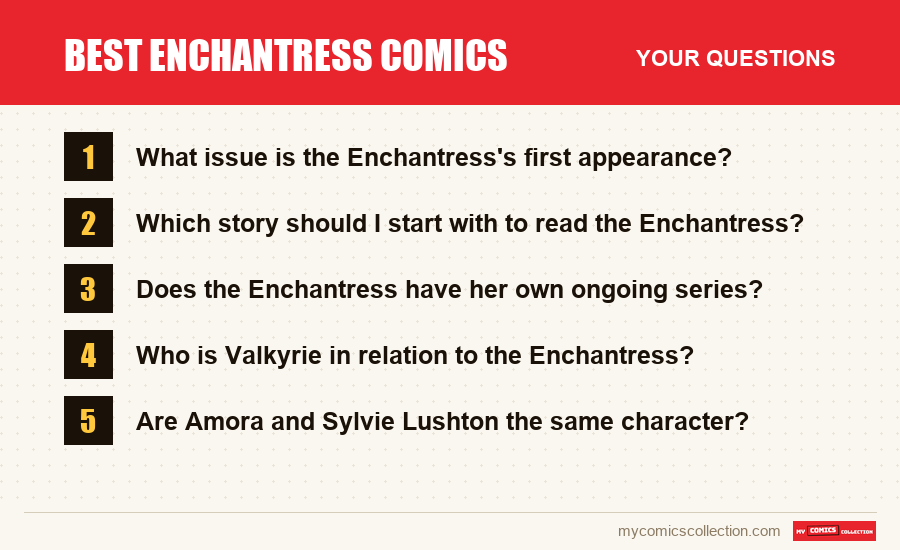
Journey into Mystery #103, cover-dated April 1964, introduces Amora, conceived by Stan Lee and Jack Kirby. The Executioner debuts in the same issue. Her second appearance, in issue #104, is not on the cover, which is what tells the two single issues apart among collectors.
For the source, read Journey into Mystery #103. For the most readable ruse, pick The Avengers #83 (1970), where she takes on Valkyrie's identity. For a modern story collected in a trade paperback, choose Matt Fraction's The Mighty Thor #13 to 17 (2012).
No, no ongoing series follows her from start to finish. She lives in the pages of Thor, the Avengers and the Defenders, and in a few one-off issues like Marvel Two-in-One #7. That is why this guide ranks stories rather than a continuous run.
In The Avengers #83, Amora herself takes on Valkyrie's appearance. In Defenders #4, she makes Barbara Norris the vessel for the warrior's essence. These are two different uses of the same name, best read in that order.
No. Amora is the Asgardian Enchantress born in 1964. Sylvie Lushton is another Enchantress, who appeared in Dark Reign: Young Avengers #1 (July 2009) and was created by Paul Cornell and Mark Brooks. The two characters cross paths later, but their stories read separately.
Do you own a Journey into Mystery #103 or an Avengers issue featuring the Enchantress? Get it appraised by comparing its condition to sales that actually closed.
Appraise my comic