On the 1992 booklet which depicts the confrontation with Doomsday, abundance has erased the usual benchmarks: the August 30, 2026 survey, carried out on the current announcements of a general auction site on the American market, shows 135 unverified offers asking between $4.25 and $1,500.00, with a median at $14.99. The five cheapest ads fit within a seventy-five cent spread as they describe unrelated items: a fourth printing, an anniversary edition, a special edition, and even a press clipping. Next to it, only 18 ads feature a verified copy, starting at $35.00 and around $139.99 in central value. These are amounts claimed on a single date, not sales concluded: they say nothing about an evolution, and eighteen announcements are not enough to set a level. What they suggest, on the other hand, is that the state observed by a third party has become the only dividing line still legible.
There are booklets that we no longer talk about in terms of rarity, because the question no longer makes sense. Issue #75 from 1992, the one that closes the confrontation with Doomsday, belongs to this category. The character dies at the end of the fight: the fact is known, it is contained in one sentence, and it does not need to be told further to understand what happened on the market. What matters here is not the event, it is what the event triggered: a distribution so wide that the booklet is today present everywhere, among people who do not collect, in lots, in boxes opened twenty years later. When an object reaches this degree of presence, the categories which were used to classify it cease to produce price differences.
The reading of August 30, 2026 makes this shift visible without needing to be interpreted. This is not a historical report: it is a photograph taken on a given day, of current advertisements, in a single market area. The amounts shown there are those that sellers requested, not those that buyers paid. No comparison with an earlier date was made, so no trend can be drawn from it: writing "it's going up" or "it's going down" from this single snapshot would be pure invention. What the survey allows, on the other hand, is to look at the structure of the market at a precise moment: how many announcements, at what levels, and above all according to what distinctions.
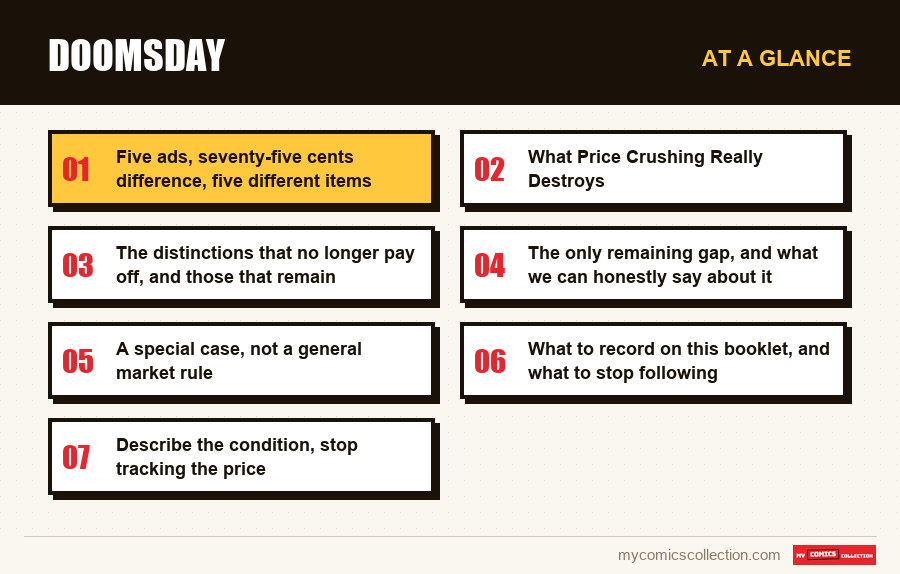
Five ads, seventy-five cents difference, five different items
The most telling detail of the statement is not the maximum, nor the median. This is the bottom of the list. The five cheapest ads are spread over a seventy-five cent interval: $4.25, $4.95, then three times $4.99. Such a narrow interval gives the impression of a coherent market, where comparable objects trade at a comparable price. The exact opposite is happening. These five ads describe different things, and their descriptions say so explicitly.
The first offers a copy of No. 75 presented as « KEY », at $4.25. The second, at $4.95, is not a comic at all: it's a press cutting from 1992. The third advertises a « Superman #75 (1993) | 6.0 FN | Rare 4th Print Newsstand » at $4.99. The fourth, for the same amount, offers a « Superman #75 30th Anniversary Special Edition » described in NM. The fifth, still at $4.99, a « Superman #75 Special Edition » in VF/NM, mentioning the black variant and the year 1992. A fourth printing, an anniversary edition and a special edition therefore require exactly the same amount.
This is not a sample anomaly, it is a direct consequence of abundance. When supply greatly exceeds demand for a given item, the price does not go down indefinitely: it hits a floor set by shipping costs, handling and the psychological threshold below which a seller no longer bothers to create an ad. All variants then crash against this floor. The differences between them do not disappear (the fourth printing remains a fourth printing, the anniversary edition remains thirty years later than the first) but they cease to be remunerated.
What Price Crushing Really Destroys
The draw no longer separates anything
Distinguishing a first from a fourth draw is a useful reflex on most series. Here, one of the fourth printings noted asks for the same amount as an edition published decades later. The distinction remains exact on the documentary level; it no longer produces a measurable difference in the amounts claimed as of August 30, 2026.
The year becomes a simple label
The survey combines announcements dated 1992 and 1993 for the same issue, and an anniversary edition which refers to a much later commemoration. None of these dates pulls the price up or down at the bottom of the ranking: they serve to describe, more to prioritize.
The mention “special edition” no longer carries weight
Two different listings claim a special edition, at $4.99 each, amid regular copies charging the same amount. A qualifier that the market no longer pays for is not a false qualifier: it is a qualifier that has become descriptive, in the same way as the color of a cover.
The category of object itself becomes blurred
A press clipping from 1992 is found at $4.95, surrounded by booklets. Nothing is blamed on the seller: he correctly describes what he is selling. But a buyer who sorts by increasing price sees items that do not belong to the same family appear in the same column.
We need to measure what this changes for someone who already owns the copy. On a rare booklet, the question “which one do I have exactly?” » has an immediate financial consequence: identifying the right print can multiply the value. On this issue, at the price level observed, the same question no longer has any financial consequences at all. It retains its documentary interest, knowing what one owns is an end in itself, but it no longer deserves that we devote time to it in the hope of gain. This is a complete reversal of priority, and it only concerns a small family of fascicles: those which were printed and preserved in very large numbers.
All values cited here are amounts requested by sellers on August 30, 2026, in the ads then online. None correspond to a completed transaction. An isolated maximum: $1,500.00 on the unverified side, $1,992.93 on the verified side: reflects what a seller hopes to get, and nothing else: it does not prove that a buyer ever agreed to that amount.
A single reading does not by construction show any movement. Without comparable previous measurements, it is impossible to say that this fascicle is rising, falling or stabilizing. All these numbers describe is the dispersion of requests on a given date.
The distinctions that no longer pay off, and those that remain
“Rare” without definition
One of the announcements describes a fourth print as “rare”. No one controls this adjective: there is no benchmark or obligation to justify it. It is not an attackable lie, it is a word that nothing obliges to mean anything. Reading it as information is the most common mistake.
Two years for the same number
The statement contains both « 1992 » and « (1993) » attached to No. 75. The coexistence is explained by the successive printings and subsequent editions. It makes sorting by year ineffective to separate two announcements: the date does not isolate an object, it groups together several.
Edition mentions are canceled
“Special Edition”, “30th Anniversary Special Edition”, “Newsstand”: three real labels, three separate objects, one and the same amount claimed. When several labels converge towards the same price, they cease to function as selection criteria.
An object that is not a comic
The 1992 press clipping falls into another category: it is a period document, with its own interest for those interested in the reception of the story. It has no connection with the possession of the booklet and must never be confused with it in an inventory.
135 against 18
The imbalance in numbers is the structuring fact of the survey: 135 unverified announcements compared to 18 verified. The first group is large enough that its median at $14.99 makes sense. The second is too thin to support any firm conclusion.
State, the only remaining variable
Once the print run, the year and the edition mention have been removed, there remains only one characteristic capable of differentiating two copies of the same issue: their actual condition, and above all the fact that a third party has observed it. This is where the only dividing line still legible from the survey passes.
The only remaining gap, and what we can honestly say about it
Between the two segments of the survey, the difference is of another order of magnitude than all of the above. On one side, 135 unverified ads, minimum $4.25, median $14.99. On the other, 18 listings of verified copies, minimum $35.00, central value $139.99. The floor of the second segment is above the median of the first: that is, the lowest priced verified copy charges more than the top half of regular ads. This is the only place in the survey where a declared characteristic is accompanied by a clear dropout.
It remains to formulate this observation with the caution required by the numbers. Eighteen ads is not a deal: it's a handful of offers, each of which weighs more than five percent of the total. A single eccentric announcement visibly shifts the central value. On a sample of this size, it is impossible to say that a verified copy is “worth” one hundred and thirty-nine dollars, or even that it is worth one hundred. What eighteen ads suggest is the approximate location where the denomination is located, above thirty-five dollars rather than above five, without allowing us to fix the level. The difference between “where the border passes” and “at what price” is exactly the margin of uncertainty that must be maintained.
There is a simple reason for this dropout, and there is nothing mysterious about it. On an abundant item, a buyer cannot verify what he is buying himself: the ad photos are heterogeneous, the assessment scales applied by the sellers are declarative, and the adjective “rare” has just shown what free qualifiers are worth. Certification by an external body replaces a speech with an observation. It does not make the issue rare, nothing could, but it makes the copy identifiable. In a market saturated with interchangeable objects, this is the only operation that still produces a difference.
This does not mean that you should have your copy checked. The approach has a cost, a delay, and on an object whose ordinary segment is around fifteen dollars, this cost has no chance of being covered by an average copy. The reasoning is reversed only for examples whose apparent condition is exceptional, and evaluating it yourself is precisely not possible, which closes the loop. The practical conclusion is more modest than the commercial conclusion that could be drawn: in this booklet, verification is what separates prices, but it is not necessarily a profitable operation by default.
Collecting this series?
Track what you own, what you are missing and what your collection is worth. 7 day trial.
Start my trial →A special case, not a general market rule
It would be tempting to generalize: “only the state counts”. This would be false for most comics. On a booklet whose surviving copies number in the dozens, the first question remains identification (what print run, what edition, what distinctive mark) and a discrepancy in identification produces considerable price differences. What makes No. 75 special is precisely its abundance. It is because identification no longer decides anything that the state takes up all the space.
Comparison with old fascicles sheds light on the mechanism by contrast. On a founding title from the thirties, the question of what constitutes the value of a number that has become untraceable arises in terms of existence: how many copies remain, in what condition, and where are they. Rarity creates hierarchy, the state refines it. On No. 75, the rarity is zero: all that remains is the refining, which then becomes the main criterion in the absence of a competitor. The same factor does not play the same role depending on the population of objects to which it applies.
This reading has a direct consequence for anyone looking to complete a series without devoting an unreasonable budget to it. The abundance that makes tracking value unnecessary is also what makes acquisition easy: a booklet whose median demand is less than fifteen dollars requires no particular purchasing strategy. The principles that apply to get these numbers without breaking the bank are fully valid here, provided we accept that the copy obtained will not be distinguished from dozens of others by anything measurable.
There remains a category of collectors for whom this reasoning does not apply at all: those who are not looking for an object but for a moment. Owning the booklet where the confrontation with Doomsday ends does not need to be justified by a price difference. What the statement says, in this case, is simply that it doesn't cost much to own, and it's unlikely to make any money: which is useful information, as long as you don't confuse it with buying advice.
What to record on this booklet, and what to stop following
Note the actual condition of your copy, precisely. This is the only variable in the statement that still produces a difference. Not a global adjective like "good condition", but what is observable: the hold of the angles, the presence or absence of a fold on the spine, the condition of the black cover which marks the traces more visibly than a light cover. This description is not used to estimate a value today, there is none to estimate, but it is the only thing that will one day be able to distinguish your copy from the hundred and thirty-four others online on the same day.
Record the exact draw, without expecting anything from it. The statement shows that a fourth draw is claimed at the same price as a first at the bottom of the ranking. Recording “fourth printing” or “anniversary edition” remains fair and useful for the consistency of your inventory, but this information is not intended to provide value monitoring. Treat it as a descriptive characteristic, just like a format, never as a financial criterion.
Explicitly separate objects that are not booklets. The 1992 press clipping that appeared in the survey among the comics illustrates the risk: an inventory that contains period documents without distinguishing them becomes illegible. If you have one, create a separate category. These pieces have their own interest, often greater than that of the booklet in understanding how the event was received, but they cannot be counted with it.
Stop tracking the value of that specific number. A booklet with requests ranging between four and fifteen dollars for most of the volume does not warrant a tracking line. The time spent raising your price each month is time taken away from the numbers where an identification discrepancy really changes something. Mark it as owned, describe its condition, and move on: it's the most cost-effective inventory decision it allows.
Record the date and nature of each statement you keep. The figures cited here are valid for August 30, 2026, on current announcements, with verified copies counted separately. An inventory that notes an amount without specifying whether it is a request or a sale, or on what date, creates a false memory: a few months later, no one knows whether the recorded figure described a seller's hope or a transaction. The mention of the source and the day is worth more than the amount itself.
Because the price hits a floor related to shipping and handling costs, and that floor is reached by all variants at once. The August 30, 2026 statement shows this directly: an anniversary edition, a special edition and a fourth printing each charge $4.99. The mention “anniversary” remains accurate, it simply no longer creates a price difference on such a widespread item.
Nothing prevents this, and the statement contains an example. L'adjectif n'est soumis à aucune définition ni à aucun contrôle : il ne renvoie à aucun seuil de tirage, à aucune population connue d'exemplaires. It is therefore not a verifiable assertion that could be contested, it is an empty word of opposable content. The correct reaction is to ignore it, not discuss it.
No. This is the core value of just eighteen listings, and these are requested amounts, not closed sales. On such a small staff, each ad weighs more than five percent of the total and an atypical offer shifts the result. This figure roughly indicates how high the verified segment is compared to the ordinary segment; it does not constitute an established price level.
It means that a seller set this amount in his advertisement on August 30, 2026. No one paid this amount, and nothing in the statement indicates that an offer of this level has ever found a taker. An isolated maximum, in a list whose median is $14.99, measures the ambition of an announcement, not the ability of the market to honor it.
It shows no evolution, neither downward nor upward. A measurement taken on a single date describes a distribution, never a movement: at least two comparable readings, carried out using the same method, would be required to speak of a trend. Any dynamic reading of these figures would add information that is not there.
Describe the condition, stop tracking the price
On abundant issues, the value tracking produces nothing and the description of the copy produces everything. My Comics Collection allows you to record the actual condition of each issue, separate period documents from booklets, and keep track of the date and nature of your statements rather than an orphan amount.