Doomsday is an adversary who does not speak, demands nothing and announces no plans. This is precisely what makes it formidable the first time: there is nothing to negotiate, therefore nothing to delay. But a silent threat is a single-use resource. Without motive, she can't come back for a reason, only reappear, which is much weaker. And giving it a voice, as the 1994 spin-off series did, means dismantling what made it effective. On the market, this explanatory suite did not find an audience: on August 29, 2026, advertisements without certification ranged from 1 to 55 dollars, with a median less than eight dollars.
There is a category of antagonists whose effectiveness is entirely due to what they do not say. Not to silence as a stylistic effect, not to the taciturn character who will end up blurting out a sentence at the right moment: complete, structural muteness, with no background to reveal. Doomsday belongs to this category, and it is probably the clearest case in mainstream American comics. He has no demands. He does not seek to convince, to humiliate, to convert, to explain himself. It is not addressed to anyone. He moves forward, and that’s all the story asks him to do.
This device works remarkably well once. The thesis of this article is that it only works once, and that this limit is not a manufacturing accident but a logical consequence of the process itself. A wordless threat is a resource that is completely consumed on its first use. Everything the authors then tried to make it reusable (to give it an origin, a consciousness, a voice, a speaking role) consisted of removing one by one the pieces that made it hold together. The 1994 spin-off series, which cast him in a role where he expresses himself, is the most frank illustration of this movement, and its fate on the collectible market says it all.
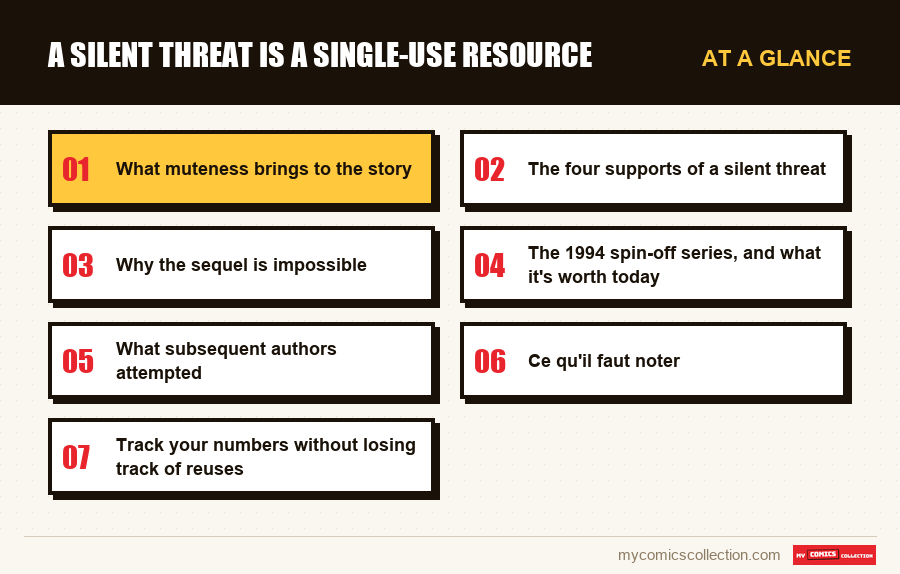
What muteness brings to the story
An antagonist who speaks automatically sets up a temporality of discussion. He sets conditions, he is answered, he retorts, someone tries a verbal ruse. Each exchange is a moment where the physical confrontation stops, and where the reader implicitly understands that nothing irreversible will happen as long as the conversation lasts. It's comfortable. This is also what defuses the vast majority of major confrontations: the reader knows that a talkative adversary has not yet decided to put an end to it.
Take away the floor, and you take away this security gate. There is no longer a moment when the action suspends itself. There is no longer any possibility for the hero to gain time by dragging out an exchange. There is no more psychological flaw to exploit, no more pride to flatter, no more contradiction to highlight. The only register available is the physical register, and it only knows two directions: the hero is still holding on, or he is no longer holding on.
The second benefit is more subtle. A silent adversary does not have to be explained, and therefore does not have to be measured in advance. When an antagonist announces his intentions, he also announces, as a result, his ceiling: what he wants defines what he is ready to do, and therefore what he is capable of. Silence removes this ceiling. The reader has no idea where this progression stops, because no sentence has told her where she wants to go. The unknown is not artificial: it is structurally inscribed in the fact that there is nothing to interpret.
The third benefit concerns readability. A purely physical confrontation can be read without mediation. The reader needs no prior information, no reminder of continuity, no footnote. He measures progress by what he sees: the defenses which give way one after the other, the participants who successively fail, the distance which is reduced. It's the type of sequence that a completely new reader can follow at first glance, which largely explains why this episode went so far beyond the usual comic book readership.
The four supports of a silent threat
Nothing to negotiate
No conditions set means no counter-proposal possible. The story cannot settle into a negotiation phase, and the reader has no clue leading him to believe that the confrontation could be resolved other than by the exhaustion of one of the two camps.
No psychology to spare
An antagonist with an interiority imposes scenes that construct it: hesitations, contradictions, moments of doubt. None of that here. The fully liberated narrative space is reinvested in the only thing that matters, that is, the build-up in intensity.
Visually measurable progress
The reader assesses the extent of the threat by visible facts rather than statements. Each obstacle overcome is a unit of measurement, and the accumulation of these units produces a curve that no one needs to comment on.
No ceiling announced
In the absence of a stated project, nothing indicates where this progress stops. Uncertainty is not maintained by announcement effects, it arises mechanically from the absence of discourse. It is the most effective support, and also the most fragile.
These four supports have one thing in common: they are all based on an absence. They do not describe what the character has, but what he has been denied. But a construction that holds by subtraction does not support any addition. Each element that is added to it afterwards does not enrich it, it corrects it, and to correct a subtraction is to cancel it.
This is the fundamental difference between this type of antagonist and a classic adversary. A classic adversary improves with successive appearances: each reuse adds a nuance, a grudge, a relationship, a context. Narrative capital accumulates.
Here, capital does not accumulate, it is spent. The first spawn used the entire resource. Everything that comes after can only draw from an already empty reservoir, or fill it with something else: that is, making a different character under the same name.
Why the sequel is impossible
No mobile, no return
An antagonist with an agenda may come back for a reason: he didn't get what he wanted, he wants revenge, he has a score to settle. Without a motive, there is no return possible, only a reappearance. But a reappearance without cause is a coincidental event, and a coincidence has no dramatic value.
The second time is already known
The strength of the first confrontation was that no one knew where it ended. By the second occurrence, the reader knows it. He knows the ceiling, he's seen the whole curve. Replaying the same climb without the unknown is like replaying a revelation whose fall everyone knows.
Surenchérir ne rétablit rien
The obvious temptation is to make the threat even greater. But scale was not the resource: uncertainty was. An adversary twice as powerful who we already know will be stopped does not produce twice as much tension, it produces less, because the outcome is now readable in advance.
Giving him a voice destroys him
Having this character speak solves the motive problem and removes the entire construction at the same time. From the first sentence spoken, he becomes an ordinary antagonist, with intentions, a register, a tone, and therefore a ceiling, a psychology, takes. The gain is immediate and the loss is total.
The origin closes the doors
Explaining where it comes from answers a question that the reader was not necessarily asking, and closes one that he really was asking. As long as nothing is explained, the reader's imagination works in the void and fills it to its extent. An explanation, no matter how ambitious, will always be smaller than this void.
The accompanying series changes the function
A threat conceived as a passing event cannot be installed in a followed series. A series supposes a character capable of carrying recurring situations; the event, on the contrary, supposed an adversary incapable of lasting. Both formats ask for opposite things with the same name.
The 1994 spin-off series, and what it's worth today
1994 marks the most explicit attempt to make the character something other than a passing event: a derivative series which gives him a role where he expresses himself. This is a perfectly understandable choice from an editorial point of view. The character had just generated considerable attention, he was identifiable, and the production apparatus knew what to do with a name that sold: give him a title of its own. The business logic was impeccable. The narrative logic came up against the obstacle described above: to have a title, you have to be a character; to remain effective, you definitely didn't have to be one.
Thirty-two years later, the collector's market gives a fairly dry verdict on this attempt. As of August 29, 2026, online announcements devoted to this derivative series were divided into two very unequal groups. The first, by far the most extensive, brought together one hundred and fourteen announcements of copies without certification. Amounts requested ranged from one dollar to fifty-five dollars, and the median amount claimed was seven dollars thirty-nine. The second set, that of copies evaluated by a certification service, included only nine advertisements, from forty-eight dollars ninety-nine to one hundred and fourteen dollars sixty-two, for a median asking price of sixty-six dollars ninety-nine.
We must immediately clarify what these figures are and what they are not. These are amounts claimed by sellers on a given date, not completed transactions. A seller can ask for whatever he wants; nothing obliges a buyer to follow it. These statements therefore describe a state of supply, what the holders hope to obtain, and not a price level observed on actual sales. It’s a nuance that completely changes the way we can read it.
The second precaution concerns the workforce. Nine ads is very few. At this level, a single particularly bullish seller visibly moves the entire range, and the observed maximum then reflects one person's isolated hope rather than a market benchmark. A median calculated on nine elements does not have the same solidity as a median calculated on one hundred and fourteen. On the certified set, it is better to talk about a fragile index than a price.
That said, the whole without certification is sufficiently provided for us to be able to draw an observation from it. One hundred and fourteen advertisements, the highest amount of which tops out at fifty-five dollars and whose median asking price remains under eight dollars, this describes a widely available series, from which the holders themselves do not expect much. Worded carefully: the sequel which explains the character did not find a collector's audience. It circulates, it is easy to find, and the offer does not behave like that of a sought-after title.
This is an interesting convergence between editorial analysis and market observation, and we must be careful not to overinterpret it. The market does not judge the quality of a story, and many excellent series sell for next to nothing because they were printed in very large numbers. But when a spin-off series designed to capitalize on massive attention results, three decades later, in no supply tension, it indicates at the very least that it has not become that character's focal point. What we are looking for, when we are looking for this character, is not the title in which he speaks.
Collecting this series?
Track what you own, what you are missing and what your collection is worth. 7 day trial.
Start my trial →What subsequent authors attempted
After this first attempt, the character was the subject of several reuses which all follow, to varying degrees, the same slope. We gradually add to him the attributes that were missing: an origin, an ability to understand what he does, sometimes an interlocutor. Each of these additions responds to a real need on the production side, you have to be able to write scenes with it, and each costs a part of what made it formidable.
Adding an origin transforms an uncaused force into a consequence of a process. A consequence is describable, therefore evaluable, therefore limited. The curiosity that silence maintained is replaced by information, and the information is always smaller than the question it closes.
Adding consciousness introduces an interior where there was none. However, as soon as an antagonist has an interior, the reader seeks to access it, and the story must respond to him. We move from an adversary we endure to an adversary we understand, and an adversary we understand is an adversary we can anticipate.
The addition of dialogue is the most radical, because it makes the other two inevitable. You cannot make someone speak without giving them a position, a tone, intentions. Speech is not one more attribute: it is the attribute which contains all the others. This is why the 1994 series constitutes such a readable tipping point in the character's journey: not because it is poorly done, but because it carries out exactly the operation that the original device prohibited.
We can summarize the mechanism as follows: each subsequent author inherits a character whose main asset is to have nothing, and finds himself under the professional obligation to give him something. There is no bad will there, no isolated bad choice. There is a resource designed to be consumed once, entrusted to a system that needs to reuse it indefinitely.
Ce qu'il faut noter
Silence is not a character trait, it is a construction constraint. We tend to read it as one characterization among others, in the same way as brutality or stubbornness. This is an analysis error. Mutism here is the condition which allows everything else to hold, and it functions through what it prevents: no negotiation, no procrastination, no psychological grip. Judging it as an aesthetic choice misses its function.
A threat without a motive cannot return, it can only reappear. It is the structural weakness which condemns any further action. The return of an ordinary antagonist is motivated, therefore meaningful: he returns because he wants something. Here, there is nothing to want, therefore nothing to motivate. Reappearance is reduced to a circumstance, and a circumstance does not create tension.
Excessive scale does not repair the loss of uncertainty. The reflex consisting of making the threat greater with each reuse is the wrong variable. What made the first confrontation tense was not the power level but the reader's ignorance of its outcome. Once this ignorance is dissipated, no increase in scale restores it; it simply makes the outcome more predictable.
The 1994 spin-off series documents the price of speaking up. It constitutes the textbook case of the problem, because it directly carries out the forbidden operation: giving a speaking role to a character whose effectiveness rested on the absence of speech. It deserves to be read for this very reason, as an object of editorial analysis, regardless of what one thinks of its content.
The August 29, 2026 statements describe an offer, not a market price. One hundred and fourteen uncertified advertisements from one to fifty-five dollars, median asking under eight dollars; nine certified listings from forty-eight dollars ninety-nine to one hundred and fourteen dollars sixty-two, median asking at sixty-six dollars ninety-nine. These are sellers' expectations on a specific date. The certified number is too low to draw a firm conclusion, and the isolated maximum is not a benchmark.
Because it eliminates all the downtime. An antagonist who speaks automatically creates pauses where the confrontation stops, and the reader understands that nothing definitive will happen as long as the conversation lasts. Without words, there is no pause, no negotiation, no psychological outlet to exploit. All that remains is a physical progression that the reader measures directly by what he sees.
An adversary without motive has no reason to return. It can only reappear, which is a coincidence and not a consequence. Furthermore, the uncertainty which caused the first confrontation has been overcome: the reader now knows the end of the curve. Replaying the same sequence without its main unknown mechanically produces less effect.
An origin transforms an uncaused force into the result of a process. This result is describable, therefore measurable, therefore limited. The space that the reader's imagination freely filled closes in on an explanation that will always be narrower than the void it replaces. The gain in usable narrative material is paid for by a loss of scope.
On August 29, 2026, one hundred and fourteen listings for uncertified copies were asking for between one and fifty-five dollars, with a median amount claimed of seven dollars and thirty-nine. On the certified side, only nine ads asked between forty-eight dollars ninety-nine and one hundred fourteen dollars sixty-two, median at sixty-six dollars ninety-nine. These are amounts claimed by sellers, not completed sales.
No, and it must be said clearly. On such a small number, a single very ambitious announcement visibly distorts the entire range, and the maximum observed reflects the hope of an isolated seller rather than an observed level. The whole without certification, with its one hundred and fourteen announcements, offers a much more solid basis for observation.
Track your numbers without losing track of reuses
Between the original appearance, the 1994 spin-off series and subsequent revivals, the same character can be scattered across very different titles. Record what you have, spot what's missing and keep track of your certified or uncertified copies, in a single, up-to-date space.