
In short
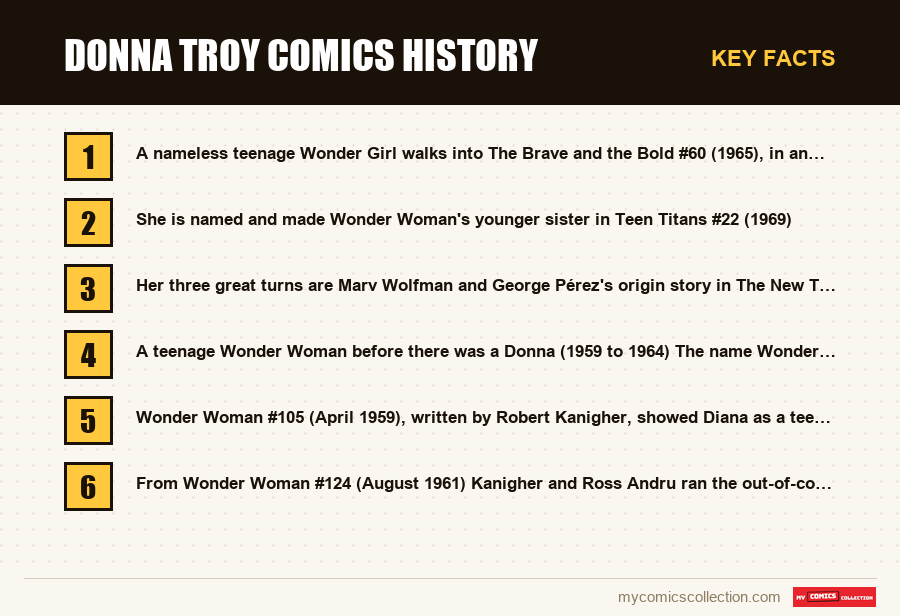
A nameless teenage Wonder Girl walks into The Brave and the Bold #60 (1965), in an adventure scripted by Bob Haney that also brings the Teen Titans together. She is named and made Wonder Woman's younger sister in Teen Titans #22 (1969). Her three great turns are Marv Wolfman and George Pérez's origin story in The New Teen Titans #38 (1984), her rebirth as Troia in The New Titans #55 (1989), and Phil Jimenez's The Return of Donna Troy (2005), which tried to fuse her many origins.
Few characters in superhero comics have been given as many pasts as Donna Troy. She began as a teenage companion with no name, became a sister, an orphan, a mythic seed, a copy, and then a merger of all of them, and each version has its own issues, creators and readers. Following her across sixty years is mostly a matter of knowing which origin each era is telling.
Every issue number, year and credit below was checked before publication, and a month is given only where one was confirmed. The judgments about what each stretch means for her are analysis, and no panel or dialogue is reproduced.
A teenage Wonder Woman before there was a Donna (1959 to 1964)
The name Wonder Girl predates Donna Troy by six years. Wonder Woman #105 (April 1959), written by Robert Kanigher, showed Diana as a teenager in flashback, and another character teasingly called her Wonder Girl. From Wonder Woman #124 (August 1961) Kanigher and Ross Andru ran the out-of-continuity Impossible Tales, which added the toddler Wonder Tot and Queen Hippolyta to form a Wonder Family. The Impossible Tale label was dropped in #150 (November 1964), Wonder Girl stayed a regular through #155 (July 1965), and she briefly headlined #152 and #153.
This matters because Donna's first appearance borrowed a name that already meant something else. The Wonder Girl of the Kanigher stories was Diana herself at a younger age, a time-travel conceit. The character who walks into The Brave and the Bold in 1965 is a different girl wearing the same label, and later writers spent decades untangling the overlap.
A team gets its name in issue #60 (1965 to 1966)
Issue #54 of that anthology (July 1964), scripted by Haney and drawn by Bruno Premiani, had already paired Robin, Kid Flash and Aqualad against Mister Twister. Issue #60 (July 1965), also written by Haney, brings the trio back as the Teen Titans, and it adds a young heroine billed as Wonder Girl. That is the first appearance of Donna Troy, and it is also the issue that gives the team its name. Collectors should treat it as a double debut.
The writing credit on #60 belongs to Haney, and a listing should give the series, number and year rather than lean on the cover. The character has no civilian name yet; she is simply Wonder Girl, a teammate who is described as connected to Wonder Woman.
An outing in Showcase #59 (December 1965) follows, and the group graduates to Teen Titans #1 (January and February 1966), with Haney writing and Nick Cardy drawing. For a long time that was the whole of Donna's story: a fourth member whose identity was left vague so that she could be Wonder Woman's helper without anyone having to define her.
A name and a sister: Teen Titans #22 (1969)
Teen Titans #22 (cover-dated July and August 1969) gives Wonder Girl her name, with art by Nick Cardy. She is identified as Donna Troy, Wonder Woman's younger sister. The origin offered there is a rescue story: Wonder Woman saves her as an infant from an apartment fire, Queen Hippolyta raises her on Paradise Island, and Paula von Gunther gives her powers. It is a compact, comfortable origin, and it is the version that all the later revisions treat as the baseline to overturn.
The original Teen Titans series was cancelled with #43 (February 1973), revived with #44 (November 1976) and cancelled again with #53 (February 1978). In that gap Donna is mostly a name on a roster, which is why the next section is the real beginning of her modern life.
Wolfman and Pérez make her a person (1980 to 1985)
Marv Wolfman and George Pérez relaunched the team as The New Teen Titans in November 1980, and Donna was part of the cast alongside the newcomers. Their first act of ownership is The New Teen Titans #38 (January 1984), titled "Who Is Donna Troy?" In the story Robin traces her birth mother, Dorothy Hinckley, uncovers a child-selling racket that ended in a furnace explosion and a fire, and reunites Donna with her adoptive mother, Fay Stacey; her adoptive father, Carl, had died in a work accident. The result is that Donna stops being a rescued symbol and becomes a woman with a family history that she can go back and look at.
The same era gives her a domestic life. Tales of the Teen Titans #50 (February 1985) stages her wedding to Terry Long. Nothing in that issue is a fight, and it is easy to underrate for that reason. It confirms what #38 started: in the Wolfman and Pérez years Donna is defined by relationships more than by a power set. For the same creative team's work on her teammates, see the Starfire history and the Raven history, which cover the same stretch of the book from other angles.
Crisis rewrites her, and Troia is born (1985 to 1989)
Crisis on Infinite Earths (1985 to 1986) changed the ground under her. Wonder Woman was relaunched in Wonder Woman vol. 2 #1 (February 1987), and the old link between Diana and Wonder Girl no longer held, so Donna's origin had to be rebuilt. The answer arrives in "Who Is Wonder Girl?", which runs through The New Titans #50 to #54 (December 1988 to March 1989). It reveals that the Titans of Myth raised Donna and other orphans as "Titan Seeds", and that Rhea rescued her from the fire.
The cycle ends with The New Titans #55 (June 1989), where Donna becomes Troia, with a new hairstyle and a costume that uses gifts from the Titans of Myth. The series had just changed its name: the second New Teen Titans series dropped the word Teen with #50, becoming The New Titans, because its heroes were no longer teenagers. The timing is deliberate, since a book about grown heroes needed a grown Donna. Anyone studying how DC repaired its continuity after Crisis should read this arc next to the Crisis on Infinite Earths key issues.
A son, a future and a lost marriage (1991 to 1995)
The New Titans Annual #7 (1991) opens the Team Titans storyline, whose threat, Lord Chaos, is the man Donna's son could become. The Lord Chaos arc runs through The New Titans #89 to #92 (August to November 1992): after giving birth to Robert, Donna sacrifices her powers so that he cannot become Lord Chaos. In The New Titans Annual #11 (1995), after Zero Hour, Donna loses custody of Robert to Terry, and both later die in a car accident, which takes away the family that the Wolfman and Pérez era had built for her.
For collectors, this stretch is where her story becomes entangled with the Team Titans and Zero Hour reading order. Our Zero Hour key issues guide helps to place those crossovers, and her move to the Darkstars in the same period is a reminder that the late New Titans years are sprawling.
Do you collect this series?
Track what you own, what you are missing and what your collection is worth. 7-day trial.
Start my trial →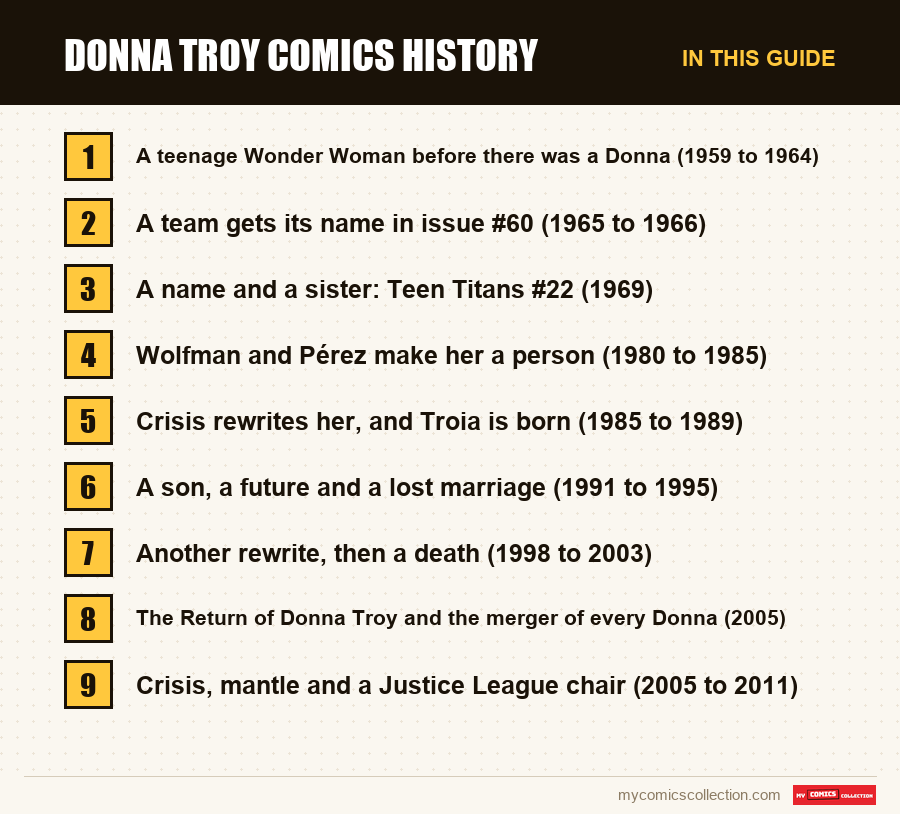
Another rewrite, then a death (1998 to 2003)
Wonder Woman vol. 2 #131 to #135 reintroduce her as a magical duplicate of Diana, created by the sorceress Magala and kidnapped by the figure called Dark Angel. The retcon is credited to John Byrne, and it is the least popular of her origins because it erases both the rescued child and the Titan Seed. It is the origin that the next decade then works to undo.
A rogue Superman robot then appears to kill Donna in Titans/Young Justice: Graduation Day, the three-issue crossover that comes just before Geoff Johns relaunches Teen Titans in 2003. It was a death in name only. Within the story she is shown alive on another world, and the apparent loss opens the door to the 2005 miniseries.
The Return of Donna Troy and the merger of every Donna (2005)
DC Special: The Return of Donna Troy ran four issues from June to August 2005. Phil Jimenez wrote it; José Luis García-López and George Pérez drew it. The premise is that Donna is a merger of every alternate Donna, so that the rescued child, the Titan Seed and the magical duplicate all survive as aspects of one person. Dark Angel turns out to be the Earth-Seven Donna, saved from death by the Anti-Monitor. The Titans and the Outsiders restore her true memories, and she banishes most of the Titans of Myth to Tartarus.
This is the point where her history stops being a series of replacements and becomes a stack. If you only buy one Donna story from the twenty-first century, it is this one, because it is written as a reading guide to all the earlier ones. Pérez's presence on the art is a quiet bookend to The New Teen Titans #38 twenty-one years earlier.
Crisis, mantle and a Justice League chair (2005 to 2011)
In Infinite Crisis she returns to New Cronus, gathers heroes and fights Alexander Luthor Jr., and she later gives the Green Lantern Corps a Sun-Eater to imprison Superboy-Prime on Mogo. After the One Year Later jump she takes up the Wonder Woman mantle in Wonder Woman vol. 3 #1 (2006); once Circe is unmasked as the mind behind her captivity, she puts her old red Wonder Girl jumpsuit back on and tells Diana she wants to give the title back. The Infinite Crisis reading order shows where her scenes sit.
She is at the funeral of Duela Dent in Countdown #51 (May 2007), where Jason Todd contacts her; the group, Kyle Rayner among them, later reaches Apokolips and witnesses its destruction, and she becomes a Justifier in Final Crisis #5. Her Justice League chapter is short: volume 2 of Justice League of America recruits her in #41 (January 2010), after her Blackest Night ordeal as a Black Lantern, and her resignation comes in #60 (August 2011).
New 52, Rebirth and the present (2011 to today)
The New 52 reintroduces her in Wonder Woman as an Amazon created by the sorcerer Derinoe, while Titans Hunt gives her a conflicting history. In Wonder Woman #46 and #50 (2016) Zeus chooses her to replace the Fates, making her a new embodiment of Fate. Titans Rebirth #1 (2016) restores her childhood memories after she touches Wally West, and Titans vol. 2 Annual #1 (May 2017) reconciles the New 52 and earlier origins. Tales of the Titans #3 (2023) re-establishes the original backstory as her true origin, and a 2025 Titans Annual introduces her late biological father, Lou.
The pattern is steady across sixty years: a period of simplification, a rewrite, and then a gesture that restores something earlier. The collector's takeaway is that no single Donna is the definitive one, and that the best-regarded versions are the ones that were written by people who loved the older ones.
The key issues across her history
- The Brave and the Bold #60 (1965): first appearance as the unnamed Wonder Girl, written by Bob Haney, and the debut of the Teen Titans as a team.
- Teen Titans #22 (1969): the issue that names her Donna Troy and makes her Wonder Woman's younger sister.
- The New Teen Titans #38 (January 1984): the Hinckley and Stacey origin, told by Marv Wolfman and George Pérez.
- Tales of the Teen Titans #50 (February 1985): her wedding to Terry Long.
- The New Titans #50 to #54 (December 1988 to March 1989): "Who Is Wonder Girl?" and the Titan Seeds.
- The New Titans #55 (June 1989): the transformation into Troia.
- DC Special: The Return of Donna Troy #1 to #4 (2005): Phil Jimenez's merger of every origin.
- Titans Rebirth #1 (2016) and Titans vol. 2 Annual #1 (2017): memories restored and origins reconciled.
How to follow Donna Troy in a collection
Start with the stories where she is the subject, not with the team books in which she is one of five. The New Teen Titans #38, the New Titans #50 to #55 cycle and the 2005 miniseries give three different Donnas that line up with three eras. Buy them as single issues if you collect floppies, or as the trade collecting #38 with other chapters, and keep the volume numbers straight: the first New Teen Titans series becomes Tales of the Teen Titans from #41, while the second New Teen Titans series is renamed The New Titans with #50.
Numbering is the trap. The Wonder Girl name belongs to Donna from 1965, to the teenage Diana in the Kanigher stories from 1959, and to Cassie Sandsmark in later decades, so a listing that says "Wonder Girl first appearance" needs the series, number and year before it means anything. The best Donna Troy comics ranks the stories for reading, and this page is the map to hang them on. Listings can be checked against the blog guides before you buy.
Frequently asked questions
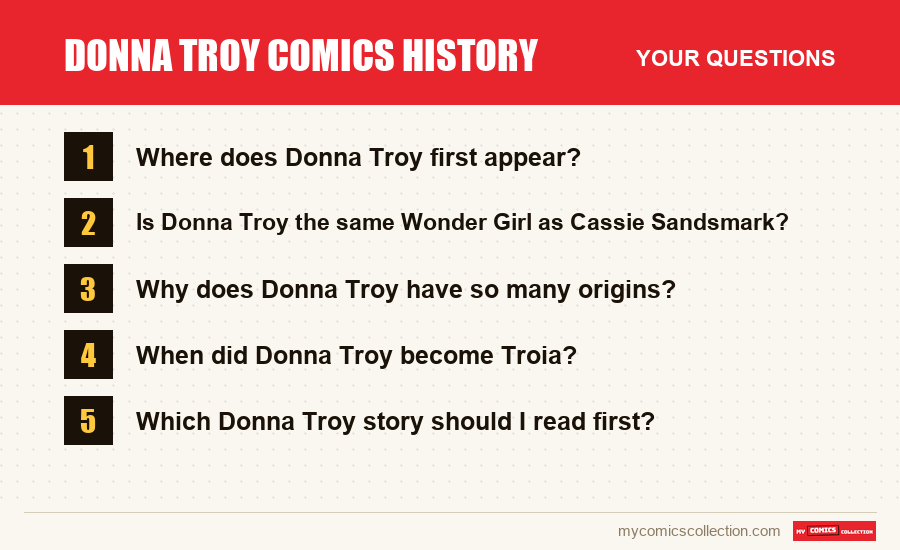
The debut is The Brave and the Bold #60 (1965), where Bob Haney scripts Wonder Girl's entrance alongside the Teen Titans' team debut. She has no civilian name in that issue. The name Donna Troy comes later, in Teen Titans #22, cover-dated July and August 1969.
No. Donna Troy was the original Wonder Girl of the Teen Titans and was later renamed Troia. Cassie Sandsmark is a separate, later character who carries the Wonder Girl name. When a listing says Wonder Girl, check the series, issue number and year to know which character it means.
Crisis on Infinite Earths removed the link to Wonder Woman, and later writers kept rewriting the answer: a rescued infant, a Titan Seed raised by the Titans of Myth, a magical duplicate, and finally the merger told in The Return of Donna Troy (2005). Each new version tries to fix a problem left by the one before.
In The New Titans #55 (cover date June 1989) the new name arrives, one issue after the five-part cycle ends. The change brings a new hairstyle and a costume that incorporates gifts from the Titans of Myth.
Open with The New Teen Titans #38 (January 1984), the Wolfman and Pérez issue titled for her question of identity. It gives her a family history and is the base on which the 1989 Troia arc and the 2005 miniseries build. Then follow the order in this page.
Found a Donna Troy issue in a Titans run and want to know what the copy is worth?
Estimate my comic