
In short
Rachel Roth, the empath Raven, debuts as a few bound-in pages of DC Comics Presents #26 (October 1980), from Marv Wolfman and George Pérez, one month ahead of The New Teen Titans #1. She becomes the team's empath and the face of its demonic-father plot, Trigon, whose storyline opens the second New Teen Titans series in 1984. Later turns include the Geoff Johns relaunch of 2003, solo series from a five-issue Wolfman miniseries to the 2017 Raven book, and the Evil Raven stories of 2023.
Raven is a character whose publishing history is easy to misread, because she never began with a title of her own. She walked into the comics through the middle of a Superman team-up book, was built into a team series within weeks, and then spent more than four decades alternating between supporting the Titans and carrying her own stories. Tracing that path in order explains why the issues collectors chase are scattered across so many different series.
Every credit, issue number and cover date below was read in published histories of Raven and her team, and a month appears only where one was confirmed. The judgments about what each era did for her are mine, and no panel or dialogue is quoted.
A preview insert inside a Superman team-up (1980)
She first shows up in number 26 of DC Comics Presents, dated October 1980. That title belonged to a series that paired Superman with a different DC character each month, and the Raven material was a special insert bound into it. Marv Wolfman wrote the preview and George Pérez drew it. Those pages were a trailer rather than a story, and the Raven in them was a stranger to readers, standing next to Robin, Wonder Girl and Kid Flash.
That origin matters for a collector tracing her history. Raven was not introduced by a cover, a title logo or a standalone first issue. She arrived as a few pages in a book that was officially about someone else, which is why catalogs list the issue under its host series and why the Titans connection has to be read from the insert itself. If you want the physical details of that book, our guide to the DC Comics Presents #26 first appearance covers them, so this page stays with the story of the character.
November 1980: the New Teen Titans series begins
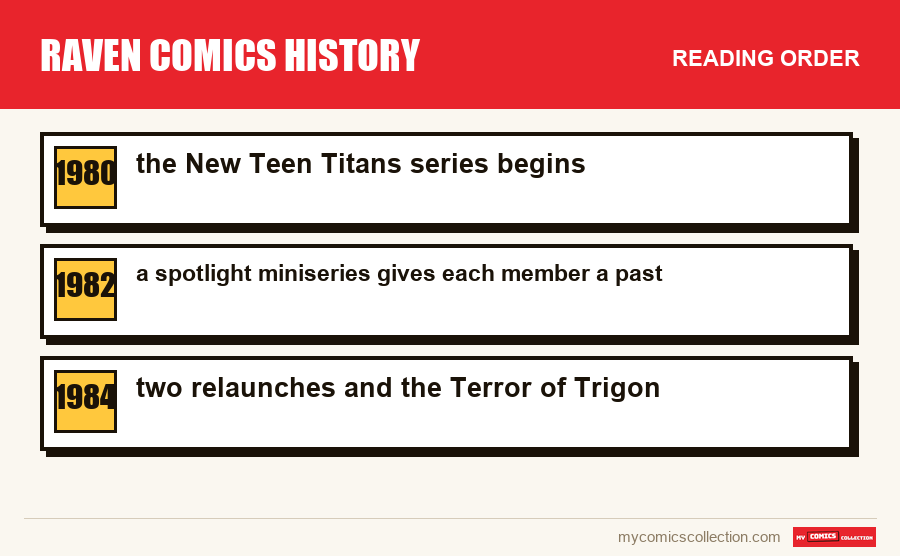
In November 1980 Wolfman and Pérez followed with The New Teen Titans #1, the issue that put Raven beside Starfire and Cyborg and brought back Beast Boy under his new name, Changeling. Both men thought the book would end after six issues. It became one of the defining DC titles of the decade.
In that opening structure, Raven is the one who sets the group in motion: she forms the team to fight her demonic father, Trigon. This is the editorial hinge of her whole history. Where the other new members were each defined by a single trait or origin, Raven carried a long-running threat inside her own family, and Wolfman could return to that thread for years. Her role, in other words, was built as a plot engine as much as a personality, and that explains why her best-known stories keep circling back to the same father.
The early run is one creative team's design for a whole cast. Our author pages for Marv Wolfman and George Pérez place her beside the rest of their work.
1982: a spotlight miniseries gives each member a past
Four issues in 1982, titled Tales of the New Teen Titans, gave Cyborg, Raven, Changeling and Starfire one backstory apiece. The format is worth noting because it is a different solution from the one the Titans used in their monthly book: instead of folding each origin into ongoing plots, the creators gave every member a single issue of dedicated history.
For Raven, that placed her origin in a short, self-contained read at an early moment of the franchise, at a time when readers already knew her as the mysterious member of the team. For a collector the lesson is structural: the character's early canon lives in a limited series and in the main title together, and a complete set of her early years needs both.
1984: two relaunches and the Terror of Trigon
The year 1984 is the busiest in the character's history. From issue #41 the monthly book carried the title Tales of the Teen Titans, which it kept through issue #91 in July 1988. That same year, #42 to #44 and Annual #3 told Terra's betrayal in "The Judas Contract," a winner of a 1984 Comics Buyer's Guide fan award and collected in a 1988 trade paperback. It is a team story rather than a Raven story, but it sits at the center of the era in which she was a regular member.
August 1984 then brought a second The New Teen Titans, whose first issue began "The Terror of Trigon." That series started the Trigon payoff at the very top of its first volume. The storyline ran over issues #1 to #5, and Pérez left the series after #5. The structure here is deliberate: the 1980 threat was answered in a short, tightly planned arc, and it ended with the artist who had designed her departing from the book at the same moment.
The effect on Raven is that her central conflict was answered early, while the team book kept going. For readers who want a first Trigon read, our best Raven comics guide places the arc among other entry points.
From teenagers to adults: The New Titans (1988 to 1996)
When Tales of the Teen Titans ended with #91, the property continued as The New Titans, which ran from #50 in December 1988 to #130 in February 1996. The new title kept the earlier numbering and dropped the word "Teen" as the characters aged. Pérez returned for a time with issue #50 and came back to provide the cover art for the finale, #130.
For collectors, that renumbering is the first trap in following Raven in a single series. The title on the spine changes, the volume number changes, and the numbers do not restart. A complete run from 1980 to 1996 therefore spans three consecutive titles, and anyone counting issues has to decide whether they are following the characters or the logo. Our overview of how many Teen Titans comics exist works through the counting problem more fully.
The team she joined already had a history
It helps to see what Wolfman and Pérez were building on. Her team's lineage starts earlier, with a 1964 issue of The Brave and the Bold numbered 54. A series called Teen Titans launched in 1966 from Haney and Nick Cardy, was canceled with #43, revived in 1976 with #44, and canceled again with #53 in February 1978.
The 1980 insert's mention of Robin, Wonder Girl and Kid Flash is a direct reference to that earlier lineage. Raven, Starfire and Cyborg were new additions to a brand that had been dormant for roughly two years. That is why her debut reads as a relaunch beat: the old names provided continuity, and the three newcomers provided what was missing. A reading path that starts with her story and then steps back into the 1960s makes more sense than the reverse.
Do you collect this series?
Track what you own, what you are missing and what your collection is worth. 7-day trial.
Start my trial →
The Geoff Johns relaunch and the long reboot cycle (2003 onward)
Writer Geoff Johns and artist Mike McKone relaunched the team in a new Teen Titans series that began in 2003. The series reached 100 issues and finished in October 2011. For his other work, see our page on Geoff Johns comics.
After that, the numbering becomes a catalog of reboots. Titans volume 2 ran from 2008 to 2011 for 38 issues under Judd Winick. Teen Titans volume 4 launched with the New 52 in 2011, written by Scott Lobdell with Brett Booth providing interiors. Rebirth reached Teen Titans in 2016 under writers Ben Percy and Adam Glass, with Jonboy Meyers among the pencillers, for 47 issues, while Titans volume 3 ran beside it from 2016 to 2019. Teen Titans Academy filled 2021 and 2022, and a new Titans series written by Tom Taylor and drawn by Nicola Scott started in 2023.
The practical consequence for Raven is that no single run owns her. Each reboot reintroduced her in a new setting, and the useful way to follow her is by story, not by series title. Our guide to the 2026 Teen Titans relaunch shows how the current cycle continues the same pattern.
Solo stories: from a Wolfman miniseries to Daughter of Darkness
Raven later headlined a five-issue miniseries written by Marv Wolfman with art by Damion Scott, set during the "missing year." It brought the character's co-creator back to write her.
A series titled Raven followed in 2017. Its first six issues were collected in 2018 as Raven: Daughter of Darkness volume 1, and issues #7 to 12 followed in 2019 as volume 2. Those collected editions are the easiest way to read the book today. The reprint structure, six issues per volume, gives collectors a clear map of what each book contains.
Evil Raven and the recent years (2021 to today)
Future State: Teen Titans #1 (2021) introduced the Unkindness. In August 2023, Knight Terrors: Night's End #1 marked the first appearance of Evil Raven, also called Dark Raven. Both are modern first-appearance issues of the kind collectors track as new characters rise around an established one. Around the same period, the second issue of Tales of the Titans revisited her history, and the third carried cover art by Nicola Scott.
Raven plays a major role in the Titans: Beast World crossover, whose main villain, Doctor Hate, is revealed as a dark version of her. In the same cycle, Dark Raven ascends to a prophesied form, the Dark-Winged Queen, and the collected volume Titans: The Dark-Winged Queen, gathering Titans #8 to #15, followed in 2025. These recent issues show a character who is no longer defined by a single father plot but by a set of alternate versions of herself, a shift from the 1980 premise.
The key issues across her history
- DC Comics Presents #26 (October 1980): Raven's debut in a bound-in insert by Wolfman and Pérez.
- Late 1980, The New Teen Titans #1 (November): where she turns into a regular.
- Tales of the New Teen Titans (1982): the four-part limited series that gave the members their backstories, Raven among them.
- 1984, issues #42 to #44 and Annual #3 of Tales of the Teen Titans: "The Judas Contract," in which Terra turns on the team.
- The New Teen Titans volume 2 #1 to #5 (from August 1984): "The Terror of Trigon," the payoff of the demonic-father plot.
- Raven (2017) #1 to #6: the opening of the solo series later collected as Daughter of Darkness.
- Future State: Teen Titans #1 (2021): the debut of the Unkindness.
- Knight Terrors: Night's End #1 (August 2023): the first appearance of Evil Raven.
How to follow Raven in a collection
Start from the story, not from the series. The cleanest order is the 1980 insert for the debut, The New Teen Titans #1 to #6 for the team and the threat, then the second series' opening five issues for the Trigon payoff. After that, choose whether to continue the main numbering through Tales of the Teen Titans and The New Titans, or to jump to the 2003 relaunch by Geoff Johns.
Two practical points save money and shelf space. First, check which volume you hold: the second New Teen Titans series restarts at #1 in 1984, so a bare "#1" can mean 1980 or 1984. Second, prefer collected editions for the solo material, since the 2017 series is organized into volumes by issue range. Keep a short list of cover dates for each purchase and note the host series for the 1980 insert, because that is the one entry that will not appear under a Titans title.
Frequently asked questions
Raven's first showing is the preview bound into DC Comics Presents #26, dated October 1980, with Marv Wolfman writing and George Pérez drawing. The series proper began a month later with The New Teen Titans #1. Catalogs file the debut under the Superman team-up title, not a Titans one.
"The Terror of Trigon" opens the second The New Teen Titans series, which began in August 1984. It runs over issues #1 to #5 and follows Raven's demonic father, Trigon, the threat that she formed the team to fight. Pérez left the series after issue #5.
Yes. Marv Wolfman wrote a five-issue miniseries with art by Damion Scott, and a Raven series launched in 2017. Its issues #1 to #6 were collected in 2018 as Daughter of Darkness volume 1, and issues #7 to #12 followed in 2019 as volume 2.
Evil Raven, also called Dark Raven, first appears in Knight Terrors: Night's End #1, dated August 2023. Future State: Teen Titans #1 (2021) introduced the Unkindness. Collectors treat both as modern first-appearance issues tied to the original character, so check the cover date before buying either one.
Because the title changes while the story continues. The team series ran as The New Teen Titans, then Tales of the Teen Titans from #41, then The New Titans from #50 in 1988 to #130 in 1996. A second New Teen Titans also restarts at #1 in 1984.
Do you own a Titans issue from the 1980s and want to know how its condition and edition affect it?
Estimate my comic