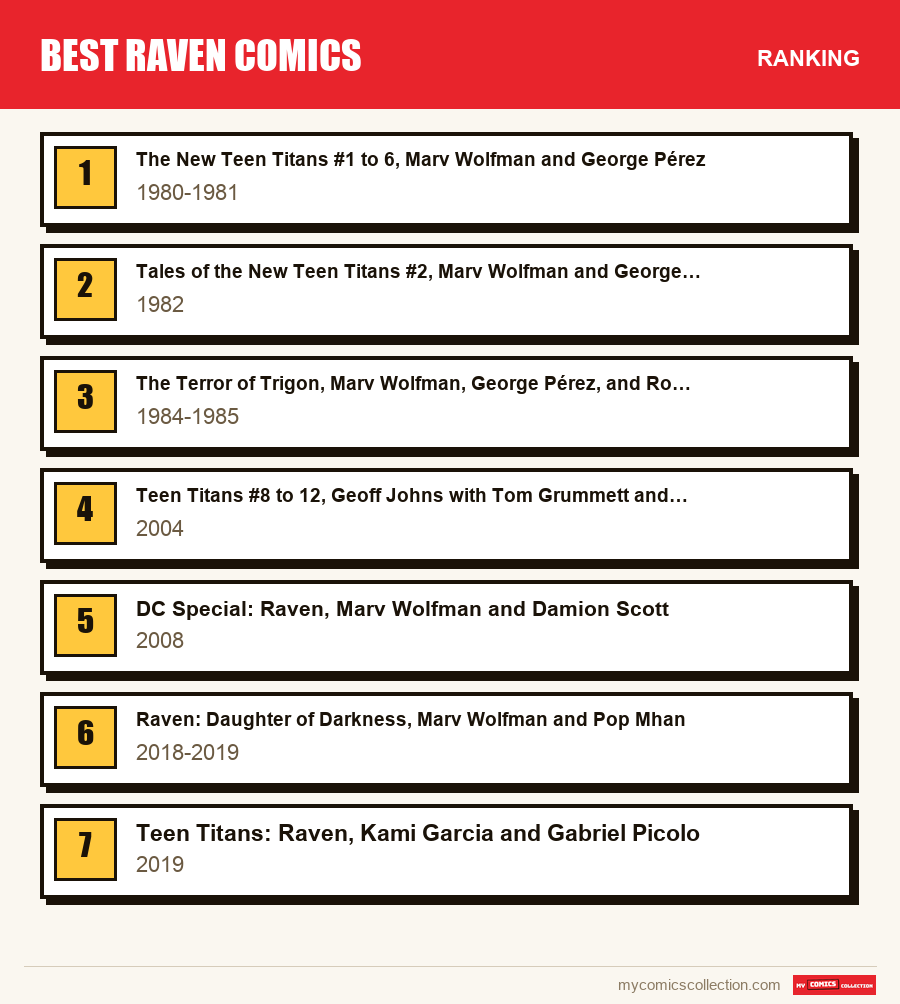
The best Raven comics start with the opening issues of Marv Wolfman and George Pérez's The New Teen Titans (1980-1981), which set up her father Trigon, then move on to The Terror of Trigon (1984-1985), the payoff of that arc. Her debut is a preview insert in DC Comics Presents #26 (October 1980). Next read Geoff Johns's Teen Titans #8 to 12 (2004), and save the solo stories, from DC Special: Raven to Kami Garcia's graphic novel, for later.
Raven (Rachel Roth) is a DC heroine whose strength is also the threat: an empath who must contain what she inherits from her father, a demon lord. That tension runs through more than forty years of publishing history, from Wolfman and Pérez's team to graphic novels for young readers. The right entry point therefore changes depending on whether you want the epic, the suspense, or an easy read.
As always in this guide, only verified information (creators, issue numbers, dates) is stated as fact; the analysis is our own, with no reproduction of protected panels or dialogue.
Her first appearance
The character introduces herself to the public in the fall of 1980, in a supplement tucked into the middle of DC Comics Presents #26 (October 1980). Marv Wolfman writes, George Pérez draws, and this insert serves as the lead-in to the series that follows: The New Teen Titans #1 comes out in November 1980. In this insert, she asks the Justice League for help, and they decline. Pérez has said that the Phantom Stranger guided his design of the character.
Having debuted in an insert, and not on the cover of a dedicated title, has a practical consequence: collectors know the issue by the name of the host series, and that is where you need to look for it. To read the character, you do not need this issue. The stories below exist in trade paperback, and they are what builds Raven.
1: The New Teen Titans #1 to 6, Marv Wolfman and George Pérez (1980-1981)
These six issues, from November 1980 to April 1981, form the backbone of everything that follows. Wolfman and Pérez bring the team together there, and Raven is its mysterious pivot. Trigon appears in a simple cameo in #2 (December 1980), then in full in #4 (February 1981), before #6, titled "Last Kill!", tells of his childhood and his rise to power.
This block answers the question the character raises: where does the threat she carries come from? It is for those who want to understand Raven at her source, with no knowledge of the DC universe, since the series introduces each member at its own pace. Read it in published order, in one go, in trade paperback; to place the whole series, our collecting guide to The New Teen Titans details the issues that follow.
2: Tales of the New Teen Titans #2, Marv Wolfman and George Pérez (1982)
This July 1982 issue is simply titled "Raven"; Marv Wolfman scripts it, George Pérez provides the layouts, and Pablo Marcos inks it. It is not a team adventure: Raven tells the other Titans about her past, from the union of her parents to her life in Azarath and her first meeting with Trigon.
This is the most economical entry for anyone who wants the origin without committing to a long series. This issue is enough to lay out the character's mythology, and it can be read without having opened the others. On the other hand, it hands over right away elements that The New Teen Titans reveals over the course of its issues; if you would rather discover those secrets as the series goes, read it after the previous entry, not before.
3: The Terror of Trigon, Marv Wolfman, George Pérez, and Romeo Tanghal (1984-1985)
The saga fits in the five issues of the second The New Teen Titans series, from #1 (August 1984) to #5 (February 1985). Wolfman writes, Pérez draws, and Romeo Tanghal inks. Trigon escapes his prison, reaches Earth, seizes Raven, and destroys Azarath. The outcome shakes up the team and the character; we do not detail it here so as not to spoil a read that is valuable above all for its sequence of events.
This is the payoff of the thread opened in 1980, and the story to read if you keep only one Raven story. It is for those who have read the previous entries, since it assumes you already know Trigon and Raven's link to him. It is collected in a trade paperback that gathers exactly these five issues, which makes it one of the easiest reads to find. Issue #5 was also reprinted in Tales of the Teen Titans #64, a useful detail so you do not buy the same content twice.
4: Teen Titans #8 to 12, Geoff Johns with Tom Grummett and Mike McKone (2004)
In the third Teen Titans series, Geoff Johns devotes a stretch to Raven, from "Family Lost" (#8, April 2004) to "Raven Rising" (#12, August 2004). Tom Grummett draws #8, then Mike McKone takes over, with Marlo Alquiza on inks for #12. Issue #8 opens on her origin and her current situation, while Deathstroke and his daughter Rose, now Ravager, are looking for her. What follows brings in Brother Blood and Jericho, and leads to a return of Raven in a younger body.
This stretch has a precise role in the bibliography: it brings Raven back to the center of a modern team, when the 1980s team is a memory. It suits anyone who wants an ensemble story from the 2000s, livelier and less dense than the Wolfman and Pérez style. There are many ties to the start of the series, so it is better to have read at least one earlier entry. Our page on Geoff Johns places this run in his career at DC.
Do you collect this series?
Track what you own, what you are missing and what your collection is worth. 7-day trial.
Start my trial →
5: DC Special: Raven, Marv Wolfman and Damion Scott (2008)
This five-issue miniseries, from May to September 2008, is written by Marv Wolfman and drawn by Damion Scott, with Robert Campanella on inks. It puts Raven in high school: someone is killing students and the Psycho-Pirate's Medusa mask resurfaces, spreading violent emotions. The tone is that of a school thriller, very far from the cosmic epic of 1984.
The story is for readers who already know the heroine and want to see her on her own, away from the team. It is easier to approach than the group sagas, since it fits in five issues, but it assumes a minimal knowledge of Raven's legacy. Wolfman returns here to a character he created twenty-eight years earlier: the interest is in measuring what he keeps and what he changes.
6: Raven: Daughter of Darkness, Marv Wolfman and Pop Mhan (2018-2019)
A twelve-issue series, from early 2018 to #12 dated March 2019, written entirely by Marv Wolfman and drawn by Pop Mhan. It follows up an earlier Raven miniseries by the same writer and focuses on the heroine's half-sisters. Issue #3 is dated May 2018, which gives the series' monthly cadence.
This is the read for a fan already attached to the character, eager to follow her fate outside the group. It lends itself to reading in two trade paperbacks of six issues each, but it requires knowing Raven's demonic heritage to appreciate what is at stake. If you are not starting from zero, this is the right way to catch up on the recent period of the solo series.
7: Teen Titans: Raven, Kami Garcia and Gabriel Picolo (2019)
Kami Garcia writes and Gabriel Picolo illustrates this young adult book, published by DC under the DC Ink label. Raven tries to face her past and the darkness rising inside her, surrounded by her foster sister Max and by Tommy Torres. Marv Wolfman, the character's creator, welcomed the new take on her while acknowledging her original DNA.
This is the most accessible way in: a standalone story that requires no knowledge of the DC universe. It suits teen readers or anyone who wants to give an introductory read without a stack of single issues to catch up on. It does not replace the stories from 1980 to 1985, but it reads as an independent version of the character, with its own visual choices.
Where to start based on your profile
If you are looking for the founding story, start with The New Teen Titans #1 to 6, then read The Terror of Trigon: these two blocks give you Raven in her most influential version. If you like short origin stories, open Tales of the New Teen Titans #2 before the rest. Our ranking of the best Teen Titans runs helps place those first two blocks within the whole series.
If you came through the animated series, the comparison with the books is in our dedicated guide, which shows what the screen keeps of the character. For a modern, quick read, Geoff Johns's Teen Titans #8 to 12 offers a story centered on her. To give an introductory read to a teenager, pick the graphic novel by Kami Garcia and Gabriel Picolo. Finally, if you have read everything and want to keep going with the character on her own, follow with DC Special: Raven and then Daughter of Darkness.
The key issues to know
The starting landmark is DC Comics Presents #26 (October 1980), which holds Raven's first appearance in an inserted booklet. Next come The New Teen Titans #1 (November 1980), #2 (December 1980, Trigon cameo), and #4 (February 1981, his full presence). Tales of the New Teen Titans #2 (July 1982) lays out the origin, and The New Teen Titans vol. 2 #1 (August 1984) opens The Terror of Trigon, whose #5 (February 1985) closes the arc. For the modern period, Teen Titans #8 (April 2004) and #12 (August 2004) bookend Johns's story, and DC Special: Raven #1 (May 2008) launches the Wolfman and Scott miniseries.
For each landmark, proceed in this order: what the issue changes for Raven, then its status (first printing or reprint), then a cross-check of several completed sales. An issue inserted in another title, like DC Comics Presents #26, is judged on the condition of the preview booklet and on whether it is missing, something the label on a graded copy does not always tell you. For the issues of the 2000s and 2010s, printed in large numbers, it is the condition of the copy that makes the difference; read the story first in trade paperback, then decide whether the original single issue brings you anything more.
Frequently asked questions
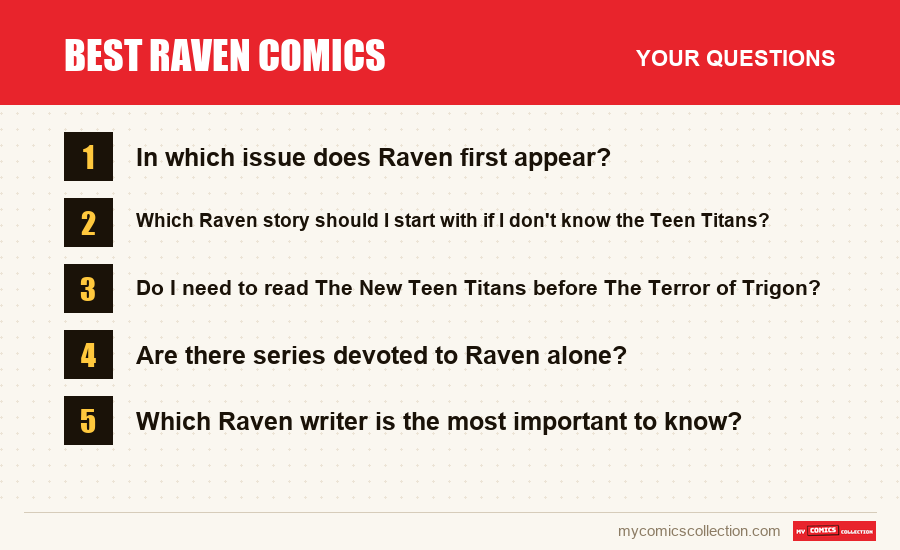
In a supplement tucked into the middle of DC Comics Presents #26 (October 1980), by Marv Wolfman on script and George Pérez on art. The The New Teen Titans #1 series follows in November 1980. To read the character, the series' trade paperbacks are more than enough.
There are two routes. The one most faithful to the origin is The New Teen Titans #1 to 6, which introduces the team step by step. The most direct is the graphic novel Teen Titans: Raven by Kami Garcia and Gabriel Picolo, standalone and with no prerequisites. Choose depending on whether you prefer classic single issues or a recent story.
It is recommended. The Terror of Trigon (The New Teen Titans vol. 2 #1 to 5, 1984-1985) concludes a thread launched in 1980, and its impact depends on what you know about Trigon. A reader in a hurry can, however, read Tales of the New Teen Titans #2 first, which sums up Raven's origin.
Yes. Marv Wolfman wrote the five-issue miniseries DC Special: Raven (2008, art by Damion Scott), then the twelve-issue series Raven: Daughter of Darkness (2018-2019, art by Pop Mhan). Kami Garcia and Gabriel Picolo added a graphic novel in 2019.
Marv Wolfman, who created her with George Pérez and wrote her from 1980 through his solo stories of 2008 and 2018. Geoff Johns puts her back at the center of Teen Titans in 2004. If you like either of the two, each author's page on this site lists their other series.
Did you find an issue of The New Teen Titans in your boxes? Have its condition and value appraised before you sell it or have it graded.
Appraise my comic