In short
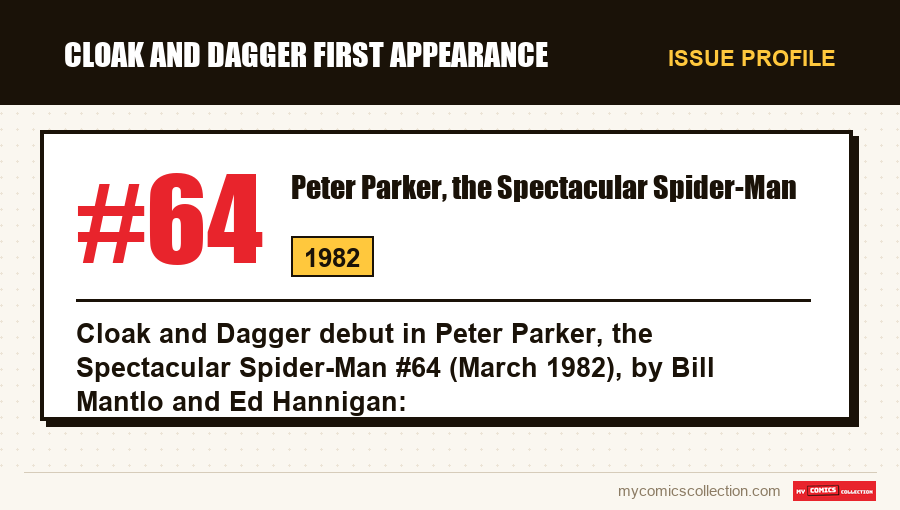
Cloak and Dagger first appear in Peter Parker, the Spectacular Spider-Man #64, cover dated March 1982. Writer Bill Mantlo and artist Ed Hannigan created Tyrone Johnson and Tandy Bowen, two teenage runaways in New York who gain opposing powers, darkness for him and light for her. The issue is a Spider-Man guest slot, not a solo launch, and the pair earned a four-issue miniseries in October 1983 and an ongoing title in 1985.
Spectacular Spider-Man #64 is a book that many collectors pass over in a longbox of early-1980s Spider-Man, because the cover logo and the cast look like any other issue of the run. That is exactly why it rewards a careful look: the debut sits inside a series whose title and numbering invite confusion with several neighbors.
Mantlo and Hannigan's credits, the March 1982 cover date, the three collected editions and the dates of the 1983 miniseries and 1985 series were all verified for this page; the judgment on why #64 matters and the inspection routine are our own.
What the issue is: cover date, series title and credits
The book is Peter Parker, the Spectacular Spider-Man #64, and its cover date is March 1982. That series title matters for searching: in 1982 the magazine carried the longer name, with Peter Parker's name in front, so a listing for plain "Spectacular Spider-Man" in a catalog can point at the same book, or at a later volume that restarted numbering. When you see "#64" next to Cloak and Dagger, you want the 1976 series, the one that began with a first issue and reached its sixty-fourth number in 1982.
The creative credits are straightforward on the writing and art sides. Bill Mantlo wrote the issue. Ed Hannigan provided the art and shares the creator credit with Mantlo. For the inks and the cover, read the credits box printed in the issue you are holding rather than a seller's summary, since store descriptions of secondary credits tend to drift from one listing to the next.
It is worth separating two dates that blur in sales descriptions. The first is the cover date, March 1982, which is the printed date and the one a grading label repeats. The second is the on-sale date, which a seller sometimes quotes instead, so a year that looks off in a listing is worth checking against the indicia before you treat it as a different book.
How Cloak and Dagger enter the story
The duo arrives as guest characters in a Spider-Man story, which shapes how you should think of the book. Tyrone Johnson, later Cloak, and Tandy Bowen, later Dagger, are teenagers who meet as runaways in New York City. A criminal chemist named Simon Marshall abducts them and tests a synthetic drug on them, on behalf of Silvermane and the Maggia. They survive it, and the drug leaves them with powers that mirror each other: Cloak can manipulate darkness, teleport and alter his density, while Dagger can form light into blade-like constructs and use light to heal. After this they take their names, and Spider-Man is the established hero whose path they cross.
The key point for a buyer is the form of the debut. This is not an origin issue of a solo book, with the character at the center of every page. It is a Peter Parker story in which a new pair is introduced against the backdrop of his own series, and the reader first meets them as figures on the street with a mission of their own. That is the same pattern as many Bronze and Copper Age introductions: the character enters through a popular host title, proves herself or himself, and graduates to a separate book only when readers respond.
Who created them, and the idea behind the pair
Bill Mantlo and Ed Hannigan are the creators. Mantlo has said the concept came to him after a visit to Ellis Island, the historic gateway for immigrants arriving in the United States. That inspiration is Mantlo's own account of how the pair began, and it fits the shape of the characters: two young people who arrive in a large city from somewhere else, find the city indifferent to them, and end up bound to each other by what happens next. Hannigan is the co-creator, and the two names stay attached to the pair.
The editorial context is the early 1980s Spider-Man line, where a guest character introduced in one monthly book could be picked up by another if it caught on. Readers responded to the pair, and within a year and a half of the debut they had a miniseries of their own.
For a collector, the creator pairing is itself a small selling point. Mantlo wrote a large amount of Marvel work in this period and returned to Cloak and Dagger repeatedly: he wrote the 1983 miniseries and the 1988 graphic novel discussed below. Hannigan drew this debut. When both names are on the same book that introduced a lasting duo, the issue gains a coherence that a debut drawn and written by a changing crew would lack.
Why it is a key issue: what the debut led to
The reason this issue carries weight is the trail it started. Following the debut, Cloak and Dagger received a four-issue limited series written by Bill Mantlo, penciled by Rick Leonardi and inked by Terry Austin, which debuted in October 1983. The success of that miniseries led to an ongoing bi-monthly Cloak and Dagger title in 1985 with the same creative team. Leonardi left after issue #6, and after issue #11 the title merged with Doctor Strange into a monthly revival of Strange Tales.
The pair continued after that. Terry Austin later returned as writer, and he created their first nemesis, Mister Jip. Marvel Graphic Novel #34 (1988), titled Cloak and Dagger: Predator and Prey, was written by Mantlo. A later series, The Mutant Misadventures of Cloak and Dagger, had Austin as writer and Mike Vosburg as penciler; Dagger is blinded in its first issue, Steve Gerber and Terry Kavanagh took over with issue #14, and the title was canceled with issue #19. A five-part miniseries by Valerie D'Orazio was announced for 2008 but was not published.
The characters later reached television in Cloak & Dagger, a Freeform series created by Joe Pokaski that ran for two seasons in 2018 and 2019; the companion guide linked above compares it with the comics.
Put those pieces together and the case for #64 is simple. A character debut matters when there is a lasting body of stories behind it, and here there is: a miniseries, an ongoing series, a graphic novel, a later team-up series and an adaptation, all built on a pair introduced in a monthly Spider-Man book. The debut remains the one Spider-Man-series issue that every one of those later items traces back to.
Do you collect this series?
Track what you own, what you are missing and what your collection is worth. 7-day trial.
Start my trial →
Reprints, collections and issues that get confused with it
If you want to read the story without handling a four-decade-old newsprint comic, the issue has been collected more than once. It appears in Cloak & Dagger: Crime and Punishment (June 2012), in Cloak & Dagger: Shadows and Light (February 2017) and in Cloak & Dagger Omnibus Vol. 1 (September 2020). Those are collected editions, not reprints of the single issue, and they do not stand in for the original in a debut run. A collection is a way to read; the original is what a debut-run collector shelves.
Several pairs of numbers get mixed up in listings, so a short list helps.
- #64 versus the 1983 miniseries. The miniseries opens with its own first issue in October 1983. A "#1" for Cloak and Dagger is the miniseries or a later series, not the debut. The debut is #64 of the Spider-Man title.
- Spectacular Spider-Man versus Amazing Spider-Man. Both are Spider-Man monthlies of the same years. A seller who writes "Spider-Man #64" without the title may mean either, and the two are different books with different covers.
- The 1976 series versus later volumes. Numbering restarted in later volumes of The Spectacular Spider-Man. The debut sits in the 1976 run, in the issue dated March 1982.
- Collections versus originals. The 2012, 2017 and 2020 books reproduce the story. They are not substitutes for the comic itself.
What to check before buying a copy
Because the issue is a Copper Age Marvel monthly, the condition problems are the typical ones for the period, and none of them is specific to this book. A short inspection routine covers them.
- Confirm the book. The cover logo should read Peter Parker, the Spectacular Spider-Man, and the issue number should read 64. If a seller lists a bare number, ask for the cover image and compare the date, March 1982, in the indicia.
- Read the spine. Stress lines on a spine that has been read often show as white fractures through the color. Look at the staple area, where the cover has been flexed the most.
- Check the corners and edges. Rounded corners and fraying are normal on a book that went through hands; sharp corners and tight edges are what separate a high-grade copy from an average one.
- Check the interiors. Paper tone, brittleness and tanning at the margins. A book with bright covers and brown interior pages tells you something about storage.
- Look for restoration. Color touch, spine splits closed with glue, and pressing can all alter a copy. For a 1982 Spider-Man book, the restoration-spotting guide lists the signs, and the note on restoration and value shows why a touched-up #64 sits apart from a plain one.
On graded copies, learn what the label tells you. The color of the label states whether the book is unrestored, qualified or restored, and the census shows how many copies sit at each grade; the guides on label colors and on reading the census explain both. A mid-scale #64 suits someone who wants the debut on the shelf and the story in hand; at the top of the scale, the census count and the label wording carry the decision, since each step up in grade is hardest to earn there.
To judge what a #64 should change hands for, line up completed sales of this exact issue at your grade and label type across a stretch of months, and discard the asking figures. No figure is quoted here because a number printed on a page ages quickly, and because the useful comparison is always the one you make yourself against recent sales of your exact book.
The appearances that follow and are worth tracking
If you collect the pair and not only the debut, the next steps are clear, and each one is a verified title or date.
- Cloak and Dagger miniseries (October 1983). Four issues, written by Mantlo, penciled by Rick Leonardi and inked by Terry Austin. This is the character's own opening act and the most natural second purchase.
- Cloak and Dagger ongoing (1985). A bi-monthly title with the same creative team. Leonardi left after issue #6, which marks a change of art that run collectors want to note.
- The Strange Tales revival. After issue #11 of the ongoing series, the book merged with Doctor Strange into a monthly Strange Tales, so the pair's later 1980s stories sit under a different cover title.
- Marvel Graphic Novel #34 (1988). Cloak and Dagger: Predator and Prey, written by Mantlo. A standalone story for the shelf.
- The Mutant Misadventures of Cloak and Dagger. Written first by Terry Austin with Mike Vosburg as penciler, with Dagger blinded in the first issue, taken over by Steve Gerber and Terry Kavanagh at issue #14 and canceled with issue #19.
A sensible order is to buy the debut first, then the 1983 miniseries, and to fill the later titles when copies surface at a fair grade. If your goal is the Spider-Man side of the story, the guide to Spectacular Spider-Man key issues places #64 inside the run, and the Spider-Man hub lists the other books around it.

Frequently asked questions
Peter Parker, the Spectacular Spider-Man #64, with a cover date of March 1982. Writer Bill Mantlo and artist Ed Hannigan created Tyrone Johnson and Tandy Bowen for that story. Their own four-issue miniseries followed in October 1983.
No. The four-issue Cloak and Dagger miniseries began in October 1983, written by Bill Mantlo with Rick Leonardi and Terry Austin on art. It comes after the debut in Spectacular Spider-Man #64, which is why a listing that says "#1" refers to a later book and not to the introduction.
Ed Hannigan drew the story that Bill Mantlo wrote, and the two share the creator credit for Cloak and Dagger. For the inker and cover names, rely on the credits printed inside the comic, not on a store description.
Yes. The issue is collected in Cloak & Dagger: Crime and Punishment (June 2012), Cloak & Dagger: Shadows and Light (February 2017) and Cloak & Dagger Omnibus Vol. 1 (September 2020). These books reproduce the story but are not the original comic, so they do not replace it in a debut run.
The Freeform series Cloak & Dagger, created by Joe Pokaski and aired for two seasons in 2018 and 2019, moved the pair to New Orleans. The comic debut stays the same book, and the series has simply sent more readers looking for it. The companion guide compares the show with the comics.
Holding a copy of Peter Parker, the Spectacular Spider-Man #64 or a Cloak and Dagger run, and want a read on its grade and place in your collection?
Estimate my comic