
In short
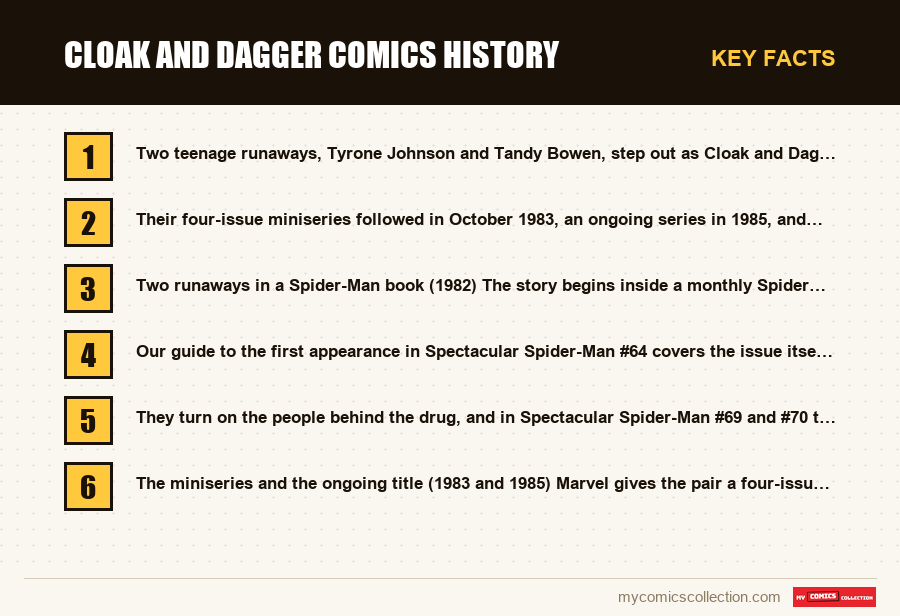
Two teenage runaways, Tyrone Johnson and Tandy Bowen, step out as Cloak and Dagger in a guest slot of Peter Parker, the Spectacular Spider-Man #64 (March 1982), conceived by Bill Mantlo and Ed Hannigan. Their four-issue miniseries followed in October 1983, an ongoing series in 1985, and a 1988 graphic novel. Three turns define their history: the move from Spider-Man guest stars to headliners, the shuffle through Strange Tales and The Mutant Misadventures of Cloak and Dagger, and the later decades as team members and event players.
Cloak and Dagger are an unusual case for a collector, because the pair were created as guests in someone else's book and then grew into two of Marvel's most durable street-level characters without ever settling into one steady series. Their story is a chain of short runs, miniseries and crossovers, linked by one idea: two teenagers whose powers make sense together, one a doorway to darkness and the other a source of light.
Credits, issue numbers and cover dates below come from published references, with unconfirmed details dropped. Our reading of how each shift changes Tyrone and Tandy is analysis, and nothing is quoted from the books.
Two runaways in a Spider-Man book (1982)
The story begins inside a monthly Spider-Man title, number 64, with Mantlo scripting and Hannigan drawing. A visit to Ellis Island inspired Mantlo, and the two creators devised the visual design together. Tyrone Johnson and Tandy Bowen are teenage runaways whose powers come from a synthetic drug that the criminal chemist Simon Marshall tested on runaways for Silvermane and the Maggia. It gives Tyrone a body that is a living portal to the Darkforce Dimension, with a hunger that light alone can satisfy, and it gives Tandy the ability to create daggers of Lightforce.
The design logic matters for everything that follows. Each hero needs the other to function, and that dependence is what keeps the pair together through decades of redesigns and relaunches. Our guide to the first appearance in Spectacular Spider-Man #64 covers the issue itself, the title confusion around that series and what to inspect. This article starts where that one stops.
The Silvermane follow-up and the vigilante years
The pair do not vanish after one issue. They turn on the people behind the drug, and in Spectacular Spider-Man #69 and #70 they kill Silvermane's reanimated cyborg form. Spider-Man remains the lens through which readers meet them in this period, a street-level hero who finds two teenagers handing out a harsher justice than his own.
For a collector following the trajectory, these return visits are a sign that Marvel saw a franchise in the pair. A character who comes back within a few issues of a debut has been noticed by the editorial office, which helps explain how quickly they earn their own book. The early issues of Spectacular Spider-Man reward a careful look for exactly this reason.
The miniseries and the ongoing title (1983 and 1985)
Marvel gives the pair a four-issue Cloak and Dagger miniseries in October 1983, with Mantlo writing, Rick Leonardi penciling and Terry Austin inking. It is the pair's opening act as headliners, and it works as the true foundation of their solo identity, because it moves the story out of Spider-Man's neighborhood. A bi-monthly ongoing series follows in 1985 with the same creative team. Leonardi leaves after issue #6, and Mantlo ends his own run on the title with that same issue.
That change is the first real stress on the franchise. The characters were built by one writer with one penciler, and when both go, the book has to find a different voice. After issue #11 the title merges with Doctor Strange into a monthly series that takes the name Strange Tales. Bret Blevins pencils and inks it, and Terry Austin returns for a short stint as writer, during which he introduces the villain Mister Jip.
Graphic novel (1988) and the Strange Tales years
Marvel Graphic Novel #34, titled Cloak and Dagger: Predator and Prey, appears in 1988 and is written by Mantlo. It is a self-contained story for the shelf, and it is the last Cloak and Dagger work Mantlo wrote before he left the characters. The graphic novel is collected under the same title in a 2018 edition, which matters for readers who want it without hunting a large-format original.
The Strange Tales arrangement is the part of the pair's history most likely to trip a collector. Their later 1980s stories sit under a different cover title, shared with another headliner, so a search by the characters' names alone misses issues. Consult the cover title and volume number before buying, not the logo on the front. Our note on Spider-Man volumes and legacy numbering shows how common this kind of title shift is across the line.
The Mutant Misadventures and the event crossovers
The Mutant Misadventures of Cloak and Dagger is the next attempt at a solo series. Terry Austin writes it, with Mike Vosburg as penciler, and Dagger is blinded in the very first issue. Steve Gerber and Terry Kavanagh take over the writing with issue #14, and the title is canceled with issue #19. Gerber's arrival ties the pair, by chance, to the writer who shaped Man-Thing, though the stories bear little resemblance.
The title also reflects a status question that runs through the 1990s. The pair were first described as latent mutants and later as "mutates," a term that signals an uneasy fit. A 2010 one-shot eventually addresses it, with Doctor Nemesis confirming that Dagger's powers came solely from the drug. For now, the name Mutant Misadventures sits on the cover as a marker of that earlier assumption.
Event crossovers follow. In Infinity Gauntlet #4, Thanos kills Cloak, and the character is brought back in issue #6. Our Infinity Gauntlet key issues guide places those issues in the context of the series. During Maximum Carnage, Dagger is apparently killed by Shriek while saving Spider-Man, before she is revealed to be recuperating inside Cloak's shroud, and she helps defeat Carnage. The Carnage crossovers guide covers that event. These are guest turns, not solo stories, but they keep the pair in circulation between their own series.
Do you collect this series?
Track what you own, what you are missing and what your collection is worth. 7-day trial.
Start my trial →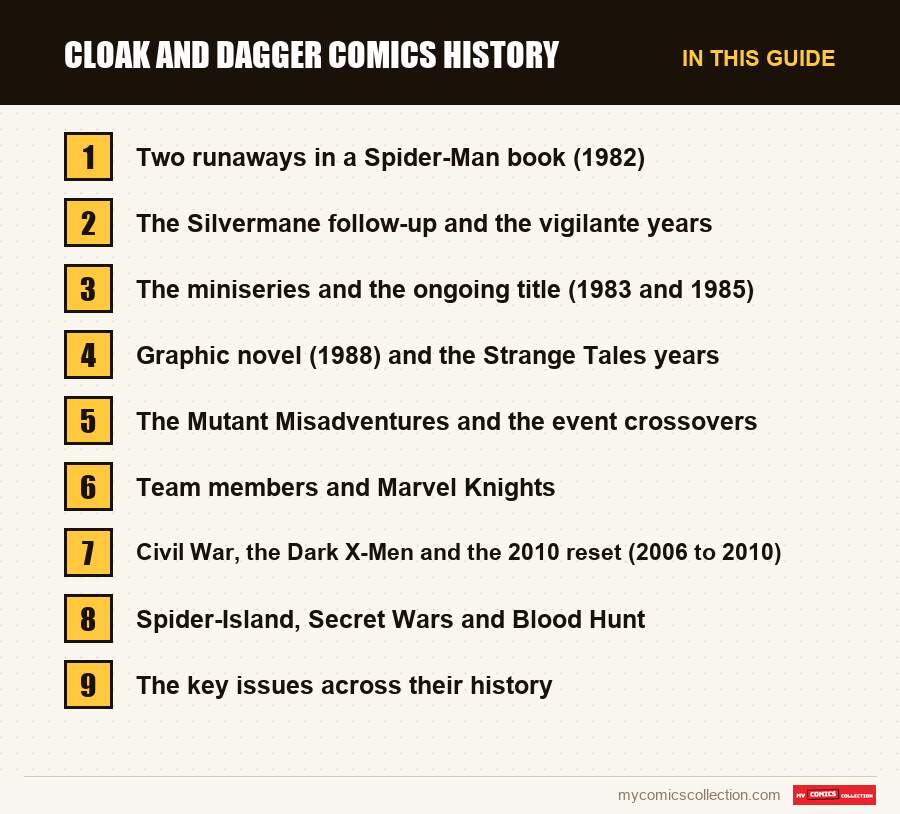
Team members and Marvel Knights
With no ongoing book of their own, Cloak and Dagger become reliable supporting players. Dagger joins the Marvel Knights team, and Marvel Knights #1, #9 and #13 take the pair through a Black Widow and Daredevil storyline, Cloak's possession by Nightmare and a Life Model Decoy attack. Tandy absorbs Cloak's powers to free those trapped in his cape. They also cross paths with the Runaways in Runaways #11 and #12, and again in the second volume's issues #9 through #12, where an impostor posing as Cloak frames him for an attack on Dagger.
The period shows the pair settling into a role rather than a book. They are most useful as a duo that can be dropped into a team or a crossover and read at once, because the powers explain themselves. That portability helps explain why they keep returning, and it shapes a collection: the later appearances are scattered across other titles rather than gathered in one run.
Civil War, the Dark X-Men and the 2010 reset (2006 to 2010)
In Civil War the pair join Captain America's side against the Superhuman Registration Act. They are captured and taken to the Negative Zone, in the storyline's issues #3 and #5 through #7. Our Civil War key issues page covers the event. After that, Norman Osborn recruits Cloak and Dagger into his Dark X-Men in Uncanny X-Men #513. Dark X-Men: The Beginning #2 shows their early hesitancy, and after Emma Frost and Namor betray Osborn, the pair join the X-Men in Dark Avengers #8.
A 2008 miniseries by Valerie D'Orazio was announced at San Diego Comic-Con, with Irene Flores on pencils and Emily Warren on colors, and it was not published. The pair's next solo project is a 2010 one-shot, Cloak and Dagger vol. 4 #1, in which Doctor Nemesis confirms that Dagger's powers came solely from the drug. In the same issue Tyrone is kidnapped and tortured by Tia, who has been brainwashed to hate powered people. It resolves the status question the 1980s titles raised, and for collectors it is the cleanest dividing line between the older and newer versions of the pair.
Spider-Island, Secret Wars and Blood Hunt
The 2010s and 2020s keep the pair on the move. In the Spider-Island tie-in Spider-Island: Cloak and Dagger #1 through #3, Mister Negative kidnaps and corrupts Dagger, which swaps the pair's powers. In 2015 a Runaways spin-off tied to Secret Wars comes from ND Stevenson and Sanford Greene, and later the pair return evil under Mister Negative's influence until Peter Parker cures them, in Amazing Spider-Man vol. 4 #6 through #8. In the vampire storyline Blood Hunt, Cloak loses control of his powers, in Blood Hunt #1 and Blood Hunters #1 and #2.
Beyond the page, the pair appear in the Freeform series Cloak & Dagger and again in the third season of Runaways. The collected editions run from Crime and Punishment in 2012 to Shadows and Light and Lost and Found in 2017, Agony and Ecstasy in 2019, and two omnibus volumes in 2020 and 2021. For the screen side of the story, see our comparison of the series versus the comics.
The key issues across their history
- Peter Parker, the Spectacular Spider-Man #64 (1982): the debut of Tyrone Johnson and Tandy Bowen, by Bill Mantlo and Ed Hannigan.
- Peter Parker, the Spectacular Spider-Man #69 and #70: the Silvermane story that continues the pair's vigilante run.
- Cloak and Dagger #1 (1983): the opening of the four-issue miniseries by Mantlo, Rick Leonardi and Terry Austin.
- Cloak and Dagger ongoing (1985), issue #6: the end of Leonardi's and Mantlo's run on the title.
- Marvel Graphic Novel #34 (1988): Cloak and Dagger: Predator and Prey, written by Mantlo.
- The Mutant Misadventures of Cloak and Dagger #1: the issue in which Dagger is blinded, with Terry Austin and Mike Vosburg.
- Infinity Gauntlet #4 (1991): Thanos kills Cloak, who returns in issue #6.
- Cloak and Dagger vol. 4 #1 (2010): the one-shot in which Doctor Nemesis traces Dagger's powers to the drug alone.
How to follow Cloak and Dagger in a collection
Treat the pair as a set of short, separate runs rather than one long series. The debut and the Silvermane issues sit in Peter Parker, the Spectacular Spider-Man. The 1983 miniseries and the 1985 ongoing book form the solo core. Everything from the merger onward moves through a shared cover title and later volumes, so build a checklist by volume and year, not by title alone.
The main trap is the number one. Several different series carry a first issue for the pair: the 1983 miniseries, the 1985 ongoing, the 2010 one-shot and the Spider-Island tie-in, so a listing that says "Cloak and Dagger #1" needs a cover date next to it. The debut itself is number 64 of a Spider-Man title that also appears under a shorter name; our guide to the second Spectacular Spider-Man series explains the numbering. Collected editions are the easy route to the later material, and they stand in for scattered single issues.
Frequently asked questions
Bill Mantlo wrote and Ed Hannigan drew their debut in issue #64 of Peter Parker, the Spectacular Spider-Man, in 1982. A visit to Ellis Island inspired Mantlo, and the two creators devised the visual design of the pair together, one tied to darkness and the other to light.
A four-issue miniseries arrived in October 1983 from Mantlo, with Leonardi on pencils and Austin on inks. An ongoing bi-monthly title followed in 1985 with the same team. After issue #11 it merged with Doctor Strange into a monthly series under the name Strange Tales.
No. They were first described as latent mutants and later as mutates, but a 2010 one-shot, Cloak and Dagger vol. 4 #1, has Doctor Nemesis confirm that Dagger's powers came solely from the synthetic drug the pair were given. That chemical origin is what sets them apart from the mutants of the X-Men family.
Thanos kills Cloak in Infinity Gauntlet #4, and the character is resurrected later in the series, in issue #6. The event is one of the pair's best-known crossover appearances, and it fits into the larger story of the early 1990s Marvel cosmic line.
Begin with issue #64 of the Spider-Man title and then the 1983 miniseries, which together lay the foundation. For the later material, collected editions such as Crime and Punishment or the two omnibus volumes are an easier route than hunting single issues spread across several titles.
Holding a Cloak and Dagger issue from the 1980s? Confirm its title, volume and cover date, then estimate its value from real listings.
Estimate my comic