CCS pressing removes bends, warping and cover marks on an unrestored comic. On a properly selected copy, the typical gain runs from 0.5 to a full grade (8.5 to 9.0, 9.2 to 9.4 or even 9.6). Cost runs $17-30 per book, profitable above roughly $550 in post-grading value.
Professional pressing became a standardized step in a comic's journey to grading after CGC acquired Classics Conservation Services (CCS) in 2008. The principle is to subject the cover and interior pages to a controlled combination of heat, humidity and mechanical pressure to erase non-structural defects: handling bends, warping caused by residual moisture, storage marks, light corner creases. Unlike restoration (adding material, color or glue), pressing does not alter the book's physical composition and triggers no special notation on the CGC label: the copy keeps its universal blue label and its full value on the secondary market.
For the collector deciding between submitting a comic raw or having it pressed before grading, the call rests on three variables: the book's true starting condition, the ceiling grade targeted after the work, and the copy's market value in the post-pressing grade. An Amazing Spider-Man 300 bought raw at $385 with 9.2 potential can climb to $770-990 in 9.4 after a $25 press: a return ratio that's hard to beat. Conversely, pressing a modern comic worth under $110 in 9.8 almost always loses money: the combined cost of pressing plus the CGC tier exceeds the spread between 9.6 and 9.8 on most post-2015 titles.
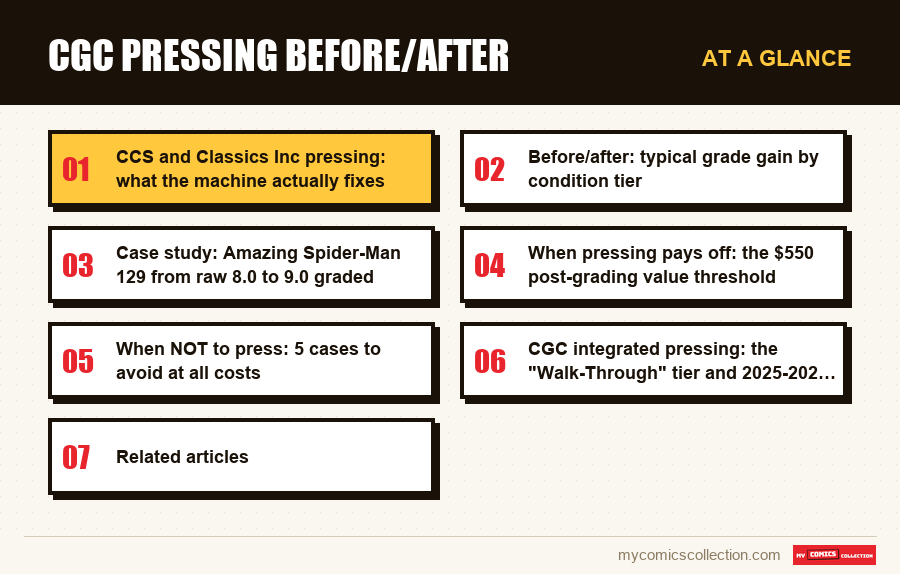
CCS and Classics Inc pressing: what the machine actually fixes
Classics Conservation Services follows a three-phase protocol. The first is a raking-light inspection meant to map the defects: vertical tension bends running along the spine, page fanning from upright storage, sawtooth edges on the cover, the horizontal center bend on saddle-stitched comics. The presser then judges whether each defect is compressible (a bend with no fiber tearing) or structural (a perforation, missing material, an actual tear). Compressible defects enter the cycle; the rest are noted and will remain visible.
The second phase is controlled humidification. The cover and pages are exposed to an atmosphere held at 50-60% relative humidity for 4 to 12 hours depending on the age of the paper. This step rehydrates the cellulose fibers and lets them recover their original elasticity. A Silver Age comic on acidic paper needs less time than a Modern Age book on neutral stock: too much humidity on old paper causes ink migration and a drop in page quality, something to avoid at all costs on 1962-1975 key issues.
The pressing phase itself uses a hydraulic press heated to 60-80 °C with 2 to 4 tons of pressure spread across the book's surface. The cycle runs 24 to 72 hours. Out of the press, the book is reconditioned at 20 °C and 45% humidity before final inspection. CCS charges $17 for modern comics (post-1980), $22 for Bronze Age (1970-1979), $27 for Silver Age (1956-1969) and $32 for Golden Age (pre-1956). Classics Inc, an independent service based in Pennsylvania, runs comparable rates ($18-30) with often shorter turnaround (4-6 weeks versus 8-14 at CCS). Both refuse restored copies, books already cleaned chemically, or any showing signs of active mold. See our complete guide to CGC pressing for a breakdown of when it makes sense.
Before/after: typical grade gain by condition tier
The post-pressing grade gain depends on the starting grade. Across 1,200 cases documented by CGC community boards between 2020 and 2025, the distribution of outcomes breaks down as follows. A copy entering at 7.5-8.0 (Very Fine-) with non-structural bends gains a full grade on average (8.5 to 9.0), peaking at 1.5 grades in 12% of cases. ROI is highest in this band: $22 pressing + $35 grading = $57 to turn a copy bought at $90 into one worth $220-330.
In the 8.5-9.0 band (Very Fine to Very Fine/Near Mint), the average gain drops to 0.5 grade. An Amazing Spider-Man 252 estimated raw at 8.5 mostly comes back at 9.0 after pressing, sometimes 9.2 if the only defects were micro cover bends. The market spread between 8.5 and 9.0 on this title sits around $200-275 on 2024-2025 Heritage sales, which easily covers the cost of the work. The 9.2-9.4 band stays profitable but with higher volatility: 40% of copies gain 0.5 grade, 35% hold steady, 15% lose a quarter grade because of minor defects revealed by CGC's inspection, which is stricter than self-assessment.
The 9.6-9.8 zone is a trap. A comic self-graded at 9.6 has a statistical 28% chance of climbing to 9.8 after pressing, 50% of holding at 9.6, and 22% of dropping to 9.4 if the CGC grader spots a mark previously masked by warping. On modern key issues (Edge of Spider-Verse 2, Ultimate Fallout 4, Walking Dead 1), the 9.6-to-9.8 spread frequently tops $1,100, which justifies taking the risk. On a common 2000s title, the spread is just $35-90, which makes pressing a net loss. The updated value table in our CGC grading scale guide details the gaps between adjacent grades for 200 key titles.
Case study: Amazing Spider-Man 129 from raw 8.0 to 9.0 graded
Take the example of an Amazing Spider-Man 129 (first appearance of the Punisher, July 1974) bought in a raw lot on Catawiki at $530 in May 2024. The copy showed two non-structural vertical bends on the upper left quarter of the cover, light page fanning from poorly supported horizontal storage, and a greasy fingerprint at the center of the spine. No Marvel chipping, no marker marks, off-white interior pages.
A cautious self-assessment placed the copy between 7.5 and 8.0. Bundled CCS pressing ($22) + CGC Modern tier at $50 because of a value above $400, so $72 + $38 return shipping = $110 total investment. Turnaround 11 weeks in late 2024. Result: blue label, grade 9.0, OW/W pages. The market spread between 8.0 and 9.0 on this title per 2024-2025 Heritage and ComicLink sales: 8.0 trades at $1,050-1,200, 9.0 reaches $2,000-2,400. Gross gain excluding initial shipping: around $1,300, a 12x return on the cost of the work.
Could the copy have come back at 9.2 without pressing? Highly unlikely: the two vertical bends were pronounced enough that CGC would classify them as notable defects, capping the grade at 8.5. This is exactly the kind of setup (compressible defects, healthy paper, a high-value key issue) where pressing transforms the economics of the operation. By contrast, an Amazing Spider-Man 129 already at a cosmetic 9.4 with a 2 mm micro-tear on the spine would have been a bad candidate: the tear stays, pressing fixes nothing structural, and the combined cost would not have been recovered. Our Spider-Man CGC grading guide lists the defects that pressing can eliminate, title by title.
When pressing pays off: the $550 post-grading value threshold
The empirical rule of thumb, stable since 2015, sets the pressing break-even point around $550 in post-grading value for the target grade. Below that threshold, the combined cost of pressing + grading + shipping represents too large a share of the sale price to absorb the failure cases (15-25% of copies gain no grade or lose one). Above $550, gains on successful cases more than offset the neutral or negative outcomes on the rest.
A few concrete title-by-title thresholds. Walking Dead 1 (October 2003) in 9.6 sits around $880-1,200 in 2025, so pressing is justified on a raw copy estimated 9.0-9.4. New Mutants 98 (1991, first appearance of Deadpool) in 9.8 tops $1,500, against $385-550 in 9.6: pressing is ultra-profitable on any borderline copy. Iron Man 55 (1973, first appearance of Thanos) in 8.0 trades at $2,400-3,100, climbs to $6,000-7,700 in 9.0: pressing is mandatory on any high-grade raw copy bought in a lot.
Conversely, pressing an Amazing Spider-Man 700 (2012) estimated raw at 9.6 to chase 9.8 is rarely profitable: the 9.6-to-9.8 spread on this title is just $65-100 in 2025, against a $90 minimum cost of work. Same story on Superior Spider-Man 1, Death of Spider-Man, and most post-2010 modern comics outside 1:100 ratio variants. Our modern comics investment analysis for 2020-2026 identifies the modern titles where pressing still makes sense despite capped values.
When NOT to press: 5 cases to avoid at all costs
Five configurations make pressing inadvisable or even dangerous. First case: any restored copy, even lightly. A chemically cleaned cover, a corner rebuilt with pulp, a transparently re-glued tear: CCS detects these interventions under UV light and refuses the copy, but more importantly, the heat of the cycle can make added glues and pigments react, worsening the appearance. CBCS and PGX apply the same rule.
Second case: brittle paper. Golden Age comics stored in hot, dry conditions have paper whose fibers have lost their flexibility. The pages crack at the slightest fold. CCS humidification can worsen the embrittlement and drop the page grade from OW/W to BR (brittle), a 40-60% depreciation on some titles. The at-home test is to gently fold a 2 mm corner of a page: a healthy page springs back, a brittle page cracks or breaks.
Third case: active mold or brown moisture stains. Foxing (rust-colored spots) can be amplified by the humidification cycle. Comics showing moisture halos should go through preliminary conservation (gradual drying over several weeks) before any pressing. Fourth case: major structural defects (missing paper, tears over 5 mm, perforations). Pressing never restores missing material. Fifth case: copies with signatures not certified through Signature Series. The heat can make a marker signature from the 80s-90s bleed, turning a neutral defect into a visible one. For certified signatures, see our CGC Signature Series analysis.
Collecting this series?
Track what you own, what you are missing and what your collection is worth. 7 day trial.
Start my trial →CGC integrated pressing: the "Walk-Through" tier and 2025-2026 turnaround
Since 2019, CGC has offered an integrated pressing + grading service that simplifies logistics for the collector. Rather than shipping the book to CCS and then having it transferred to CGC, a single submission form lets you check the "Pre-screen + Press" box: CGC first evaluates whether the copy is worth pressing, sends it internally to CCS if the answer is yes, then grades it. The Walk-Through service (rush tier) adds $150 but brings the combined pressing + grading turnaround down to 4-6 weeks versus 12-16 on standard.
The public 2025-2026 fee schedule breaks down into several tiers. Modern (value under $400) runs $35 grading + $17 CCS pressing = $52 all in. Economy (value $400-1,000) moves to $45 + $22 = $67. Standard (value $1,000-2,500) reaches $70 + $22 = $92. Express (value $2,500-5,000) calls for $100 + $27 = $127. Walk-Through adds $150 on top of the base tier with a guaranteed turnaround under 10 business days. Return shipping from Sarasota oscillates between $35 and $80 depending on the number of books and the insurance option.
The pre-screen is a useful safety net for collectors on the fence: CGC commits to not grading if the copy can't reach the minimum grade specified on the form (for example, "do not grade below 9.4"), returning the copy raw for a reduced fee of $12-18. This option lets you test an investment on a borderline comic without committing the full cost if it fails. Our CGC tiers and pricing guide details the thresholds and options available.
FAQ: CGC pressing and grade gain
Does pressing affect value or the CGC label?
No. Pressing is a non-restorative intervention recognized by CGC, CBCS and PGX. The label stays universal blue, with no "Pressed" or "Restored" notation, and the full market value applies. The secondary market (Heritage, ComicLink, Catawiki) does not distinguish a pressed copy from one that was never pressed, at equal grade and page quality. It's precisely this neutrality that makes pressing economically rational: the added cost of the work disappears into the final sale price, and only the grade achieved matters. Worth noting: since 2022, some CGC graders occasionally spot the signs of repeated pressing (excessive fiber compression) and may lower the page grade, but this stays anecdotal on a single professional press.
How much does a full press + grade cost for an $800 comic?
For a copy whose target post-grading value sits around $800, the CGC Economy tier applies (value $400-1,000). The cost breaks down like this: $45 grading + $22 CCS pressing = $67 at CGC, plus $18-25 outbound shipping (bundling recommended), $35-50 insured return, so $120-145 all in before customs duties. On import, local VAT applies to the declared value plus fees: budget $20-30 extra if the copy is declared at its true value. Total between $140 and $175 per book, to amortize against the expected grade spread.
How long does CCS pressing via CGC take in 2025?
CGC's public 2025 turnaround for the combined standard pressing + grading service runs between 80 and 120 business days from receipt in Sarasota. CCS pressing accounts for 4 to 6 weeks of that window, grading 6 to 10 weeks depending on the tier chosen. The Walk-Through option brings the combined turnaround down to 8-15 business days for an extra $150. Peak periods (post-San Diego Comic-Con, year-end) can stretch standard turnaround to 150-180 days. Classics Inc, as an independent service, offers press-only turnaround of 4-6 weeks, to then pair with a separate CGC submission.
Can the same comic be pressed more than once?
Technically yes, economically no. A second press on an already-pressed copy rarely adds more than 0.1-0.2 grade and risks the fiber over-compression that CGC graders have been able to detect since 2022. The cost of a second cycle ($22-27 + $45-70 grading) almost always exceeds the market gain. The optimal press is a single one, preceded by a rigorous self-assessment and ideally backed by a CGC pre-screen to validate the ceiling grade achievable. If a first press didn't deliver the hoped-for result, the cause is usually a structural defect (a tear, an indelible mark) that pressing cannot fix, not a lack of intensity in the cycle.
Home pressing vs professional pressing: what's the difference?
Home pressing (humidification + a heavy book press) can give acceptable results on modern comics in good condition with a single light bend, but stays inadvisable on any copy worth more than $220. The main risks: over-humidification causing blistering, water stains, ink migration; uneven pressure leaving surface marks; the inability to control temperature. CCS and Classics Inc use presses specifically calibrated for the comic format, with heating plates regulated to the degree. On a key issue worth $550 and up, saving $22 doesn't justify the risk of losing half a grade or worse. Home pressing remains useful for prepping a bundled submission by eliminating minor defects before CCS inspection.