In short
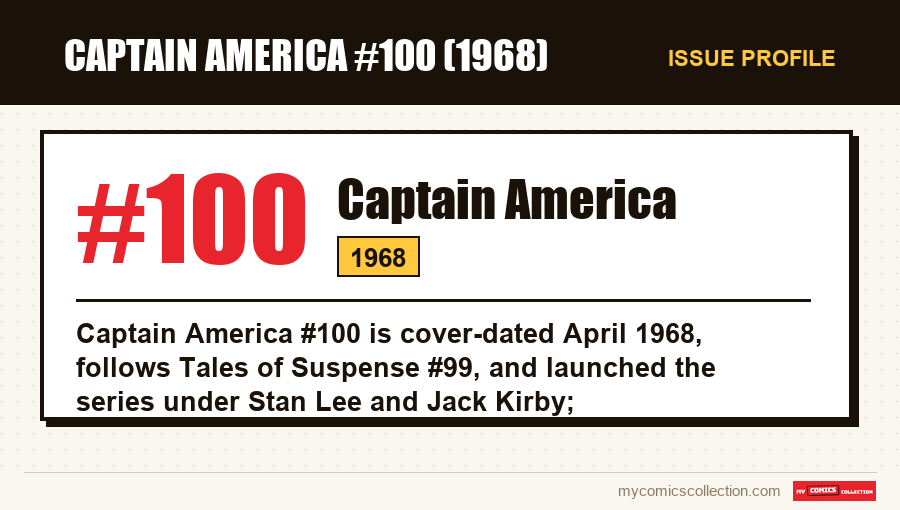
Captain America #100 is cover-dated April 1968 and carries a cover by Jack Kirby. It followed Tales of Suspense #99, so the retitled book kept the old numbering, and it launched the self-titled series with Stan Lee writing and Kirby penciling. It is not the character's first appearance, which dates to Captain America Comics #1 in 1941. What a copy is worth depends on grade, restoration status, and a clear identification of the issue.
Collectors who search for this book often assume that a hundredth issue must mark a milestone for the character. The number is real, but the reason for it is administrative: the title inherited a count from the comic it replaced. Understanding that inheritance is the key to judging the issue, because the value of a copy rests on how the book fits into Captain America's publication history and on the condition of the object, not on the roundness of the number.
The cover date, the numbering, the creators of the relaunch, and the surrounding issues below were checked against published reference material. The sections on identification and condition are analysis, and they carry no prices, since any figure printed here would drift out of date quickly.
What the #100 on the cover actually means
Tales of Suspense ran from 1959 to 1968. Its last issue was #99, and the next comic in the sequence was Captain America #100, cover-dated April 1968. There was no new first issue and no restart. The publisher simply changed the title and kept counting, so the Captain America series of the Marvel Age begins at #100.
That detail answers the most common confusion. Anyone hunting a "Captain America #1" lands on a 1941 book instead, Captain America Comics #1 from March 1941, made by Joe Simon and Jack Kirby. A collector who looks for the start of the 1960s series will find #100. These are different objects from different decades, and neither one is a substitute for the other. The #100 issue is not a first appearance of anything we can verify for the character, and any listing that describes it that way is mistaken.
The cover is by Jack Kirby. Lee is the writer and Kirby the penciler of the April 1968 relaunch. This guide does not name an interior inker; if a seller's description lists an inker, check it against the book's own credit box or a source you trust before repeating it.
How Captain America got here: the feature that grew into a title
The hundredth issue was the end of a path, not a beginning. After the character's 1941 debut and a gap, he was brought back in the early 1960s. A Captain America figure turned up in Strange Tales #114, cover-dated November 1963, in a story that revealed him as an impostor defeated by the Human Torch, a test of reader interest, and the real hero was formally reintroduced in The Avengers #4, cover-dated March 1964, with cover art by Kirby and George Roussos. Those two books are the Silver Age reappearances, and our first-appearance guide separates them from the 1941 debut.
Solo stories began in Tales of Suspense with issue #59, cover-dated November 1964, where Captain America shared the book with Iron Man in a split format. Kirby drew all but two of the Captain America stories in that run; Gil Kane and John Romita Sr. filled in on the other two. George Tuska finished several stories over Kirby layouts. Kirby's regular inkers on the feature were Frank Giacoia, credited as Frank Ray, and Joe Sinnott, with Don Heck and Syd Shores each inking one story. That long split-book period is what turned the character into a headliner who could hold his own title.
When the split books were discarded, Iron Man and Captain America each moved to a book of his own. The armored Avenger moved through a one-shot dated April 1968 before his own series began a month later, while Captain America simply inherited the Tales of Suspense count at #100. If you collect the two characters together, our guide to Tales of Suspense #39 covers Iron Man's side of the story.
The creators and the style of the relaunch
The new title of April 1968 was scripted by Stan Lee over Jack Kirby's pencils. Kirby had drawn nearly all of the Captain America stories in Tales of Suspense, so for a collector the issue reads as a continuation of that run under the character's own name. Their other work is gathered on the Jack Kirby and Stan Lee pages.
It helps to be precise about what the issue is and is not. It opens the Captain America title at the count that Tales of Suspense left behind. It carries the Captain America title in the numbering of the Marvel Age. It is not the first Captain America comic, it is not the character's introduction, and a listing that claims it introduces a major character should be asked to name the page.
The cover by Kirby is a selling point, but a cover credit alone says little about the condition of a particular copy. Titles of the period used heavy color and dark areas, and those areas show chipping, color breaks, and fading more readily than lighter areas. The artwork you are admiring in a photograph can also hide the exact flaws you need to find.
Why the issue still ranks among Silver Age Captain America keys
The case for the issue is structural. It is the doorway between two eras of the character's publication: the split-book years in Tales of Suspense and the self-titled run that followed. Collectors who build a Captain America run in order need a book that marks the handoff, and #100 is that book.
What followed gives the run its weight. Jim Steranko had a short run on the title. Captain America #117, cover-dated September 1969, introduced the Falcon, and it is covered in our Falcon first-appearance guide. The title later became Captain America and the Falcon from #134 (February 1971) through #222 (June 1978). Volume one, as the series is counted, ended with #454 in August 1996. A run that long means the early numbers are the ones collectors treat as the starting point, and #100 is the first of them.
It is worth saying plainly what the issue does not do. It does not hold a collector's attention the way a character debut does, and it does not carry the premium that comes from being the origin of a famous supporting cast. Its standing comes from its place in the sequence, from the Lee and Kirby credits, and from the age of the book. Read that standing as a ranking inside the Silver Age Captain America list, not as a claim about every Marvel book of 1968. Our Silver Age key issues list shows where it sits among its neighbors.
Do you collect this series?
Track what you own, what you are missing and what your collection is worth. 7-day trial.
Start my trial →
Books that get confused with Captain America #100
Several issues share space with this one in a seller's search results, and the mistakes are predictable.
Tales of Suspense #99 closes the old title just before the switch. It is a different book with a different cover and a different title on its masthead. A buyer who wants the Captain America title should check the title as well as the number.
Iron Man and Sub-Mariner #1 and Iron Man #1 are the sibling launches from the same split, with cover dates of April and May 1968. They sit near #100 in time but belong to a different character's history.
Captain America Comics #1 (1941) is the original. If a description says "Captain America #1," ask which one is meant. Our 1941 collector guide explains that book on its own terms.
Later series that reach their own issue #100 are different comics with different cover dates. Volume one ended with #454 in 1996, so a copy listed as #100 should show an April 1968 cover date. If the date is anything else, the book is not the one this guide discusses.
Reprints are the other trap. Facsimile editions, collected volumes, and reprints exist for many Silver Age Marvel issues, and the quickest way to avoid them is to read the cover date, the indicia, and the price printed on the cover against what a 1968 book should show. Our fakes and reprints guide goes through the checks in detail.
What to check before buying a copy
Start with the date and the number. A cover reading April 1968 and #100 is the issue. Anything else is a different book.
Next, the spine. A comic from the 1960s was folded and stapled, and stress lines along the spine are the first sign of handling. Look for splits, color breaks, and areas where the cover ink has cracked and left white showing. A copy with a bright front cover can still have a damaged spine.
Next, the staples. Rust, replaced staples, or extra holes suggest that the book has been opened or repaired. Re-stapled copies are common among older comics and are not automatically a problem, but they should be reflected in the grade and the description.
Next, corners and edges. Chips, missing pieces, and trimmed edges all matter. A trimmed copy is smaller than it should be, and the difference shows when you compare it with a copy you know to be untrimmed.
Next, the interior. Pages that have turned brown or brittle, a detached centerfold, or writing on the inside cover change the picture, as do page tears and tape. Checking the interior requires the book in hand or a seller willing to photograph it page by page.
Finally, restoration. Tape, glue, color touch, and cleaning can be done skillfully. Third-party grading companies add a label that states whether work has been detected, and a restored copy is graded and valued differently from an unrestored one. If you are thinking of paying for a graded copy, read our note on restored-label copies and the Captain America grading guide first.
Comparing copies without a price list
Without figures, the right question is how two copies differ. Four variables do most of the work.
Grade comes first. The scale used by grading companies is numeric, but the steps between numbers do not carry equal weight, so a one-step difference near the top of the scale is not the same as a one-step difference lower down. Our grading guide explains the scale.
Label type comes second. A standard label and a restored label are not equivalent, even when the number on the slab is the same.
Third is what the 1968 paper and cover look like within the grade. Gloss, page tone, and centering vary between slabs that read alike, and good photographs show it.
Timing and venue come fourth. An auction result and a shop sale answer different questions. Collectors who follow a single issue over months learn how much the results can vary between sales of the same grade, and that variation is a reason to treat any single result as a data point, not a verdict.
A practical routine is to record the same items for every copy you consider: cover date, number, grade, label type, and any notes from the slab or the seller. Put the records side by side, and you will have a comparison that is more useful than any quoted figure and that can be updated as new sales appear.
Where to go next if you are building a Captain America run
Following Captain America through the Silver Age works best in publication order. Captain America Comics #1 (March 1941) starts the story. Strange Tales #114 (November 1963) tests reader interest with an impostor, and The Avengers #4 (March 1964) brings the real character back. Tales of Suspense #59 (November 1964) starts the solo stories. Captain America #100 (April 1968) retitles the book. A short Steranko run follows, and #117 (September 1969) brings the Falcon.
That list is short enough to buy one book at a time. A sensible approach is to decide in advance which grade and label type you will accept, and to hold that standard across the whole set. A uniform standard keeps the run coherent, and it makes it easier to see which book is the weak link when you come to sell. For a wider view of the character, the Captain America hub collects the guides in one place.
Frequently asked questions
Because the title replaced Tales of Suspense, whose last issue was #99. The publisher kept the numbering, so the retitled book became Captain America #100, cover-dated April 1968. There was no new first issue, which is why a collector looking for a first issue of the 1960s series ends up at #100.
No. His 1941 origin sits in Captain America Comics #1, a Simon and Kirby book dated March 1941. An impostor appeared in Strange Tales #114, and the real hero returned in The Avengers #4. Issue #100 is the retitled series launch, so it matters for run-building, not as a debut.
Lee wrote and Kirby penciled the April 1968 relaunch, and Kirby drew the cover. This guide names no interior inker, so treat any seller's claim of a specific inker as something to check against the book.
Match three things on the cover: Captain America, #100, and an April 1968 date. Do not confuse it with Tales of Suspense #99, with Iron Man #1, or with the 1941 Captain America Comics #1. For reprints, compare the indicia and the printed cover details with a known original.
Compare grade first, then label type, then the actual look of the book, then where and when each copy sold. A restored copy and an unrestored copy at the same number are different products. Write down the same details for every copy, and the differences become easy to see.
Own a copy of Captain America #100 or a nearby Tales of Suspense issue? Start from the cover date and the condition, then see what an estimate suggests.
Estimate my comic