Captain America #117, cover-dated September 1969, contains the first appearance of Sam Wilson, the Falcon. The story is by Stan Lee, the art by Gene Colan. Steve Rogers, caught up in the body-swap plot with the Red Skull, meets a social worker in Harlem who trains a hawk named Redwing and chooses to fight at his side. Collectors look for this issue because it launches one of the few Marvel characters from 1969 who is still central today.
There are two ways to look at Captain America #117, and they do not carry the same price. Seen from 1969, it is a middle-of-arc issue in a series that was then neither Marvel's flagship nor a title in trouble. Seen from today, it is the birth certificate of the character that millions of moviegoers have watched pick up the shield on screen. The collector who buys this issue is buying that gap, and the gap has a price.
As always on this guide, only verified information (creators, issue numbers, dates) is stated as fact; the analysis is our own, with no reproduction of panels or protected dialogue.
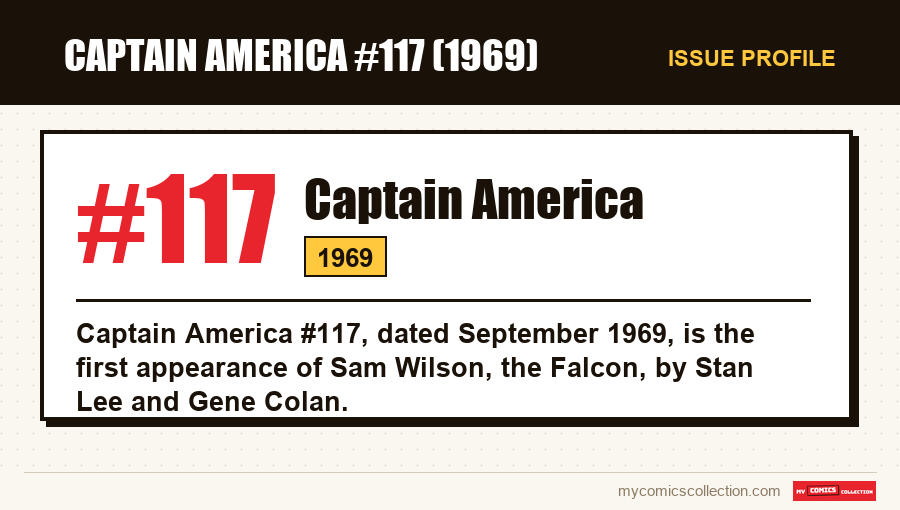
The issue: date, creators, what happens in it
The comic is cover-dated September 1969, following the American practice of moving the date forward by several weeks ahead of the actual on-sale date. The story is titled, in the original version, “The Coming of... the Falcon!” Stan Lee writes, Gene Colan pencils, and the inks are generally credited to Joe Sinnott. If you are buying for the autograph or for the artwork, have this last credit confirmed on the copy itself rather than in a listing.
The story takes place during the sequence in which the Red Skull has taken on the appearance of Steve Rogers, leaving Rogers trapped inside a body that is not his own. The hero ends up in Harlem, with no credit and no usable identity. There he meets Sam Wilson, who works with a trained bird of prey. The costume Wilson wears in these pages is green and orange, with no wings at all. This detail, which may seem minor, is in fact the best visual identification tool you have, and we come back to it below.
What the series was publishing in autumn 1969
It is worth remembering that the numbering of Captain America does not start at 1. The title picked up the count of the anthology magazine that hosted the hero, and the first solo issue carries the number 100, in 1968. Captain America #117 is therefore only the eighteenth issue published under the character's own name: a young series with a high-looking number. Many sellers and buyers get this wrong and imagine a publication older than it really is.
At this point in its run, the series alternates espionage plots, the return of adversaries from the wartime period, and chapters in which Steve Rogers simply no longer has a stable civilian identity. The tone is darker than in the 1968 issues, and Gene Colan's layouts, with their drop shadows and low-angle framing, accompany that shift. For a collector, this means the issues around #117 hold together: it is not an isolated island in a weak series.
1969: why this arrival matters in American comics
Sam Wilson is very often described as the first African American superhero in mainstream American comics. The wording matters: Black Panther, who appeared three years earlier, is African and sovereign ruler of a fictional kingdom, which is not the same narrative proposition. Sam Wilson, by contrast, is presented as a New Yorker, with a job, a neighborhood and ordinary ties. In September 1969, for a publisher selling its comics at newsstands across the country, that choice was not neutral.
This historical significance is real, and it is also the reason the issue gets cited in bibliographies that reach beyond the collecting community: academic work, exhibitions, press retrospectives. An issue that circulates outside the specialist market sees its demand widen, and wider demand shows up as scarcity of fine copies well before it shows up as a visible rise in the price of average copies.
That said, it is important to stay honest about the other half of the picture. Strictly from an editorial standpoint, 1969 did not make Sam Wilson a star. He became a regular supporting character, the series was later associated with his name in the early 1970s, and that was that. For forty years, this comic remained a key for connoisseurs, not a key for the market.
Why the value took off long after publication
The reversal came from the screen. Anthony Mackie's portrayal of Sam Wilson, first as a supporting character in films from 2014, then as the lead of a television series in 2021, and then in a 2025 feature film where he wears the Captain America costume, shifted demand from a circle of specialists to the general public. In the meantime, Marvel had already handed the shield to the character in its comics in the mid-2010s, which gave movie audiences a paper anchor they could immediately recognize.
This is a textbook case of value driven by the adaptation rather than by the editorial weight of the period, and there is a practical consequence to draw from it. The price levels reached by Captain America #117 were built in steps, with each announcement of an adaptation producing one step, and each step followed by a partial pullback once the news had faded. Buying right after an announcement structurally costs more than buying in a lull. On this title in particular, the price history shows that the lulls do exist.
What moves the value: condition, edition, distribution
A Marvel comic from 1969 was sold on newsstands, without a network of specialist shops: the direct market did not yet exist. This means no copy was set aside by a bookseller in a sealed box. Fine copies of Captain America #117 are the product of luck in preservation, not the result of a professional stockpile, and this is why the top of the pyramid is so narrow.
The typical defects of this period and format are well known: the newsstand fold across the spine, staples rusted by humidity, paper yellowing that was already of poor quality to begin with, and top corners crushed by stacking. On this cover in particular, the large areas of flat color make every reading crease visible under a flat light, which penalizes the grade more harshly than a cover full of detail would.
As far as editions go, three families stand out in the European market: the original American copy, the original American copy with a pence price stamped on it for British distribution, and the foreign publications that translated the story. The first two are 1969 printings; the third is not, whatever the quality of its paper.
Telling one edition from another
Start with the price block on the cover. A copy intended for the American market and a copy intended for the British market from the same printing do not carry the same indication: this is the first sorting step, and it is done from a sharp photograph of the upper left corner. Ask for that photograph before any discussion of price.
Next, check the legal notices on the interior page. An original from 1969 carries an imprint mentioning that year; a later reprint, a collected edition or a modern facsimile carries another year, often accompanied by a standard book number that did not exist on a newsstand comic of the period. A well-made facsimile reproduces the cover faithfully: the notices page is what gives it away.
A third marker is the advertising. A 1969 newsstand comic is full of commercial ads from its time, for mail-order items and for the publisher's own titles then on sale. A modern collector's edition has none, or reproduces them all together in a separate section, apart from the story. If the advertising pages are missing and the paper is white, you are not holding a 1969 copy.
Do you collect this series?
Track what you own, what you are missing and what your collection is worth. 7-day trial.
Start my trial →
The costume without wings, your best marker
The Falcon of September 1969 does not fly under his own power. He jumps, he climbs, he uses his hawk, and his costume has no wings. The wings arrive later, in the mid-1970s, through a harness built from Wakandan technology supplied by Black Panther, and it is that winged silhouette the screen has made famous.
For you, this difference is a working tool. Any cover, any panel, any advertising image in which the character wears wings postdates his first appearance. It is the quickest way to rule out a listing that presents a 1970s comic while implying a first appearance, and also the quickest way to date an image you come across without a caption.
Buying traps
The most common trap is confusing the character's first appearance with the first appearance of the winged version, or, more recently, of the version that carries the shield. Three distinct milestones, three distinct issues, three very different levels of rarity. A listing that mentions “first appearance of the Falcon” without giving the issue number and cover date deserves a question before any offer.
The second trap is discreet restoration. On a 1969 comic with a colored cover, a stain removal or a respined spine can go unnoticed in a photograph. The spine should be examined in raking light, and the stiffness of the fold is a clue: a respined spine is often stiffer than the rest of the book.
The third trap is the incomplete copy. Marvel comics of this period passed through the hands of children, and the detachable puzzle pages or order forms were often cut out. An incomplete book is disqualified from a grading standpoint, whatever the cover looks like. Check the full page count, not just the presence of the four cover pages.
The neighboring issues that matter too
The arc that #117 belongs to extends over several issues around it, and the immediately following issues contain the character's first supporting appearances, the ones where he takes on his role as a regular ally. These issues are considerably easier to find and in better condition, for a simple reason: nobody has been hunting them for thirty years.
By the same logic, the issues where the series carries a title combining the two names are good hunting ground for anyone who wants to build a coherent set around Sam Wilson without paying the premium for the first appearance. The espionage side, with the issues where the Winter Soldier reappears, forms a second, less contested axis.
What grading changes
On Captain America #117, third-party encapsulation has an uneven effect. In the high grades, it has become close to mandatory for reaching buyers who discovered the character through the screen and have no means of assessing a 1969 paper on their own. In the low grades, the cost of the service does not relate well to the value of the object, and a fine copy honestly described and properly photographed sells very well without a case.
The tipping point lies where one grade step changes the price more than the cost of grading does. On this issue, that threshold has moved with the adaptations: it was higher when demand came from connoisseurs, and it has come down since demand came from the general public. Assess it at the moment you sell, not at the moment you buy, and never have a copy graded if you have not checked the page count yourself.
Tracking this issue in a collection
Captain America #117 is typically the kind of line that gets recorded poorly: the high number makes the series look old, the title changed name along the way, and the nature of the appearance gets confused with two other milestones of the same character. In your inventory, therefore, record four fields rather than one: the exact title of the comic as printed, the issue number, the September 1969 cover date, and the precise nature of the event, namely the first appearance of Sam Wilson in the costume without wings.
Add the edition, American or pence-priced, and the condition detail that led you to buy it. Two years from now, when a new adaptation revives the searches, that exact line will tell you whether you hold the copy worth displaying or the one to keep for reading. The catalog will give you the references; your record has to keep what the catalog does not know, namely the real condition and the provenance of your copy.
Finally, watch the calendar of adaptations rather than the sales listings: for this comic, the lull between two news cycles remains the only lasting window in which buying is favorable. The other guides are gathered on the blog index.
A September 1969 copy, with its original price on the cover and its spine intact, cannot be judged from a photograph of the cover alone: have it appraised before setting a price.
Estimate my comic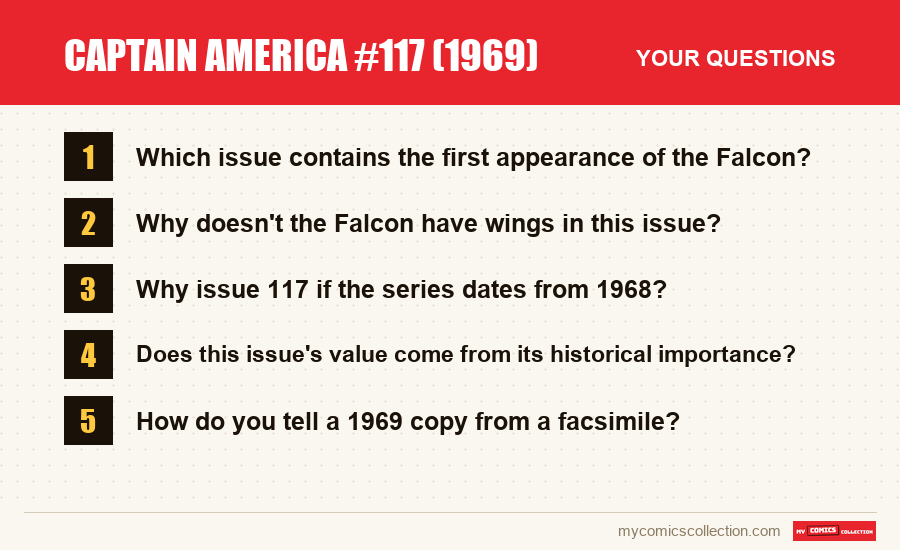
Frequently asked questions
Captain America #117, cover-dated September 1969, written by Stan Lee and drawn by Gene Colan. Sam Wilson receives his codename, his costume and his hawk in that same issue. Be careful not to confuse it with the later issues where he appears with wings, or with much more recent ones where he carries the Captain America shield.
Because the winged harness does not yet exist in 1969. The character is then a ground fighter who works with his trained bird. The wings are supplied in the mid-1970s by Black Panther, built from Wakandan technology. This difference in costume is the most reliable marker for dating an image or a cover of the character.
Because the numbering does not restart at 1. The solo title picked up the count of the anthology magazine that hosted the hero, and its first issue carries the number 100, in 1968. Issue 117 is therefore only the eighteenth issue of the series under its own name, which explains why it looks older than it really is.
Only in part. Its importance in American comics of 1969 is real and documented, but it did not drive its price for forty years. The adaptations on screen, starting in 2014 and then in 2021 and 2025, widened demand to the general public. The current price mainly reflects that recent notoriety.
By the interior pages, never by the cover, which a facsimile reproduces faithfully. The imprint on the interior page must mention 1969, the paper must be the yellowed newsstand paper, and period advertisements must be present in the book. White paper, the absence of ads and a standard book number point to a reprint.