
The best budget entries for Black Panther: the Christopher Priest run (1998-2003) in lots under $50, Black Panther #1 (2016, Ta-Nehisi Coates) under $10, and the Jungle Action issues found in average condition for $20-40.
Black Panther has become one of Marvel's most popular characters since the 2018 film, and his first appearance in Fantastic Four #52 (1966) exploded well beyond the average collector's budget. But T'Challa has a rich bibliography with many accessible entry points.
This guide shows you how build an impressive Black Panther collection without blowing your budget. From still affordable key issues to undervalued runs, here's how to collect the King of Wakanda wisely.
Key issues Black Panther under $50
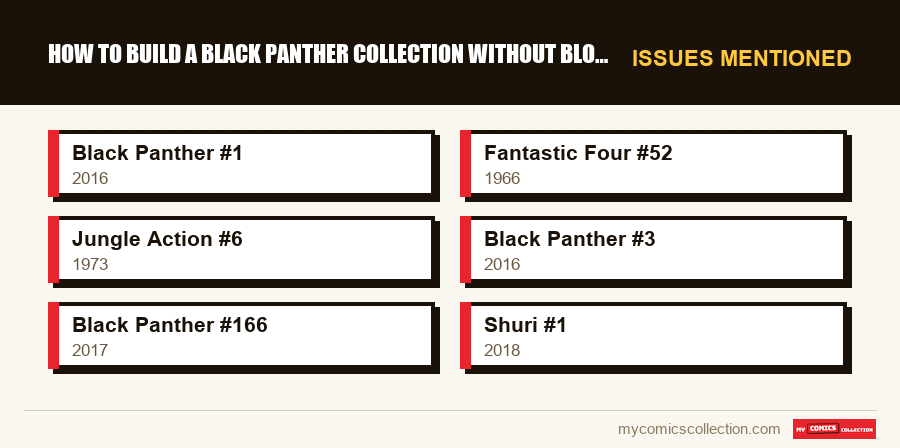
Fantastic Four #52 is inaccessible ($3000+ in low condition), but other key numbers remain affordable:
- Jungle Action #6 (1973): start of Don McGregor's solo run "Panther's Rage", copies in GD/VG around $30-45.
- Black Panther #1 (1977, Jack Kirby): first solo series, VG copies around $35-50.
- Black Panther #1 (1998, Christopher Priest): start of the final run, NM under $25.
- Black Panther #1 (2005, Reginald Hudlin): series which modernized the character, under $15.
- Black Panther #1 (2016, Ta-Nehisi Coates): first issue of the acclaimed run, under $10 in NM.
Underrated Runs to Buy Now
Le run Christopher Priest (1998-2003, 62 issues) is unanimously considered THE definitive Black Panther run. Despite its exceptional quality, the issues can still be found in complete sets for $40-60 on eBay. This is pure and simple theft.
The run Jungle Action #6-24 (1973-1976) by Don McGregor, the first long story arc of a black character in Marvel comics, is historically significant. Mid-run issues (#10-20) can be found individually for $10-20 in average condition.
Where to find deals
Dollar bins and lots
The Hudlin run (2005-2008) and post-Coates numbers regularly fall into the dollar bins. On eBay, “Black Panther run” lots from the 1998 and 2005 series are common and underbid. Also look for Avengers issues in which T'Challa plays a central role: often overlooked by sellers.
Comic conventions and fairs
Specialty 70s Marvel sellers often have Jungle Action issues in stock at a reasonable price. On Sunday afternoons, discounts of 20-30% are common.
Raw vs slabbed: budget strategy
For post-1990 issues, stick to raw: the market doesn't justify slabbing fees. For Jungle Action and #1 from 1977, a CGC grade can be justified if you find a copy at a good price: the premium slabbed is significant on these issues (a CGC 7.0 is worth 2-3x the estimated raw price). Buy raw, grade if condition merits it.
Newsstand and variants to watch out for
THE newsstand editions from Black Panther vol. 3 (1998-2003) are notably rarer than the direct editions. They do not yet command a major premium but the trend is increasing. The variant covers of #1 (2016) by Alex Ross and Skottie Young are solid picks under $20.
Modern keys under $20
- Black Panther #3 (2016): first appearance of Zenzi, under $8.
- Black Panther #166 (2017): start of “Klaw Stands Supreme”, under $5.
- Black Panther #1 (2018, "Intergalactic Empire"): start of an ambitious space-opera arc, under $8.
- Shuri #1 (2018): Shuri's first solo, under $10.
2nd prints and budget alternatives
Le Black Panther #1 (2016) second printing exists in a very aesthetic purple variant, available for under $8. The True Believers editions ($1 reprints) of Fantastic Four #52 and Jungle Action #6 are symbolic alternatives to complete the collection without breaking the bank.
Reading copies vs investment copies
The optimal strategy: build a complete Priest run in reading copies (eBay lot), then invest in 2-3 key issues in high condition: Jungle Action #6 in VF+ and Black Panther #1 (1998) in NM/MT are the best quality/potential ratios. The MCU is not done exploiting Wakanda.
Follow your Black Panther collection number by issue and identify your missing items with our collection management application. Estimated value, condition, wish-list: all in one place.
Building a Black Panther collection step by step
A Black Panther collection is easier to build by era than by isolated issues. Each period matches a distinct series with its own writer and tone, and shelving them in chronological order avoids duplicates as well as impulse buys.
The 1960s and 1970s. The character was born in Fantastic Four #52 in 1966, an issue that exceeds a typical budget: keep it as a distant landmark. Next comes Jungle Action, where Don McGregor's run goes from #6 to #24 between 1973 and 1976 and offers the first long story arc devoted to a Black character at Marvel. The first solo series, by Jack Kirby, starts in 1977 with Black Panther #1.
1998 to 2008. In 1998 Christopher Priest began a 62-issue run that is regarded as the reference for the character. The newsstand editions of that series are scarcer than the direct editions, a detail worth watching. Reginald Hudlin then relaunched the title in 2005 and modernized the character. Both series often turn up as complete lots, which makes them the backbone of a sensible collection.
The modern run. Ta-Nehisi Coates's series starts in 2016 with Black Panther #1, and Zenzi makes her first appearance in #3. Issue #166 of 2017 opens the "Klaw Stands Supreme" arc, and the 2018 #1 launches a space opera arc. Shuri #1 (2018) is Shuri's first solo and rounds things out for anyone interested in Wakanda's royal family.
Things to watch. Several Black Panther #1 issues coexist (1977, 1998, 2005, 2016 and 2018) and are easily mixed up on a wish list: always note the series year before buying. The cover variants of the 2016 #1 by Alex Ross and Skottie Young, as well as the purple second printing, are collector landmarks not to be confused with the regular printing. The True Believers editions of Fantastic Four #52 and Jungle Action #6 fill the gaps symbolically without pretending to replace the originals.
Keep a record. Once the series are identified, tick off each issue in your inventory as you buy and note the condition of every copy. This habit prevents buying the same issue twice and shows at a glance which era still needs completing.
Frequently asked questions
Christopher Priest's run (1998-2003, 62 issues) is regarded as the reference for the character and often turns up as complete lots. Black Panther #1 from 2016 by Ta-Nehisi Coates is another accessible way in.
In Fantastic Four #52 (1966), drawn by Jack Kirby. That issue is far beyond a small budget, which is why the True Believers editions work as a symbolic alternative.
It runs from #6 to #24 (1973-1976) and is the first long story arc devoted to a Black character in Marvel comics. Issues from the middle of the run can be found individually in average condition.
For issues after 1990 it is better to stay raw, since the market does not justify the grading fees. For Jungle Action and the 1977 #1, grading can make sense if the copy is in good condition.
The cover variants of the 2016 #1 by Alex Ross and Skottie Young are good picks, as is the purple second printing. Newsstand copies of the 1998 series are scarcer than direct editions and their value tends to rise.