Bone is an epic disguised as a comedy, and the disguise is deliberate. The first pages establish three round characters, a burlesque tone and a gag rhythm; two hundred pages later, the story speaks of war, betrayal and mourning without ever having broken with humor. This continuity is the tour de force of the work -nothing is left behind: and this is also what explains the contradictory judgments it arouses.
Understanding how this shift works avoids the two classic mistakes: stopping too soon, or offering it to the wrong person.
The following pages describe the switching device, the place of the three registers which coexist, what the length requires of the reader, and who the work is really suitable for.
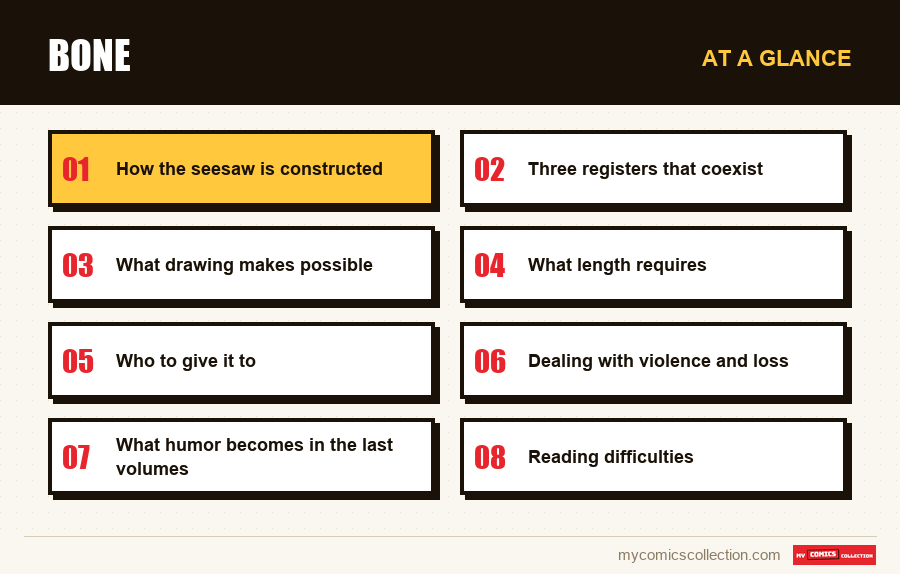
How the seesaw is constructed
It does not occur at an identifiable moment, which is precisely its technical success.
The tone does not change suddenly. There is no pivotal chapter after which the work would have become serious. Each volume contains a little more at stake than the previous one, in proportions too small to be noticed.
Comic characters remain comical. Those who made people laugh at the beginning continue to do so at the end, in situations that become serious. Their register is not revised: it is the context around them that darkens.
The decor gradually widens. We move from an isolated place to a valley, then to a territory, then to an ancient history: each enlargement making the previous one retrospectively smaller.
The result is that we cannot date the changeover. A reader who rereads the beginning after the end finds clues that he had not seen, which is the sign of a plan held rather than a deviation.
Three registers that coexist
Burlesque
Visual gags, chases, misunderstandings, stubborn characters. This register dominates at the beginning and never completely disappears.
It is based on cartoon know-how more than comics.
The rural story
Field work, fairs, village rivalries, passing seasons. It is the most discreet register and the one which gives the whole its depth.
The epic
Prophecies, vanished kingdoms, ancient creatures, war. He arrives late and ends up structuring everything else.
Their superposition
All three are present simultaneously in the later volumes. A battle scene can contain a gag without one canceling out the other.
What drawing makes possible
The cohabitation of these registers is largely due to a graphic choice, and it is worth naming it.
The main characters are drawn in a cartoon tradition: simple shapes, sharp contours, elastic expressions. The settings and human characters are treated with much more detail and realism.
This difference in treatment in the same box is the central device of the work. He places comic figures in a world that is not, and makes it visible on every page that they are not in their place.
This is what allows a scene to be funny and serious simultaneously: the register of the character and that of the setting do not say the same thing, and the reader receives both.
A homogeneous drawing-all comic or all realistic-could not have produced this effect. It would have been necessary to choose, and the work is entirely based on the refusal to choose.
This is also what explains the difficulty of recommendation. An isolated image from this series only shows one of the registers, never their superposition.
Showing a comic panel gives the impression of a children's series; showing a battle board feels like a classic epic. Neither gives an account of what reading produces, and this is why this work is poorly recommended in extracts.
What length requires
The work has several dozen numbers, and this duration is not negotiable for the system to work.
The changeover takes time. A gradual, imperceptible transformation involves many steps; compressing it would make it visible, and therefore inoperative.
Attachment is built in the light parts. If the characters had not first made people laugh for a long time, what happens to them next would not cost the reader anything.
The clues must be forgotten. The story sows elements very early on that will only make sense much later, and this effect assumes that the reader has lost sight of them in the meantime.
This is why reading split up over months works better than going through it in one go. The work was designed for a spread publication, and finding something of this rhythm serves the reading.
Who to give it to
The question arises constantly about this series and it deserves a precise answer rather than a convenient “all audiences”.
To a child reader, yes, without particular reservation. Nothing is graphically harsh, and the dark passages are treated with a restraint that makes them accessible. Length is the only real obstacle.
To an adult reluctant to read comics, very good. The work assumes no knowledge of the medium, no shared universe, no pre-existing character. It reads like a picture novel.
To a reader looking for action, less obvious. The rhythm is that of a long story, with entire volumes devoted to setting up situations.
The only real precaution concerns waiting: saying in advance that the series is getting darker prevents people from abandoning it by finding it too childish, and avoids it being subsequently discouraged by finding it too harsh.
Dealing with violence and loss
Since the series gets darker, it's necessary to specify how far, which recommendations rarely do.
There is violence, and it has consequences. Characters die, including figures we have become attached to, and the story does not replace them or return to them.
But she is never shown head-on. The drawing cuts forward, frames to the side, or leaves the scene out of frame: not out of caution with regard to a young audience, but because the graphic register of the main characters would make the direct representation grotesque rather than serious.
This is another consequence of the choice of design explained above. A round and elastic figure cannot be shown injured without the image switching to an involuntary register, and the ellipse here is a technical necessity as much as a bias.
The result is well suited to young readers without watering down anything for adults: what happens is clear, only the representation is retained.
Collecting this series?
Track what you own, what you are missing and what your collection is worth. 7 day trial.
Start my trial →What humor becomes in the last volumes
One effect is worth noting, as it is rarely achieved and easy to miss.
In the first volumes, humor is the object of the story: the scenes exist to produce gags. In the latter, it changes function without changing form.
It becomes a character trait rather than a process. When a character jokes in the middle of a serious situation, it's no longer the story that makes you laugh but him who refuses to let it get you down, and that says something about him.
This shift is almost invisible when reading and it explains why the same comic mechanisms no longer produce the same effect five hundred pages apart. The reader laughs less and becomes more attached.
This is probably the finest aspect of the entire construction, and it's also the one that a quick read misses entirely: another reason to take your time on the last volumes rather than rushing to the conclusion.
Reading difficulties
A slow entry
The first volumes are light and not very tense. A lot of abandonment happens there, before the issue arises.
Several volume divisions
The work has been brought together according to successive logics, with collection numbering that does not correspond.
Two colorimetric versions
Original black and white and later colorization: the same story in two very different presentations.
Threads sown very early
Elements introduced in the first volumes only take on meaning hundreds of pages later, without reminder.
What the work owes to the tale
A final element sheds light on the overall construction and explains why it holds up despite its scale.
The structure is that of a tale: simple characters leave a familiar place, cross a world larger than them, encounter figures who surpass them, and return transformed. This is a very old and very solid pattern.
This plan authorizes the progressive enlargement which makes the work unique: in a tale, the world expands as the hero advances, and no one finds this strange.
It also allows the coexistence of the comic and the serious, which is the rule in traditional tales and the exception in modern stories.
This connection finally explains why the work works with such different audiences. A tale has no target age: it's a recent editorial invention, and it behaves like its models.
What to record
On such a long and deliberately spread out reading, the sheet must keep track of what the memory will not retain.
Elements introduced without explanation, with the volume where you encountered them. The work sows threads whose resolution arrives hundreds of pages later, without the slightest reminder, and a reading spread over months, which is what the story calls for, guarantees that we will have forgotten them.
Noting these elements transforms the effect: instead of undergoing a revelation that we do not connect to anything, we recognize what had been stated.
The date of your reading sessions, more useful here than on a short work: knowing that eight months have passed between two volumes explains why a character seems new to you, and avoids wrongly concluding that the story has lost you.
These two fields serve a work that can be read over years: a situation where the inventory becomes a reading log as much as a register of objects.
Frequently asked questions
At no identifiable moment, and that is his technical achievement. Each volume contains a little more at stake than the previous one, in proportions too small to be noticed. A reader who rereads the beginning after the end finds clues that he had not seen: a sign of a plan kept, not of a deviation.
This is the central device: the main characters come from a cartoon tradition, the settings and the humans from a much more detailed treatment. This gap in the same box places the comic figures in a world that is not, and allows a scene to be funny and serious simultaneously.
No, reading split up over months works best. The shift needs time to remain imperceptible, attachment is built in the light parts, and the clues sown very early only have an effect if we have lost sight of them. The work was designed for a spread publication.
Yes, without any particular reservation: nothing is graphically harsh and the dark passages are treated with restraint. Length is the only real obstacle. The useful precaution is to prevent the series from becoming darker: this prevents us from abandoning it by finding it childish, and then disadvising it by finding it harsh.
Because an isolated image only shows one register, never their superposition. A comic panel gives the impression of a children's series, a battle board that of a classic epic, and neither reflects what reading actually produces.
Where did you first see this?
On a work that sows its threads hundreds of pages in advance, memory alone is not enough.